
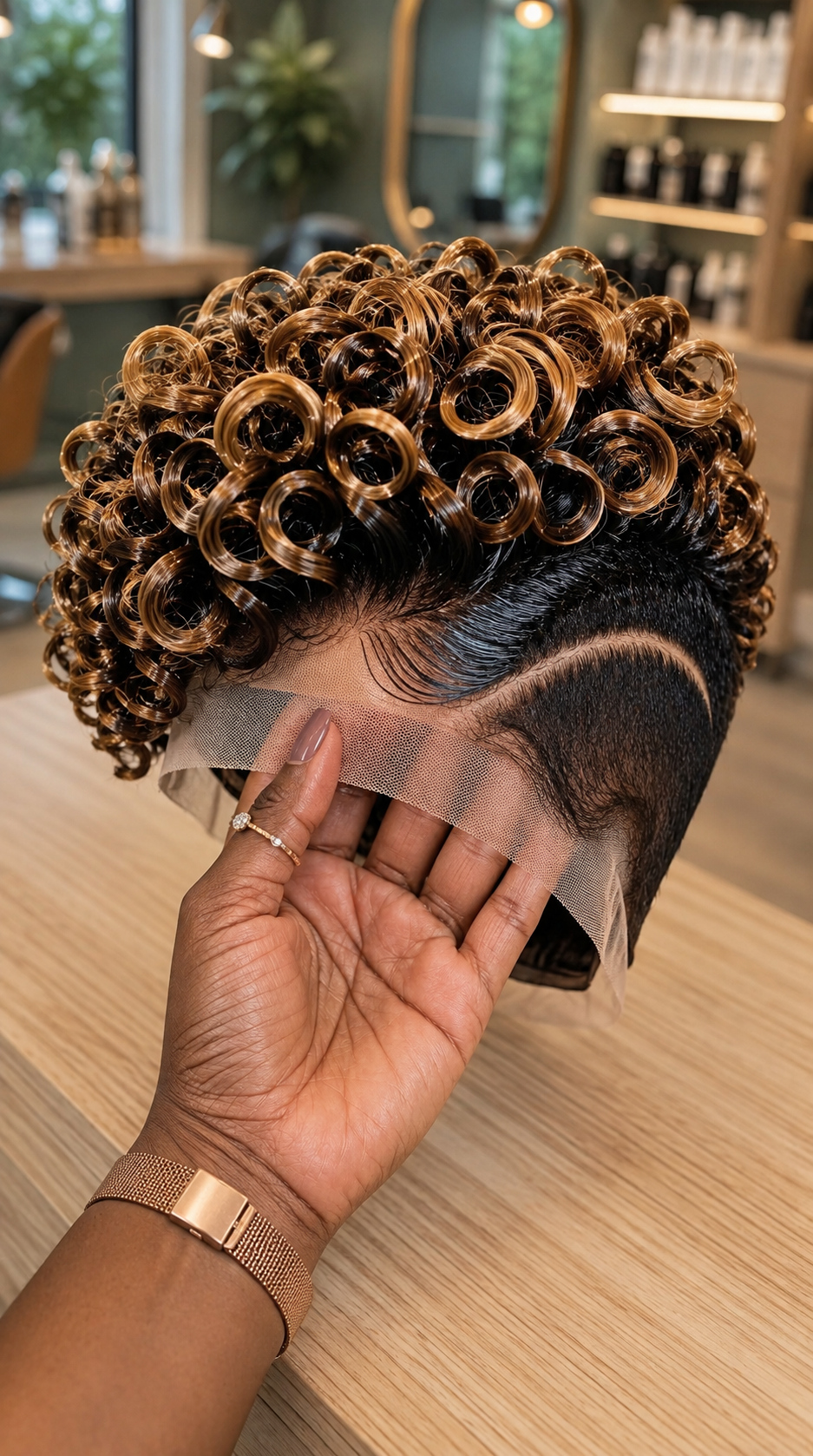
Take the black frame away and the honey coils become a costume. Leave the frame and they read as hair that was lifted on purpose.
What This Photo Is Actually Showing
The crown is a dense dome of tight spring coils in honey, caramel, and light golden brown. The colour is warm and reflective. That is the half that stops the scroll.
Under the hand the lace is open. The hairline, the temple, and the side panel are near-black. The light coils do not continue into the side. They stop. A short, dark section takes over and runs back toward the nape. The unit is built as a light top on a dark base, not as an all-over blonde.
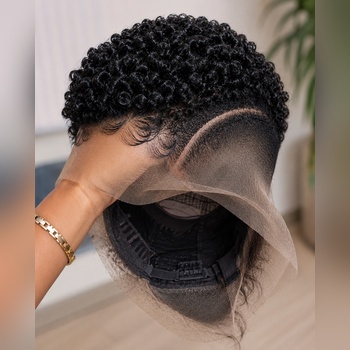
That contrast is the construction. Without it the same coils on an all-honey cap often look flat and costume-like under daylight. With it the red-brown depth at the root and side keeps the lighter rings grounded.
Two Colours, Two Jobs
The honey coils are the fashion layer. They were lifted and toned. They catch light, they show every spring, and they will be the first thing to shift.
The dark base is the anchor. It does three practical jobs:
It hides the logic of regrowth. Real hair lifted to this level shows a dark band at the scalp within weeks. Building that band in from day one keeps the silhouette honest.
It frames the face. A short dark side next to a light crown is a deliberate colour-block. It shortens the visual width of the forehead and keeps the eye on the coil shape instead of on a floating blonde mass.
It forgives the lace. Dark hair at the hairline is more forgiving of a slightly warm or slightly cool lace tint than a full blonde hairline would be. The dark fibres absorb small mismatches that a light edge would advertise.
Ask whether the dark section is knotted hair at full density or only a tinted zone with sparse fibres. Full density holds the frame. Sparse “root” colour washes thin and leaves the honey floating.
Honey On Dark Is A Lift Story
This is not a natural level. Getting fibre or human hair from near-black to this honey requires significant lift. Lift opens the cuticle and leaves the coil more porous than the dark base underneath.
Expect the lighter zone to move first:
Warmth comes back. Honey and caramel fade toward yellow or brass before they fade toward nothing. A cool toner slows it. Without regular toning the crown goes brighter and more golden while the sides stay dark. The contrast increases.
The springs open. Tight rod-set definition is a set. After the first wash the coils loosen. The dark side, being short and flat, changes less. The silhouette shifts from “sharp honey dome” to “softer honey over a black frame.”
The light fibre is more fragile. Ends on the outer coils are the most processed and the most exposed. They will dry and fray faster than the dark base. A leave-in and gentle detangling matter more on this unit than on a solid black coil.
Synthetic honey holds the tone longer and does not brass the same way. If the price is low and the colour looks identical under every light in the listing, ask what the fibre is.
The Side Is A Cut, Not Just A Colour
Look at the temple and the short dark panel. That hair is not coil. It is short, directional, and finished like a fade or a tapered side. The honey springs stop above it.
That join has to be clean. If full-density light coils sit right against the short dark hair, you get a colour shelf and a texture shelf at the same place. In a beauty shot the gel hides it. On a head in daylight it reads as two units stacked.
Judge the join dry. Ask for a close-up of the temple with no product. You want to see whether the light coils taper in density before the dark short hair begins, and whether the dark section is knotted down or only cut.
How Much A Rooted Honey Coil Cap Costs
Human-hair tight-coil pixies with a dark rooted base and honey or caramel coils commonly sit between $190 and $340. The two-tone work and the denser dark frame sit above a solid black or solid brown coil unit. Synthetic versions of the same look usually sit between $50 and $120.
You are paying for two constructions: the lifted light coils and the dark foundation that keeps them from floating. If the seller cannot show the side and the part dry, you cannot judge the frame.
Do not pay the human-hair premium only for the honey under salon lights. Warm light makes every caramel look richer. One outdoor or daylight photo of the actual unit is the real test.
Where To Buy This Honey Coil
Buy from a seller who shows the dark side and the lace hairline clearly, not only the crown from above.
[WhatsApp: +XX XXX XXX XX XX]
Confirm the honey is the tone you want in daylight. Some caramels go brass, some go flat beige, some stay warm. Ask how the unit looks after one wash and whether a toner is recommended.
Confirm cap size. A compact coil dome with a short dark side has almost no length to hide a high or sliding hairline. Straps fine-tune a small range. They do not fix a wrong base.
Before You Pay
Check the join where honey coils meet the dark side. A hard shelf will show after the first wash.
Ask whether the dark section is full-density knotted hair or only root tint.
Confirm human hair versus synthetic. Lifted honey looks similar in one lit frame.
Measure your head. This shape sits close. The dark side shows fit problems first.
Search Terms
honey coil pixie wig
caramel spring curl lace front
rooted dark honey pixie
blonde coil dark side wig
two tone honey curly pixie
glueless caramel coil cap
honey brown curly pixie human hair
dark root light coil pixie
Final Thoughts
The honey sells the photo. The dark sides are what keep the unit from looking like a light hat on a dark head.
If the frame is thin or only painted on, the coils will float as soon as the gel is gone and the tone shifts one step warmer. If the frame is real density and the join is tapered, the silhouette still reads as a cut when the springs soften. Check the black before you pay for the gold.