
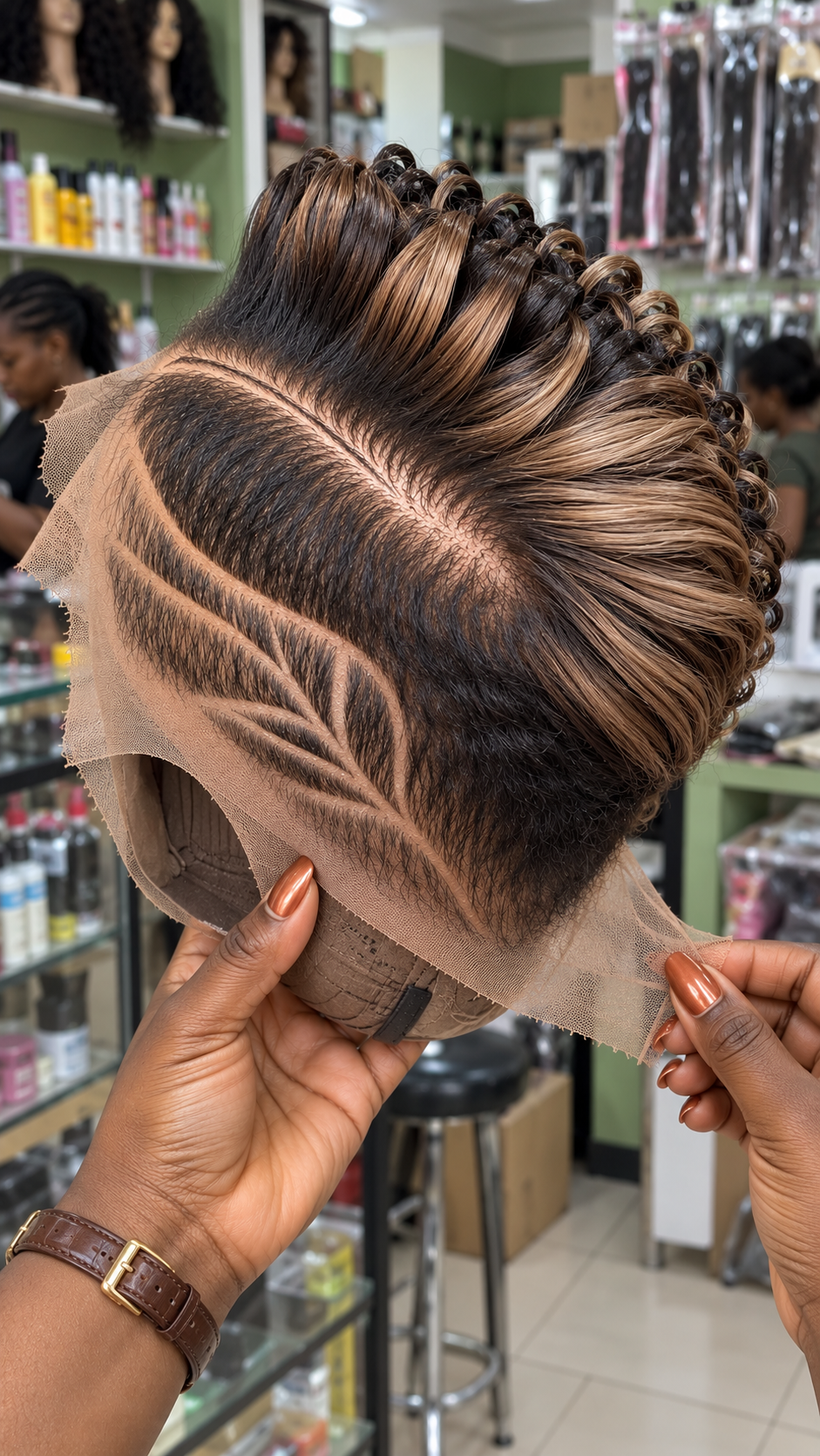
There is a striking difference between a wig that simply contains highlighted curls and one where the highlights actively shape the hairstyle. In this photograph, honey blonde ribbons travel through a dark chocolate-brown foundation, rising from the upper hairline before sweeping toward a cluster of compact curls. Beneath that movement, the side displays an elaborate feather-inspired arrangement of exposed parting channels. The result is a hairstyle in which color, direction, and decorative precision work together.
The wig is presented before installation inside a beauty supply shop. Two hands support the unit while a section of beige lace is held outward, revealing the untrimmed perimeter and part of the brown interior cap. This presentation makes the photograph particularly valuable for customers considering a custom order, because it shows both the decorative hairstyle and some of the construction beneath it.
Unlike an ordinary highlighted curly pixie, this design uses several distinct styling zones. The front rises into broad, glossy ribbons. The upper rearward area contains small curled loops. The visible side transitions into a tightly arranged dark-brown panel with branching, feather-like separations. Along the outer portion, honey and caramel strands sweep backward in closely aligned sections.
Anyone searching for a honey blonde lace pixie wig with side art should pay attention to these relationships. Reproducing the color without the feather pattern would change the identity of the hairstyle. Similarly, recreating the decorative channels without the raised highlighted ribbons would produce a noticeably different result.
The Feather Pattern Is the Detail That Sets This Wig Apart
The lower side of the wig contains the most unusual element in the photograph. Rather than relying on a simple shaved-looking stripe or two parallel parting lines, the styling incorporates several narrow channels that converge and branch across the temple area.
A long upper channel follows the boundary between the raised crown and the closely arranged side hair. Below it, another separation runs diagonally through the temple section. Near the middle and lower portion, smaller curved divisions branch toward the surrounding strands, producing a shape reminiscent of a feather or leaf.
The branching design is especially noticeable because the exposed beige-toned foundation contrasts with the dark brown hair. The hair between the channels remains closely arranged, making the individual separations easier to distinguish.
It is important to describe these as visible parting channels rather than automatically identifying them as razor-cut lines. The photograph shows a wig, not a naturally shaved scalp. The exact method used to create the pattern cannot be established from the image alone.
Understanding the Branching Arrangement
The design begins with a relatively long diagonal division. Smaller channels appear to connect or approach this central pathway, producing several tapered sections of dark hair. These sections vary in width and direction.
The effect is more intricate than a conventional double-line temple design because the smaller branches introduce additional movement. Their placement also creates a visual transition between the compact lower side and the elevated highlighted hair above.
For a custom order, the number and placement of these branches should be agreed upon before styling begins. A stylist who substitutes a generic curved line may produce an attractive wig, but it would not closely reproduce the reference.
The buyer should provide a close-up photograph of the side design and ask whether the wig maker has completed comparable geometric or feather-inspired work.
Honey Blonde Highlights Follow the Hair’s Architecture
The color arrangement deserves attention because the lighter strands are not distributed uniformly across the wig. The roots and much of the side panel remain dark chocolate brown. Above this foundation, honey blonde and caramel-brown ribbons appear in concentrated sections.
The brightest pieces are visible across the upper middle and outer sweeping strands. They contrast with darker hair between the ribbons, making the direction of each section easier to follow.
At the top, some highlighted pieces rise in broad curves before bending backward. Along the visible outer edge, lighter strands form a fan-like arrangement that moves toward the compact curls.
The photograph contains several warm shades rather than one flat blonde tone. Certain sections appear golden honey, while others have a softer caramel-brown appearance. Darker strands remain visible throughout the upper styling.
These color differences may reflect a combination of actual hair shades and lighting. The image does not confirm the dye formula, extension color codes, or whether the hair was colored before or after construction.
Why the Dark Foundation Should Remain Visible
The chocolate-brown foundation provides separation between the highlighted ribbons. If the entire upper section were made uniformly blonde, some of the directional detail could become less apparent.
The darker roots also connect the elevated upper styling to the lower temple panel. This creates a visual relationship between sections that otherwise have very different arrangements.
Customers ordering a similar wig should request a dark brown base with selective honey blonde and caramel accents, rather than simply asking for a blonde pixie.
It may help to provide the maker with separate color references for the roots and highlighted sections. A seller’s color chart can be useful, but actual photographs of the proposed hair under natural lighting are more informative.
From Raised Ribbons to Compact Circular Curls
The upper hair has been arranged into elongated, glossy sections that rise and bend backward. These sections resemble broad ribbons rather than loose, individual spiral curls.
Near the front, the ribbons stand comparatively high. Their roots remain closely gathered before the strands expand into wider curves. This creates an elevated profile without making the entire hairstyle appear uniformly rounded.
Moving toward the visible rearward edge, the broad sections transition into smaller circular curls. Several loops are clearly visible along the upper outline, with darker strands forming much of their interior and lighter accents appearing around selected curves.
The combination gives the hairstyle two kinds of movement. The ribbons create directional flow, while the compact curls provide a more intricate edge.
A wig maker should understand this distinction before beginning work. Producing small coils across the entire crown would not replicate the broad sweeping sections. Conversely, styling all the hair into large backward waves would eliminate the circular detail visible near the outer edge.
Controlling the Height Without Excessive Bulk
The apparent volume comes partly from the elevated arrangement of the ribbons. It should not be assumed that the wig requires unusually heavy hair density.
Too much hair could make the individual sections difficult to distinguish, particularly where dark and blonde strands overlap. Too little hair might make it difficult to create the raised shape.
A custom stylist should assess the intended ribbon width, available hair length, and chosen setting method before recommending density.
The photograph does not reveal the complete back of the wig. Anyone seeking a close reproduction should request an additional rear view to understand how the curls continue around the head.
What the Untrimmed Lace Tells a Buyer
The wig is displayed with a broad section of beige lace extending beyond the styled hairline. One hand supports the cap while the other holds the lace outward, making its mesh appearance visible.
The lace extends along the exposed front and side perimeter. Its untrimmed condition indicates that at least this visible portion has not yet been cut to the wearer’s preferred hairline.
The photograph does not establish the lace’s commercial classification. It should not be advertised as HD lace or another specialized grade without confirmation from the supplier.
The brown interior cap is partly visible beneath the lace. Stitched fabric sections and an adjustable strap can be seen near the lower edge. These details are useful for assessing construction, although they do not reveal the complete cap interior.
There is insufficient visual evidence to determine every attachment point, the exact lace dimensions, or whether the wig is intended for adhesive-free installation.
Cap Measurements Before Customization
A customer should measure head circumference, front-to-nape distance, and ear-to-ear width according to the maker’s instructions. These measurements help determine whether the cap can sit correctly without distorting the decorative side pattern.
When the wig arrives, it should be fitted before trimming the lace. This allows the wearer or stylist to check how the hairline and feather pattern align with the face.
Removing too much lace may complicate positioning, especially around the temple where the decorative channels approach the perimeter.
If professional installation is planned, the stylist should inspect the cap and confirm the appropriate attachment method rather than assuming the visible strap provides sufficient security.
Finding a Wig Stylist Who Understands Feather-Inspired Side Work
The decorative side arrangement makes stylist selection especially important. A salon that routinely installs straight or loosely curled lace wigs may not necessarily specialize in intricate geometric styling.
Look for wig makers who display examples of precision parting, sculpted pixie hairstyles, detailed temple patterns, and raised ribbon curls.
A portfolio containing close-up side photographs is more useful for this purpose than one consisting entirely of frontal beauty portraits. The buyer needs evidence that the stylist can control the placement and continuity of narrow channels.
Independent wig makers, specialist lace wig salons, and custom hair businesses may offer suitable services. Online sellers can also be considered, provided they are willing to share photographs of previous comparable work.
The original reference should be sent before requesting a quotation. The maker should confirm whether the feather arrangement can be reproduced on the proposed cap and whether the chosen hair material can support the elevated ribbon styling.
Separating the Order Into Essential Requirements
A useful consultation begins by identifying which details cannot be changed. For this hairstyle, the most recognizable elements are the dark brown foundation, selective honey blonde ribbons, compact curled upper edge, and branching side pattern.
Other decisions can be discussed according to the customer’s preferences, including overall height, cap measurements, and whether the styling should be concentrated on the left or right side.
Ask the seller to clarify whether the quoted price includes the completed decorative pattern or only a base wig that requires further salon customization.
Before paying, obtain confirmation of the agreed design, expected production time, material category, cap construction, and revision arrangements.
Should You Buy a Ready-Made Wig or Commission This Design?
A ready-made highlighted pixie may provide a similar color combination at a lower initial cost. However, the feather-inspired temple arrangement and raised ribbons make this reference more specialized than a conventional curly wig.
Ready-made options are worth considering when the buyer is flexible about the exact side design. A seller may have a unit with comparable blonde accents and a raised crown but a simpler temple pattern.
A custom order becomes more appropriate when the branching channels are essential. The maker can plan their placement in relation to the hairline and the customer’s measurements.
Before choosing, compare the total cost of both routes. Purchasing an inexpensive base wig and paying separately for complex customization may not always be more economical than ordering a completed unit.
The correct decision depends on the quality of the starting wig, the amount of alteration required, and the stylist’s ability to preserve the original proportions.
Illustrative Budget for Honey Blonde Feather-Pattern Wigs
The labor involved in this design may be influenced by the selective color placement, raised ribbon styling, compact curled sections, and intricate branching temple channels.
The following USD amounts are illustrative planning estimates only. They are not verified seller prices, confirmed quotations, or evidence of the photographed wig’s market value.
| Wig Category | Illustrative USD Range | Potential Scope |
|---|---|---|
| Premium Custom | $380–$850+ | May include carefully planned honey blonde placement, specialized ribbon styling, detailed feather-pattern customization, and individual cap fitting. |
| Standard Custom | $190–$440 | Could accommodate the main highlighted arrangement and branching side design using a suitable prepared wig foundation. |
| Basic Human Hair | $110–$275 | A possible starting unit for additional coloring and styling, depending on the hair’s condition and suitability. |
| Premium Synthetic | $75–$200 | May provide a pre-styled highlighted alternative if the fiber and construction are compatible with the intended appearance. |
| Basic Synthetic | $30–$100 | A budget-oriented option for similar coloring and silhouette, potentially without the detailed branching temple work. |
These categories describe possible purchasing options. The photograph does not confirm whether the displayed wig is made from human hair, synthetic fiber, or a combination.
Additional services may include cap adjustment, lace preparation, color correction, styling restoration, shipping, and installation. A custom quote should identify which services are included and which require separate payment.
The branching side pattern may be a significant source of labor because its visual appeal depends on accurate spacing and continuity. Buyers should consider this when comparing a generic highlighted pixie with a custom sculpted unit.
Maintaining the Feather Channels and Highlighted Ribbons
The maintenance priorities are different for the upper and lower portions of this wig. The raised ribbons need to retain their shape, while the closely arranged temple hair must remain aligned around the exposed channels.
Brushing directly through the elevated sections could disturb the individual ribbons. Repeatedly separating the compact curls may also change their appearance.
The side design requires particular care because even small shifts in the neighboring hair can reduce the visibility of the branching pattern.
Customers should ask the maker which styling products were used and whether the arrangement can be refreshed at home or requires professional attention.
Care Considerations for the Honey Blonde Sections
The lighter strands may require different care depending on the material and coloring process. If the wig contains chemically colored human hair, the maker should explain whether additional conditioning or color-preserving products are appropriate.
If the unit contains synthetic fiber, washing instructions and heat compatibility must be verified before attempting to restyle the ribbons.
The glossy appearance in the photograph should not be interpreted as a reason to apply large amounts of oil. Product buildup could make the closely arranged strands harder to maintain and reduce the separation between the lighter and darker sections.
After cleansing, restoring the elevated ribbons may require the original styling technique. The buyer should understand this requirement before committing to frequent wear.
Inspecting the Finished Wig Before Installation
When a custom unit arrives, begin by comparing the color distribution with the approved reference. The dark brown foundation should remain prominent, with honey blonde and caramel accents positioned through the upper ribbons and outer curls.
Next, examine the feather-inspired side arrangement. Check whether the long dividing channels are visible and whether the smaller branches follow the agreed pattern.
The upper ribbons should also be inspected from more than one angle. A hairstyle may appear accurate from the side while having an unexpected height or shape from the front.
Requesting a frontal and rear photograph before shipping can help identify potential differences early. If the seller offers a final approval stage, use it to evaluate the arrangement rather than focusing only on color.
After delivery, inspect the lace, stitching, adjustment hardware, and overall fit before trimming or altering the unit.
Where This Hairstyle Makes the Strongest Impression
The combination of warm highlights and geometric side work makes this wig particularly suitable for customers who enjoy distinctive salon styling.
It can work well for celebrations, portrait photography, fashion-focused events, and occasions where the hairstyle is intended to be a central visual element.
The honey blonde ribbons provide brightness without requiring the entire wig to be blonde. The dark brown foundation also offers flexibility when pairing the hairstyle with clothing in black, cream, beige, chocolate, or other complementary tones.
For everyday use, the wearer should consider the amount of care needed to preserve the raised ribbons and exposed channels. Someone who prefers minimal maintenance may want to discuss a less elaborate interpretation with the stylist.
That adjustment should be deliberate. Simplifying the feather pattern or replacing the ribbons with ordinary curls would change the distinctive character of the original reference.
A Design Worth Judging Beyond Its Color
The defining quality of this wig is the balance between decorative complexity and visual organization. Honey blonde ribbons introduce brightness and movement, compact curls add dimension, and the feather-inspired side channels provide a recognizable signature.
The exposed lace and partially visible cap also remind buyers that an attractive hairstyle must be supported by suitable construction and a comfortable fit.
A successful reproduction begins with an accurate reference, continues through clear communication with an experienced wig maker, and depends on careful inspection before permanent customization.
For buyers seeking this particular appearance, the most important question is not simply whether a seller has a honey blonde pixie wig available. It is whether the seller can reproduce the branching temple artwork, maintain the dark-to-light ribbon contrast, and deliver a unit that fits without compromising the intended design.
Those details are what separate a general highlighted curly wig from the distinctive sculpted hairstyle shown in this photograph.
Search Terms
Honey blonde feather pattern lace wig · Chocolate brown branching side parting · Caramel ribbon curl pixie hairstyle · Golden honey highlights dark root wig · Sculpted feather temple lace design · Raised blonde ribbon crown wig · Untrimmed beige lace brown cap wig · Dark brown pixie with leaf shaped side channels