
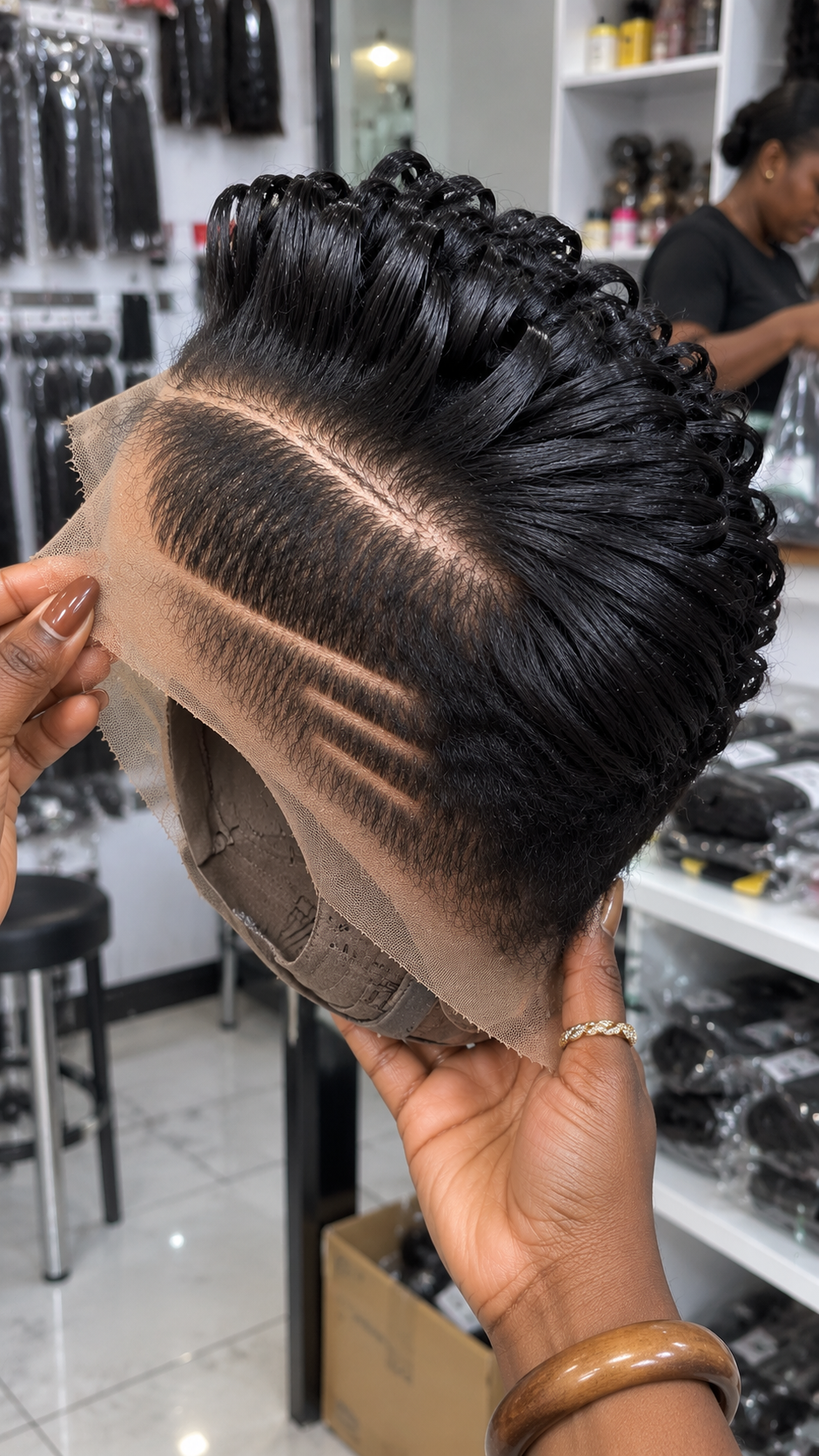
Some wigs are designed to be admired from the front. Others reveal their most interesting craftsmanship when viewed from the side, before they have even been installed. This jet black lace wig belongs to the second category. Held between two hands inside a working hair shop, the unit displays a remarkable arrangement of elevated ribbon curls, closely directed side strands, and two pale parallel parting channels that divide the lower hairstyle into distinct sections.
The photograph offers something more valuable than a conventional product portrait: an opportunity to examine the relationship between the hairstyle and its underlying construction. Untrimmed beige-brown lace extends beyond the hairline, a dark interior cap is visible beneath the hair, and the sculpted upper curls rise from a carefully arranged foundation. Nothing in the image requires an elaborate color combination to create impact. The almost entirely black appearance makes the differences in hair direction, density, and shine particularly noticeable.
For a buyer, this is an example of why a hairstyle should be evaluated as a complete piece of workmanship rather than simply by its color or advertised length. The ribbon curls, exposed parting channels, and compact lower section must be proportioned correctly for the design to retain its character after installation.
Two Parallel Channels Are the Signature of This Side Profile
The most revealing area of the photograph is the closely arranged side section. Two light, elongated channels run diagonally across the dark hair, creating a double-parting effect. The upper channel separates a compact strip of hair from the longer strands directed toward the raised curls. The lower channel forms another boundary beneath that strip.
These are not zigzag carvings, intersecting triangles, or decorative finger waves. Their principal characteristic is their parallel direction. Both channels follow a similar diagonal path, with a band of closely arranged dark hair between them.
The upper channel appears slightly broader in places because of the angle at which the lace is held. Fine hair roots remain visible along its edges. The lower channel is narrower and creates a distinct division between the middle strip and the tapered-looking lower portion.
This geometry gives the hairstyle a disciplined appearance without introducing the sharp angles found in more elaborate barber artwork. The double-parting arrangement also makes the side more visually interesting than an ordinary uniformly cropped pixie.
It is important to understand that the image does not establish the exact production technique used to create the channels. They may involve controlled hair placement, closely cropped areas, or another wig-making method. A supplier should explain whether the pattern is permanent within the construction or whether it can be modified by a stylist.
Preserving the Space Between the Lines
When commissioning a similar unit, pay particular attention to the width of the dark strip between the two channels. If the strip becomes too narrow, the two divisions may appear to merge when viewed from a distance. If it becomes excessively broad, the compact relationship between the lines and the upper curls will be lost.
The channels should also maintain a consistent directional relationship. An upper line that curves dramatically away from the lower one would produce a different design.
Customers should request a photograph of the finished side at approximately the same angle as the reference. A straight frontal photograph is unlikely to reveal whether the double-parting arrangement has been reproduced accurately.
The Black Hair Creates Its Own Contrast Through Direction and Reflection
The hair appears deep black throughout the visible styling, with cool gray reflections created by the salon lighting. There is no clearly visible blonde, burgundy, copper, or silver coloring. The lighter bands across the upper section are reflections on the dark strands rather than evidence of contrasting highlights.
This distinction matters when ordering a wig from an online supplier. Product photographs taken under strong lighting can make reflective black hair appear to contain lighter streaks. A customer who mistakes those reflections for actual highlights may request an entirely different color treatment.
The upper curls display narrow, bright reflections along their curved surfaces. Meanwhile, the longer strands directed across the visible side produce broader reflective areas because they lie closer together.
The dark lower section appears less reflective, partly because the hair is shorter and the strands are arranged more closely against the underlying structure. This difference creates depth without requiring multiple colors.
For a similar appearance, ask for a natural-looking deep black shade with visible strand separation and a glossy finish. Avoid requesting an oily appearance simply because the reference looks reflective. Shine can come from several factors, including fiber properties, styling products, lighting, and the arrangement of the hair.
Raised Ribbon Curls Form a Directional Upper Arrangement
The upper hairstyle contains a sequence of elongated loops that rise above the dark foundation. Rather than hanging freely, many strands travel upward, curve backward, and fold into open ribbon-like shapes.
The visible front area contains taller, relatively narrow loops, while the curls farther toward the rear become more closely gathered. Several sections overlap, creating a layered appearance with dark openings between the reflective strands.
Unlike compact spring coils, these loops are made from broader groups of hair that maintain a similar direction within each section. Their shape depends on controlled placement rather than random curl expansion.
The result resembles an elaborate sculpted pixie, with the upper hair arranged into a raised decorative composition while the lower area remains comparatively compact.
There is also a noticeable progression in density. The upper front does not appear as tightly packed as the visible rear curls. This allows individual loops to remain recognizable and prevents the entire hairstyle from becoming a uniform mass of black hair.
What a Stylist Must Reproduce Beyond the Curl Shape
A close reproduction requires attention to more than the size of each loop. The direction in which the hair enters and leaves the curl is equally important. Several visible sections begin near the parting area and travel upward into the raised arrangement.
If the stylist changes this direction, the upper hair may cover the parallel channels or create unwanted bulk near the temple.
Customers should therefore describe the hairstyle as a directional ribbon-curl pixie with an exposed double-parting side, rather than merely requesting a curly black wig.
Ask the maker to demonstrate how the upper loops sit when the unit is positioned upright. The photograph shows the wig held at an angle, which may slightly influence the apparent height and direction of the curls.
Reading the Untrimmed Lace Before It Is Altered
The lace extends beyond the styled hairline along the visible front and side. It has a light beige-brown appearance, with a fine mesh structure that becomes especially noticeable where the left hand holds the edge.
The mesh appears relatively broad in the untrimmed area. Fine hairs emerge near the boundary between the lace and the darker hair sections, creating a transition that will need to be evaluated during fitting.
The exposed lace is particularly relevant because the double-parting design approaches the front portion of the wig. A careless cut could remove useful lace or interfere with the intended relationship between the channels and the hairline.
However, the photograph cannot establish the precise lace classification, its durability, or how well it will blend with an individual wearer’s skin. Those characteristics depend on product specifications and fitting conditions.
Buyers should request the lace dimensions, available tint options, and a photograph of the unit positioned on a mannequin or suitable display head. These details help establish whether the hairline can be fitted appropriately without compromising the decorative side arrangement.
The Interior Cap Deserves Attention Before Any Purchase
Part of the wig’s interior is visible beneath the hair. The cap appears dark brown, with stitched sections and structural bands. The opening is exposed because the unit is being supported by hand rather than worn.
This view is useful but incomplete. It does not establish the full cap circumference, the presence of every possible securing attachment, or the exact construction materials.
A buyer should request an underside photograph that clearly shows the complete cap perimeter and any combs, clips, straps, or adjustment mechanisms that are actually included.
For someone considering an adhesive-free installation, these details are especially important. The presence of lace alone does not establish that the wig can be worn securely without adhesive. A suitable fit and the manufacturer’s recommended attachment method are essential.
Measurements should be discussed before purchase. Depending on the maker, these may include head circumference, front-to-nape distance, ear-to-ear measurements, and temple placement.
The relationship between cap size and hairstyle position is especially significant here. If the cap sits incorrectly, the double-parting channels may appear too high or too low relative to the wearer’s temple.
Where to Look for a Wig With This Particular Construction
A conventional wig catalog may offer numerous black pixie styles, but relatively few will reproduce the combination of raised ribbon curls and parallel side divisions.
Begin with wig makers who advertise customized pixie units, sculpted curl styling, or detailed lace-front work. A stylist experienced in precision hair placement may be more suitable than a supplier whose catalog consists primarily of loose curly and straight wigs.
When searching online, use descriptive phrases that include the actual design elements. Terms such as black ribbon curl lace wig, double side parting pixie wig, and sculpted loop curl wig can help narrow the results.
Local salons may also be able to customize an existing unit. However, not every ready-made wig provides enough hair density or suitable construction to accommodate this particular side arrangement.
Before paying for customization, ask the stylist whether the double channels can be produced without exposing unwanted cap material or damaging the foundation. This assessment should be based on the actual wig rather than an assumption that any black pixie can be altered successfully.
Questions Worth Asking a Custom Wig Maker
Ask whether the stylist can reproduce the raised ribbon arrangement and maintain the two diagonal side channels. Request examples of previous work involving similar directional curls.
Confirm the fiber type, cap size, lace specification, expected styling requirements, and whether the photographed appearance will be achieved before shipping.
It is also useful to ask for an approval photograph before final delivery. This provides an opportunity to identify differences in loop height, side density, or parting placement while corrections may still be possible.
For customers ordering internationally, clarify whether shipping protection is designed to prevent the raised curls from being compressed. A carefully arranged wig can lose some of its visual structure if packaged without adequate space.
Planning a Salon Appointment Around the Side Detail
Installation should begin with a fitting assessment rather than immediate lace cutting. The stylist needs to establish the intended hairline position and determine whether the side channels align appropriately with the wearer’s head.
Once the position is confirmed, the lace can be evaluated for trimming according to the cap construction and installation method.
The double-parting section should remain visible throughout the fitting process. If the stylist pulls surrounding hair over the channels, the most distinctive part of the design may disappear.
After fitting, the raised loops may require limited adjustment to restore their original arrangement. This should be performed using methods compatible with the confirmed fiber rather than automatically applying heat or styling products.
When booking, describe the unit as a lace pixie wig with sculpted upper curls and precision side parting. This helps the salon understand that the appointment involves more detailed work than a routine installation of a straight wig.
Estimated Budget for a Jet Black Sculpted Loop Wig
The cost of a similar wig will depend on the base material, cap construction, lace specifications, and the amount of labor required to produce the raised curls and double-parting design. The following amounts are illustrative USD planning ranges rather than verified market quotations or prices for the photographed unit.
| Wig Category | Illustrative Price Range | Potential Inclusions |
|---|---|---|
| Premium Custom | $290–$680+ | Individual sizing, advanced ribbon-curl arrangement, carefully positioned double side channels, and specialized lace customization. |
| Standard Custom | $155–$340 | Customized black pixie styling, directional upper loops, and a tailored parallel-parting design. |
| Basic Human Hair | $90–$230 | A human-hair pixie base that may require additional curl setting and side customization. |
| Premium Synthetic | $60–$170 | Higher-priced synthetic alternatives with arranged curls and possible pre-styled side detailing. |
| Basic Synthetic | $25–$90 | Budget black pixie wigs that may offer a similar silhouette without the intricate ribbon curls or double-parting construction. |
The absence of complex coloring does not necessarily make this design inexpensive. Much of its visual character comes from the arrangement of individual hair sections, and that work can require substantial styling time.
Premium custom pricing may reflect labor-intensive curl preparation, cap fitting, and careful placement of the two side channels. Simpler ready-made options may reduce the initial purchase cost but require separate professional styling.
Ask whether the quoted amount includes installation, lace preparation, delivery, and any future adjustments. These services may be charged independently.
The material cannot be identified conclusively from the photograph. Human hair and synthetic categories in the table represent possible purchasing choices, not verified descriptions of the displayed wig.
Maintaining the Black Ribbon Structure Between Appointments
The primary care concern is preserving the elevated curl arrangement. The loops are formed from groups of strands that follow deliberate directions, and repeated brushing may separate them or alter their shape.
Before washing or restyling, obtain the maker’s instructions for the actual material. Human hair, synthetic fibers, and blends may require different products, temperatures, and drying procedures.
For human-hair versions, excessive heat can gradually affect the condition of the strands. For synthetic versions, heat compatibility must be confirmed before using any heated tool. Some fibers may deform when exposed to unsuitable temperatures.
The glossy appearance should be maintained without saturating the hair with heavy oils. Too much product may cause neighboring strands to cling together, reducing the visible separation between the ribbon loops.
If the curls begin losing their arrangement, consult the stylist about professional resetting. Attempting to rebuild the loops without understanding their original construction could produce an uneven result.
Keeping the Double Parting Visible
The side channels should remain free from unnecessary product buildup and displaced strands. Their appearance depends on the contrast between the pale divisions and the closely arranged dark hair.
Avoid aggressively combing across the channels. If hair begins to cross the exposed areas, ask the stylist whether it can be redirected safely.
Do not attempt to widen the channels with clippers or a razor without professional assessment. Depending on the wig’s construction, cutting too deeply could damage the cap or create gaps that cannot be repaired easily.
When storing the wig, choose a support that maintains the cap shape without compressing the upper curls. Keep the side detail away from surfaces that might rub against the arranged hair.
The Value of a Design That Does Not Depend on Added Color
This hairstyle demonstrates how a single dark shade can support a highly elaborate composition. The jet black appearance draws attention to the shape of the upper ribbon curls, while the two diagonal side channels provide a precise visual division beneath them.
Its appeal lies in the relationship between structure and restraint. The curls create height and movement, but the compact side prevents excessive bulk. The parallel channels add interest without requiring dramatic geometric intersections or contrasting dye.
For customers who appreciate distinctive pixie wigs, this is a design worth discussing with a specialist rather than purchasing solely on the basis of a product title. Accurate side placement, appropriate cap sizing, and careful curl construction will determine whether the finished unit resembles the reference.
A buyer who confirms the construction details, requests multiple viewing angles, and chooses a stylist experienced with sculpted curls will be better positioned to obtain a satisfying result. The photograph provides an excellent visual reference, but the quality of the finished purchase must ultimately be established through the actual wig, its specifications, and the skill of the professional preparing it.
Search Terms
Jet black ribbon curl lace wig · Double parallel side parting pixie wig · Black raised loop crown hairstyle · Untrimmed beige lace sculpted pixie · Glossy black directional ribbon curls · Two diagonal side channels lace wig · Dark brown interior cap black wig · Black sculpted curl wig with exposed parting