
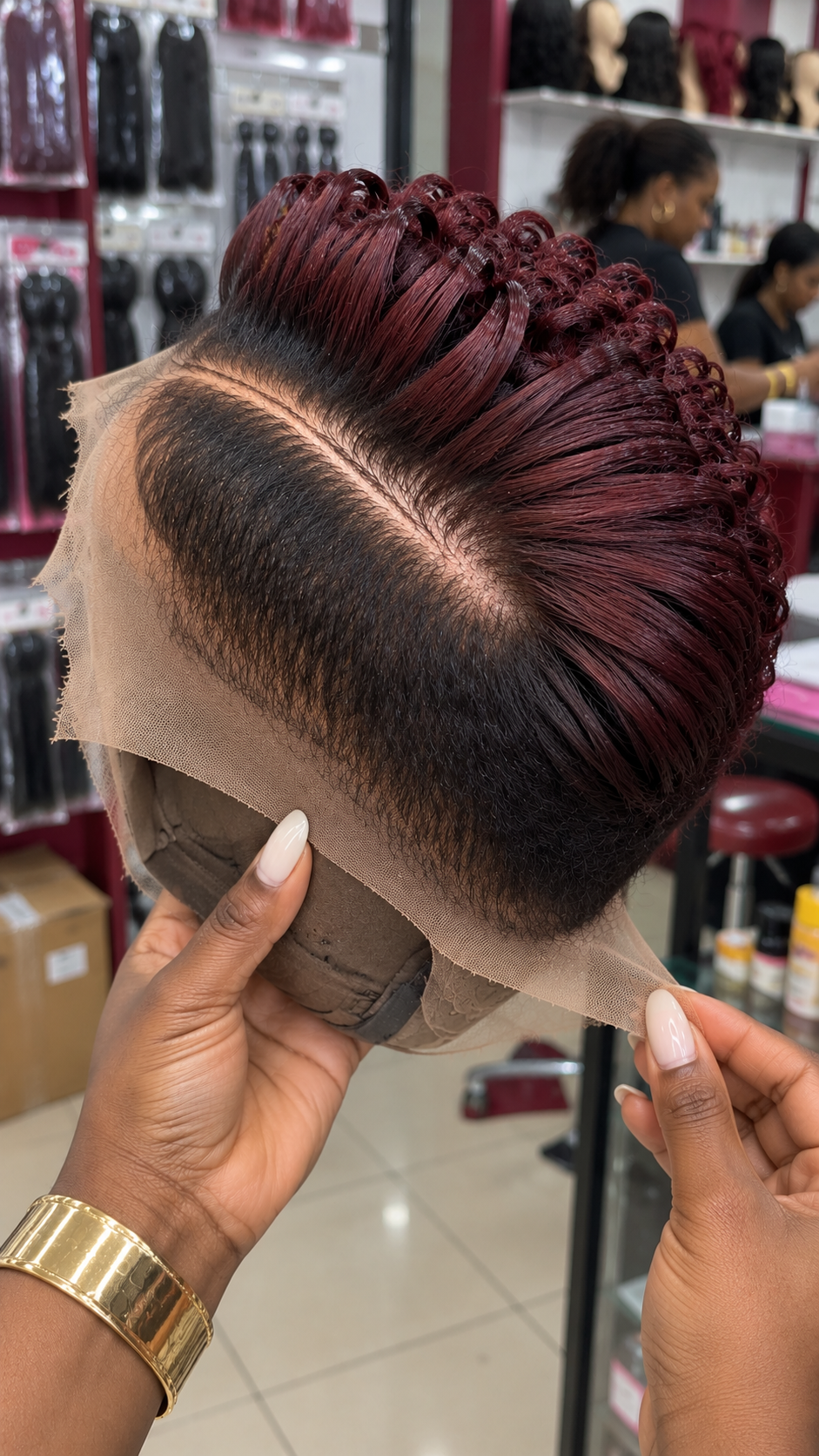
A striking hairstyle does not always need multiple carved lines or a dramatic color contrast to command attention. Sometimes the strongest design decision is the direction in which the hair moves. This burgundy and black pixie wig demonstrates that principle through a fan-shaped arrangement of glossy strands, a prominent curved temple parting, and a compact cluster of ribbon curls gathering toward the upper rear.
The photograph captures the wig before installation, with one hand supporting its interior cap while another gently extends the frontal lace. This presentation reveals details that customers rarely see in photographs of finished hairstyles. The visible mesh, dark side hair, color transition, and directional crown styling provide valuable clues about the appearance a buyer should request from a wig maker.
What makes this particular design interesting is its deliberate asymmetry. The burgundy strands are not distributed evenly across the entire head. Instead, they travel diagonally from the darker foundation toward the upper and rear-visible portion of the crown. The closely arranged black side creates a contrasting surface beneath the colored hair, while a single sweeping parting channel gives the temple area its distinctive shape.
For customers looking for a burgundy pixie lace wig, this image offers a useful reference for discussing color placement, crown proportions, frontal fitting, and specialist styling. Reproducing the hairstyle successfully requires understanding how these elements interact rather than purchasing an ordinary red curly wig.
The Fan-Shaped Crown Is the Main Attraction
The upper section is constructed around elongated strands that travel outward and backward from a relatively concentrated area near the side of the crown. Their arrangement resembles an opened fan, with individual sections spreading across the surface before curving into the elevated upper styling.
This directional movement distinguishes the hairstyle from conventional spiral pixie wigs. Rather than covering the entire crown with evenly distributed curls, the design uses comparatively straight, closely grouped lengths that lead into decorative loops.
Several burgundy strands rise prominently along the upper ridge, while others travel farther toward the rear-visible edge. The ends form narrow, overlapping ribbon curls, creating an intricate appearance without requiring excessive height.
The photograph also shows that the upper strands do not all originate from the same visible point. Their direction gradually changes across the crown, producing a broad sweep that follows the head’s curvature.
Customers should pay particular attention to this arrangement when commissioning a similar hairstyle. If a stylist simply curls the entire top into separate spirals, the resulting wig may have the correct color but a substantially different silhouette.
Preserving the Spread of the Burgundy Strands
The fan effect depends on the spacing and direction of the hair before it reaches the curled ends. The visible strands form narrow, parallel sections that remain recognizable across much of the crown.
A custom wig maker should understand that these sections need to retain their directional flow. Randomly placed curls could interrupt the visual movement and make the upper hair appear bulkier than intended.
When placing an order, request a photograph from the same elevated side angle shown in the reference. This perspective makes it easier to compare the spread of the burgundy sections and the location of the curled ends.
A second image taken directly from the front can help establish whether the upper styling remains proportional when the wig is positioned on a head. The reference photograph alone does not reveal the complete frontal silhouette.
One Curved Temple Parting Creates the Side Identity
The side styling is considerably simpler than the decorative crown, yet it plays an essential role in the overall design. A single prominent curved parting channel separates the dark temple panel from the upper hair.
The channel begins near the frontal region and travels diagonally across the side before meeting the area where the burgundy strands begin to spread. Its exposed, scalp-toned appearance creates a clear boundary between the two styling zones.
The dark hair beneath the channel is arranged very close to the underlying surface. Numerous fine strands are visible, producing the appearance of a closely cropped side rather than a thick, hanging section.
Importantly, this photograph does not show the same double-arc temple arrangement found on some decorative pixie wigs. The dominant side detail here is one broad curved separation. Small changes in hair direction around the channel should not be mistaken for additional carved lines.
That distinction matters when ordering a custom wig. Adding extra decorative channels would change the original design and could interfere with the large, uninterrupted dark temple panel.
The Transition From the Dark Panel to the Colored Crown
The area immediately above the curved parting contains dark roots that gradually lead into burgundy lengths. This transition creates a visual connection between the temple and the upper hairstyle.
Instead of beginning with bright red strands directly at the exposed channel, the design retains a dark foundation near the base of the hair. The burgundy becomes more noticeable as the strands rise and extend backward.
This placement helps the color appear integrated into the hairstyle. It also prevents the temple from competing with the decorative upper section.
Buyers should explain this relationship to their stylist. A wig with burgundy hair extending uniformly from every root may look very different from the reference, even if the overall shade is similar.
Understanding the Wine-Red Color Distribution
The photographed hair displays a deep burgundy shade with wine-red reflections and subtle plum undertones. Under the salon lighting, certain strands appear brighter, especially where the light strikes their glossy surfaces.
The dark foundation remains particularly visible around the frontal hairline and temple. Moving upward, the colored lengths become increasingly prominent, while the curled ends display several different levels of burgundy intensity.
The result is not a conventional two-tone split with a sharp horizontal boundary. Instead, the color follows the direction of the styled hair.
There is also no clear evidence of blonde, copper, or bright cherry-red highlighting. The warmer reflections visible in the photograph are consistent with the burgundy color under indoor illumination.
Anyone attempting to reproduce this shade should request photographs under more than one lighting condition. A salon with bright overhead lights can make burgundy hair appear considerably more reflective than it might look outdoors.
Ask the seller whether the shade is described as burgundy, wine red, or dark plum, and request a sample when precise matching is important. Color names vary between manufacturers and do not guarantee identical results.
The Extended Lace Deserves Attention Before Purchase
The two-handed presentation makes the frontal construction particularly noticeable. Beige lace extends well beyond the styled hairline, with the right hand gently holding a loose section of the mesh away from the cap.
This provides a clear view of the lace before it has been cut for installation. The mesh extends around the visible frontal and side areas, leaving material that may later be trimmed according to the wearer’s hairline.
The photograph also reveals a fine hairline-adjacent transition where dark strands become less dense near the lace. However, the exact ventilation method, lace grade, and construction technique cannot be confirmed from the image.
Although the mesh appears relatively fine, it should not automatically be identified as HD lace. That designation requires reliable information from the manufacturer or seller.
Likewise, the photograph does not establish that the wig is suitable for adhesive-free installation. A visible lace front and an interior cap do not independently confirm the attachment method.
What the Two-Handed Display Helps Buyers Inspect
Holding the lace outward reveals how much excess mesh remains before fitting. This is useful because a finished installation photograph may conceal the original lace dimensions.
Buyers should request an additional close-up showing the frontal mesh resting flat. The photograph should ideally include the hairline without fingers covering the transition between hair and lace.
It is also worth asking whether the lace extends around both temples and whether the seller can provide the exact frontal dimensions.
The visible beige shade may not match every complexion equally well. Customers should discuss lace color with their installer rather than assuming the photographed mesh will become invisible against their skin.
Trimming should take place only after the wig has been positioned correctly. Removing too much lace can compromise the hairline and may be difficult to repair.
Evaluating the Brown Cap Beneath the Hairstyle
The lower portion of the photograph exposes part of a brown interior cap. Visible seams and fabric panels suggest a constructed wig foundation, although the complete internal layout remains hidden.
Unlike a full underside photograph, this view does not establish the number of attachment combs, the presence of adjustable straps, or the exact cap circumference.
Those details should be confirmed separately before purchase.
A buyer should ask the seller to turn the wig inside out and photograph the complete cap. This makes it easier to inspect the interior materials, seam placement, attachment components, and any adjustable sections.
Cap measurements are especially important for this hairstyle because the visible curved temple parting needs to sit in the intended position relative to the wearer’s face.
If the cap shifts excessively, the side pattern may appear misplaced. A secure and comfortable fit is therefore essential to preserving the design.
Finding a Specialist for This Particular Pixie Design
Customers searching online should avoid relying exclusively on broad phrases such as burgundy curly wig or red pixie hair. Those searches may return products with completely different crown arrangements and side styling.
A more productive approach is to look for wig makers experienced in sculpted pixie units, directional crown styling, custom lace fronts, and decorative temple partings.
Independent wig studios, specialist lace wig salons, and custom hairpiece makers may offer suitable services. Before ordering, examine their previous work for evidence of precise strand placement and compact crown construction.
It is useful to send the reference photograph together with a concise explanation of the required design. Identify the single curved temple channel, dark side panel, burgundy fan-shaped crown, and narrow ribbon curls near the upper rear.
Ask whether the stylist can reproduce these details using the proposed hair material. Not every fiber responds to shaping techniques in the same way.
For an online order, request photographs of the actual completed unit before dispatch. If the wig is custom-made, agree on the viewing angles that will be used for approval.
When a Ready-Made Wig May Not Be Enough
A ready-made burgundy pixie may provide the desired color and general length but lack the directional crown or exposed temple channel.
Recreating those details after purchase could require significant styling work. In some cases, the original cap construction or hair density may not permit the intended result.
Before buying a base wig for customization, ask a specialist whether the necessary changes are realistic. This is particularly important when the work involves cutting, thinning, or changing the placement of the hair.
A custom commission may be preferable when accurate reproduction is the priority. It allows the maker to consider the temple arrangement and crown direction during construction rather than attempting to modify an unsuitable finished product.
Arranging the Installation in the Correct Sequence
When the wig arrives, begin by comparing it with the approved photographs. Inspect the burgundy color placement, the fan-shaped crown, the visible ribbon curls, and the temple separation before making any alterations.
The next step is a fitting appointment with a stylist experienced in lace wigs. The cap should be positioned carefully to establish where the hairline and curved side parting will sit.
Once the fit has been checked, the installer can assess the excess lace and determine whether trimming is appropriate.
Any changes to the temple density should be approached cautiously. The closely arranged dark strands are part of the hairstyle’s appearance, and excessive cutting could expose unwanted gaps.
The upper burgundy sections should also be handled carefully during fitting. Pulling or brushing through the decorative loops may disturb their shape.
Customers who anticipate regular wear may wish to ask their stylist for a demonstration of safe removal and repositioning. This can help reduce unnecessary handling of the lace and styled crown.
Estimated Costs for a Burgundy Fan-Crown Lace Wig
The cost of reproducing this hairstyle depends on more than hair length. The directional placement of the burgundy strands, the compact curled ends, the curved temple separation, and the lace construction may each require additional labor.
The following amounts are illustrative USD planning ranges. They are not verified current market quotations, confirmed seller prices, or prices for the photographed wig.
| Wig Category | Illustrative Price Range | What Buyers Should Consider |
|---|---|---|
| Premium Custom | $290–$680+ | Commissioned construction with detailed burgundy placement, individually arranged crown sections, specialist temple styling, and possible lace customization. |
| Standard Custom | $155–$340 | Personalized color and directional styling with selected cap and frontal adjustments. |
| Basic Human Hair | $90–$230 | A potential human-hair base that may require separate coloring and specialist shaping to resemble the reference. |
| Premium Synthetic | $60–$160 | A possible pre-styled option when the manufacturer offers suitable ribbon curls and a comparable side pattern. |
| Basic Synthetic | $25–$80 | Lower-cost alternatives may approximate the color and silhouette without reproducing the intricate crown arrangement. |
These are purchasing categories rather than verified descriptions of the pictured wig. The photograph does not establish whether its strands are human hair, synthetic fiber, or a blend.
Before accepting a quotation, confirm whether the price includes the finished styling, lace preparation, cap adjustments, and any color work.
Installation, shipping, additional customization, and later maintenance appointments may be charged separately.
For this hairstyle, a slightly higher initial cost may be worthwhile if the supplier can deliver the correct fan-shaped crown without requiring extensive reconstruction. The quality of the directional styling is more relevant than the amount of hair alone.
Protecting the Crown Without Disturbing Its Direction
The most vulnerable aspect of this hairstyle is the relationship between the elongated strands and their curled ends. The upper hair relies on coordinated movement, and repeated manipulation may interfere with that arrangement.
Customers should avoid brushing through the decorative loops without instructions from the original stylist. Separating the strands can change the fan-shaped appearance and reduce the visibility of the individual ribbon sections.
Before washing, applying styling products, or using heat, confirm the material and its care requirements. The photograph does not provide enough information to recommend a specific temperature or chemical treatment.
If the wig is synthetic, the manufacturer should confirm whether heat styling is permitted. If it is human hair, any previous coloring or processing may affect its response to additional heat.
The burgundy shade also deserves attention. Repeated exposure to unsuitable products or chemical treatments may alter the color, depending on the material and original processing method.
For the dark temple panel, minimizing unnecessary friction can help preserve the arrangement of the closely positioned strands. The curved separation should remain visible without requiring aggressive combing.
Handling the Wig Between Appointments
Support the cap rather than lifting the wig by its lace edge or decorative curls. The extended mesh is intended for fitting and should not be used as a carrying handle.
When storing the wig, avoid placing pressure directly on the upper ribbon curls. A properly sized support may help maintain the overall shape, provided it does not stretch the cap.
If the crown loses its original direction, contact a stylist familiar with sculpted wig designs before attempting extensive restyling. The correct approach will depend on the fiber, construction, and products originally used.
Choosing the Right Version of This Burgundy Hairstyle
The strongest characteristic of this wig is the controlled movement from the dark temple toward the burgundy upper section. Its design does not depend on excessive height, numerous decorative lines, or uniformly curled hair.
The single curved side parting creates a clear boundary. The close dark hair beneath it provides contrast, while the burgundy strands spread backward and gather into narrow loops along the upper ridge.
For buyers seeking an accurate reproduction, the most important decisions involve the crown’s direction, the location of the color transition, and the placement of the temple channel.
A reliable seller should be able to discuss these details, explain the proposed material and cap construction, and provide photographs that demonstrate the finished work.
The visible untrimmed lace also makes professional fitting an important part of the purchasing process. Proper positioning and careful trimming can help the hairstyle retain its intended proportions after installation.
Ultimately, the appeal of this design comes from the balance between a restrained dark side and an expressive burgundy crown. Preserving that relationship is the key to obtaining a wig that resembles the reference rather than merely sharing its color.
Search Terms
Burgundy fan swept pixie lace wig · Single curved temple part burgundy wig · Wine red ribbon curl crown hairpiece · Black side panel red crown wig · Extended beige frontal lace pixie · Diagonal burgundy strand arrangement · Dark root plum burgundy lace wig · Rear gathered ribbon loop pixie