
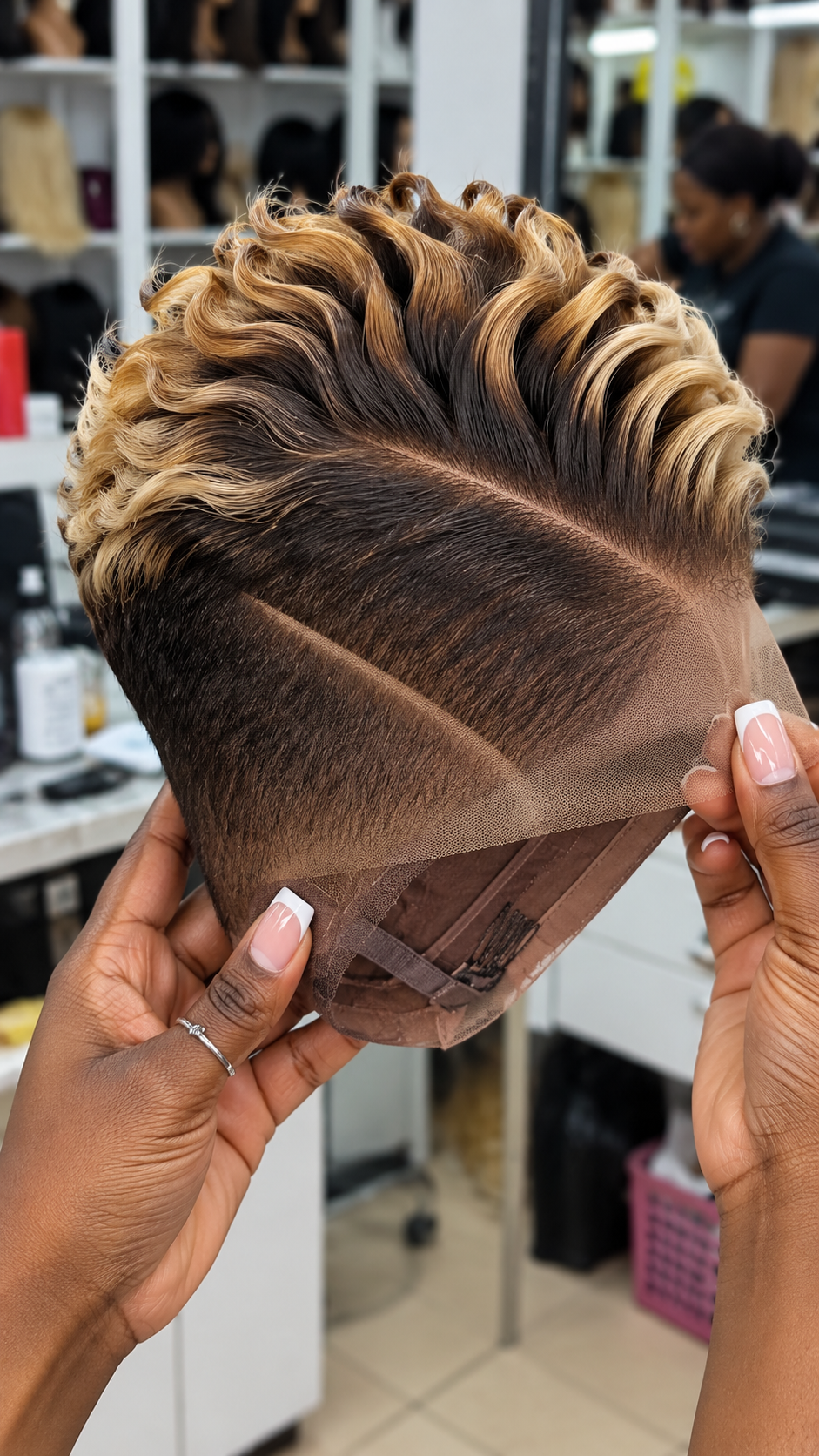
The most important decision when ordering this particular pixie wig is choosing how much blonde should appear above its dark, closely fitted side. The photograph presents a dramatic division between two styling approaches: tall honey-blonde and pale golden ribbons across the upper head, and a deep espresso-brown side that follows the contour of the cap. Between them, a long diagonal part creates a deliberate boundary that gives the hairstyle much of its character.
Held between two hands in a wig retail salon, the unit is photographed before installation. Its beige lace extends beyond the front and temple hairline, and a portion of the brown interior cap is visible underneath. The upper strands rise from darker roots, sweep backward, and curl into loose, sculpted bends rather than compact circular ringlets. The side remains comparatively flat, with a single prominent diagonal separation running from the rearward visible area toward the front temple.
This is a useful reference for customers who want a blonde pixie without sacrificing the depth of a darker foundation. It also offers an opportunity to understand how color placement, styling height, parting geometry, and lace fitting affect the result. Reproducing the photograph requires more than purchasing a generic blonde curly wig. The stylist must account for the proportions of the raised quiff and the way the darker side supports it visually.
Start With the Contrast, Not the Curl Count
At first glance, the pale blonde curls attract the eye. Yet the hairstyle would look substantially different without the broad dark section underneath. The espresso-brown side acts as a visual foundation, making the golden upper hair appear brighter and more dimensional.
The lighter hair is not arranged in a uniform blanket across the head. Individual sections emerge from dark roots, rise into broad curves, and bend toward the back or sideways. Some strands show rich honey-blonde coloring, while others appear closer to pale golden blonde. The lighter sections are especially noticeable near the upper front and outer edges of the sculpted curls.
The dark roots remain visible between the lifted sections. This creates depth at the base of the hairstyle and prevents the blonde from appearing as one continuous solid color. The photograph suggests a deliberate combination of darker underlying hair and selectively lighter lengths, although the precise coloring technique cannot be confirmed from the image.
The dark side is equally important. Its close-fitting appearance keeps the hairstyle from becoming overly rounded or bulky. The contrast between raised upper hair and compact lower hair creates a distinctive profile that a customer should preserve when requesting a similar wig.
The Golden Quiff Is Built From Broad, Sweeping Sections
The upper styling resembles a sculpted quiff composed of several individually directed hair sections. Rather than forming small, tightly packed coils, the strands gather into elongated ribbons with lifted roots and curled ends.
Near the front, the hair rises sharply from the dark foundation before bending into soft-looking, structured arcs. Some sections curl inward, while others travel backward toward the crown. The different directions create a layered arrangement that gives the hairstyle movement without requiring excessive length.
The photograph shows several larger curled formations near the front-right portion of the upper head. Farther back, the curls become more irregular, with smaller bends and overlapping sections. This gradual variation is important because a wig made entirely from identical curls would not reproduce the same silhouette.
There is also a visible distinction between the roots and the outer curled ends. The roots appear relatively closely gathered and directed upward, while the blonde ends separate into more prominent curved shapes. A stylist attempting to recreate this look should preserve that progression.
Requesting the Correct Height
One common mistake when ordering sculpted pixie wigs is requesting additional volume without considering the original proportions. More hair does not necessarily produce a better result.
In this reference, the raised blonde sections occupy the upper head while the dark side remains comparatively close to the cap. If the quiff becomes too tall or spreads too far outward, the hairstyle can lose its compact pixie character.
Ask the wig maker to discuss the intended height from the root area to the outermost curl. A front-side photograph of the work in progress can help establish whether the raised sections resemble the reference.
The stylist should also consider the way the upper hair will sit after installation. A cap positioned too far forward or backward may change the perceived height and direction of the quiff.
One Diagonal Separation Carries the Side Design
The visible side does not contain a network of crossing decorative lines. Instead, a single prominent diagonal channel separates two dark sections of closely directed hair.
The line begins toward the rearward visible portion of the side and travels diagonally toward the front temple. Its pale appearance contrasts with the surrounding espresso-brown strands, making the separation noticeable without requiring additional patterns.
Above the line, dark hair follows a backward and slightly upward direction toward the upper styling. Below it, the hair lies close to the cap and follows the lower contour. This difference in direction helps the part remain visually distinct.
The separation should not automatically be described as a shaved razor line. On a wig, a similar appearance may be achieved through controlled parting, hair placement, or exposed foundation. The photograph does not establish the exact construction method.
Keeping the Side Proportional
A successful reproduction depends on maintaining the width and angle of the diagonal channel. A very wide separation could overpower the dark side, while a narrow one might disappear beneath adjacent strands.
The line should also remain aligned with the hairstyle’s overall direction. In the photograph, it complements the backward movement of the upper quiff rather than competing with it.
Customers should request a side photograph before accepting a custom order. The image should clearly show the line from its rearward visible starting point to its forward endpoint.
The opposite side and complete rear are not shown clearly in the supplied photograph. Their appearance should be confirmed separately rather than assumed to match the visible side.
Choosing Between Honey Blonde, Golden Blonde, and Pale Blonde
The upper hair contains several warm blonde appearances rather than one completely uniform shade. Some strands resemble golden honey, while lighter sections approach pale beige-gold. The roots and much of the underlying hair remain dark espresso brown.
Lighting affects how these shades appear. The retail environment contains bright indoor illumination, which can emphasize the reflective surfaces of the blonde curls. A customer should therefore ask for color samples or photographs under more than one lighting condition.
If the goal is to reproduce the photograph, the maker should preserve the darker foundation and avoid extending the lightest blonde throughout the entire side. The dark-to-light relationship is central to the hairstyle.
For human-hair options, the stylist should consider whether the requested blonde shades require lifting the original hair color. Repeated chemical processing can affect hair condition and styling performance.
For synthetic wigs, color selection usually depends on the available manufactured shades. Ordinary hair bleach or dye should not be applied without specific confirmation that the fibers are compatible.
Why the Lace Perimeter Needs Its Own Inspection
The photograph clearly shows beige mesh extending beyond the front hairline and across the visible temple. The lace has not yet been trimmed to an individual wearer’s forehead.
Fine dark hairs appear near the boundary between the styled hair and the lace. Their placement may contribute to the final hairline appearance, but the photograph does not establish whether additional customization has already been performed.
The visible lace cannot be identified as HD lace solely from its appearance. Customers should request the seller’s actual lace specifications, including coverage, color options, and construction details.
During installation, the wig should be positioned before the excess lace is cut. This is especially important for a hairstyle with a high front quiff because the hairline position influences how the raised sections frame the face.
Trimming too close to the hairline may remove useful mesh or interfere with the intended perimeter. A professional installer can assess the appropriate boundary after checking the cap fit.
Understanding the Brown Interior Cap
Part of the interior is visible beneath the lower edge of the wig. The photograph shows brown fabric construction, stitched sections, and an internal attachment area. However, the complete underside is not exposed.
It is therefore not possible to confirm the full cap circumference, exact lace coverage, complete adjustment system, or number of securing components from this view.
Before purchasing, request a photograph showing the entire cap interior. Ask the seller for the available cap sizes and the measurements required to select an appropriate fit.
Customers interested in adhesive-free wear should also ask whether the particular unit is designed for that purpose. Visible interior construction alone does not prove that the wig will remain secure without adhesive.
A properly fitted cap should support the hairstyle without excessive tension. The lifted quiff should retain its intended position rather than shifting because the cap is too loose or too tight.
Where to Look for a Comparable Blonde Pixie Wig
Finding a similar design may require searching beyond ordinary blonde curly wigs. The combination of a sculpted quiff, dark espresso side, and single diagonal part is more specialized than a basic pixie silhouette.
Begin with wig retailers offering lace-front pixie units and customization services. Search for stylists experienced in sculpted quiffs, raised ribbon curls, and precision side parting.
A local wig salon can be useful because the customer may inspect the construction and discuss how the hairstyle will sit on the head. However, not every retailer performs detailed styling work in-house.
Online custom wig makers may offer more flexibility in color placement and curl arrangement. Before ordering, request examples of previous work involving dark-root blonde pixie styles and closely fitted temple sections.
Do not assume that a seller displaying a similar photograph has the exact unit in stock. Ask whether the image represents the actual available product, a previous custom order, or a reference for future production.
Preparing a Custom Order Without Leaving Important Details Open
A useful order begins with a clear description of the desired silhouette. Explain that the upper hair should rise into broad, backward-swept blonde curls while the visible side remains dark and close to the cap.
Specify the color relationship rather than requesting blonde hair generally. The desired combination includes dark espresso roots, honey-gold lengths, and lighter blonde accents concentrated in the upper styling.
Next, identify the diagonal side separation. Ask the maker to retain one prominent line on the visible side rather than introducing extra decorative channels.
The seller should then discuss cap measurements, lace construction, fiber type, and installation requirements. If a custom cap is available, measurements may include head circumference, front-to-nape distance, and ear-to-ear dimensions.
Before production begins, establish which aspects can be adjusted after completion. Changes to curl direction may be possible depending on the material, but significant alterations to color placement or cap construction can be difficult or expensive.
Request a production timeline and clarify whether photographs will be provided before shipment. An approval stage is especially useful when ordering a hairstyle with several coordinated visual elements.
Comparing Ready-Made Units With Salon-Customized Alternatives
A ready-made blonde pixie may offer a lower initial cost and faster delivery. However, it may not include the same dark side, elevated quiff, or diagonal separation.
Customers considering a ready-made alternative should compare the upper hair direction first. A wig with downward-facing curls may require extensive restyling to resemble this reference.
Color is another consideration. A unit with evenly distributed blonde hair may not provide the same contrast as the photographed dark-root design.
Salon customization can sometimes improve a suitable base wig, but the existing hair length, density, and fiber compatibility determine what can be achieved. The stylist should inspect the unit before promising a transformation.
For customers who consider the diagonal part essential, a reference-based custom order may offer more control than attempting to alter an unrelated wig.
Illustrative Prices for Blonde Sculpted Quiff Wigs
The following USD ranges are illustrative planning estimates, not verified current selling prices or quotations for the photographed product. Actual costs depend on the material, cap construction, color processing, styling labor, seller, and location.
| Wig Category | Illustrative USD Range | Possible Purchase Scope |
|---|---|---|
| Premium Custom | $320–$750+ | Personalized cap specifications, detailed blonde color placement, sculpted quiff styling, and precision temple work. |
| Standard Custom | $170–$390 | Reference-based styling with selected color and side-part customization. |
| Basic Human Hair | $100–$250 | A human-hair pixie base that may require separate lightening, styling, and side detailing. |
| Premium Synthetic | $75–$185 | A manufactured-fiber alternative with prearranged blonde curls and possible dark-root coloring. |
| Basic Synthetic | $30–$95 | An entry-level blonde pixie option that may approximate the overall silhouette without the detailed styling. |
These categories represent potential purchasing choices. The photograph does not confirm whether the displayed wig contains human hair, synthetic fibers, or a blend.
The most significant additional costs may come from blonde coloring, individually setting the raised curls, and recreating the diagonal temple separation. Installation, lace trimming, shipping, and later adjustments may be charged separately.
When comparing quotations, request an itemized explanation of the services included. A lower-priced wig requiring extensive salon work may ultimately cost more than a properly finished custom unit.
Maintaining the Lifted Blonde Sections
The upper quiff requires care because its appearance depends on the strands remaining grouped and elevated. Aggressive brushing can disturb the sculpted curves and reduce the distinction between individual blonde sections.
Ask the maker which setting method was used and whether the curls can be refreshed at home. The correct approach will depend on the fiber type and any styling products used during construction.
Heat should not be applied until the material and permitted temperature range are confirmed. Human hair may tolerate certain styling methods, but previously lightened strands can be more vulnerable to damage. Synthetic fibers may have stricter limitations.
If the curls begin to fall, avoid repeatedly applying heavy products without professional guidance. Excessive buildup can weigh down the raised sections and change their appearance.
Keeping the Blonde Color Attractive
Light blonde strands can show product residue and changes in tone more readily than darker hair. The care routine should therefore account for the actual coloring method and fiber composition.
For confirmed human hair, ask whether color-safe products or professional toning services are appropriate. Do not assume that purple shampoo is necessary or suitable for every warm blonde hairstyle, since it may alter the intended honey-gold appearance.
For synthetic hair, use only manufacturer-approved cleaning products and avoid unverified coloring treatments.
The goal is to preserve the contrast between the warm blonde upper hair and dark espresso foundation rather than changing the color balance during maintenance.
Protecting the Diagonal Part and Dark Side
The lower section has a different maintenance priority from the quiff. Its visual effect depends on the dark strands remaining closely directed and the diagonal separation staying visible.
Friction from headwear or repeated handling may disturb the hair placement. When removing the wig, avoid pulling directly on the styled side or delicate lace perimeter.
If the diagonal channel becomes less visible, consult the stylist before attempting to widen it. Cutting into the hair or foundation could permanently alter the design.
For storage, select a support that maintains the cap shape without stretching it. Leave enough clearance above the wig to avoid compressing the blonde curls.
Booking the Final Fitting and Finishing Appointment
After receiving the wig, inspect the color, curl arrangement, lace perimeter, and visible cap construction before making irreversible changes.
Book a stylist who is comfortable working with lace-front wigs and sculpted pixie hairstyles. Explain that the appointment should preserve the raised blonde quiff and dark diagonal side design.
The stylist should first check the cap position and confirm that the hairline sits appropriately. Any required lace trimming should follow that assessment.
Once the wig is secured using a method suitable for its construction and the wearer, the stylist can evaluate whether minor adjustments to the upper curls are needed. Excessive reshaping should be avoided if the original reference is the desired result.
Photographs from the front, visible side, and above can help document the finished arrangement. They also provide a useful guide for future maintenance appointments.
Choosing the Right Version of This Blonde Pixie
This wig is best understood as a coordinated design rather than a collection of separate styling details. Its golden upper curls gain their impact from the dark espresso foundation, while the single diagonal temple part gives the lower section a deliberate sense of direction.
Customers seeking a faithful reproduction should prioritize the upper silhouette, color distribution, and side geometry before considering optional embellishments. Adding more curls, more blonde, or extra decorative lines would not necessarily improve the result.
A reliable supplier should be able to explain the construction, confirm the material, provide additional photographs, and clarify the services included in the price. With those details established, the hairstyle can be ordered and fitted with a clearer understanding of what makes its appearance distinctive.
Search Terms
Honey blonde sculpted quiff lace wig · Espresso root golden pixie wig · Single diagonal temple part wig · Dark brown side blonde crown hairstyle · Swept back blonde ribbon curls wig · Beige lace front honey blonde pixie · Golden blonde curled quiff with dark taper · Two tone blonde espresso lace wig