
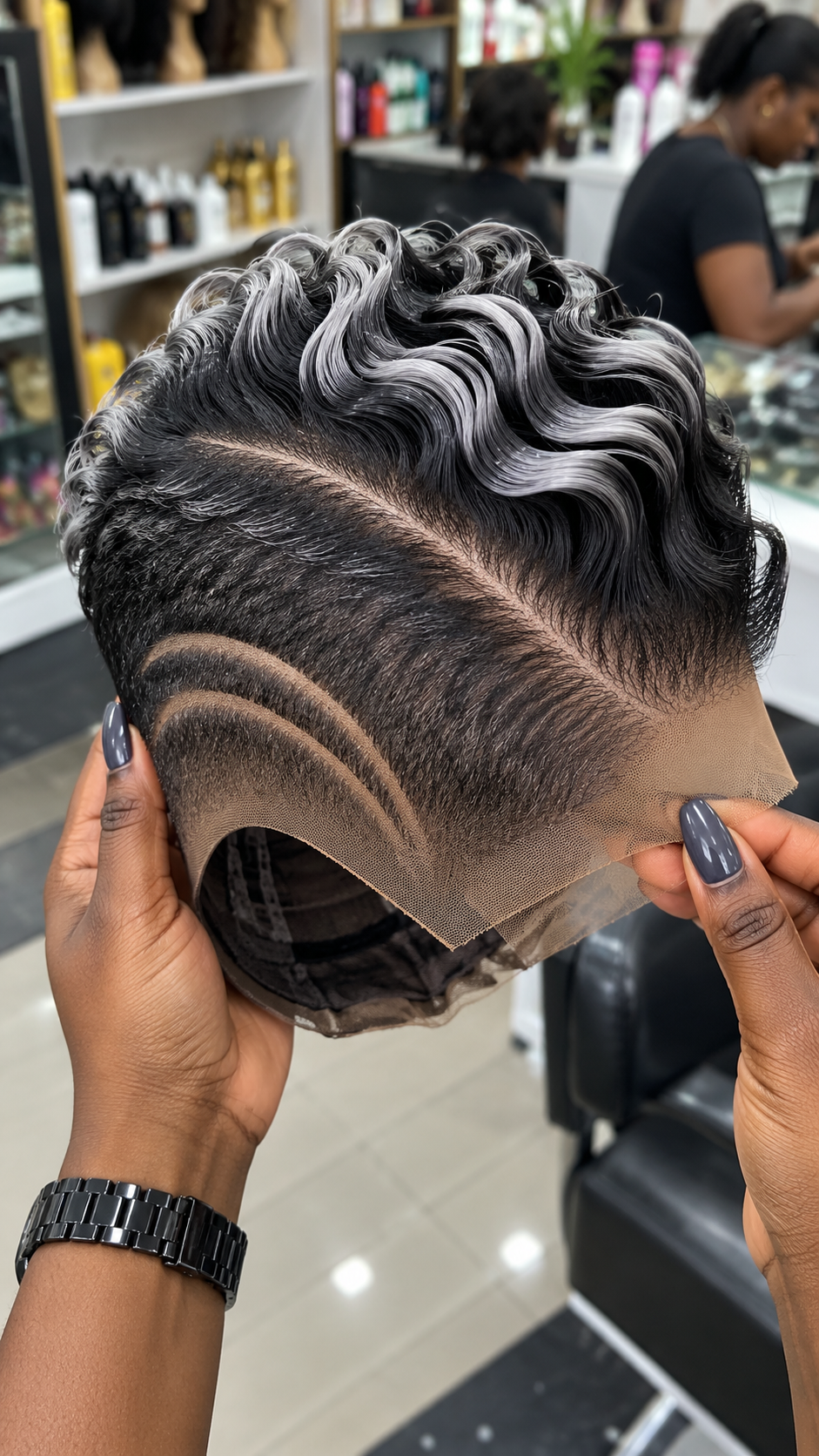
Some wig designs are distinguished by their color, while others depend on the precision of their cutting and styling. This black and silver lace wig brings both qualities together, but its most remarkable detail is the relationship between the flowing upper waves and the two curved lines carved into the darker side section. The result is a compact, sculpted hairstyle that combines the elegance of silver-accented finger waves with the sharp visual character of a barber-inspired side design.
The photograph shows the wig held with two hands inside a hair salon or beauty supply setting. Its lace extends beyond the front hairline, and the dark interior cap is partially visible underneath. The wig has not yet been fitted to a wearer, making this a useful opportunity to examine the design before installation changes its appearance.
Unlike a conventional gray pixie wig, this piece does not depend on an even distribution of silver hair. Bright silver strands follow the curves of the upper waves, while the surrounding black hair provides a contrasting background. The side design introduces another element: two closely spaced curved channels that follow the contour of the lower side section. Together, these details create a hairstyle that needs careful reproduction rather than a simple color match.
The Double Curved Lines Establish the Side Design
The most immediately recognizable detail on the visible side is the pair of curved carved lines. They begin toward the lower rear-facing portion of the side panel and sweep forward in two separate arcs. The upper curve is slightly longer and sits above the lower one, creating a layered appearance.
These lines are not straight horizontal stripes. Their curvature follows the general shape of the side panel, giving the design a sense of movement. The space between the two channels contains dark hair, which makes each line visually distinct.
The carved channels appear lighter than the surrounding hair because they expose more of the foundation beneath the strands. Their width is relatively consistent along much of the visible path, although perspective and the wig’s curved surface affect their apparent proportions.
Above the carved pattern, a separate diagonal parting divides the lower dark section from the upper finger-wave arrangement. This means the wig contains two different types of separation: a prominent upper parting and the paired decorative curves beneath it.
That distinction is essential when ordering the hairstyle. A seller who interprets the reference as a wig with only two side lines may overlook the larger diagonal separation. Conversely, adding extra stripes or intersecting designs would produce a noticeably different result.
Preserving the Distance Between the Curves
The visual appeal of the double-line pattern depends on the amount of dark hair left between the channels. If the lines are carved too close together, they may merge visually. If the space becomes too wide, the paired design may lose its coordinated appearance.
For a custom wig, ask the maker to reproduce the curvature and relative spacing shown in the photograph. It is better to provide a close-up reference than to specify an arbitrary measurement, since the apparent spacing will depend on the cap size and the finished hairstyle.
Any cutting should be performed cautiously. Hair removed from a wig cannot be restored through ordinary styling, and widening an existing channel may expose more of the underlying cap than intended.
Silver Strands Following the Direction of the Finger Waves
The upper section contains a striking combination of glossy black and bright silver-gray hair. Rather than appearing as random highlights, the silver strands are arranged along the curves of the sculpted waves. This placement makes the movement of the hair particularly visible.
Several broad S-shaped waves travel across the upper surface. The brightest silver appears along raised ridges, while darker sections remain visible within the valleys and beneath the curled strands. The result is a layered black-and-silver appearance that changes depending on the viewing angle.
At the central upper area, the waves form elevated bends with clearly visible changes in direction. Toward the visible right side, the pattern continues into a more compact arrangement, with several smaller curled sections appearing near the outer edge.
The silver is not distributed uniformly across the entire wig. The lower side remains predominantly black, while the upper section contains the strongest concentration of pale strands. Some lighter hair is also visible near the upper-left edge, although the complete color arrangement around the back cannot be established from this photograph.
Choosing Between Silver Highlights and a Full Gray Wig
Buyers should avoid treating this hairstyle as a standard gray wig. A completely silver unit would not produce the same contrast, even if its wave pattern were similar.
When contacting a supplier, describe the desired color as black hair with silver-gray strands concentrated through the sculpted upper waves. Request photographs of the proposed color arrangement before approving a custom order.
The reference image shows bright, cool silver reflections rather than a strongly yellow blonde or warm copper tone. However, the exact shade may appear different under daylight, salon lighting, or a camera flash.
A supplier should therefore provide color samples or photographs under more than one lighting condition. This is especially useful for distinguishing pale ash gray from platinum blonde, pearl silver, and darker smoky gray.
The photograph does not reveal whether the silver strands were colored individually, incorporated during wig construction, or created using another method. Those details should be confirmed before purchasing.
Examining the Finger Wave Formation Across the Upper Hair
The top of the wig is arranged into sculpted finger-wave-like sections rather than ordinary loose curls. The strands travel together in broad, coordinated bands, bending from one direction into another to create flowing S-shaped ridges.
These ridges are not completely flat against the cap. Several sections rise above the surrounding hair, giving the hairstyle controlled height and dimension. The elevated areas are especially visible toward the central crown, where the waves form a sequence of curved peaks.
Despite that height, the hairstyle maintains a relatively compact outline. The waves do not extend into long hanging curls, and the visible silhouette remains close to the shape of a pixie haircut.
There is also a noticeable difference between the broader central waves and the smaller curled formations toward the outer edge. This variation prevents the upper styling from appearing like a repeated mechanical pattern.
The Importance of Hair Direction During Styling
Finger-wave-inspired hairstyles rely heavily on the direction in which adjacent strands are arranged. A stylist cannot necessarily reproduce this appearance by curling individual sections independently.
For this wig, the upper hair should be guided into coordinated S-shaped movements, with the silver strands remaining visible along the wave ridges. If the hair is separated into numerous unrelated curls, the original flowing pattern may disappear.
The styling technique will depend on the actual hair material. Some fibers may require particular setting methods, while others may be incompatible with high temperatures or certain chemical products.
Before attempting to recreate the waves, a stylist should establish whether the wig contains human hair, synthetic fiber, or a blend. The photograph alone cannot confirm the material.
Why the Dark Side Panel Matters as Much as the Silver Crown
The lower side section provides a visual foundation for the upper waves. Its dark color and close hair arrangement make the silver ridges appear more prominent without requiring additional brightness.
Fine dark strands are visible throughout the side panel, especially between the diagonal parting and the carved curves. The hair appears to follow the contour of the cap rather than projecting outward.
This area is not completely shaved. The photograph shows closely arranged hair over the lace foundation, with the carved lines interrupting that coverage.
For someone commissioning a similar wig, the density of the side hair deserves attention. Excessive density could make the carved channels difficult to see, while insufficient coverage might reveal more of the cap than intended.
The ideal result should preserve enough dark hair to provide contrast while keeping the decorative curves recognizable.
What Can Be Learned From the Visible Lace and Cap
The wig is photographed before installation, with a broad section of beige lace extending across the front and side. The lace has not yet been trimmed to the final hairline.
Fine hairs are visible near the front, particularly where the darker side section approaches the lace edge. These strands may influence the finished hairline, but their final appearance cannot be judged accurately until the wig is fitted.
The underside reveals a dark interior cap structure with mesh-like components and stitching. Only part of this construction is visible, so the photograph cannot establish the complete cap design, size, or attachment system.
Although the lace appears relatively fine in the photograph, this is not sufficient evidence to identify it as HD lace. Buyers should request the actual lace specification from the seller.
Questions to Resolve Before Trimming the Lace
The most important first step is checking the cap measurements against the intended wearer’s head. A wig that is too tight or too loose may change the position of the decorative side pattern once installed.
Ask the seller for the cap circumference, ear-to-ear measurements, and front-to-back length. Request a complete underside photograph showing any adjustable bands, combs, clips, or other attachment components.
Do not assume the wig is glueless simply because it has a lace front. Whether it can be worn without adhesive depends on the actual construction and fit.
Once the cap has been evaluated, a qualified wig stylist can position the unit and determine how much excess lace should be removed. Cutting into the hairline prematurely may permanently affect the finished appearance.
Commissioning the Design From a Wig Maker and Barber
This hairstyle requires a combination of styling skills that may not be offered by every wig seller. The upper finger waves demand control over hair direction, while the double curved side lines require precision cutting.
For a custom order, it may be useful to work with a wig maker who has experience creating sculpted pixie units and a barber or stylist familiar with decorative line work on wigs.
Begin by sending the reference photograph and identifying the elements that must remain consistent: black and silver upper waves, a diagonal parting, two curved side channels, and a compact overall silhouette.
Ask the supplier whether the side design can be completed before shipping. If not, determine whether a local professional can perform the finishing work after the wig has been fitted.
A custom maker should ideally provide progress photographs showing the upper wave formation and side pattern before the order is finalized. This allows the buyer to identify major differences before irreversible cutting or styling is completed.
Where to Search for Similar Units
Online wig marketplaces, specialist lace wig shops, independent custom wig makers, and local beauty supply stores are possible places to begin. However, a similar photograph in a listing does not guarantee that the actual product will match the reference.
Search descriptions should emphasize the combination of black and silver finger waves and double curved side lines. A generic search for a silver pixie wig may return many unrelated hairstyles.
Before paying, request photographs of the exact unit or examples of comparable completed orders. Confirm the hair material, cap construction, styling services, and whether the advertised price includes the carved side design.
For salon booking, ask whether the appointment includes wig fitting, lace customization, wave setting, and any required barber work. Separating these services in advance can prevent unexpected costs.
Planning the Cost of a Double-Line Finger Wave Wig
The following prices are illustrative USD planning ranges, not verified live prices or quotations for the photographed wig. They are intended to help buyers compare purchasing categories. Actual costs may vary considerably depending on location, materials, customization, and professional labor.
| Wig Category | Illustrative USD Range | Potential Inclusions or Limitations |
|---|---|---|
| Premium Custom | $340–$820+ | Individual construction, black-and-silver color placement, advanced finger-wave styling, precision side carving, and possible fitting services |
| Standard Custom | $180–$420 | Selected cap options, customized wave arrangement, contrasting silver strands, and specified double-line detailing |
| Basic Human Hair | $95–$260 | Base human-hair unit, with possible additional charges for coloring, wave setting, and side design |
| Premium Synthetic | $65–$185 | Pre-styled wave appearance, selected color combinations, and material-dependent maintenance restrictions |
| Basic Synthetic | $30–$100 | General visual resemblance, simpler cap construction, and potentially less precise styling or side carving |
The photographed wig’s material cannot be confirmed visually, so the human-hair and synthetic categories should be understood as possible shopping options rather than statements about this specific unit.
For this design, precision labor may influence the final price more than hair length. Creating broad coordinated waves and carving two balanced curves can require more detailed work than styling a basic pixie wig.
Color placement is another consideration. The silver strands must remain visible along the wave ridges while the side stays predominantly dark. A custom color arrangement may cost more than purchasing a uniformly colored base unit.
Installation, shipping, taxes, lace trimming, additional styling, and barber appointments may not be included in the initial quotation. Buyers should request an itemized estimate before confirming an order.
Maintaining the Silver Waves and Protecting the Carved Pattern
The upper styling and lower side design require different kinds of attention. The finger waves depend on keeping neighboring strands arranged in coordinated directions, while the carved curves depend on maintaining their visible separation.
Brushing aggressively through the upper hair could disturb the wave ridges and redistribute the silver strands. A professional should explain how to refresh the arrangement without breaking apart the sculpted sections.
Product selection should be based on confirmed fiber information. Synthetic hair may have restrictions involving heat and coloring, while human hair may require additional care if it has undergone lightening or other chemical processing.
The reflective appearance in the photograph should not be interpreted as proof that heavy oils are necessary. Excessive product may collect between the wave ridges and reduce the clarity of the individual strands.
Preventing the Side Lines From Losing Their Shape
The two curved channels should not be repeatedly widened simply to make them more visible. Removing additional hair can alter the proportions and may expose too much of the foundation.
If nearby strands begin covering the channels, a stylist can assess whether careful repositioning is sufficient before considering any cutting.
When the wig is stored, avoid placing pressure directly against the sculpted upper waves. A suitable wig stand or head form may help maintain the silhouette, provided it does not stretch the cap.
The lace should also be handled carefully during removal and storage. Pulling on the excess lace or using the decorative side section as a grip point may damage delicate areas.
Recognizing a Faithful Reproduction Before Installation
A successful version of this hairstyle should preserve several visual relationships rather than merely copying its general color. The upper waves should form recognizable S-shaped movements, the silver strands should follow those curves, and the lower side should remain predominantly dark.
The diagonal separation and the two curved channels should be distinguishable from one another. The paired lines should remain balanced without becoming excessively wide or merging into a single design.
Before accepting a custom order, compare photographs from the front, the decorated side, the opposite side, and the back. The supplied reference does not reveal the complete rear arrangement, so those additional views are necessary for a comprehensive evaluation.
Finally, confirm the cap dimensions and attachment method before trimming the lace. A visually accurate wig still needs an appropriate fit to achieve the intended position on the wearer’s head.
The strongest quality of this black-and-silver wig is its deliberate coordination of color, wave direction, and side geometry. The silver highlights draw attention to the raised finger waves, while the paired carved curves add a distinctive barber-inspired detail. Keeping those elements proportionate produces a more faithful result than adding extra volume, brighter coloring, or additional decorative lines.
Search Terms
black silver finger wave lace wig · double curved side line pixie wig · silver streak S wave crown hairpiece · black tapered side carved arc wig · diagonal parting silver wave lace unit · glossy black and white finger waves · two curved razor line lace pixie · untrimmed beige lace sculpted wave wig