
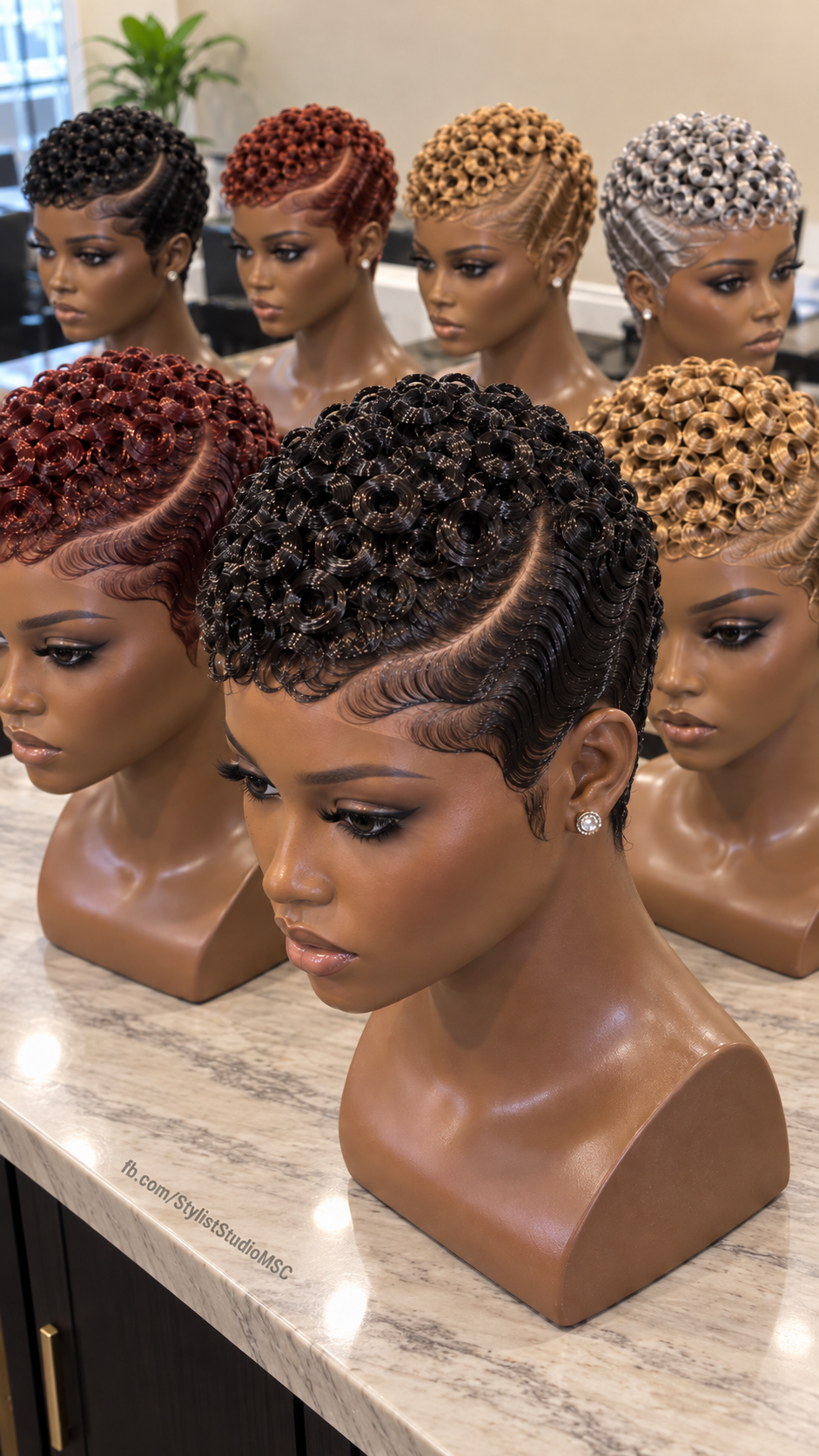
A salon display becomes considerably more useful when it shows how one hairstyle concept changes across several colors and curl arrangements. This seven-wig collection brings together sculpted finger-coil crowns in glossy black, burgundy, copper-red, golden blonde and pearl silver. The most revealing piece is positioned at the front center: a black wig with prominent circular coils, a pronounced diagonal part and an extended sequence of directional finger waves sweeping across the forehead and around the temple.
Instead of presenting each wig as an interchangeable color variation, this collection allows buyers to examine how curl diameter, wave placement, crown density and tonal contrast change the overall impression. The golden-blonde units make individual circular openings especially noticeable, while the darker pieces rely more heavily on reflected light and shadow. The silver wig offers another interpretation, with pale coils and a closely arranged side-wave pattern.
The units are displayed on dark-complexioned mannequin heads in a salon setting. Their finished appearance can be examined clearly, but the photograph does not show the interior construction of the wigs. Cap sizing, hair composition, lace material and attachment systems must therefore be confirmed with the seller. A visible scalp-like parting is not sufficient evidence to advertise any of these units as HD lace.
The Foreground Black Wig Provides a Study in Contrasting Curl Shapes
The central black unit contains several distinct kinds of movement within one compact hairstyle. The upper crown is densely populated with circular coils, many of which have visible hollow centers. Beneath the diagonal part, the styling changes into elongated strands that sweep across the forehead before bending toward the temple.
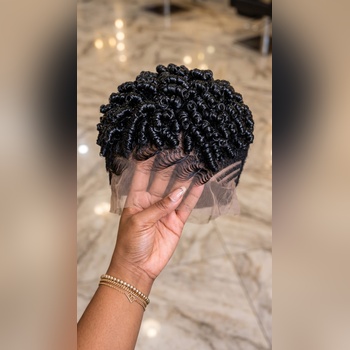
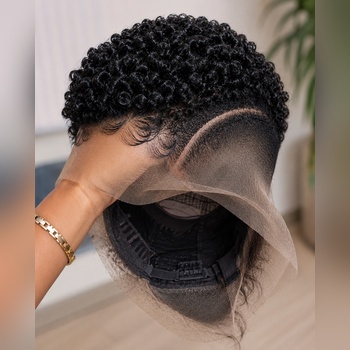
This contrast gives the wig its visual character. The crown uses repeated rounded formations, while the front introduces broad directional curves. The side then settles into smaller closely arranged sections near the ear.
A customer requesting this construction should not describe it merely as a black curly pixie. That phrase would omit the most important styling decisions.
The desired result requires a pronounced diagonal division, recognizable circular crown coils and an extended finger-wave arrangement that follows the front hairline.
The Diagonal Part Creates the Entire Face-Framing Direction
One of the clearest details on the foreground unit is the exposed parting that travels diagonally through the upper hair. It separates the main coil field from the flatter directional styling below.
The angle determines how much of the crown appears on either side. A more central placement could produce a balanced appearance, while a deeper side part creates stronger asymmetry.
In this reference, the parting provides a visible route along which the front waves begin. The hair below it follows a coordinated path rather than forming additional circular curls.
For custom ordering, the parting should be approved before the final curl construction is completed. Moving it substantially afterward may require rebuilding nearby sections.
The Finger-Wave Sweep Extends Beyond Ordinary Baby Hairs
The forehead work on the foreground black wig is particularly elaborate. Several long curved sections travel together, producing a layered wave arrangement beneath the diagonal part.
These are not simply a few short decorative hairs positioned near the edge. The strands occupy a noticeable portion of the front and side, creating an important transition between the crown and the face.
As the waves approach the temple, their curvature becomes tighter, allowing smaller strands to complete the direction near the ear.
A stylist recreating the unit should preserve this progression. Replacing the broad front arcs with numerous small curls would produce a different look even if the upper crown remained unchanged.
Black Circular Coils Depend on Their Open Centers
The black crown contains a dense arrangement of glossy rings. Several have prominent hollow centers that reveal dark recessed sections beneath the reflective outer strands.
These spaces are important because they keep neighboring coils visually separate. Without them, the crown could appear as one heavy mass of curled hair.
The rings are not all identical. Some are large and positioned prominently near the front, while smaller formations fill the spaces between them and continue toward the rear.
For a custom maker, this mixed-diameter arrangement should be treated as an intentional construction detail rather than an inconsistency.
An elevated approval photograph can help determine whether the larger curls remain recognizable and whether the smaller supporting coils provide enough coverage.
The Black Palette Allows Shine and Shadow to Do the Work
The foreground unit does not rely on obvious blonde or copper highlights. Instead, the glossy black strands reflect salon lighting along the outer surfaces of the curls.
Dark centers remain visible within the circular formations, giving each coil its own depth.
This makes curl placement particularly important. A misaligned spiral may become obvious because the surrounding hair is otherwise arranged in a coordinated pattern.
Buyers who prefer monochromatic black wigs can use this style as evidence that intricate construction does not require multiple colors. The crown and front waves already provide substantial visual interest.
Burgundy Creates a Different Kind of Crown Dimension
The burgundy wig positioned toward the front left offers a rich wine-red interpretation of the circular crown. The individual coils appear in deep burgundy with brighter reddish reflections along their raised surfaces.
The darker interior of each ring creates contrast, while the warm color makes the physical curl structure easier to follow.
This unit also contains a visible diagonal part and directional strands around the forehead. However, the curl distribution and wave arrangement should be evaluated independently rather than assumed identical to the foreground black wig.
For customers considering burgundy, color approval under neutral lighting is especially useful. Warm salon lights can make wine-red hair appear considerably brighter than it does in daylight.
The Rear Copper-Red Wig Adds Warm Reflective Movement
A second warm-colored unit appears farther back, with reddish copper and auburn tones across a densely curled crown.
Compared with burgundy, copper-red often creates brighter reflections on the outer surfaces of the coils. The color can make individual spirals stand out even when they are relatively small.
The photograph shows a compact crown and closely arranged directional hair around the front, but the full rear construction is not visible.
Buyers should therefore request individual photographs before assuming that this unit has exactly the same coil map as another red wig in the display.
Golden Blonde Emphasizes Circular Curl Construction
The central rear golden-blonde mannequin demonstrates how lighter hair changes the appearance of small sculpted coils. The circular formations become easier to distinguish because their golden surfaces reflect light strongly.
The underlying hair retains darker depth between some sections, preventing the crown from becoming entirely flat in appearance.
This palette can be appealing for customers who want the individual ringlets to remain noticeable without relying on a deep black foundation.
For purchasing, the desired blonde level should be confirmed through actual color samples or neutral-light images. Honey blonde, golden blonde and caramel blonde can vary substantially between suppliers.
The Foreground Golden Wig Uses Larger Visible Rings
Another blonde unit appears toward the front right. Its crown contains particularly noticeable hollow circular coils, several of which have larger openings than those on the rear golden mannequin.
This distinction matters because the two wigs should not be treated as interchangeable merely because they belong to a similar blonde color family.
The foreground version places greater emphasis on circular coil diameter, while the rear unit appears more tightly populated with smaller formations.
A customer choosing between them should therefore compare crown density before making a final color decision.
Pearl Silver Creates a Cooler Interpretation of the Same Concept
The pearl-silver wig at the upper right stands apart from the warm and dark alternatives. Its crown contains many pale circular curls, with silver-gray reflections visible across the raised surfaces.
The side uses closely arranged directional waves that follow the contour of the head. Because the color is so light, the individual wave ridges remain relatively easy to distinguish.
This palette introduces different maintenance considerations depending on the hair material.
If the wig is human hair, achieving the pale shade may involve substantial processing. If it is synthetic, the silver color may be incorporated into the fiber, but heat and recoloring options can be more limited.
The photograph alone cannot establish which material is used, so care recommendations should be based on the actual product specification.
Two Black Wigs Can Have Different Curl Personalities
The display includes another black unit toward the rear. Although it shares a dark palette with the foreground piece, the visible crown appears to use smaller curls and a different balance between circular formations and front styling.
This is a useful reminder that color does not determine construction.
Someone who wants black hair should still examine curl diameter, density, parting direction and perimeter movement before purchasing.
A stylist may be able to reproduce the crown from one wig with the front-wave arrangement of another, but that customization should be discussed rather than assumed.
Choosing a Wig Based on Curl Scale Rather Than Shade
The collection presents several approaches to circular curl styling. Some crowns use larger hollow rings that become individual focal points. Others employ smaller, more numerous coils that create a densely populated surface.
Neither approach is automatically better. Larger rings emphasize the construction of each individual curl, while smaller formations produce a more continuous rounded crown.
The choice should reflect the desired visual balance.
For a custom order, customers can identify which mannequin has their preferred coil diameter and then ask whether the same construction is available in another color.
The Side-Wave Arrangement Changes the Face-Framing Effect
Several mannequins contain directional strands around the forehead, but their shapes are not identical.
Some use broader sweeping curves, while others place the waves closer to the front parting and temple.
This variation can change how the hairstyle frames the face even when the crown remains compact.
During a salon consultation, the customer should indicate whether the front waves are intended to be prominent or relatively restrained.
That decision can be made independently from the color and coil diameter, making the final order more precise.
A Salon Gallery Should Be Used for Construction Comparisons
A multi-wig display is valuable because several related styles can be viewed simultaneously. Customers can compare the visual effect of black, burgundy, copper, blonde and silver without relying on separate photographs taken under different conditions.
However, the gallery photograph should not replace individual product inspection.
Once a customer identifies a preferred unit, the seller should provide photographs of that exact wig from the front, sides, crown and rear.
Those additional views can clarify the curl arrangement and reveal details that may be concealed by the surrounding mannequins.
Ready-Made Stock and Custom Reproduction Need Different Expectations
A ready-made wig is useful when the customer already likes the specific combination of color, curl scale and front styling.
A custom commission becomes more appropriate when the buyer wants elements combined from different units, such as the large black crown in burgundy or the golden color with a more elaborate forehead wave.
Custom combinations can require additional labor and may not be available from every supplier.
Before paying, ask whether the selected unit is available as finished stock or whether the hairstyle must be recreated.
Where to Buy or Commission These Finger-Coil Wigs
Specialist wig makers, custom lace-wig studios and salons experienced with finger coils and sculpted front waves are practical sources for similar units.
General wig retailers may carry compact curly foundations, but precise circular crown construction and directional forehead styling can require additional salon work.
When contacting a seller, provide the photograph and identify the exact mannequin that serves as the main reference.
Ask about the available colors, curl construction, hair material, cap sizing and what styling work is included in the quote.
If ordering online, request current photographs of the actual inventory rather than relying solely on an inspiration image.
Booking a Salon Appointment for Custom Finger Coils
The appointment required depends on the condition of the wig when it arrives.
A finished unit may need fitting and minor corrections after transportation. An unfinished base may require complete coil setting, parting construction and front-wave styling.
Customers should tell the salon whether the crown has already been formed and whether any additional color work is needed.
This information helps the stylist allocate enough time and identify whether a specialist in precision finger-wave styling should be involved.
Pricing Should Reflect Curl Density and Individual Styling Work
The wigs in this collection are compact, but their construction may involve numerous individually arranged coils and detailed front styling. That labor can influence price more than visible hair length alone.
Color processing, cap construction and lace preparation may add further costs.
Estimated Prices for Sculpted Finger-Coil Wig Options
| Category | Illustrative Price Range | Typical Scope |
|---|---|---|
| Premium Custom | $330–$610+ | Higher-grade hair, personalized sizing, hand-arranged spiral coils, selected color processing, directional front-wave work and detailed lace preparation. |
| Standard Custom | $200–$360 | Prepared finger-coil crown, chosen color and established side-wave styling with more standardized cap options. |
| Basic Human Hair | $120–$220 | A human-hair foundation requiring additional curl setting, front styling, color adjustment or fitting. |
| Premium Synthetic | $80–$160 | A quality pre-set option that may retain circular curls with relatively limited professional resetting. |
| Basic Synthetic | $40–$90 | A budget interpretation where coil variation, crown density, front-wave precision or cap construction may be simpler. |
These figures are illustrative budgeting estimates, not verified retail prices for the displayed wigs. Material, seller, country, color processing, cap construction, shipping and installation can change the final amount.
When comparing quotes, ask what level of styling is already completed. A less expensive base may require enough additional salon work to make its total cost higher than a prepared custom unit.
Material Choice Affects How the Coils Can Be Maintained
Human hair can offer flexibility for future professional curl reconstruction. Individual spirals may be reset as they loosen, depending on hair quality and processing history.
Premium synthetic fiber can provide advantages in maintaining pre-set shapes, particularly for customers who intend to preserve the original design rather than frequently change it.
Heat tolerance varies, and conventional permanent dye should not be assumed suitable for synthetic wigs.
The material should be confirmed before a maintenance routine is selected.
Preserve the Circular Openings During Washing
The ringlets are most recognizable when their individual openings remain visible. Aggressive rubbing can cause neighboring curls to intertwine and close those spaces.
Before washing, photograph the crown from above and from the side.
During cleansing, follow care methods appropriate for the confirmed material and minimize unnecessary manipulation.
After drying, restore only the curls that have shifted rather than rebuilding every section automatically.
Front Waves Require Different Care From the Crown
The elongated finger waves near the forehead should not be maintained with the same technique as the circular coils above them.
If a directional strand moves out of place, guide it back along the original curve rather than rolling it into another ringlet.
Heavy product can cause wave ridges to merge, reducing the precision of the front arrangement.
A close side photograph can provide a useful guide for later professional maintenance.
Color Maintenance Differs Across the Collection
Black wigs may require less tonal maintenance than heavily processed blonde or silver human-hair units.
Burgundy and copper human hair can gradually change in intensity with washing, heat and exposure. Refreshing the color should preserve darker recessed sections rather than automatically applying one flat bright shade.
Pale blonde and silver human-hair wigs may require particular care before additional chemical processing.
Synthetic versions should be maintained according to their confirmed fiber specifications rather than treated as ordinary dyeable human hair.
Storage Should Protect the Sculpted Crown
A wig stand or appropriately sized mannequin head can help preserve the raised circular formations between wears.
Other wigs or objects should not be stacked over the crown, because compression may flatten the ringlet openings.
The side also needs clearance to protect the directional finger waves.
Store each unit fully dry and use packaging that provides enough room for the curls during transportation.
The Best Choice Comes From Matching Curl Construction to the Desired Color
This collection demonstrates how differently a compact finger-coil wig can appear when curl scale, density, parting and front-wave direction change.
Black emphasizes reflected light and shadow. Burgundy brings wine-red depth, copper adds warm reflection, golden blonde makes the circular formations highly visible, and pearl silver creates a cooler presentation.
For buyers, the most reliable approach is to choose the preferred crown construction first, evaluate the front and temple styling next, and then select an available color. Cap and material specifications should be verified separately before purchasing.
For wig businesses, presenting coordinated collections like this can make custom ordering easier when each unit is documented individually. Customers can compare the craftsmanship and understand whether they are selecting ready-made stock or commissioning a particular combination of color and styling.
A successful order should preserve the actual characteristics of the chosen reference rather than substituting a generic curly wig in a similar shade. The value lies in accurate coil placement, controlled directional styling and clear information about the product that will be delivered.
Search Terms
black sculpted finger coil wig · burgundy diagonal part curl wig · golden blonde circular coil crown · pearl silver finger wave wig · copper red compact spiral wig · glossy black forehead wave wig · mixed diameter ringlet wig · salon finger coil wig collection