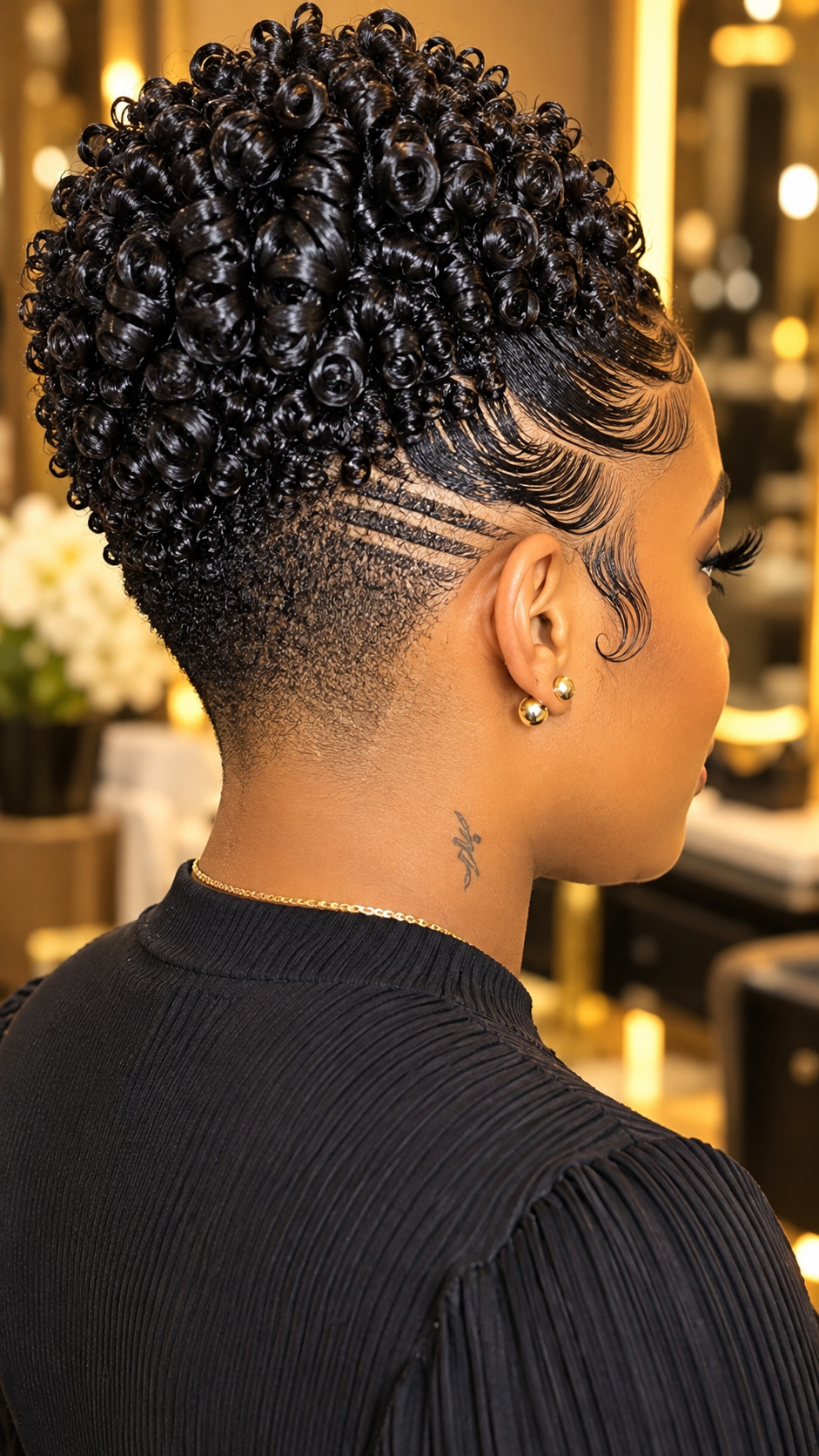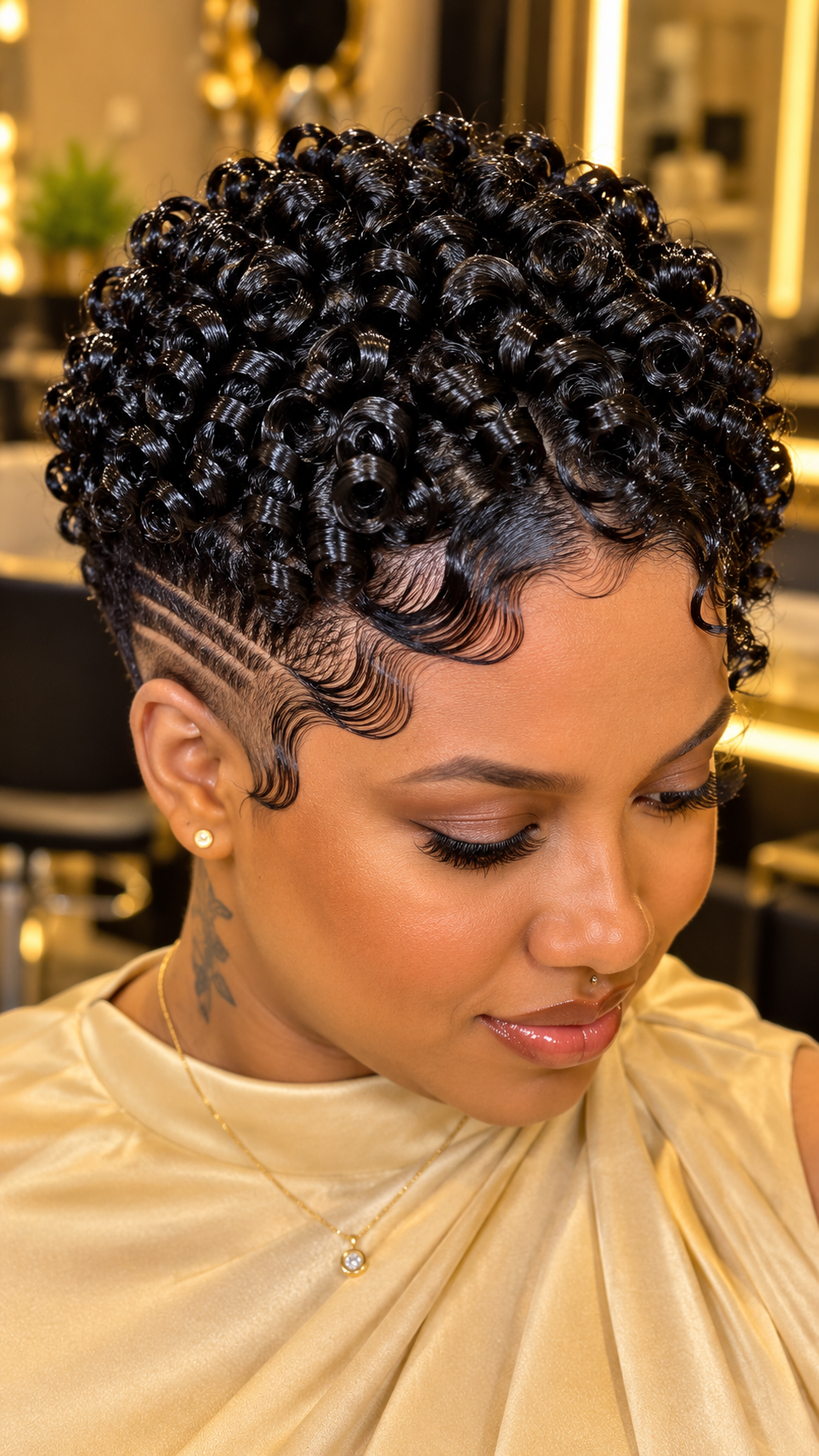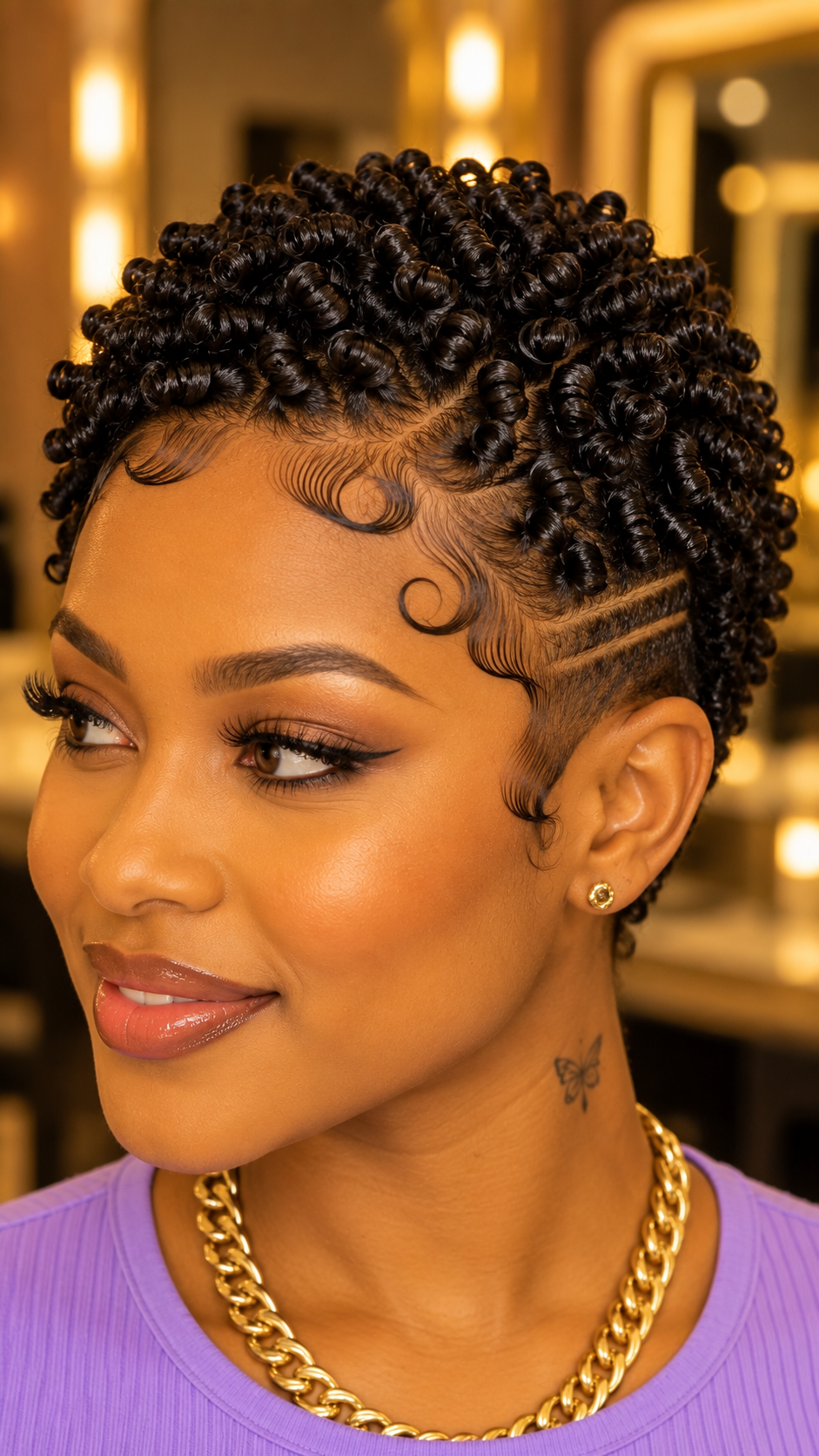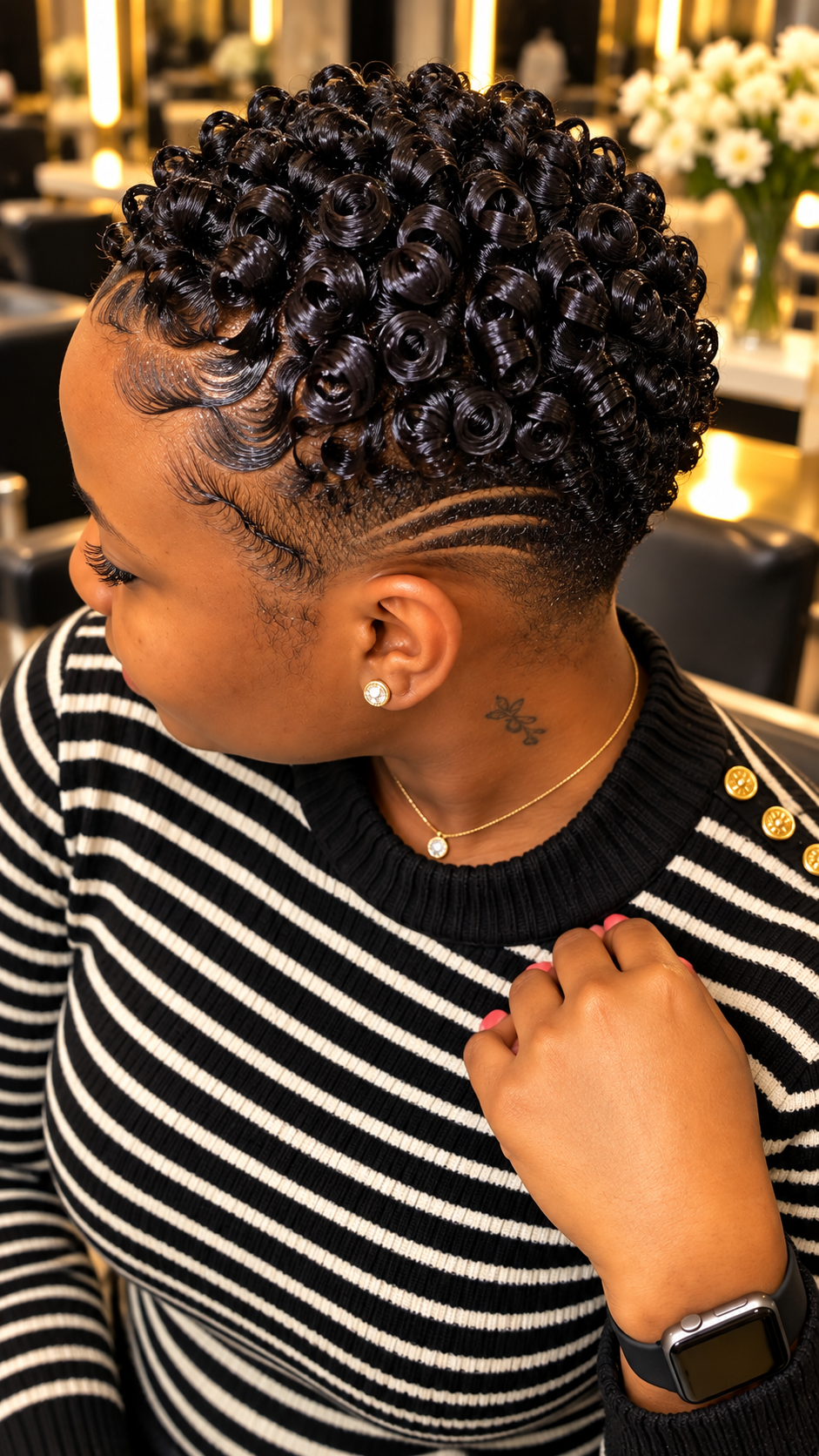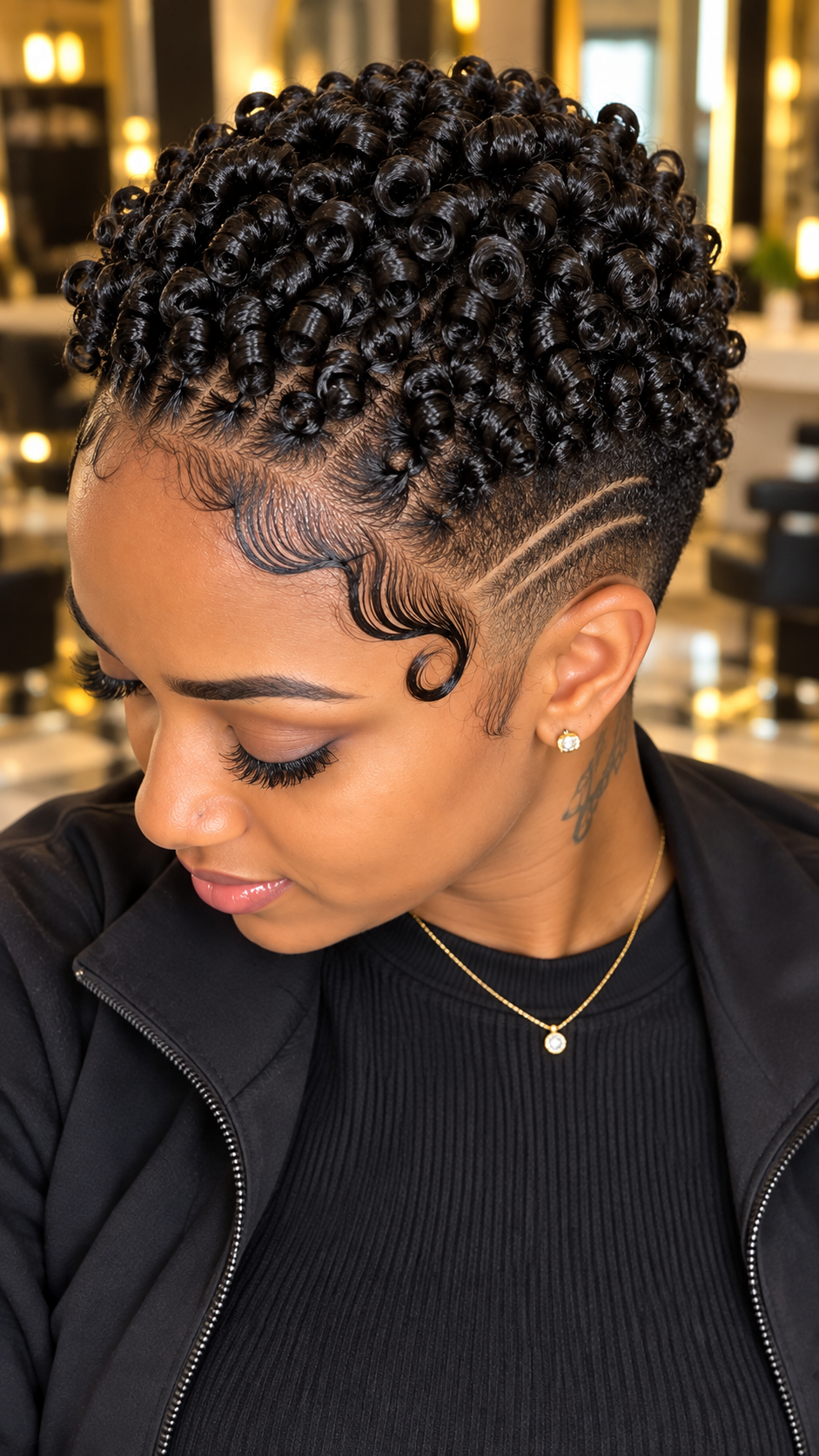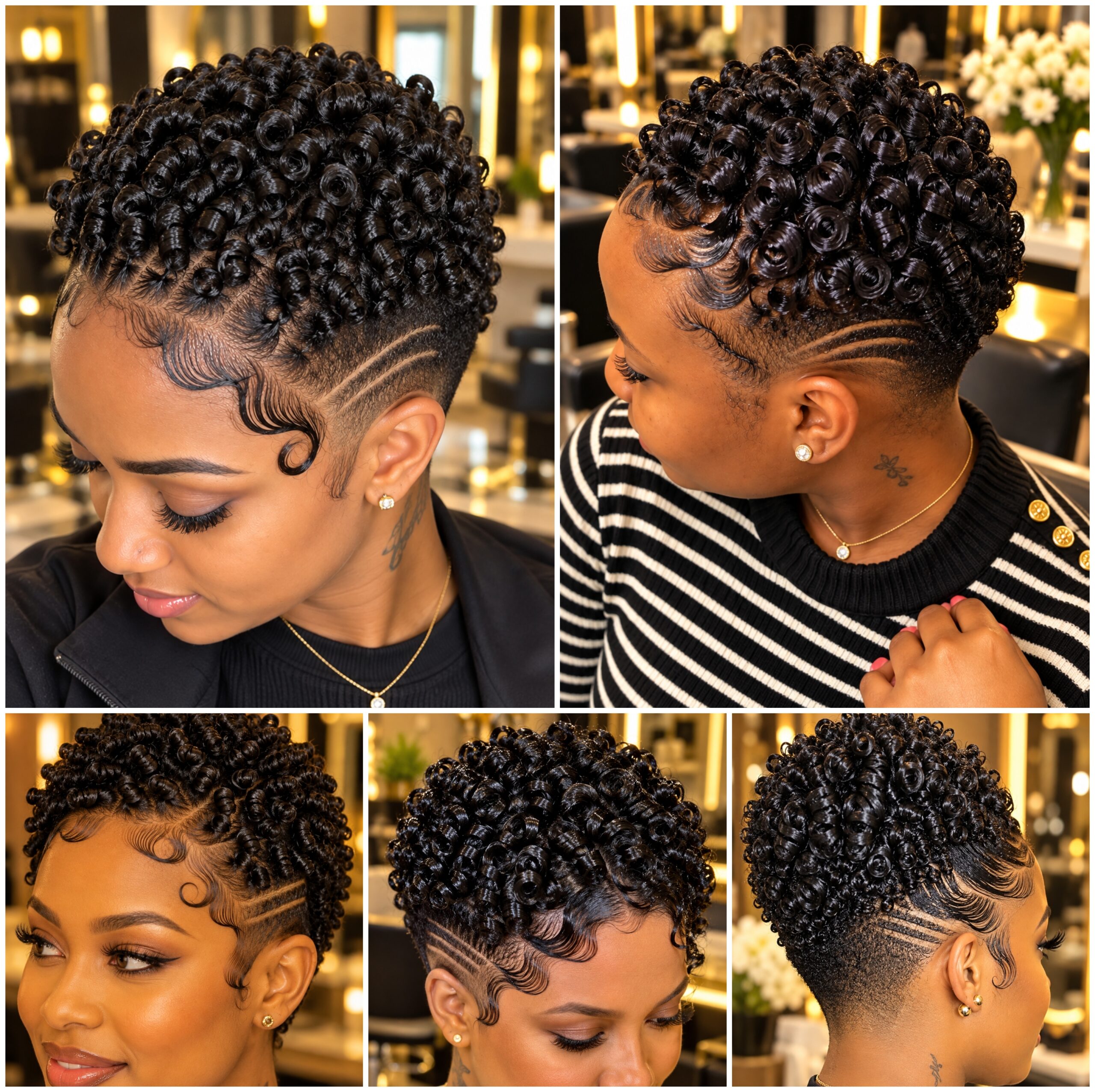
Spiral coil pixies with low fade sides offer a distinctive combination of rounded curls and closely tapered hair. Their appeal comes from the difference in height, density, and movement between the upper coils and the lower sides. Instead of relying on long hair to create volume, these hairstyles concentrate their visual impact around the crown while keeping the temple and nape areas closely fitted.
For women who appreciate compact hairstyles with noticeable curl detail, this combination provides several possibilities. The coils can be arranged into small spring-like spirals, slightly larger circular curls, or carefully positioned finger coils. The sides can remain naturally tapered, incorporate a subtle low fade, or include precision barber detailing when requested.
Although similar hairstyles can be created directly on natural hair, lace wigs offer another route for customers who want a prepared look without cutting their own hair. The choice between a salon haircut and a wig depends on the desired curl formation, maintenance routine, installation preferences, and budget.


Understanding the Balance Between Spiral Coils and a Low Fade
The essential characteristic is the difference between the elevated upper curls and the closely cropped lower sections. The crown carries most of the visible hair, while the fade gradually reduces hair length around the sides and back.
A well-proportioned low fade generally remains concentrated near the lower perimeter rather than extending excessively high into the crown. This helps preserve the rounded upper silhouette.
The spiral coils may vary in size, but their arrangement should complement the shape of the head. Extremely large curls can overwhelm a compact pixie, while very small coils may produce a denser appearance than intended.
For a balanced result, the stylist should consider the relationship between curl diameter, crown height, side density, and the natural contour of the head.
Small Spirals Versus Larger Circular Coils
Small spirals produce a closely packed crown with numerous individual curls. This arrangement can create a rounded appearance with relatively consistent volume.
Larger circular coils introduce more visible openings between the curls. They may produce a more sculptural effect, particularly when the loops are arranged individually.
Neither option is automatically better. The appropriate choice depends on the desired silhouette and the amount of styling attention the wearer prefers.
When requesting a custom wig, provide photographs showing the preferred curl diameter and crown height. Descriptions such as curly pixie alone may not communicate the intended arrangement accurately.
Low Fade Placement and Head Proportions
A low fade begins near the lower sides and nape, gradually transitioning into longer hair above. The precise height should be adapted to the hairstyle rather than treated as a fixed measurement for every person.
On a spiral coil pixie, the fade should support the upper curls without creating an abrupt or unnatural division.
The temple area deserves particular attention. If the fade extends too high, it may reduce the hair available to connect the crown with the side. If it remains too low, the hairstyle may appear heavier around the temples.
A professional barber can assess these proportions when working with natural hair. For wigs, the construction and available hair coverage must also be considered.
Why Wig Fades Require Specialist Knowledge
Creating a fade on a wig differs from cutting natural hair. The strands are attached to a cap, lace, or another supporting material, and removing too much hair can expose the underlying construction.
A wig maker may need to plan the side density during production rather than relying entirely on cutting afterward.
Customers should ask whether the tapered sides are manufactured into the unit or require final barber styling.
Any irreversible cutting should be performed only after the professional has evaluated the cap and hair placement.
Choosing a Coil Arrangement for the Crown
Several coil arrangements can work with a low fade, depending on the desired appearance.
A rounded spiral crown distributes curls relatively evenly across the top. This creates a balanced silhouette and allows the fade to remain visually secondary.
A forward-oriented coil arrangement places more emphasis near the front hairline. The curls may sit closer to the forehead, producing a different profile.
A backward-directed arrangement lifts the strands away from the face before they curl toward the crown. This can create a more pronounced sense of direction.
For custom wig orders, the selected arrangement should be communicated clearly. Changing the curl direction can alter the hairstyle even when the length and color remain similar.
Natural Black, Chocolate Brown, and Copper Color Options
Spiral coil pixies with low fade sides can be created in several colors. Natural black remains a versatile choice because it emphasizes the curl shape and the transition into the fade.
Espresso and chocolate brown provide subtle warmth while retaining a relatively dark appearance.
Copper, auburn, and caramel shades can make individual curls more noticeable, especially where light catches their curved surfaces.
Two-tone designs may use darker roots beneath a brighter crown. However, the color placement should be planned carefully to avoid an unintended division between the curls and the fade.
For wigs, buyers should confirm whether the color is manufactured into the fiber or applied through processing. The photograph of a product alone cannot establish the material or coloring method.
Finding the Right Salon or Wig Specialist
For natural hair, search for a barber or natural-hair stylist experienced in tapered cuts, spiral coils, and low fades.
For wig construction, look for professionals specializing in pixie lace wigs, custom cap sizing, and sculpted curl arrangements.
Some salons offer both services, but experience with natural hair does not automatically establish expertise in cutting or modifying lace wigs.
Before booking, ask to see examples of previous work involving compact spiral crowns and closely tapered sides.
Preparing for a Salon Consultation
Bring reference photographs showing the front, sides, crown, and back of the desired hairstyle.
Explain the preferred curl size, crown height, fade position, and whether decorative side lines are wanted.
For a wig appointment, confirm whether the unit will arrive fully styled or require additional work.
Discuss the expected appointment length, services included, and any separate charges for lace fitting or customization.
Buying a Ready-Made Spiral Coil Pixie Wig
Ready-made pixie wigs can be convenient for buyers who want a prepared hairstyle without commissioning a completely custom unit.
However, not every curly pixie wig includes a genuine low-fade appearance. Some products have uniformly dense sides or curls that extend much farther downward.
Examine product photographs carefully, particularly the temple and nape areas.
Ask the seller for a side profile and rear photograph rather than relying exclusively on a front-facing model image.
Confirm the hair material, cap dimensions, lace specifications, and intended installation method.
If the seller advertises adhesive-free wear, request information about the security components and fitting requirements.
Custom Wig Orders for More Precise Proportions
A custom order may be preferable when the buyer wants a particular coil diameter, crown height, fade placement, or color combination.
Provide head measurements according to the wig maker’s instructions. Accurate sizing is important because the side taper must sit correctly around the temples and nape.
Ask whether the maker can reproduce the selected curl arrangement and whether the wig will retain its shape after washing.
Request photographs of the completed unit before shipment, including the underside and all visible hairstyle angles.
Clarify the revision policy, production timeline, shipping charges, and any limitations on customization.
Estimated Pricing for Spiral Coil Pixie Wigs With Low Fade Sides
The following USD amounts are illustrative planning ranges rather than verified current product prices. Actual costs depend on the material, supplier, cap construction, curl styling, and fade customization.
| Wig Category | Illustrative USD Range | Potential Purchase Considerations |
|---|---|---|
| Premium Custom | $290–$690+ | Individual cap sizing, carefully arranged spiral coils, specialist low-fade construction, and personalized hairline work. |
| Standard Custom | $155–$350 | Selected cap options with custom crown curls and coordinated tapered sides. |
| Basic Human Hair | $95–$250 | A human-hair starting unit that may require additional cutting, coil setting, and fade styling. |
| Premium Synthetic | $65–$175 | A manufactured curly pixie with preformed spirals and a closely fitted side, depending on available designs. |
| Basic Synthetic | $25–$85 | A lower-cost curly pixie alternative that may not reproduce the desired coil arrangement or fade accurately. |
The cost of a custom wig may increase when individual curls require careful positioning or the side density must be adjusted during construction.
Additional services such as lace trimming, cap fitting, coloring, shipping, and salon installation may be charged separately.
Ask for an itemized quotation to compare complete costs rather than relying only on the advertised base price.
Installing a Pixie Lace Wig With Tapered Sides
Installation should begin with checking the cap size and hairline position.
The low-fade sections must align with the wearer’s temples and nape. Incorrect placement can make the sides appear uneven or shift the crown away from its intended position.
If the wig includes excess lace, the stylist should establish the correct fit before trimming.
The appropriate fastening method depends on the cap construction and manufacturer instructions.
Visible straps or combs do not automatically establish that a wig is suitable for adhesive-free installation.
After fitting, the stylist should inspect the coils for compression or displacement and determine whether any safe adjustments are necessary.
Maintaining Spiral Coils Without Losing Their Shape
Spiral coils require care because repeated brushing can separate the curls and alter their arrangement.
For wigs, the correct maintenance method depends on whether the fibers are human hair or synthetic.
Human-hair units may be suitable for professional resetting with appropriate products and techniques, taking any prior coloring or chemical processing into account.
Synthetic units may have specific restrictions on heat, washing, and styling products. Manufacturer guidance should be followed before attempting changes.
Avoid excessive product buildup between the coils, as this may reduce their visible separation.
Keeping the Low Fade Looking Consistent
The tapered sides should remain relatively close to the cap or scalp, depending on whether the hairstyle is a wig or natural hair.
For natural hair, periodic barber appointments may be needed as the hair grows.
For wigs, the hair does not grow, but handling and restyling can change how the shorter strands lie.
Do not attempt additional cutting without considering the wig’s underlying construction.
Store the unit on an appropriately sized stand that supports the crown without compressing the coils.
Choosing a Spiral Coil Pixie That Fits Your Routine
The most suitable design is not necessarily the one with the largest curls or the closest fade. It is the hairstyle whose proportions, maintenance requirements, and installation method fit the wearer’s preferences.
For a more understated appearance, natural black coils with a subtle low fade may be appropriate.
For a more expressive style, copper or caramel curls can introduce additional color contrast while retaining the compact silhouette.
Customers who want a very specific crown arrangement may benefit from custom construction, while those comfortable with a similar general shape may prefer ready-made options.
Before purchasing, verify the hair material, cap size, lace specifications, fastening method, and whether the advertised hairstyle includes the desired fade.
With accurate reference photographs and clear communication, spiral coil pixies with low fade sides can be recreated through professional natural-hair styling or carefully planned wig construction. The most important considerations remain curl shape, crown proportions, side placement, and the quality of the finished fit.
Search Terms
Spiral coil pixie wig with low fade sides · Natural black tapered spiral crown · Circular finger coil pixie lace wig · Low temple fade curly pixie hairstyle · Compact spring coil crown wig · Chocolate brown tapered coil pixie · Copper spiral curls with faded sides · Sculpted pixie lace wig with low nape taper