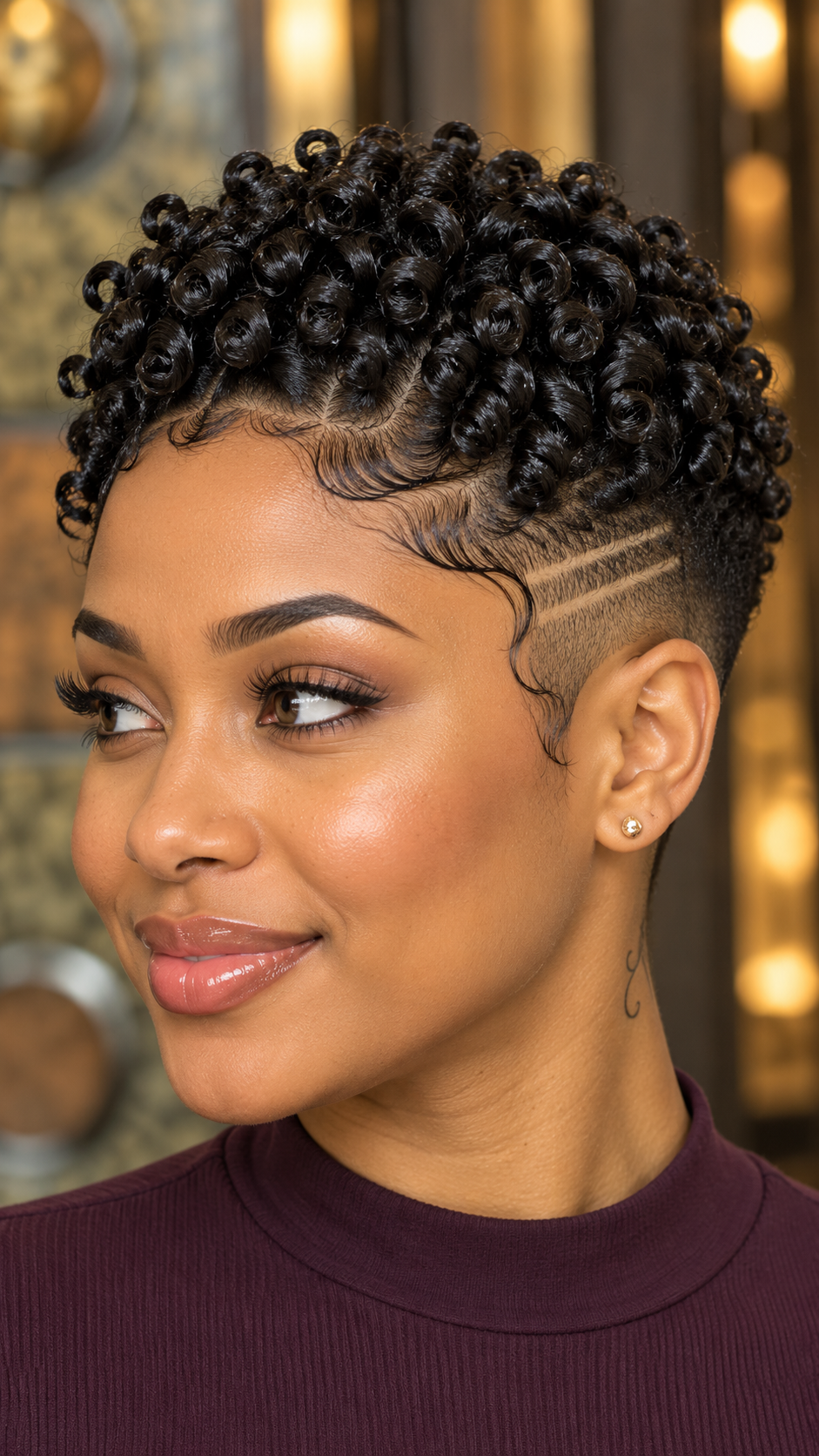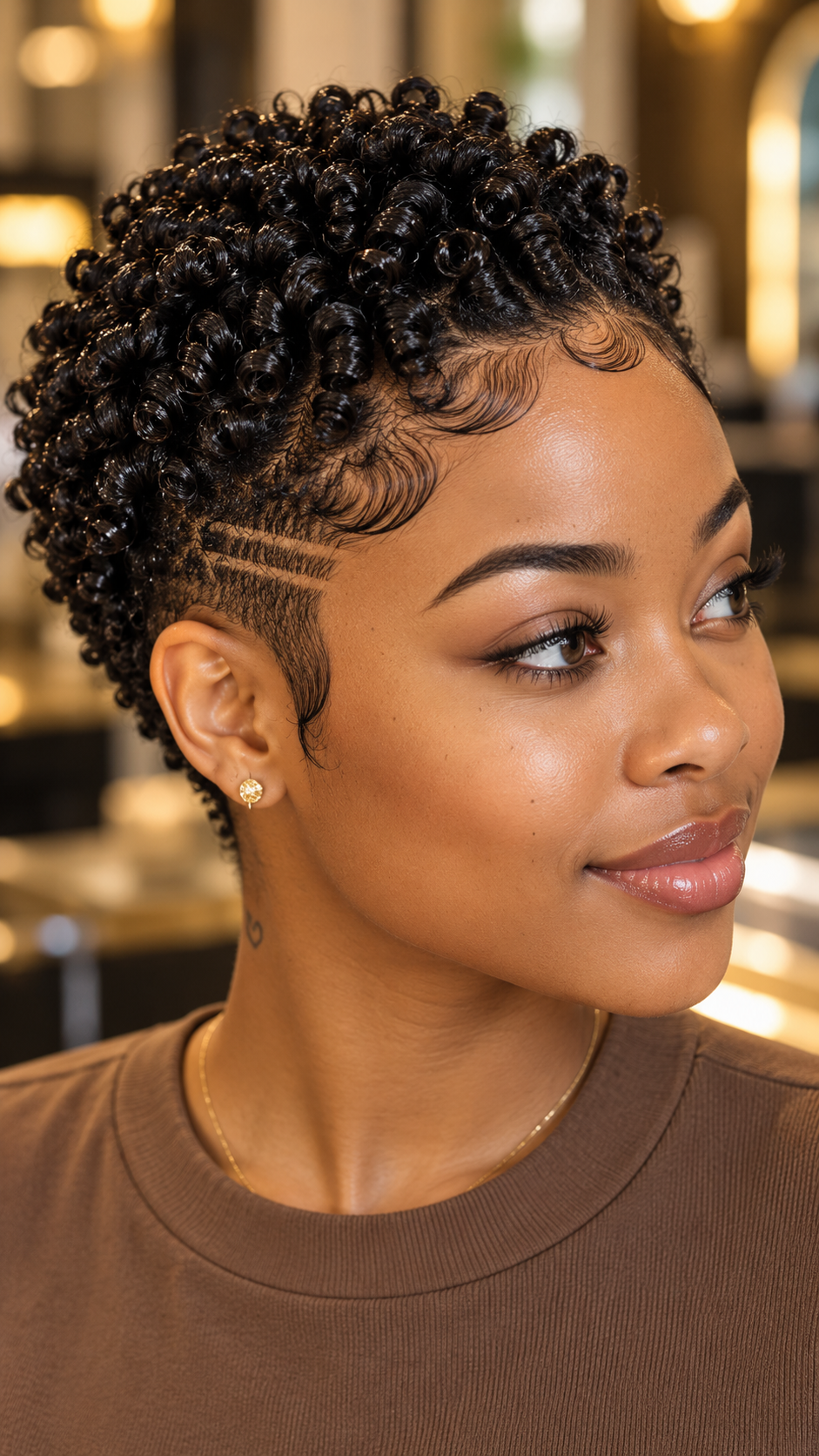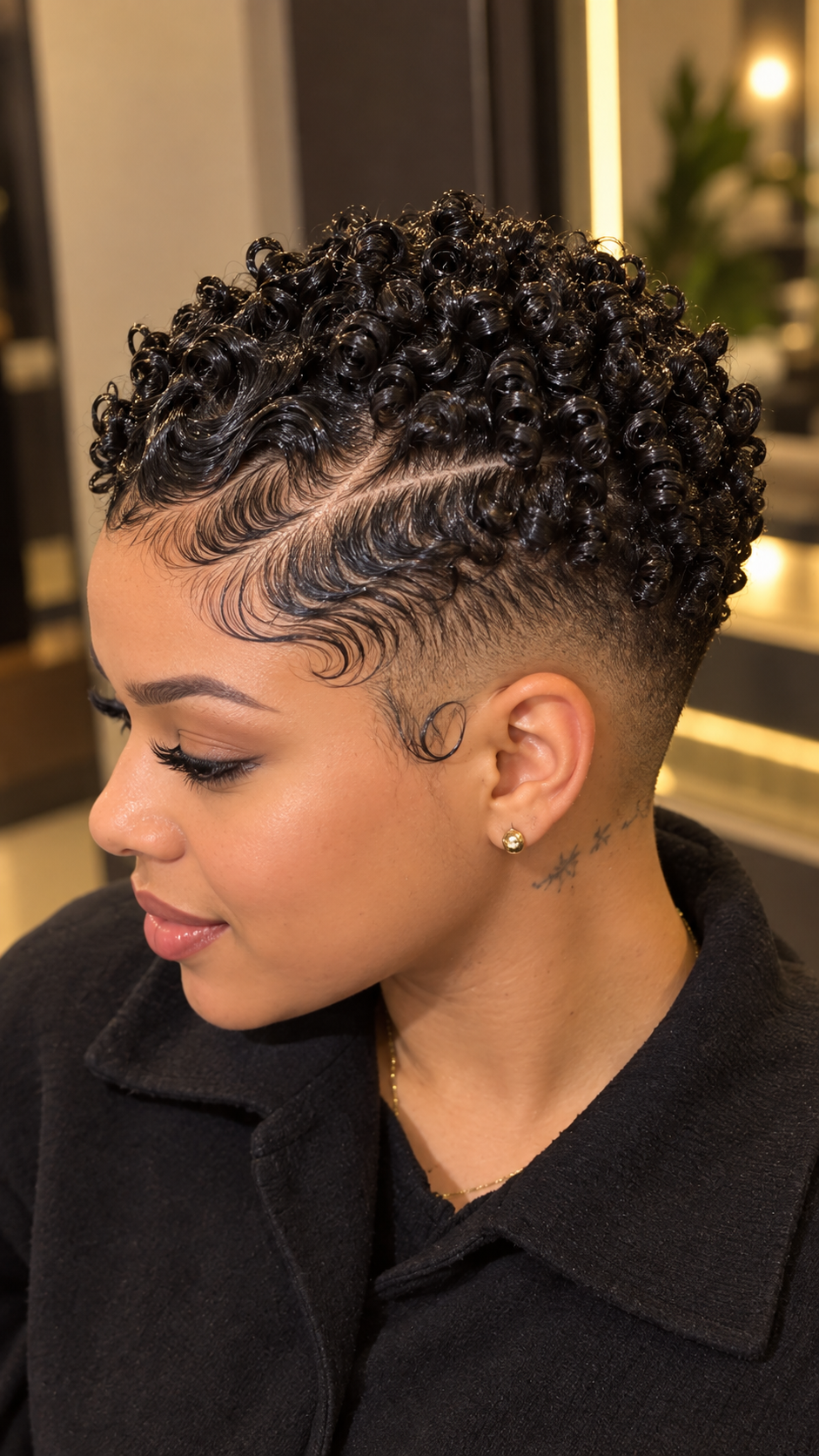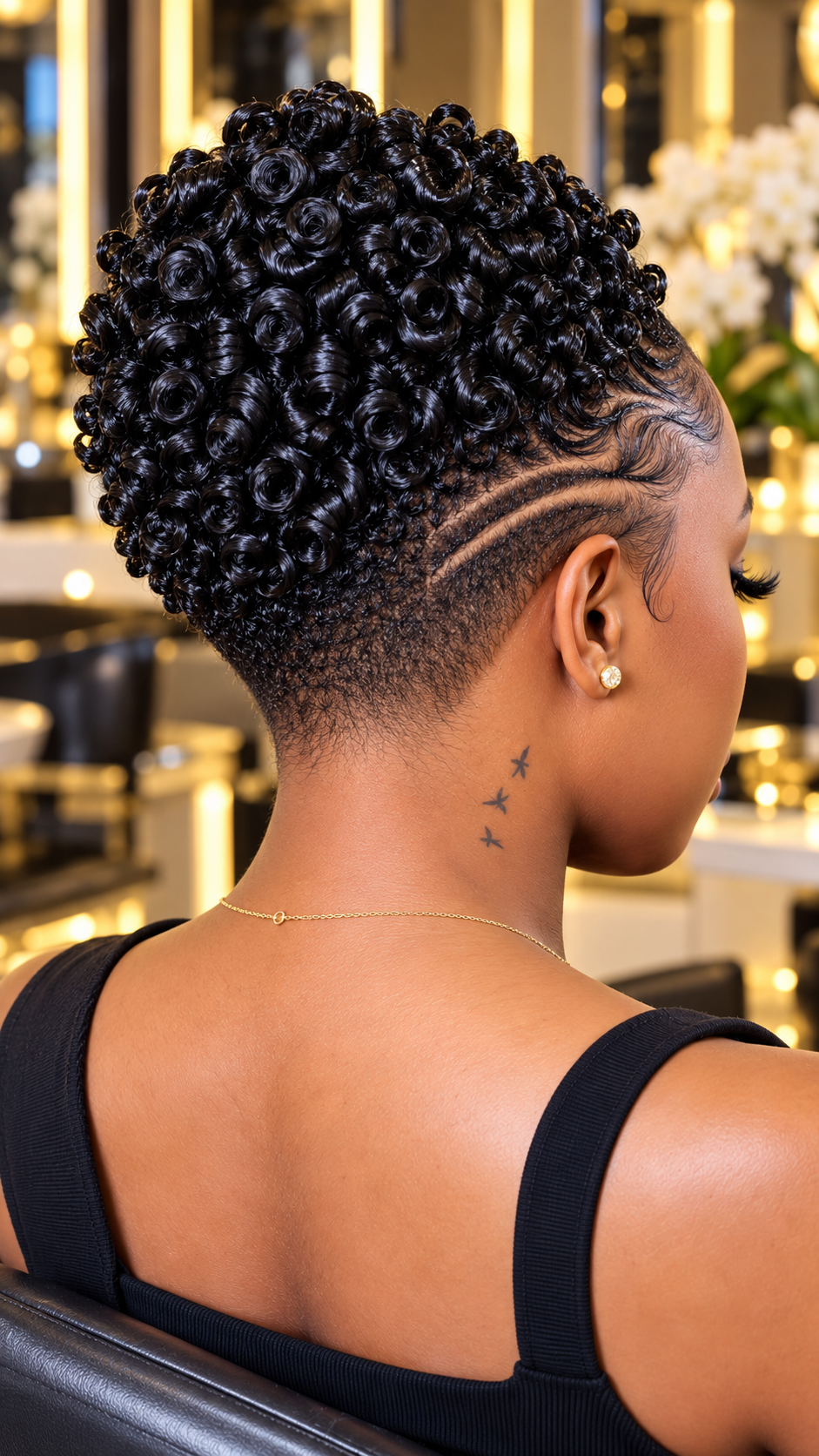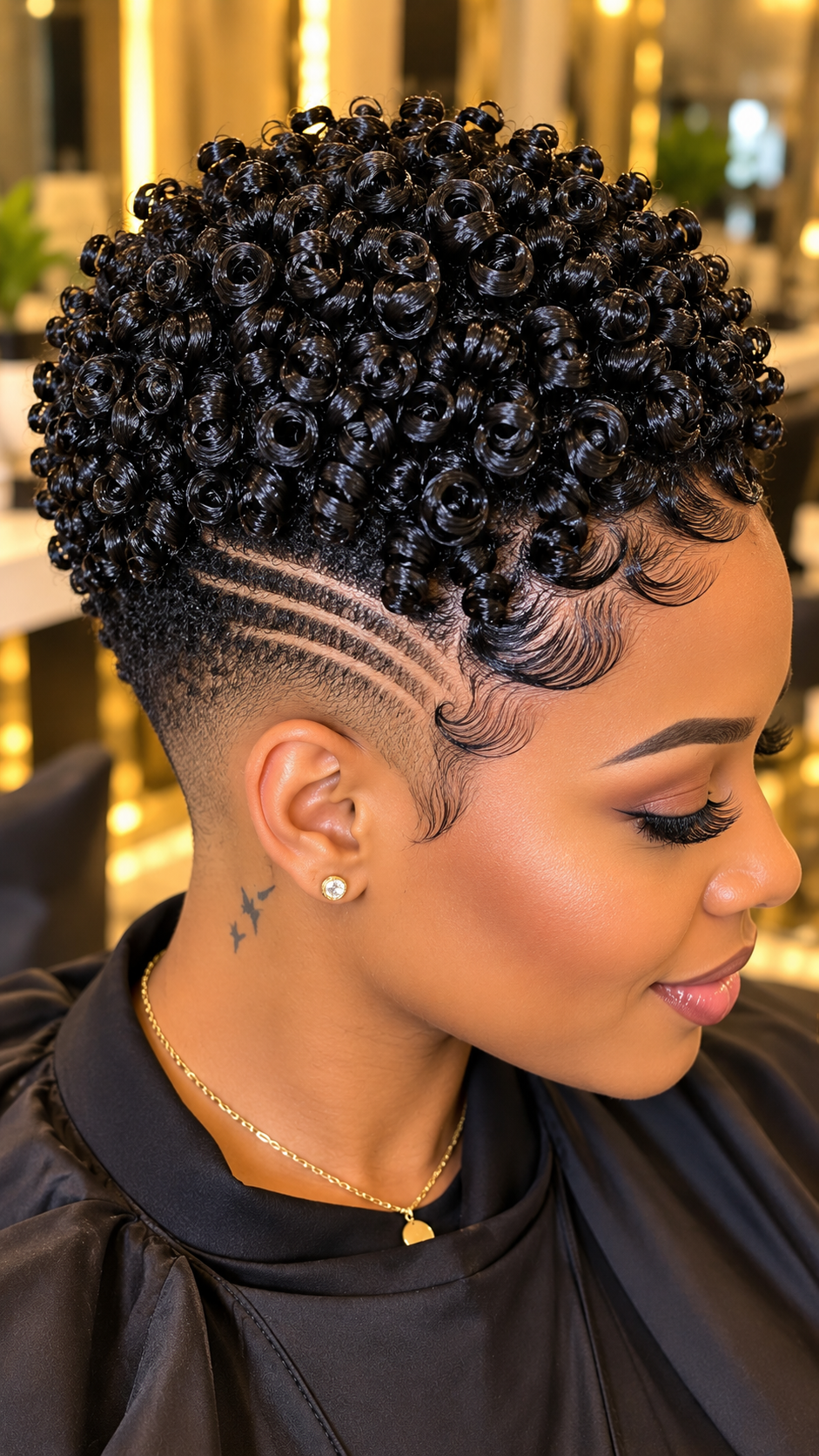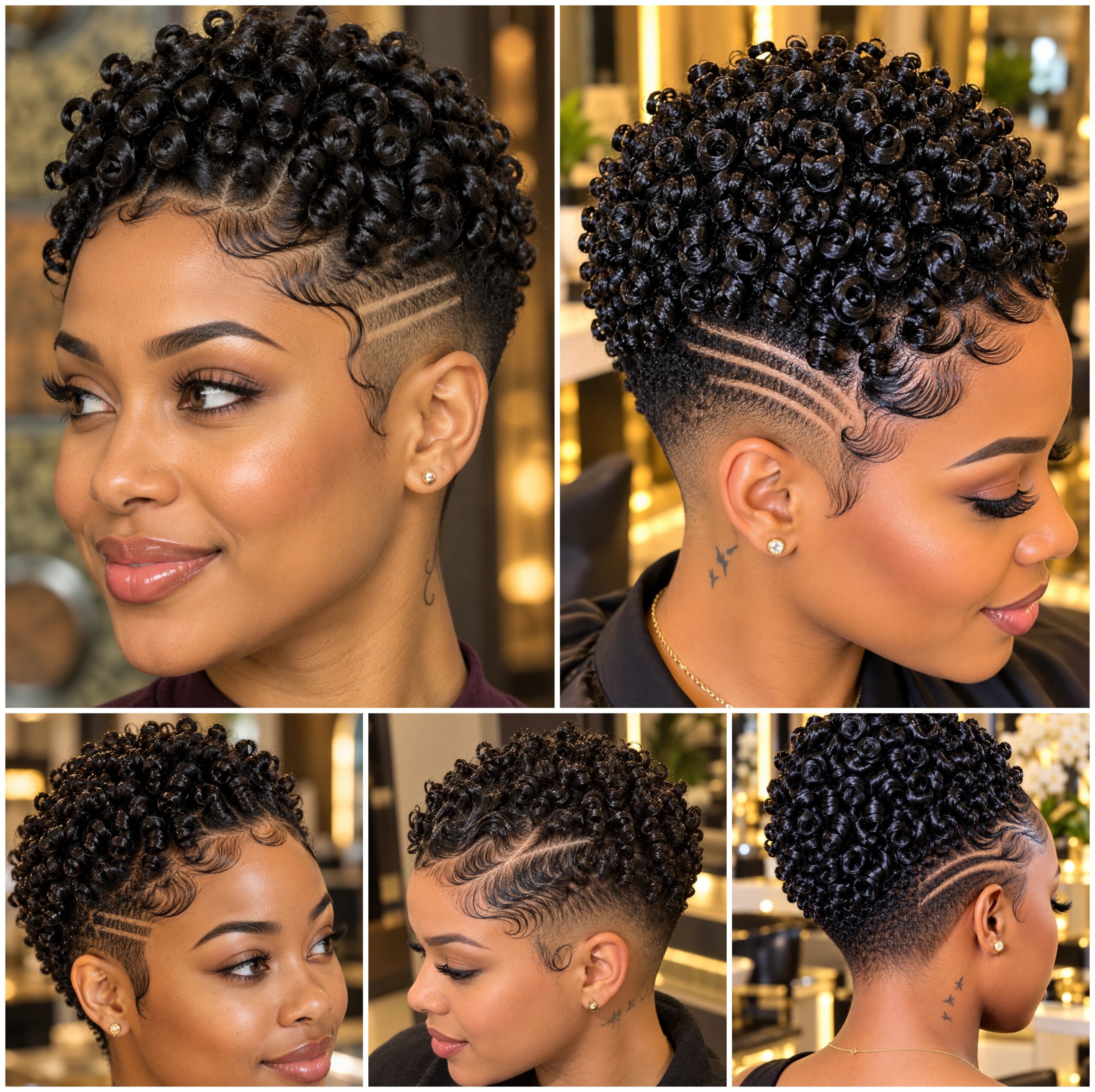
A beautifully arranged finger-coil hairstyle can transform a compact haircut into an expressive look without relying on elaborate color treatments or excessive length. Glossy finger coils paired with tapered temple sides offer a distinctive combination of rounded curl formation, controlled volume, and closely graduated hair around the sides of the head. The appeal lies in the contrast between the spring-like coils above and the shorter hair surrounding the temples.
This hairstyle is particularly relevant for women who appreciate natural-looking curls, sculpted pixie cuts, and manageable everyday styling. It can be created using suitable natural hair or reproduced in a carefully constructed wig, depending on the desired result, available hair length, and preferred maintenance routine.
Unlike decorative wigs built around large circular ribbon loops, finger coils are generally formed by winding small sections of hair around a finger or suitable styling tool. Their characteristic spiral formation allows the curls to remain individually recognizable while contributing to a rounded overall silhouette.


For anyone considering this hairstyle, the most important decisions involve coil diameter, crown density, temple graduation, hair material, and the amount of ongoing styling required. Understanding these elements makes it easier to communicate with a hairstylist, select an appropriate wig, and establish realistic expectations for daily wear.
The Appeal of a Crown Built From Individual Finger Coils
Finger coils create a distinctive appearance because each curl follows a recognizable spiral direction. Rather than forming a mass of loosely arranged curls, the hairstyle can display numerous small, spring-like sections that remain visible across the upper head.
A typical interpretation uses a rounded crown with enough length to form individual coils. The exact diameter depends on the natural curl pattern, strand length, section size, and styling technique.
Smaller sections generally produce finer coils, while larger sections can create broader spirals. Neither approach is automatically better. The ideal choice depends on the wearer’s head proportions, preferred volume, and the visual balance between the crown and tapered sides.
The word glossy describes the intended reflective appearance of the curls. It does not necessarily mean that the hair must be coated in heavy oils or styling products. Healthy-looking shine can also depend on strand condition, product compatibility, and lighting.
Finding the Right Coil Diameter
Coil diameter is one of the most important specifications when requesting this hairstyle. Very small coils can create a dense, intricate surface, while larger spirals may produce a softer, more open appearance.
For a compact pixie interpretation, a stylist might work with relatively small sections and maintain a rounded crown. However, the precise dimensions should be selected according to the available hair and the client’s preferences.
Customers should bring reference photographs showing the preferred coil size from the front, side, and above.
When ordering a wig, ask whether the proposed curls are genuine finger-coil-style spirals or a different manufactured curl pattern. Similar product descriptions do not always indicate identical styling.
Tapered Temple Sides Create the Essential Contrast
The tapered temple area is responsible for much of the hairstyle’s overall proportion. Hair gradually becomes shorter around the sides, creating a transition from the fuller crown into a more compact temple section.
A taper does not necessarily mean that the sides must be shaved to bare skin. Depending on the desired interpretation, the stylist can retain visible hair while gradually reducing its length.
This distinction matters for women who prefer a softer appearance or want to maintain enough side hair for future styling changes.
The transition should complement the shape of the crown. If the sides remain excessively full, the hairstyle may lose its characteristic contrast. If the taper is too aggressive, the upper coils may appear disproportionately elevated.
Choosing a Temple Graduation That Suits the Head
Temple graduation should be adapted to the individual rather than copied mechanically from another person’s haircut.
A professional barber or natural-hair stylist can assess the hairline, growth direction, density, and head shape before recommending a suitable taper.
For clients with delicate edges or areas of reduced density, the stylist should avoid unnecessary tension and aggressive cutting.
When commissioning a wig, the taper may be recreated through controlled hair lengths, selective density, or specialized construction methods. A wig maker should explain how the intended side appearance will be achieved.
Decorative shaved lines are optional and are not an inherent part of this hairstyle. They should only be added when specifically requested.
Natural Black, Espresso Brown, and Other Color Possibilities
Finger coils can be particularly striking in natural black or deep espresso brown because the darker strands emphasize the spiral formation through highlights and shadows.
However, the hairstyle is not limited to dark colors. Chocolate brown, warm mocha, copper, auburn, and carefully placed blonde accents can also be considered.
The choice of color should support the curl arrangement rather than obscure it. A single-color hairstyle places greater emphasis on the shape of the coils, while highlights can make individual spirals more noticeable.
Customers interested in coloring their natural hair should discuss its condition and processing history with a qualified stylist before applying chemical treatments.
For wigs, the fiber composition must be confirmed before any coloring is attempted. Conventional hair dyes may be unsuitable for synthetic materials, and previously processed human hair may require additional care.
Creating Finger Coils on Natural Hair
A successful finger-coil appointment begins with an assessment of the hair’s condition, length, and natural curl behavior.
The stylist can then cleanse and condition the hair using products appropriate for its needs. Hair is generally sectioned before the coils are formed, allowing the stylist to control their size and distribution.
Each section is guided into a spiral using the fingers and a compatible styling product. The exact technique varies according to hair type and the intended result.
The coils should be allowed to set using a drying method appropriate for the hair and products involved. Excessive manipulation before the curls have set may cause them to separate or lose their shape.
Why Product Selection Matters
Finger coils often benefit from styling products that provide suitable hold without leaving excessive residue.
A product that is too heavy may weigh down the curls, while insufficient hold may allow the spiral arrangement to loosen prematurely.
The ideal formula depends on hair porosity, strand thickness, scalp sensitivity, and environmental conditions.
Clients should discuss these considerations with their stylist rather than assuming that one product will work equally well for everyone.
The finished hairstyle should feel comfortable and should not require painful tension around the hairline.
Reproducing the Hairstyle as a Pixie Wig
A finger-coil pixie wig offers an alternative for customers who want the appearance without cutting or styling their natural hair into the same shape.
However, a wig with generic curly fibers will not necessarily reproduce the appearance of individually arranged finger coils.
The customer should look for a unit with a proportionate crown, recognizable spiral formations, and sides that gradually reduce in length or density.
Some ready-made wigs may already provide a suitable interpretation. Others may require customization by an experienced wig stylist.
The desired crown height and side graduation should be discussed before ordering because extensive alterations may not be possible with every cap construction.
What to Confirm About Wig Materials
Finger-coil-style wigs may be offered in human hair, synthetic fiber, or blended materials.
The appearance alone cannot reliably establish the composition of a wig. Buyers should request written product specifications from the seller.
Human-hair options may offer certain restyling possibilities, depending on their processing history and condition. Synthetic alternatives may retain factory-created curl patterns but can have material-specific limitations.
Neither category guarantees a particular lifespan, curl retention, or heat tolerance without additional product information.
Customers should compare the actual construction, maintenance requirements, and seller policies rather than relying solely on marketing descriptions.
Choosing Between Lace Front and Other Cap Designs
A lace-front wig may be useful for customers who want a customizable frontal hairline. However, lace is not mandatory for every finger-coil hairstyle.
Depending on the intended appearance, buyers may consider a lace-front unit, a conventional wig cap, or another construction recommended by a specialist.
The most suitable option depends on the desired hairline, wearing frequency, comfort requirements, and budget.
If purchasing a lace wig, ask the seller to confirm the lace dimensions, color, and construction specifications.
Fine-looking lace should not automatically be described as HD lace. That classification requires reliable product information.
Likewise, a lace front does not automatically mean the wig can be worn without adhesive.
Where to Find a Stylist for Finger Coils and Temple Tapers
Customers seeking this hairstyle on natural hair should consider salons experienced in coily and tightly curled hair, particularly those offering finger coils, tapered pixie cuts, and precision temple shaping.
A barber experienced with women’s tapered hairstyles may also be helpful when the design requires careful graduation around the sides.
For wig versions, look for a custom wig maker or lace wig stylist who can demonstrate previous work involving compact spiral crowns and graduated side sections.
Before booking, examine photographs of completed hairstyles from multiple angles.
Pay particular attention to the relationship between the crown volume and the temple area. A stylist who consistently creates very high crowns may not be the best match for someone seeking a compact silhouette.
Preparing for a Salon Consultation
A useful consultation should establish the preferred coil diameter, crown length, temple graduation, hairline treatment, and maintenance expectations.
Customers should also discuss whether they want the hairstyle to remain predominantly natural-looking or have a more sculpted appearance.
For natural hair, ask the stylist how the coils may change after washing, sleeping, and exposure to humidity.
For a wig, confirm the cap measurements, attachment options, and whether the unit will arrive fully styled.
Booking a consultation before a major cut or custom purchase can reduce the risk of misunderstandings.
Buying a Ready-Made Finger-Coil Wig Online
Online wig listings often use broad descriptions such as curly pixie, coily wig, or tapered curly hair. These terms can lead to products with substantially different curl patterns.
Buyers should examine actual photographs of the item rather than relying exclusively on a product title.
Look for individually recognizable spirals, a rounded crown, and a gradual reduction in volume around the temples.
Request a video showing the wig from the front, both sides, and rear. This can help establish whether the taper continues around the head or appears only in promotional photographs.
Ask the seller to confirm the material, cap size, available colors, return policy, and whether the displayed styling matches the product being shipped.
Do not assume that a particular supplier, stock level, or product specification is verified unless that information has been confirmed directly.
Illustrative Prices for Finger-Coil Pixie Wigs
The price of a finger-coil wig can depend on the material, cap construction, curl preparation, and amount of customization required to achieve the tapered temple appearance.
More elaborate custom work may involve individual curl shaping, crown-density adjustments, and specialist side styling.
The following USD amounts are illustrative planning ranges rather than verified current retail prices or confirmed supplier quotations.
| Wig Category | Illustrative USD Range | Typical Budget Considerations |
|---|---|---|
| Premium Custom | $270–$620+ | Personalized cap construction, individually arranged finger-coil styling, crown shaping, and specialist temple graduation. |
| Standard Custom | $145–$315 | Customized spiral crown and tapered sides with selected adjustments to fit and styling. |
| Basic Human Hair | $85–$210 | A potential human-hair starting point that may require additional coil setting and temple shaping. |
| Premium Synthetic | $55–$145 | A possible pre-styled alternative with compact coils and a graduated pixie silhouette. |
| Basic Synthetic | $20–$70 | Lower-cost curly pixie options that may provide a general resemblance without individualized coil styling. |
These ranges are intended for preliminary budgeting. Actual prices can vary by region, maker, material, and included services.
Customers should establish whether a quotation includes the completed styling, cap adjustments, lace preparation where applicable, and any additional fitting work.
Professional installation, shipping, and later restyling may be charged separately.
A higher-priced unit is not automatically better. The most useful comparison is whether the wig provides the desired coil structure, appropriate side graduation, and a comfortable fit.
How to Keep Finger Coils Looking Fresh
Finger coils can lose their original arrangement when repeatedly pulled apart, brushed, or compressed. Maintenance should therefore focus on preserving the spiral formations while keeping the hair and scalp comfortable.
For natural hair, the appropriate routine depends on hair type, product selection, and the condition of the scalp.
Some wearers may benefit from carefully refreshing individual coils rather than restyling the entire head. However, the technique should be appropriate for the hair and the products already applied.
For wigs, the care routine must follow the confirmed fiber specifications. Synthetic curls may not respond to water, heat, or styling products in the same way as human hair.
Before using heated tools, verify the manufacturer’s temperature guidance.
Protecting the Tapered Temple Area
The shorter hair around the temples may require periodic attention to maintain its intended graduation.
For natural hair, the interval between barber appointments depends on growth rate and the preferred appearance.
For wigs, cutting or thinning the temple should be approached cautiously because removed hair cannot simply grow back.
Customers should avoid attempting major side corrections without understanding the cap construction and hair placement.
If the wig begins losing its original shape, a professional stylist may be able to recommend suitable adjustments.
Adapting the Hairstyle for Everyday Wear and Special Occasions
The combination of compact finger coils and tapered temples can work across a variety of personal styles.
A restrained crown with smaller coils may suit someone seeking an understated everyday appearance. Slightly broader spirals and a fuller upper section can create a more expressive silhouette for formal events or photography.
The hairstyle can also be paired with subtle color changes, provided the wearer wants them and the hair material permits the intended treatment.
For women who prefer minimal daily styling, a professionally prepared wig may offer convenience, although the actual maintenance requirements depend on its construction and curl retention.
Natural-hair versions may provide greater flexibility for gradual changes in length and taper shape as the hair grows.
Making the Final Decision Based on Coil Quality and Proportion
The strongest interpretation of this hairstyle combines individually recognizable finger coils with carefully graduated temple sides. The upper curls should create a cohesive rounded silhouette, while the shorter side hair provides contrast without overwhelming the overall appearance.
Customers should prioritize coil formation, appropriate crown density, comfortable fitting, and realistic maintenance expectations.
For natural hair, choose a stylist who understands coily hair and tapered cutting techniques. For a wig, look for a maker who can demonstrate suitable spiral styling and proportional side construction.
Before committing to a purchase or appointment, confirm the intended curl diameter, temple graduation, material requirements, and any additional services.
A well-executed finger-coil pixie does not need elaborate decorative lines or dramatic coloring to stand out. Its character comes from the precision of the spirals, the relationship between the crown and temples, and the way the hairstyle complements the wearer’s preferred silhouette.
Search Terms
Glossy finger coil pixie hairstyle · Tapered temple sides natural hair · Black spiral finger coils for women · Finger coil crown tapered haircut · Coily pixie wig with graduated sides · Rounded finger coil hairstyle · Natural black finger coil lace wig · Sculpted spiral curls with temple taper