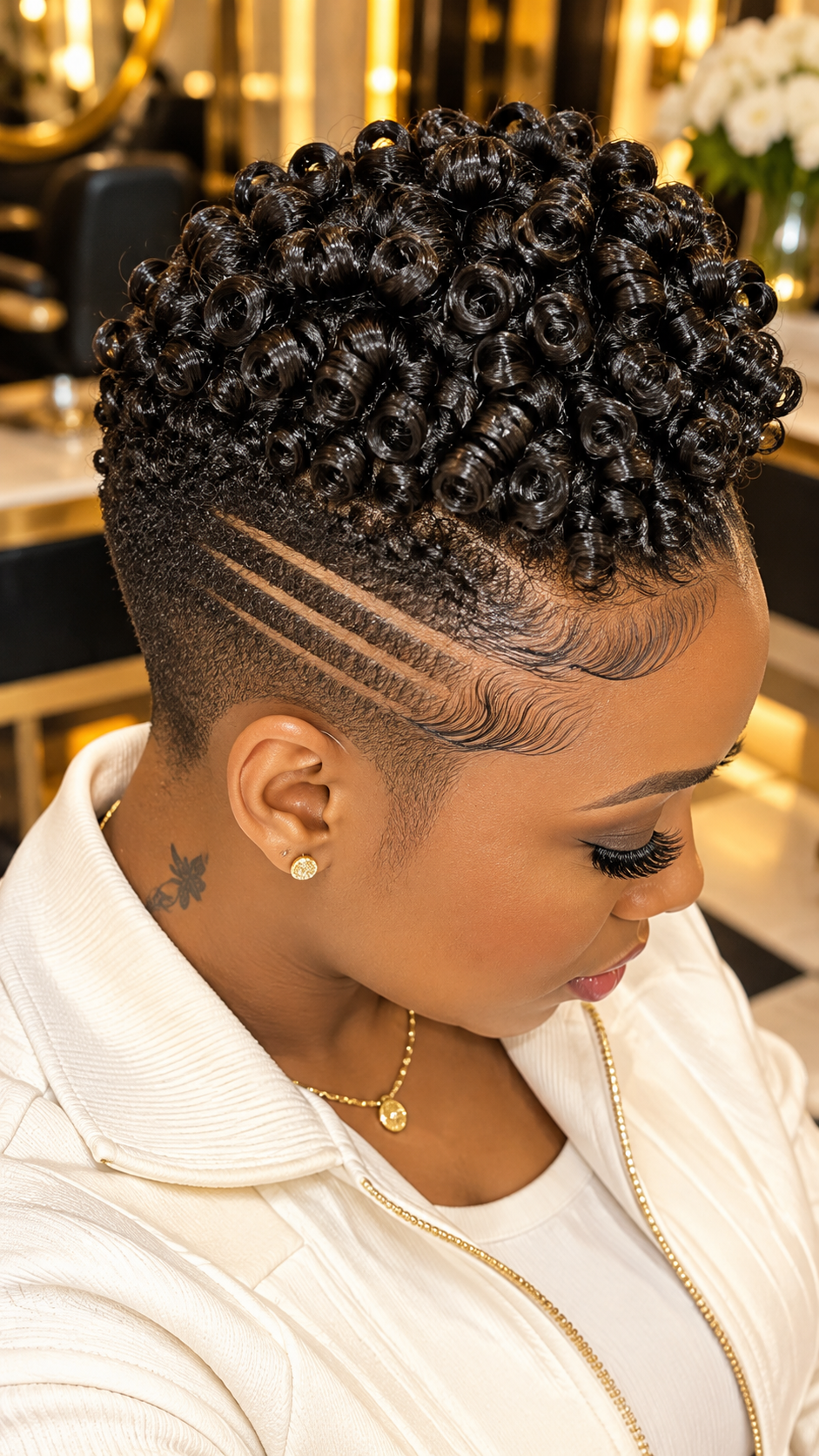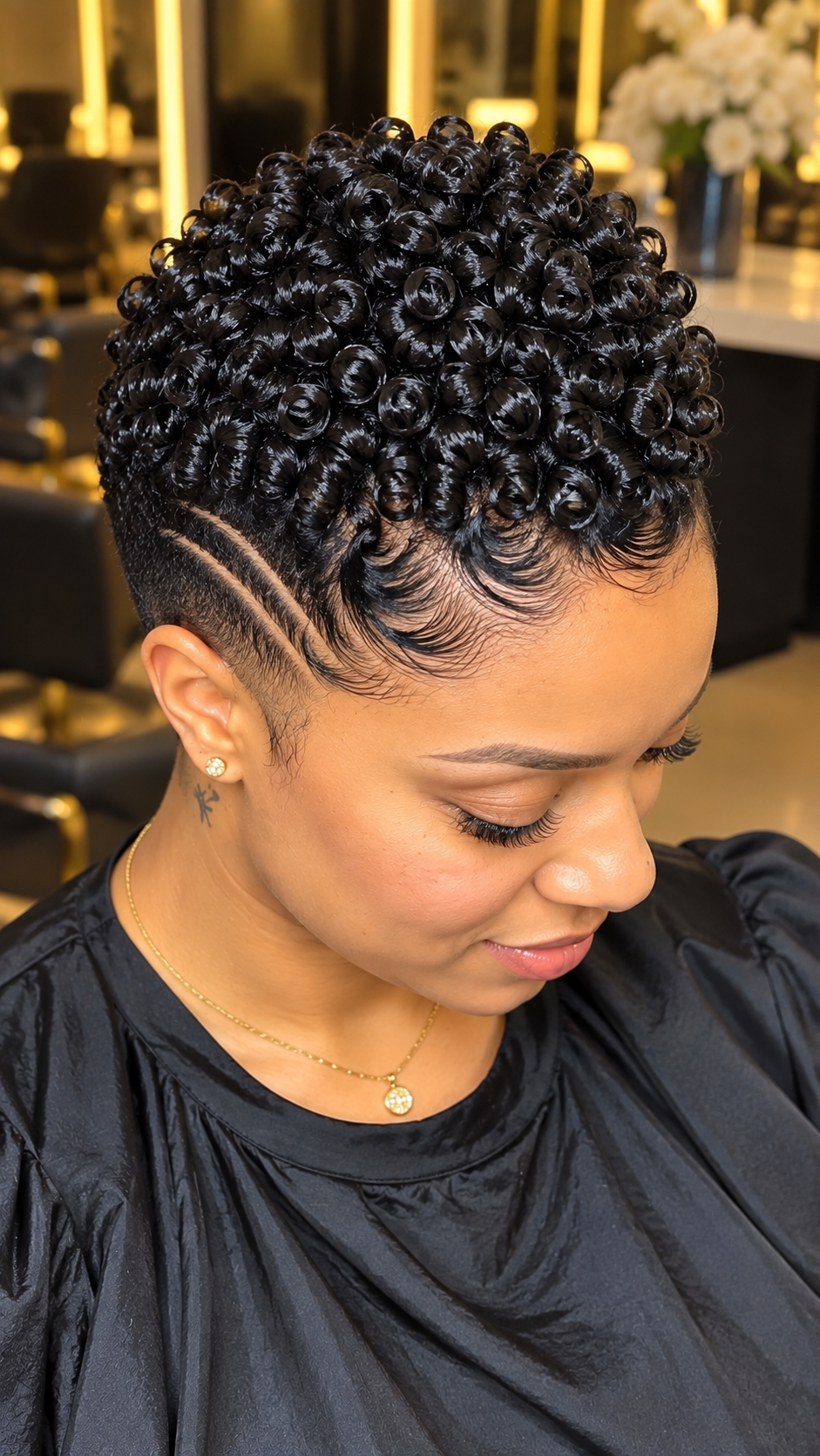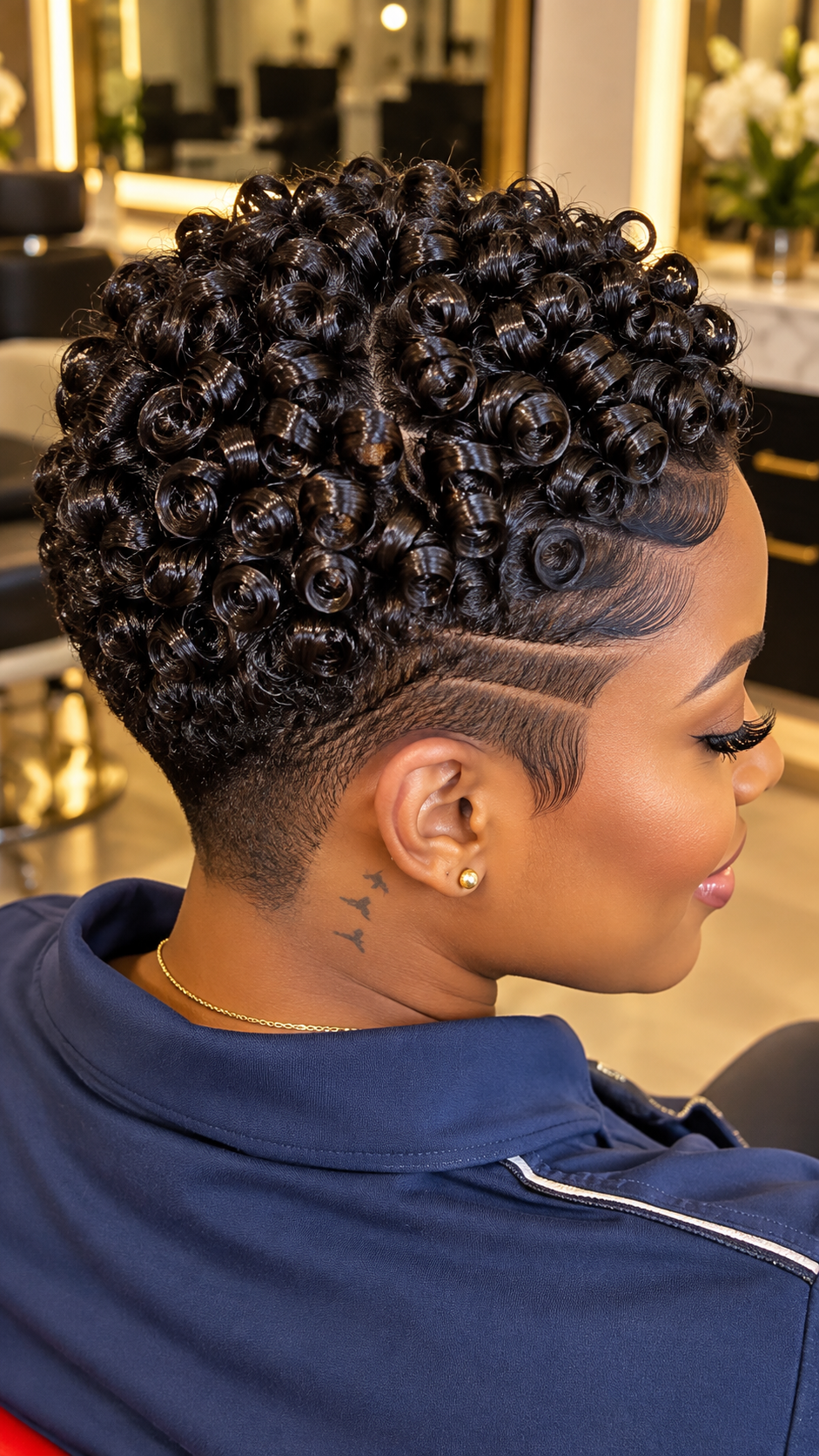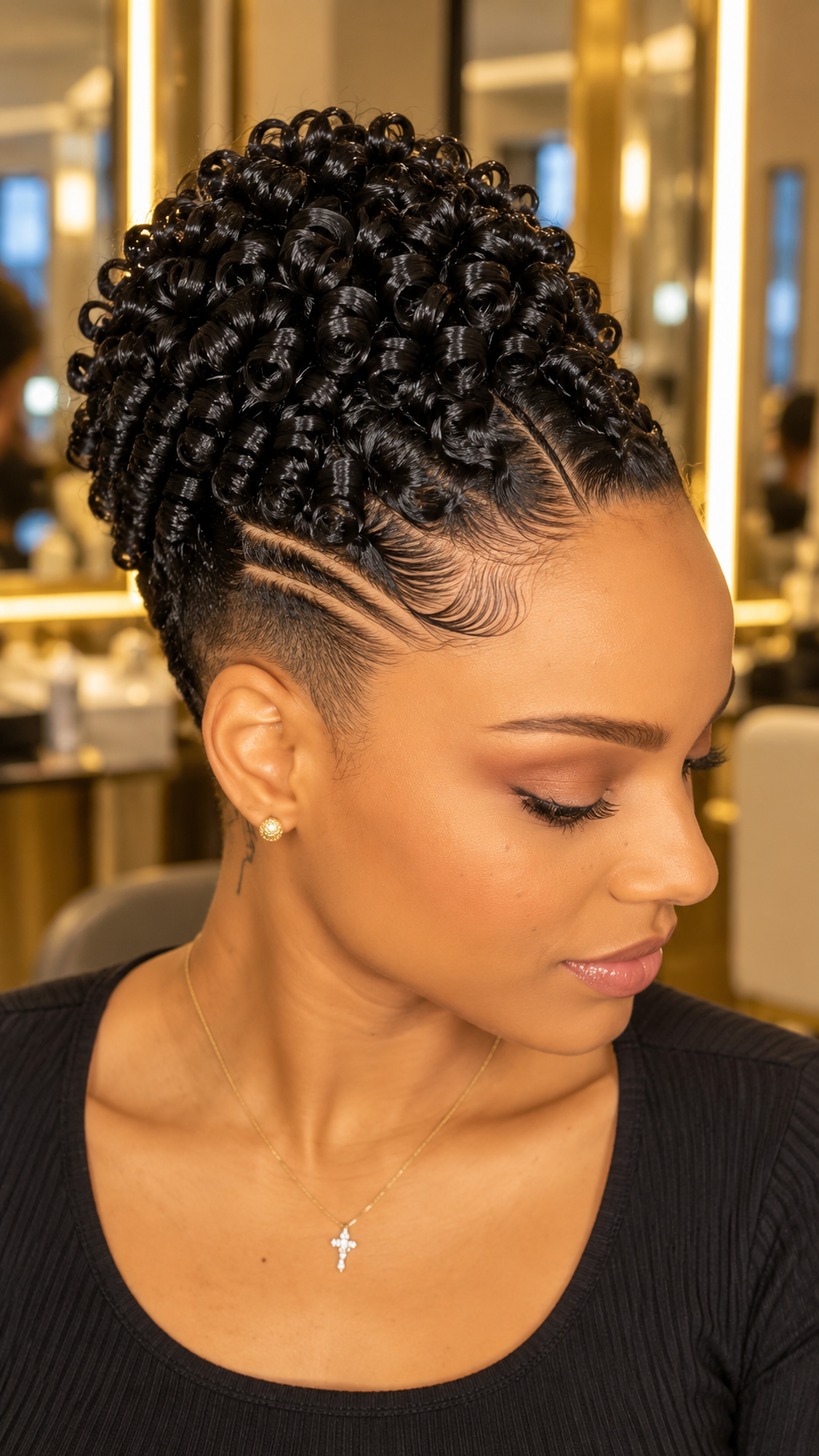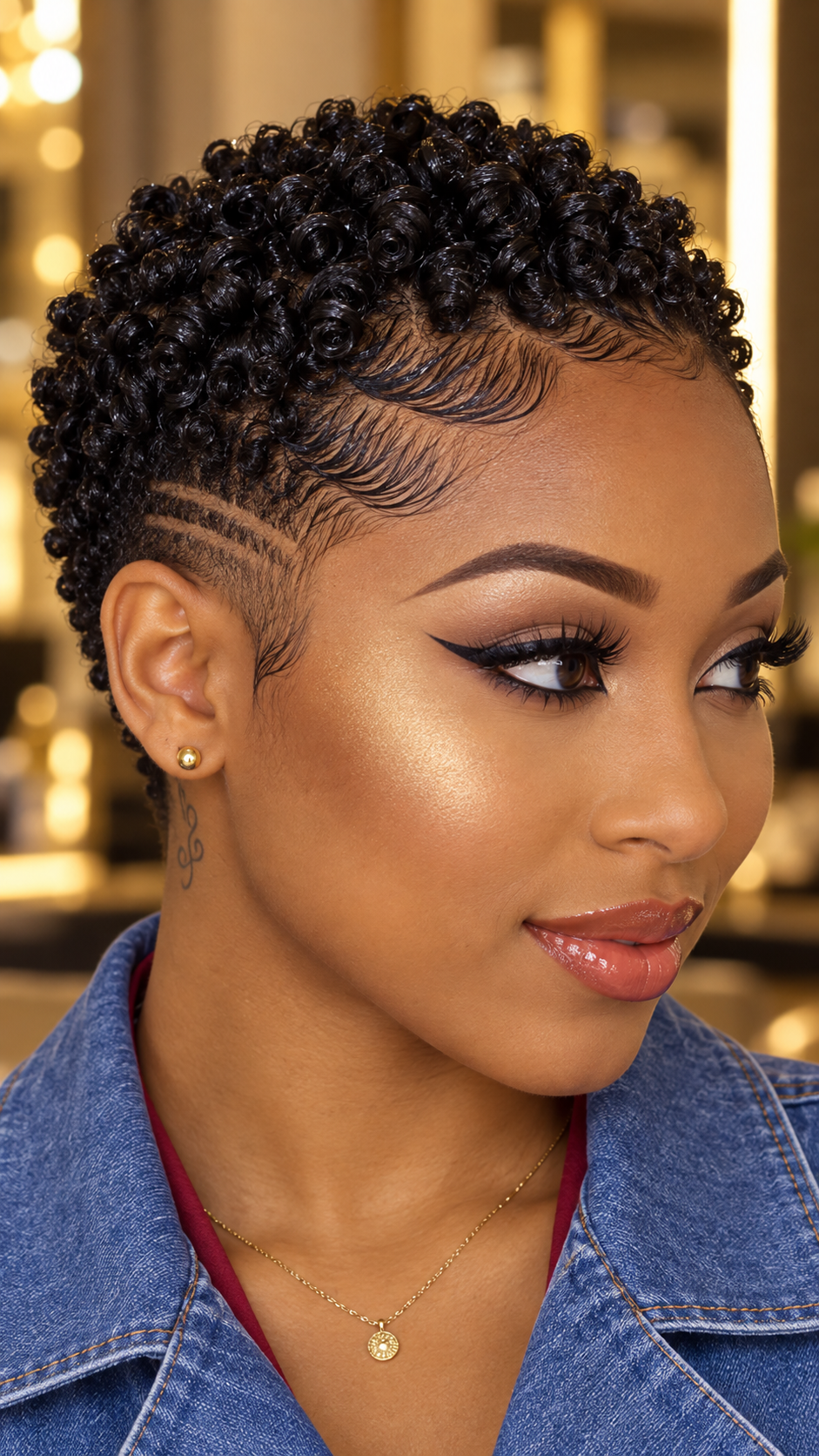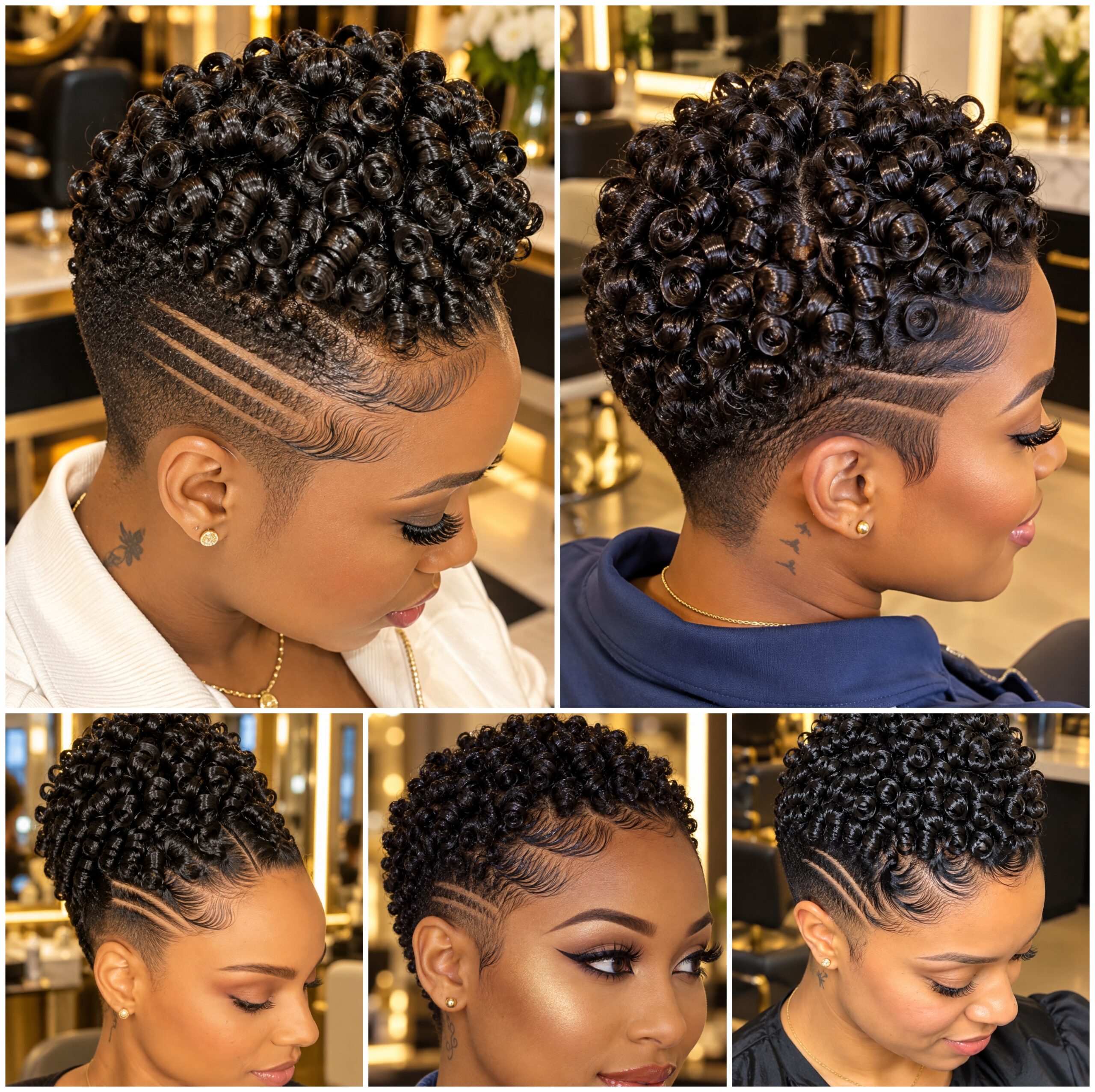
A jet black pixie can be remarkably expressive when tightly arranged coils meet carefully placed razor accents. The appeal is not simply the contrast between longer and closely cropped hair. It comes from the way the circular curls create movement above the head while precise shaved details introduce structure around the temples, sides, or lower perimeter. Together, these elements produce a hairstyle that feels deliberate, distinctive, and suitable for women who appreciate intricate salon craftsmanship.
For women exploring compact natural hairstyles or sculpted pixie wigs, this combination offers several possibilities. The crown can contain rounded finger coils, tightly arranged spiral curls, or slightly larger circular loops, while the side detailing may consist of a single diagonal line, two curved accents, or a carefully positioned geometric design. The exact arrangement determines whether the finished hairstyle appears understated or more decorative.
Jet black is particularly effective for this styling family because the dark color creates strong contrast with exposed scalp or lighter-looking parting channels. Reflections along the curls reveal their circular structure, while the closely cropped sides keep the overall silhouette balanced. However, a visible pale channel on a wig does not automatically mean the hair was shaved with a razor. Buyers should distinguish actual barber-cut designs from decorative separations created on a wig foundation.


Understanding that distinction is essential when choosing between a natural haircut and a ready-made or custom wig. Both can deliver a similar visual direction, but their construction, maintenance requirements, fitting considerations, and potential costs are different.
The Appeal of a Deep Black Coil Crown
The crown is the principal styling area in this hairstyle family. Its curls can be arranged into small spring-like spirals, compact finger coils, or rounded loops with visible openings. Each approach produces a different surface and degree of fullness.
Finger coils are commonly formed by guiding small sections of hair into spirals using the fingers and suitable styling products. On natural hair, the result depends on the hair’s length, density, condition, and curl characteristics. On wigs, similar appearances may be created through various professional styling methods, depending on the fiber composition.
Small coils generally produce a densely arranged crown. Larger loops create more recognizable circular openings and may give the upper hairstyle a sculptural appearance. Neither approach is automatically superior; the best choice depends on the desired silhouette.
The dark color helps individual curls stand out when light catches their curved surfaces. Under daylight, jet black strands may display cool reflections without containing any additional gray or silver coloring.
For a balanced pixie, the crown should remain proportionate to the head. Excessive height can make the hairstyle appear bulky, while an overly flattened upper section may reduce the contrast with the closely cropped sides.
Choosing the Right Coil Diameter
Women who prefer a compact, densely curled appearance may choose smaller coils distributed evenly across the upper head. Those seeking a more sculpted result may prefer a mixture of medium circular curls and smaller supporting coils.
The front can also be styled differently from the central crown. Some designs use rounded coils extending toward the forehead, while others transition into flatter finger-wave arrangements.
Before booking an appointment, show the stylist reference photographs that demonstrate the desired coil size. Descriptions such as curly pixie or finger coil haircut can lead to different interpretations.
For a wig commission, request photographs from above and from both sides. These views help establish whether the curl arrangement remains balanced beyond the front-facing presentation.
Razor Accents as a Form of Hair Architecture
Razor accents introduce lines and directional contrast into a hairstyle that would otherwise be dominated by circular curls. They can be subtle or highly visible depending on their placement, width, and relationship to the surrounding hair.
A single diagonal accent near the temple can create a restrained division beneath the crown. Two closely spaced curved lines may produce a more decorative appearance, while intersecting lines can introduce stronger geometry.
The placement should follow the natural contour of the head rather than appear disconnected from the hairstyle above.
On natural hair, a barber may create these accents using appropriate professional cutting equipment. The technique requires precision because removing hair from the wrong area can change the design until sufficient regrowth occurs.
On wigs, similar visual effects may be achieved through parting, density variation, or other construction methods. Not every visible line on a wig is an actual shaved channel.
Single-Line Temple Detailing
A single accent is often suitable for women who want the curls to remain the primary focus. The line may begin near the forward side and extend backward beneath the crown.
Its angle can visually lengthen the upper section or emphasize the transition into a close taper. A relatively narrow line usually preserves more of the surrounding hair.
Paired Curved Accents
Two curved accents can create a layered side appearance. The hair between them forms a visible band, so the spacing is just as important as the lines themselves.
When the channels are placed too close together, they may appear to merge. Excessively wide spacing can make the side look divided into unrelated sections.
Intersecting Geometric Details
Crossing lines create a more dramatic design and require particularly careful planning. Their intersection should appear intentional, with the surrounding hair density sufficient to keep each section recognizable.
These designs are best handled by a professional experienced in precision barber work or customized wig styling. An intricate pattern should not be improvised after the main hairstyle is completed.
Matching the Side Design to the Crown Shape
The most successful combinations consider the direction of the curls before choosing the side accents.
A rounded crown with numerous circular coils can pair well with a gently curved temple line. The curve echoes the upper hair’s circular movement without repeating it exactly.
A crown containing backward-swept loops may benefit from a diagonal separation following the direction of the strands. This creates a visual connection between the upper styling and the lower side.
For a particularly compact crown, a small accent near the temple may be sufficient. More elaborate geometry can become distracting if the upper hairstyle is already densely arranged.
Hair density is another consideration. On natural hair, a stylist should assess whether the proposed accent can be created without removing too much hair. On a wig, the maker must determine whether the foundation and hair placement can support the intended design.
Planning the complete silhouette before cutting or customizing helps prevent unnecessary corrections.
Natural Hair or Wig: Choosing the Better Route
A natural finger coil pixie and a sculpted pixie wig can resemble one another, but they involve different commitments.
Natural hair styling allows the barber or hairstylist to work directly with the wearer’s existing hair growth, density, and scalp contour. The result can be adjusted during the appointment, although any shaved accents will require time to grow out.
A wig provides an alternative for women who want to experiment with the appearance without cutting their natural hair. It may also be useful for switching between hairstyles or maintaining a consistent visual design.
However, wig construction introduces additional considerations. The cap must fit properly, the hairline needs suitable positioning, and any decorative side design must align with the wearer’s head.
Not every wig advertised as a pixie can support precision razor-style detailing. A unit with unsuitable hair density or a poorly positioned foundation may not reproduce the desired appearance.
The choice should therefore depend on the intended frequency of wear, styling flexibility, maintenance preferences, and available professional expertise.
How to Find the Right Barber or Wig Specialist
For a natural haircut, search for a barber experienced in women’s tapered pixies, precision line work, and natural finger coil styling. A hairstylist who specializes in coils may collaborate with a barber when the design requires both intricate curls and closely cut accents.
For a wig, look for a custom wig maker or lace wig stylist with examples of sculpted pixie hairstyles and decorative side separations.
Review previous work carefully. A stylist may be excellent at creating curls but have limited experience with geometric side detailing. Likewise, a barber skilled in shaved designs may not specialize in wig construction.
During the consultation, discuss the intended crown height, coil diameter, accent placement, and lower side density.
Ask whether the professional can reproduce the reference closely or whether adjustments will be necessary to accommodate the wearer’s hair or wig foundation.
Booking a consultation before the full appointment is especially valuable when the requested design includes several crossing or curved lines.
Ordering a Jet Black Coil Pixie Wig Online
Online product descriptions can be misleading when several different hairstyles share the same general name. A listing for a black curly pixie may show loose spirals, a rounded afro-like crown, or a closely cropped wig without any decorative side detailing.
When searching for a suitable product, prioritize photographs showing the actual crown and side construction.
Request a front view, direct side photographs, a rear view, and a complete underside image. The side photographs are particularly important when the design includes razor-style accents.
Confirm whether the advertised hairstyle is supplied fully styled or whether the buyer must arrange additional salon services.
Ask about the fiber composition, cap measurements, lace specifications if applicable, and permitted styling methods. Human hair and synthetic fibers can require different care and may offer different customization possibilities.
Do not assume that a glossy appearance proves human hair or that a lace-front photograph confirms HD lace.
Similarly, a product should not be considered glueless without information about its attachment system and intended fitting method.
Before payment, review the seller’s production schedule, shipping conditions, return policy, and any limitations affecting customized orders.
Cap Fitting and Hairline Placement for Decorative Sides
Wig fitting becomes especially important when the side design is intended to align with a particular temple position.
A cap that sits too far forward may move the accent toward the forehead. A cap positioned too far backward can shift the design away from its intended location.
Before installation, measure the head circumference, front-to-nape distance, and ear-to-ear width. The seller should provide corresponding cap specifications.
If lace is present, its color, dimensions, and construction should be confirmed before purchase. The lace should be assessed against the wearer’s skin during fitting rather than assumed to blend automatically.
Untrimmed lace should remain intact until the correct position has been established. Cutting too much material can be difficult or impossible to correct.
Any attachment combs, straps, or other hardware should be adjusted for comfort. Excessive tension can cause discomfort and may place unnecessary stress on the underlying hair.
The final installation method depends on the actual cap construction and the wearer’s needs, not merely on how the product is described in a photograph.
Illustrative Price Guide for Coil Pixies and Custom Wig Options
Pricing depends on whether the buyer wants a natural haircut, a ready-made wig, or an individually constructed piece. Intricate side accents and hand-arranged curls can increase labor costs, particularly when several techniques are combined.
The following USD ranges are illustrative planning estimates for wig purchasing categories. They are not verified live retail prices or quotations from specific suppliers. Natural haircut and barber services would be priced separately according to the local salon.
| Wig Category | Illustrative USD Range | Potential Inclusions or Additional Work |
|---|---|---|
| Premium Custom | $340–$890+ | Individual cap specifications, specialist coil placement, elaborate side geometry, and detailed hairline preparation. |
| Standard Custom | $165–$395 | Selected cap options, personalized crown styling, and simpler precision side accents. |
| Basic Human Hair | $90–$255 | Human-hair base unit that may require separate coil setting, side customization, and fitting. |
| Premium Synthetic | $60–$175 | Higher-grade synthetic options with prearranged curls and material-dependent styling flexibility. |
| Basic Synthetic | $25–$80 | Budget alternatives with potentially simpler curl arrangements and less detailed side construction. |
These categories represent possible purchasing options rather than guaranteed specifications. Actual prices vary by material, supplier, country, craftsmanship, and included services.
A custom piece with multiple geometric accents may cost more than a similar wig with one simple side line because the maker must plan and position additional sections.
Ask for an itemized quotation identifying the base wig, styling, lace preparation, installation, shipping, and any future maintenance services.
A less expensive wig is not necessarily better value if substantial reconstruction is required to achieve the desired design.
Maintaining Finger Coils Without Disturbing Their Shape
Finger coils require maintenance appropriate to the underlying hair or fiber. Their circular arrangement can be disturbed by aggressive brushing, repeated pulling, or unnecessary separation.
For natural hair, a stylist can recommend products and a care routine suited to the individual’s hair condition and styling method. Gentle handling and suitable nighttime protection may help reduce friction and preserve the curls.
For wigs, follow the supplier’s material-specific instructions. Synthetic hair should not be exposed to heated tools unless the manufacturer confirms that the fiber is suitable.
Human-hair wigs may allow different styling methods, but previous chemical processing, fiber condition, and the way the coils were formed should still be considered.
When a wig contains individually arranged circular loops, professional resetting may be preferable to attempting extensive restyling without understanding the original construction.
A suitable storage support can help maintain the crown’s proportions while reducing unnecessary compression.
Keeping Razor Accents Recognizable Between Appointments
On natural hair, shaved accents gradually lose their sharp appearance as the hair grows. The time between touch-ups depends on individual growth and how precise the wearer wants the design to remain.
For an intricate geometric pattern, returning to the same barber can help preserve the original placement. Repeatedly widening the lines during maintenance may gradually change the design.
On wigs, decorative channels may require a different approach. Hair can shift across exposed separations, making the pattern less visible. A stylist may need to reposition the strands or restore the intended arrangement.
Do not attempt to cut additional lines into a wig without confirming how the hair is attached. Removing hair from an unsuitable area may permanently damage the design or expose more of the foundation than intended.
For both natural hair and wigs, maintaining the original proportions is more important than making every accent increasingly prominent.
Building a Personal Style Around Black Coils and Precision Details
This hairstyle family offers flexibility without requiring dramatic changes in color. The same deep black shade can support a restrained single-line pixie, a more decorative curved temple design, or an intricate geometric arrangement.
Women who prefer subtle detailing may choose a compact crown with one narrow accent. Those seeking a stronger visual statement can explore larger circular coils combined with two carefully spaced curves.
The best result depends on proportion, styling direction, and the relationship between the upper curls and the lower hair.
For a wig purchase, prioritize accurate product photographs, verified construction details, and professional fitting. For a natural haircut, choose a stylist who understands both coil styling and precision barber techniques.
When the crown and side detailing are planned together, jet black hair can become the foundation for a distinctive pixie that emphasizes craftsmanship, controlled volume, and carefully positioned geometric accents without relying on elaborate color treatments.
Search Terms
Jet black finger coil pixie hairstyles · Black spiral crown with razor accents · Women’s tapered pixie with curved side lines · Circular finger coils with temple carving · Deep black pixie with double razor detail · Sculpted black coil wig with side parting · Precision barber lines on curly pixie · Compact raven black crown with geometric accents