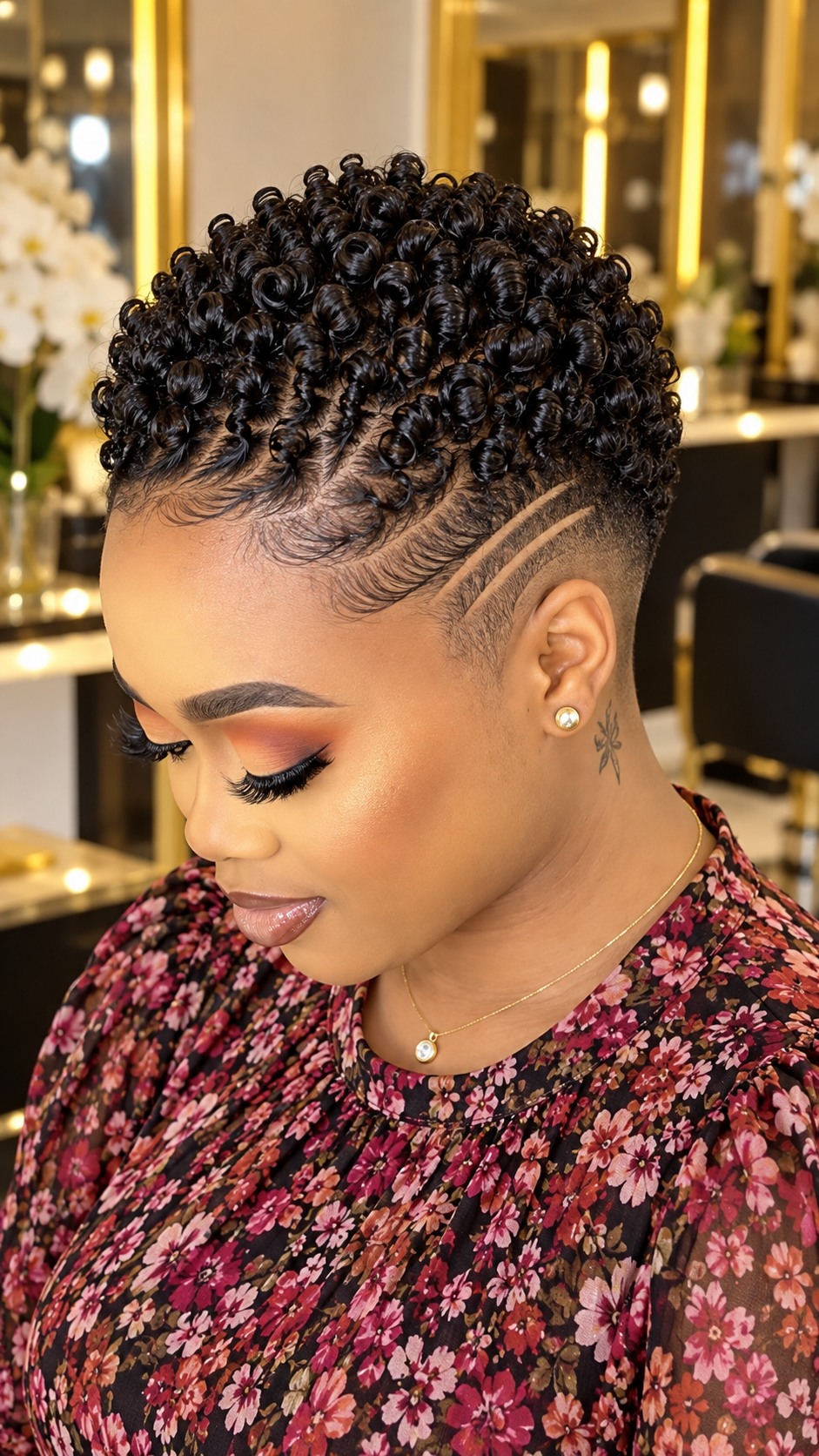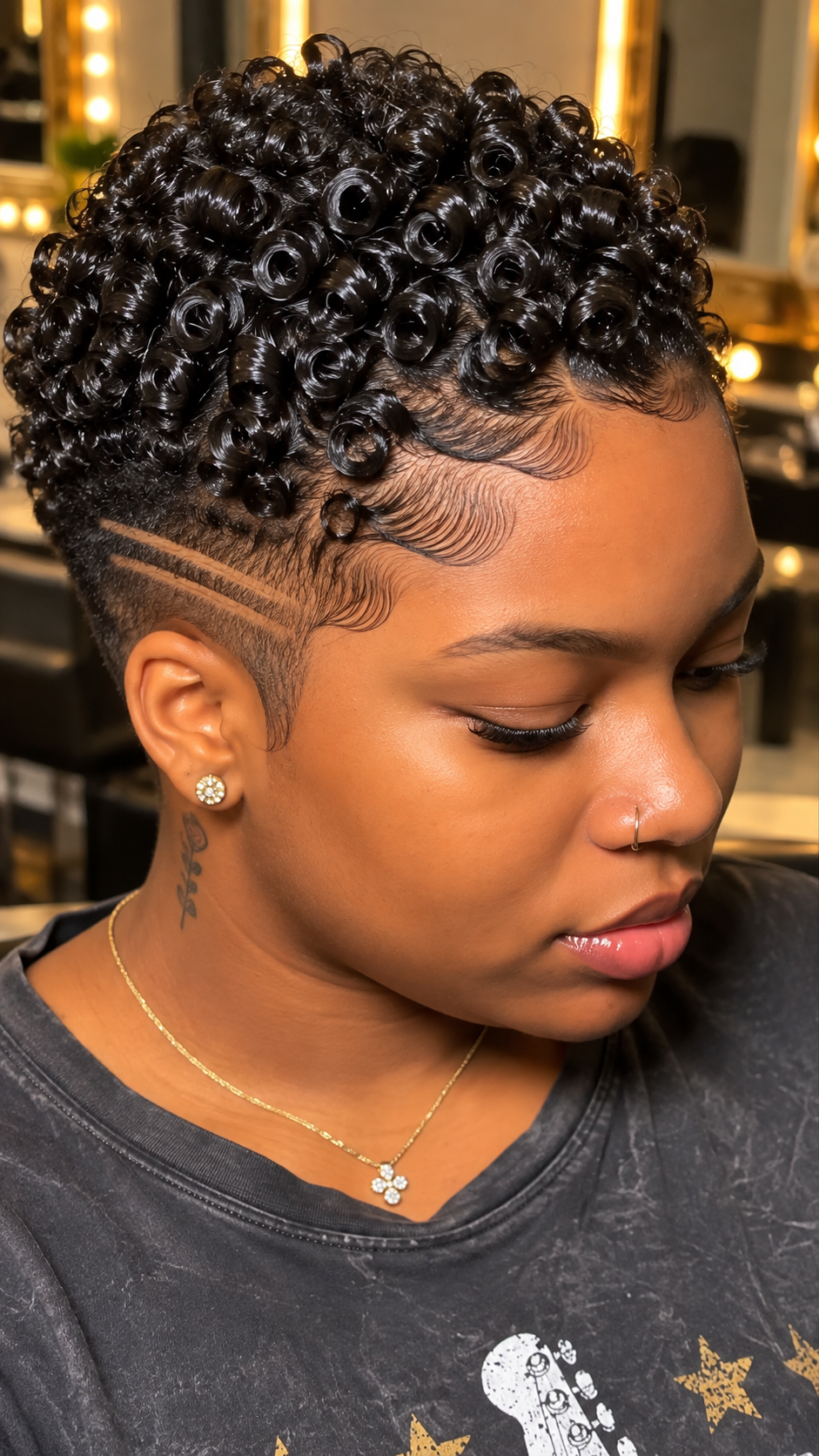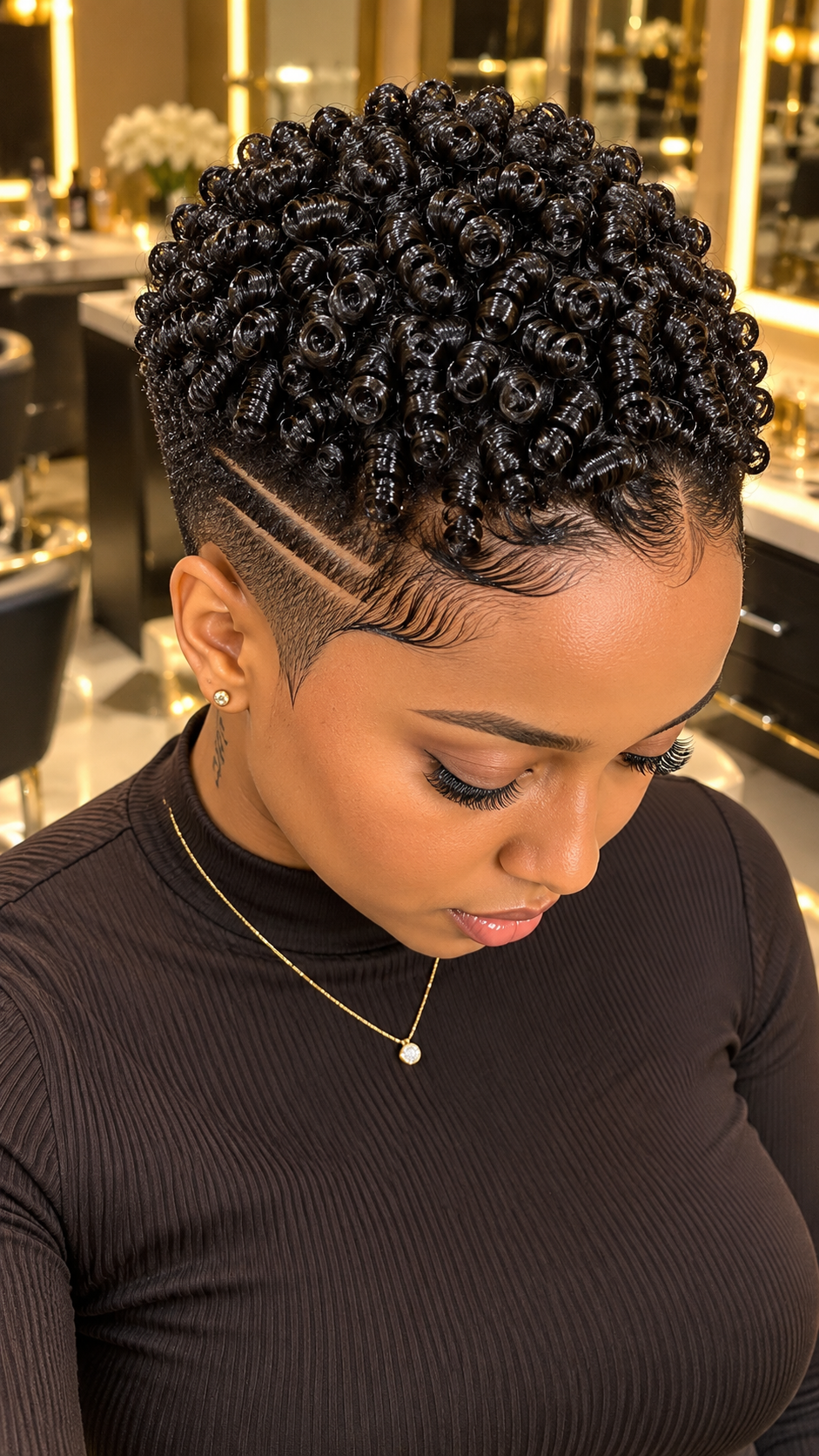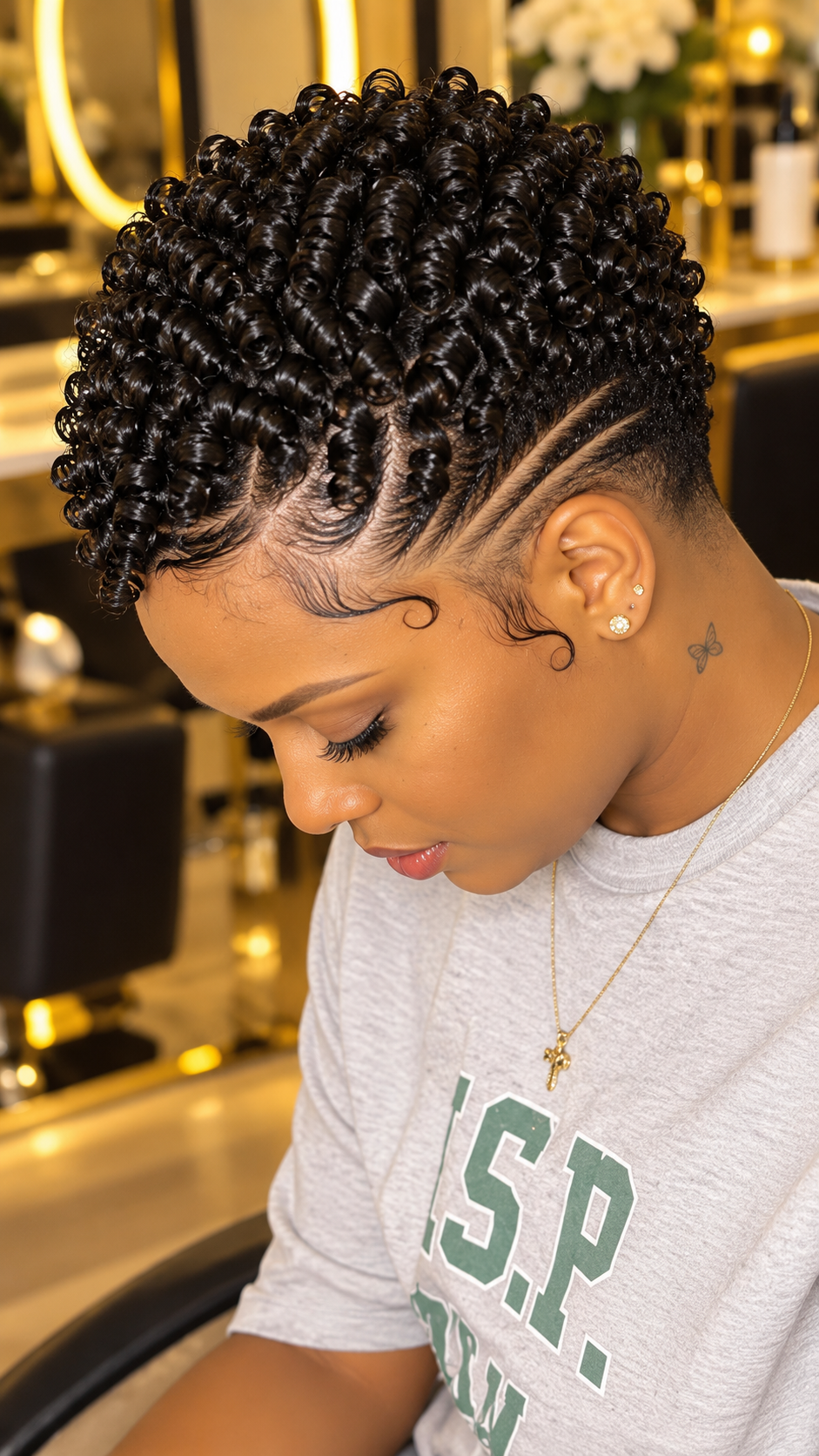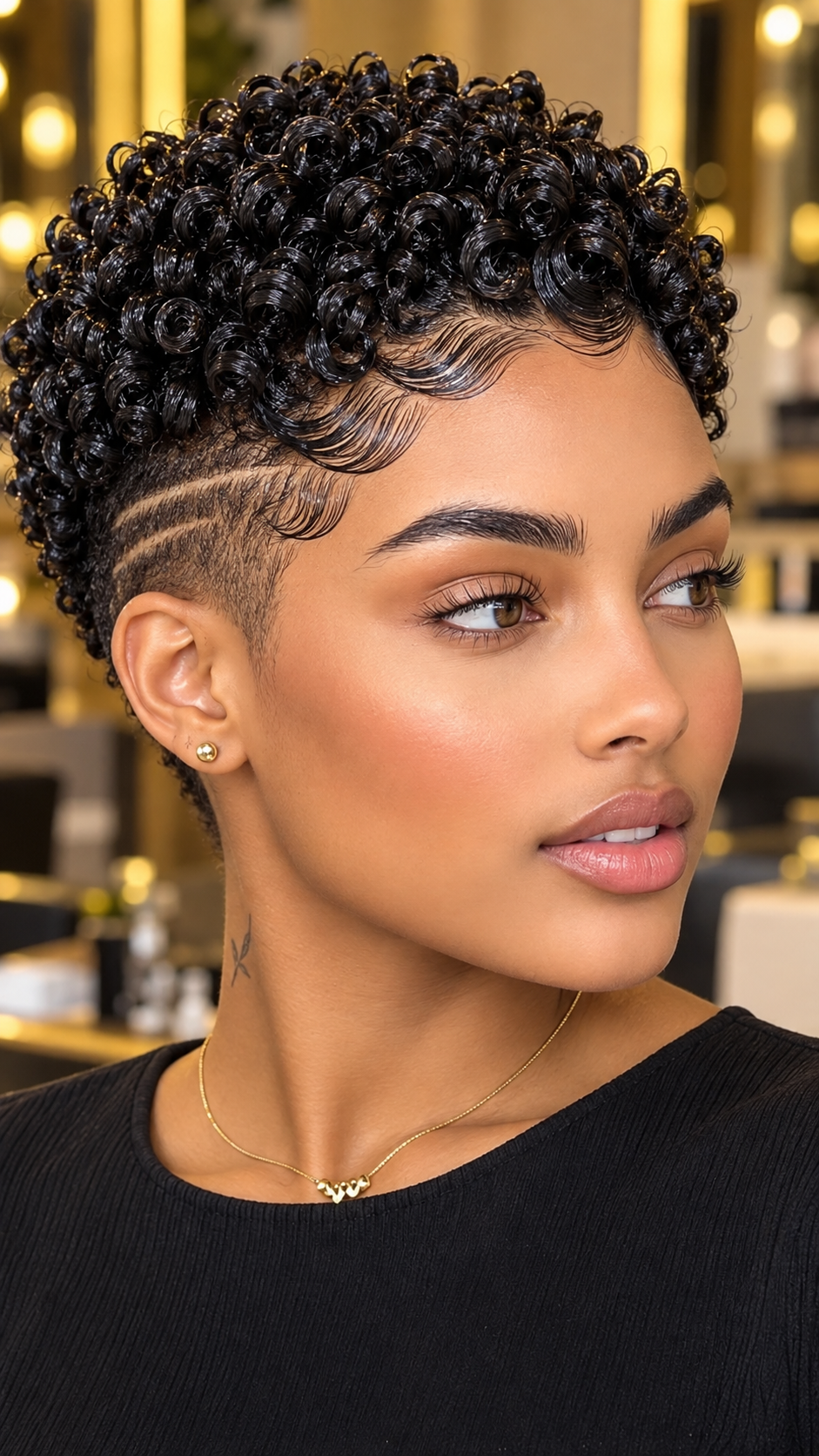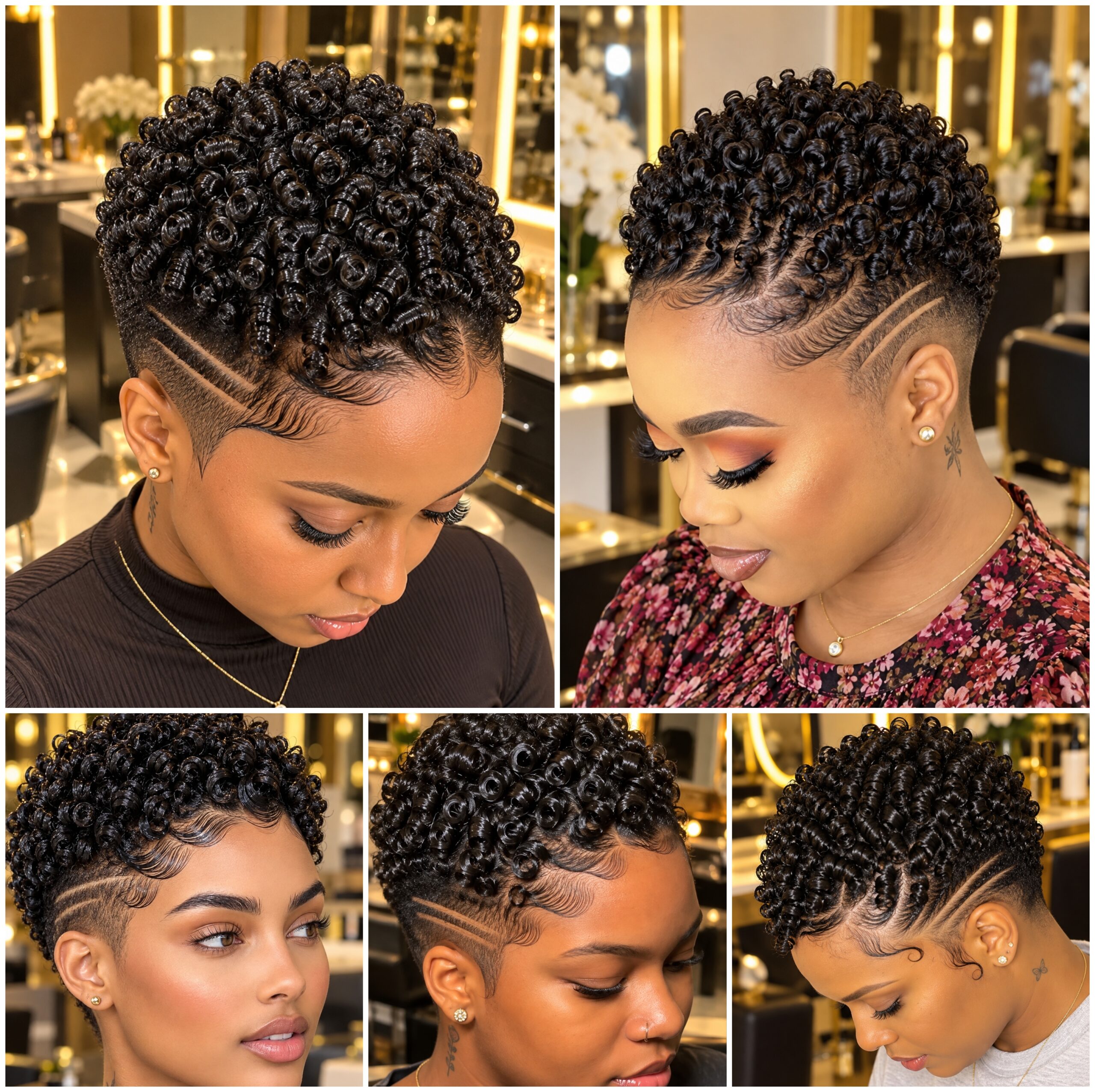
A finger coil taper can look beautifully simple from the front, yet the most demanding work often happens around the temples. Small, carefully arranged coils create a rounded upper silhouette, while curved side lines introduce movement across the closely cropped hair beneath them. When these elements are proportioned correctly, the result is a compact hairstyle with visible craftsmanship from several angles.
Finger coil tapers with curved side lines appeal to women who appreciate natural-looking curl formations combined with precision barber detailing. The crown provides softness and elevation, while the lower sections remain close to the head. The decorative curves can be subtle, or they can become the most recognizable part of the haircut.
This hairstyle can be created on suitable natural hair or reproduced through a professionally constructed wig. The two approaches involve different decisions. Natural hair requires consideration of growth patterns, curl behavior, and future trimming. A wig requires careful planning of hair density, cap coverage, lace placement, and the feasibility of creating the side pattern without exposing its construction.


Understanding these differences before booking a stylist or ordering a wig can prevent expensive alterations and help achieve a more accurate result.
The Side Lines Should Be Designed Before the Hair Is Cut
Curved side lines are not merely finishing touches. Their placement determines how the taper looks in profile and how much space remains between the upper coils and the lower hairline.
A single sweeping curve can create a restrained accent. Two closely spaced arcs introduce a layered appearance, while three carefully positioned channels can produce a more elaborate design. The number of lines should be selected deliberately rather than increased simply to make the hairstyle more noticeable.
The most successful patterns follow the shape of the temple without making the side appear disproportionately large. Their direction should also complement the overall haircut.
For example, a curve that rises toward the rear can visually support a rounded crown. A descending line may draw more attention toward the lower temple. Neither arrangement is universally preferable; the decision depends on the head shape and desired silhouette.
Single Curves, Paired Arcs, and Flowing Channels
A single curved line is often suitable for someone who wants a noticeable detail without dividing the side into several narrow sections. Its simplicity makes the exact curvature particularly important.
Paired arcs create a narrow band of hair between the two channels. Their spacing should be sufficient for the pattern to remain recognizable after styling.
Three curved channels require more planning because the lowest line may approach the temple edge or the transition toward the nape. Excessive spacing can make the design appear disconnected, while channels placed too closely together may be difficult to distinguish.
For wigs, these considerations become even more important because cutting away hair may reveal lace or cap material beneath the pattern.
Finger Coil Diameter Changes the Entire Crown
The size of the coils has a direct influence on the appearance of the hairstyle. Smaller coils create a closely packed upper surface, while larger spirals produce more visible openings and separation.
For a compact tapered haircut, finger coils measuring approximately one to two centimeters across can be a useful visual reference, although the appropriate diameter depends on hair length, density, and the desired result.
Coils should not be selected solely by diameter. Their direction and distribution also influence the crown.
Some styles use relatively upright coils across the top. Others arrange the curls slightly forward or backward to create movement. A rounded crown generally benefits from a considered distribution that avoids unintended gaps or excessive height in one area.
Working With Natural Curl Behavior
On natural hair, finger coils are created by guiding small sections into spiral formations. The final appearance depends on the hair’s curl pattern, length, condition, and styling technique.
Hair that naturally forms tight spirals may require a different approach from hair with a looser curl pattern. The stylist should assess how the coils behave after drying rather than relying exclusively on their appearance while wet.
For a wig, the manufacturer may use preformed curls, individually styled sections, or another construction method. The photograph of a finished wig cannot reliably establish which process was used.
Buyers should ask whether the coil arrangement can be restored after washing and whether professional resetting will be necessary.
Choosing a Taper Height That Supports the Coils
The taper should create a gradual transition from the closely fitted lower hair into the fuller crown. Its height determines how much of the side remains visually connected to the upper curls.
A lower taper retains more hair around the temples and may create a softer transition. A higher taper removes more volume from the side, making the crown appear more prominent.
For hairstyles incorporating curved lines, the taper must also leave enough hair to support the decorative pattern.
Cutting the side too closely before planning the channels can limit the available options. A barber should therefore establish the intended design before completing the fade.
On a wig, this planning should ideally occur during construction. A finished unit may not contain sufficient hair coverage for extensive side modification.
The Difference Between a Natural Hair Taper and a Wig Version
Natural hair and wig construction can produce similar-looking hairstyles, but their technical requirements are different.
With natural hair, the stylist works directly with the person’s hair density, growth direction, and scalp contours. The fade can be adjusted as the hair grows, and the carved channels can be refreshed during later appointments.
With a wig, the hair is attached to a supporting structure. The stylist must consider how much hair is available in each area and whether cutting will expose the cap.
A wig may offer greater flexibility for someone who does not want to cut their natural hair. However, the result depends on proper sizing and a construction method suitable for the desired taper.
Why Wig Hair Density Matters
A closely cropped side requires enough hair to create the appearance of a taper without revealing unintended gaps.
If the hair is too dense, the side may look bulky. If it is too sparse, the underlying lace or cap may become excessively visible.
Decorative channels introduce another consideration because they deliberately create areas with less hair coverage.
A skilled wig maker should plan the density around these channels rather than relying on aggressive cutting after the unit is completed.
Customers should request close side photographs before approving a custom wig.
Black, Mocha, Copper, and Ash-Brown Coil Options
Color can change how finger coils and carved side lines are perceived. Natural black emphasizes the contrast between raised curls and exposed channels without introducing additional visual elements.
Mocha and chocolate brown can reveal more of the individual coil shapes under daylight, particularly where the strands curve toward the light.
Copper shades create stronger visual separation between the crown and a darker tapered side. This approach can be especially effective when the brighter color is concentrated above the temple.
Ash-brown and smoky tones offer cooler alternatives, although their appearance depends on lighting and the original hair material.
For two-tone styles, the color boundary should be planned around the taper. Randomly extending the brighter shade into the carved channels may change the intended appearance.
Color Matching for Custom Wig Orders
When ordering a wig, provide a reference photograph showing the desired color under realistic lighting.
Ask whether the proposed shade is available as manufactured fiber or requires additional processing.
Human hair and synthetic fibers may respond differently to coloring, heat, and maintenance products.
Do not assume that a synthetic wig can be recolored using conventional hair dye. The manufacturer should confirm compatibility before any treatment is attempted.
Finding the Right Barber or Natural-Hair Stylist
For a natural-hair version, search for a barber experienced in women’s tapered haircuts, precision curved line designs, and natural finger coil styling.
A stylist who specializes only in long braids or straightened hair may not have the same experience with compact coil arrangements and close fades.
Review photographs of previous work, paying particular attention to the relationship between the crown and side pattern.
The carved channels should appear intentional, and the surrounding hair should retain enough density to support the design.
For a wig version, look for a custom wig maker or wig stylist who has demonstrated experience with sculpted pixie units and barber-inspired side detailing.
Preparing for the Appointment
Bring photographs showing the preferred coil size, crown height, taper position, and side-line arrangement.
Explain whether the curved channels should appear on one side or both sides.
If the hairstyle is being created on natural hair, discuss the starting length and whether the coils can be formed using the existing hair.
For a wig appointment, confirm whether the unit already includes the desired taper and whether additional cutting is necessary.
Ask for an estimated service price and clarify which styling steps are included.
Buying a Ready-Made Finger Coil Pixie Wig
Ready-made curly pixie wigs can provide a convenient starting point, but they do not always include the same coil diameter or side pattern as a custom design.
Some products use small spring curls, while others have larger circular loops or loose waves.
The lower sides may also differ considerably. A product advertised as a tapered pixie may have a plain side rather than decorative curved channels.
Before purchasing, request photographs from the front, both sides, above, and behind.
Ask whether the wig arrives fully styled and whether the advertised appearance is representative of the actual unit delivered.
Commissioning a Custom Finger Coil Taper Wig
A custom order is worth considering when the buyer wants precise control over coil diameter, taper height, side-line geometry, or color placement.
Provide the head measurements requested by the wig maker and confirm the available cap sizes.
Ask whether the decorative channels are incorporated during construction or added through cutting afterward.
Confirm the hair fiber, lace dimensions, fastening system, and intended installation method.
Request photographs of the completed unit before shipment and establish the revision policy in advance.
For a highly specific side pattern, a short video showing the wig from several angles can help reveal differences that may not be apparent in a single photograph.
Illustrative Pricing for Finger Coil Taper Wigs With Curved Lines
The following USD figures are illustrative purchasing ranges, not verified live product prices. They apply to possible wig-buying categories and do not include a guaranteed match to any particular hairstyle.
| Wig Category | Illustrative USD Range | Potential Cost Considerations |
|---|---|---|
| Premium Custom | $310–$720+ | Individual cap sizing, precisely arranged finger coils, controlled taper density, and custom curved side channels. |
| Standard Custom | $170–$380 | Selected cap options with personalized coil placement and moderate side detailing. |
| Basic Human Hair | $95–$255 | A human-hair starting unit that may require coil setting, taper shaping, and specialist carving. |
| Premium Synthetic | $70–$185 | A manufactured curly pixie with preformed coils and possible decorative side styling. |
| Basic Synthetic | $28–$90 | A lower-cost curly pixie alternative that may not reproduce the intended taper or curved channels. |
The price of a custom wig may increase when individual coils require precise arrangement or when the side density must be planned around multiple channels.
Additional charges may include lace customization, cap fitting, shipping, taxes, and professional installation.
Natural-hair salon services are priced separately from wig purchases and depend on the local market, starting hair length, and complexity of the requested design.
Ask for an itemized quotation before booking or ordering.
Fitting a Lace Wig With Curved Temple Detailing
The first fitting should establish the correct cap position before any excess lace is trimmed.
Curved side lines must sit at the intended angle relative to the wearer’s temples. A poorly positioned cap can make the pattern appear uneven.
A professional wig stylist can assess cap comfort, hairline placement, and the suitability of the intended fastening method.
Visible straps or combs do not automatically establish adhesive-free compatibility. The complete cap construction must be considered.
Once the fit is satisfactory, the stylist can determine whether minor adjustments are appropriate without changing the original design.
Maintaining Finger Coils Between Styling Sessions
Finger coils can lose their organized appearance when repeatedly brushed or separated.
For natural hair, the maintenance routine should account for the person’s curl pattern, hair condition, and products recommended by the stylist.
For wigs, care depends on the confirmed fiber and manufacturing method.
Human-hair units may be suitable for professional coil resetting with compatible techniques. Synthetic fibers may have restrictions on heat and styling products.
Heavy product buildup can make individual coils less recognizable and may require cleaning according to the appropriate care instructions.
Refreshing the Curved Side Lines
On natural hair, the carved channels may become less visible as the hair grows. A barber can refresh the pattern during a maintenance appointment.
On a wig, the hair does not grow, but strands can shift into the exposed channels during handling.
Do not deepen the lines with clippers or scissors without assessing the cap construction.
Store the wig on a suitable stand that supports the crown without pressing against the side pattern.
Selecting a Design That Remains Practical
Finger coil tapers with curved side lines offer considerable styling flexibility, but the most elaborate design is not necessarily the most practical.
A compact crown with one curved channel may be easier to maintain than a hairstyle with several closely spaced separations.
Customers who enjoy frequent hairstyle changes may prefer a simpler wig that can accommodate limited restyling, while those seeking a highly specific appearance may benefit from custom construction.
The best choice depends on coil size, fade placement, cap comfort, maintenance expectations, and the level of precision desired in the side design.
Before ordering a wig, verify the material, cap measurements, lace specifications, fastening method, and whether the finished hairstyle is included in the price. For natural hair, consult a stylist about the appropriate starting length and the maintenance schedule needed to preserve the taper.
A successful finger coil taper should retain a balanced crown, recognizable individual spirals, a proportionate lower fade, and curved side lines that complement the hairstyle rather than overpower it. Those considerations provide a practical foundation for choosing a stylist, comparing wig options, and achieving a result that suits the wearer’s preferences.
Search Terms
Finger coil taper with curved side lines · Women’s spiral coil tapered pixie · Natural black finger coils with temple arcs · Double curved razor line taper hairstyle · Compact finger coil crown lace wig · Low fade finger coils with side carving · Chocolate brown sculpted coil pixie · Curved temple design natural hair taper