
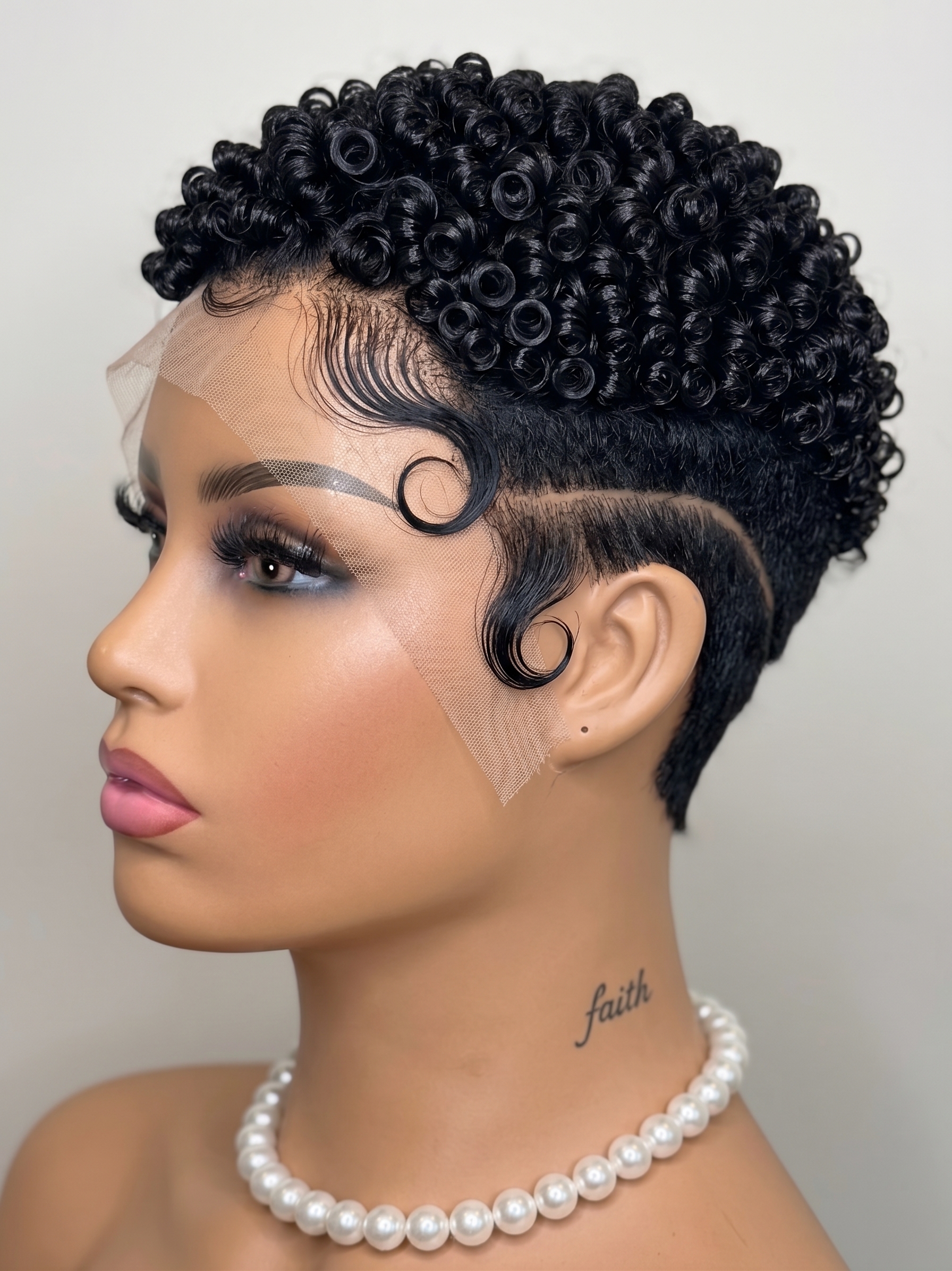
This jet black spiral curl pixie wig combines a dense crown of glossy miniature curls with an unusually artistic side treatment. The upper section is packed with compact spiral ringlets, while the sides sit much closer to the head and feature a broad sculpted wave that curves from the temple toward the ear. Long, polished swoops around the forehead and sideburn area complete the silhouette and give the pixie its unmistakable character.
The hairstyle works because the different sections are clearly separated without looking disconnected. The crown provides height and concentrated curl volume, the lower sides create a compact foundation, and the curved side detail introduces movement. Although the entire style is jet black, the contrast between shiny ringlets, flatter side hair and exposed parting lines makes every section easy to distinguish.
Dense Spiral Curl Crown
The most prominent feature is the tightly arranged spiral curl crown. Dozens of small ringlets cover the upper portion of the wig, creating a rounded pixie shape without excessive height. The curls are compact and highly polished, with visible circular openings at many of the ends.
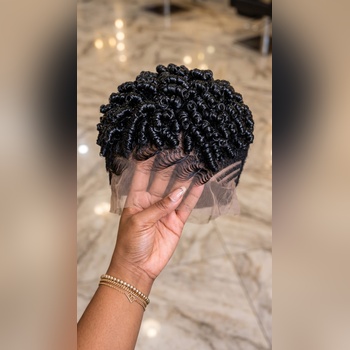
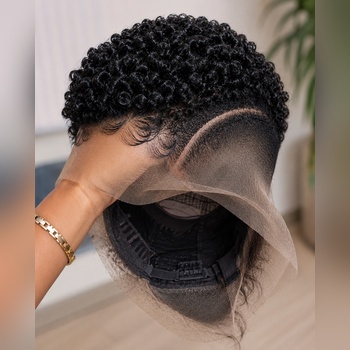
These are not loose waves or fluffy curls. Each section is intentionally formed into a small spiral, and the curls sit close enough together to create substantial density. Toward the front, several ringlets lean slightly forward while the curls through the center and rear remain more upright and clustered.
Keeping the curl diameter consistent is important when recreating this look. Oversized curls would quickly change the proportions of the pixie, while extremely small coils would remove the distinctive ringlet effect. A stylist should therefore work with narrow sections and maintain similar curl sizes throughout the crown.
Jet Black Glossy Finish
The deep jet black color gives the hairstyle a dramatic monochromatic appearance. Light catches the curved surface of each ringlet, producing narrow reflective highlights that make the individual spirals visible even though the entire wig remains within the same dark color family.
This shade is particularly effective with the hairstyle because it emphasizes the contrast between the glossy crown and the closely fitted sides. The color also allows the exposed side lines to appear more prominent without introducing an additional highlight shade.
For human hair, a stylist can use a rich natural-to-jet-black tone depending on the desired intensity. The finished color should remain consistent from the crown through the sides so the sculpted construction remains the primary visual feature.
Sculpted Curved Side Design
The side is one of the most distinctive elements of this pixie. Instead of conventional straight shaved lines, the hairstyle features a broad curved wave design running above the ear. A visible separation follows the contour of the head and sweeps downward toward the back.
The section beneath this curve remains closely fitted, while the hair above it connects naturally with the fuller crown. This difference in length creates the appearance of a precisely shaped salon pixie even though the design can be incorporated into a custom wig.
Reproducing this detail requires careful planning because the curve should follow the proportions of the wig rather than appearing like a random line placed across the side. A custom wig maker should map the shape before final trimming so both the curve and the surrounding density remain balanced.
Dramatic Swooped Temple Detail
Another standout element is the large sculpted swoop at the temple. Fine strands are arranged into several parallel curves that descend from the front hairline before sweeping back toward the side.
Unlike ordinary baby hairs, these sections are intentionally prominent and form part of the hairstyle itself. Their elongated shape creates a graceful transition between the dense ringlet crown and the lower side section.
A second circular curl appears closer to the temple, forming an almost complete loop. This smaller detail echoes the circular shapes found throughout the crown and helps connect the flat sculpted section with the three-dimensional ringlets above it.
Curled Sideburn Around the Ear
The styling continues beside the ear with another elongated curved section. Instead of ending in a straight tapered sideburn, the hair bends forward and forms a polished loop.
This curled sideburn detail is particularly important to the visible profile. Removing it would make the lower portion of the hairstyle considerably simpler and would change the character of the original design.
When ordering a similar custom wig, provide a close side-view reference so the stylist understands that these curved pieces are deliberate design elements rather than loose hairs that should be trimmed away.
Closely Fitted Back and Sides
The lower sides and back remain compact beneath the curly crown. Hair density gradually decreases as the style approaches the ear and nape, keeping the overall silhouette unmistakably pixie rather than turning it into a rounded curly crop.
This fitted construction also directs attention upward toward the ringlets. The difference between the dense crown and lower perimeter gives the style its architectural shape while keeping the neckline neat and lightweight.
For wig construction, the transition should be created carefully so there is enough coverage to conceal the cap without adding unnecessary bulk around the ears or nape.
Lace Front and Hairline Construction
A lace front construction is particularly useful for this hairstyle because several important details begin directly at the front hairline. The lace provides space for the sweeping temple sections and helps create a more believable transition between the wig and the forehead.
The front density should be lighter than the crown. If too much hair is ventilated around the hairline, the sculpted curves can become bulky and difficult to arrange. Gradual density allows the fine strands to lie flatter while the ringlet crown retains its fullness.
The lace around the temple also needs enough coverage to support the circular side detail. Accurate placement becomes especially important with a pixie because there is little surrounding length available to disguise an incorrectly positioned hairline.
Can This Pixie Be Made Glueless?
A similar style can be constructed as a glueless lace pixie wig when the cap is properly fitted. Internal elastic support, adjustable straps and carefully positioned combs can help stabilize the unit without relying entirely on adhesive.
Fit matters more than usual with this particular hairstyle because the temple swoops and curved side design need to remain in specific positions. Even minor movement can shift those details away from their intended alignment around the ear and forehead.
Anyone ordering a custom glueless version should therefore provide accurate head measurements rather than relying only on a general small, medium or large cap size.
Where to Have This Wig Made
Look for a custom wig stylist who specializes in pixie units and precision curl setting. A stylist experienced primarily with long straight lace wigs may not necessarily have the cutting and molding experience required for this type of compact construction.
Review their previous pixie work carefully. Look for consistent crown density, fitted sides, controlled lace hairlines and curls that remain individually visible rather than merging into one large mass.
A barber or stylist experienced with creative side designs can also be valuable when developing the curved section. Some custom wig makers collaborate with barbers specifically for precision work around cropped sides and napes.
How to Order a Similar Style
When contacting a wig maker, describe the unit as a jet black spiral ringlet pixie with a dense curly crown, fitted sides, sculpted temple swoops and a curved side design. Mention that the crown should remain compact rather than tall.
Send clear front, side and rear reference photographs whenever possible. The side view is particularly important because it shows how the large temple wave connects with the lower curved section and curled sideburn.
Ask the stylist whether these details will be permanently molded into the unit or whether they will require restyling after washing. Also confirm whether the wig is human hair, heat-friendly synthetic fiber or another material before attempting to reset any curls.
How Much It Costs
| Wig Type | Estimated Price | Typical Features |
|---|---|---|
| Premium Custom | $350–$650+ | Premium human hair, custom lace construction, hand-set spiral crown, sculpted temple waves and precision fitted sides |
| Standard Custom | $225–$400 | Human hair or premium blend, lace front, compact ringlets, customized side design and fitted cap |
| Basic Human Hair | $150–$275 | Human hair pixie base requiring curl setting, side shaping and hairline customization |
| Premium Synthetic | $90–$175 | Heat-friendly fiber, pre-set spiral curls, lace front and shaped pixie perimeter |
| Basic Synthetic | $50–$100 | Standard synthetic construction with simplified curls and basic cropped sides |
The detailed side work can increase the price because this is not simply a curly wig that has been cut shorter. The crown must be set into numerous individual ringlets while the temple and perimeter require separate molding and precision shaping.
Maintaining the Spiral Ringlets
Avoid running a brush through the crown. Brushing can separate the compact spirals and quickly change the recognizable shape of the hairstyle. Instead, individual curls should be repositioned gently with the fingers.
When storing the wig, use a suitable wig stand and avoid placing anything against the crown. Compression can flatten the circular ringlets and distort the carefully arranged upper silhouette.
If a human-hair curl begins to loosen, it can be reset individually using an appropriately sized styling tool and suitable heat protection. Matching the existing curl diameter is more important than resetting large portions of the crown unnecessarily.
Protecting the Sculpted Side Waves
The flat temple curves require different care from the ringlets. These sections should remain close to the surface and follow their original sweeping direction. Excess product can make the strands appear heavy, while aggressive brushing can separate the carefully arranged lines.
After washing, the sculpted areas may need to be molded again with a small styling tool and an appropriate holding product. Work from the base of each curve toward its end instead of trying to create the complete wave in one movement.
The large circular temple loop and curled sideburn should also be handled carefully during storage because they extend farther from the fitted side than the surrounding hair.
Why This Pixie Has Such a Distinctive Profile
This hairstyle combines several different forms within one compact silhouette. The crown uses three-dimensional spiral ringlets, the sides rely on closely fitted hair, and the temple introduces long two-dimensional curves. Together, those elements create strong visual movement without requiring additional length.
The jet black color keeps the design cohesive while allowing shine, curl direction and exposed side lines to provide contrast. For someone looking for a pixie wig with noticeable salon detailing, this combination of spiral curls, sculpted waves and fitted sides offers a highly recognizable alternative to a conventional curly crop.
Search Terms
jet black spiral curl pixie wig with sculpted side wave · black ringlet pixie with curved temple design · glossy spiral curl pixie with fitted sides · jet black curly pixie with circular sideburn · compact ringlet crown pixie with swooped edges · black lace pixie with sculpted temple curls · dense spiral ringlet pixie with curved side part · jet black pixie wig with loop curls and side wave