
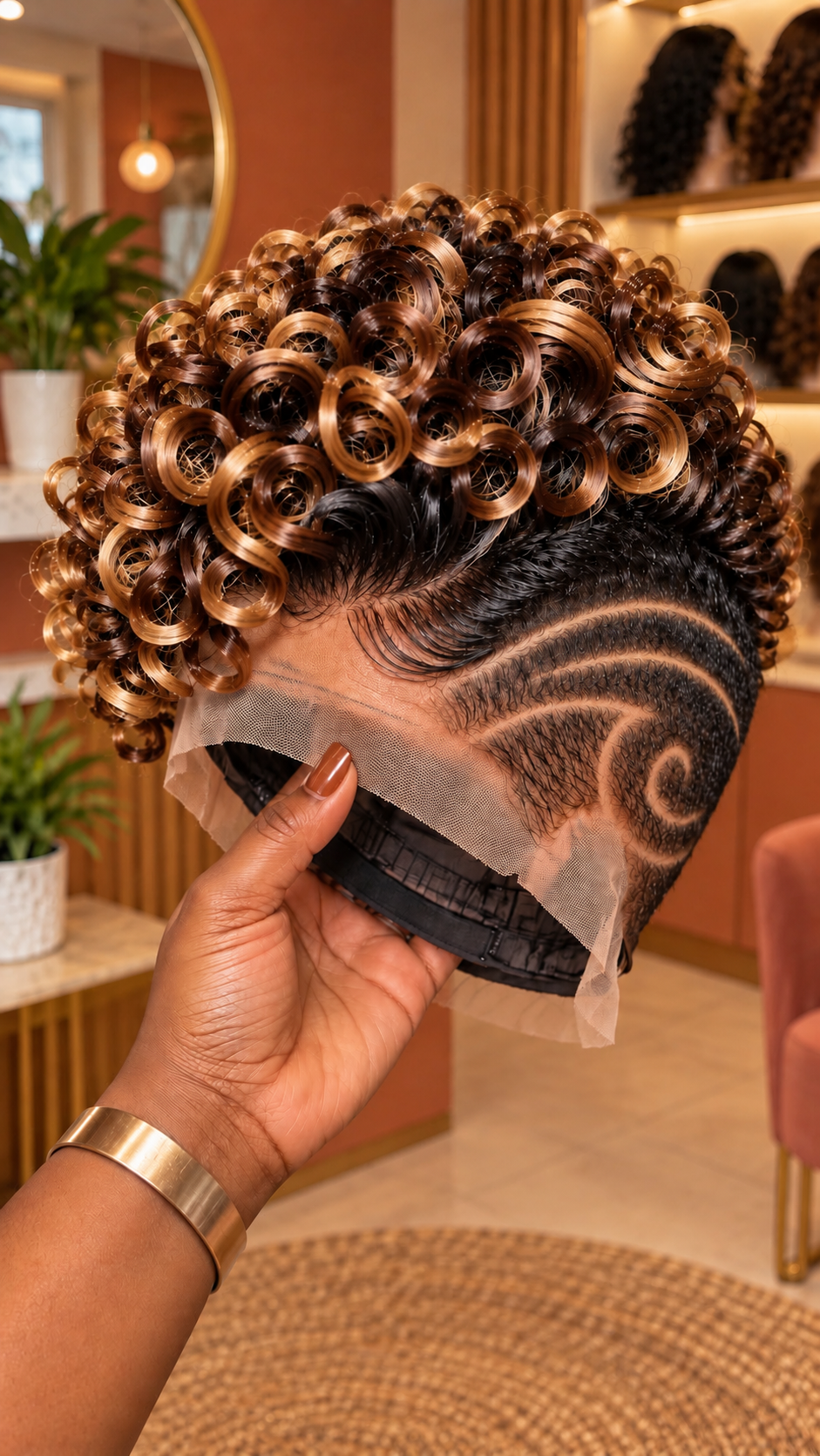
The deciding detail in this honey-caramel wig is the spiral carved into its dark side. It turns a conventional curved barber pattern into a more elaborate design with a circular ending, while the upper crown carries oversized golden-brown ringlets. Rather than distributing equal amounts of detail everywhere, the hairstyle creates two separate focal points: large open curls above and a compact spiral motif near the temple. The dark hair between them provides the contrast that allows both to remain recognizable.
This particular unit is photographed before installation. Its copper-gold and caramel ringlets have already been arranged across the crown, the side carving is visible, and untrimmed lace extends around the front and lower perimeter. Part of the dark interior cap can also be seen. The photograph provides useful information about the hairstyle’s construction, but it does not establish whether the hair is human or synthetic, whether the lace belongs to a particular commercial grade, or whether the unit is intended for adhesive-free wear.
For someone commissioning this wig, accurately reproducing the temple spiral is at least as important as matching the golden color. A seller could produce beautiful honey-brown curls and still deliver a noticeably different product if the lower carving were replaced by ordinary parallel lines. The shape of the side artwork must therefore be treated as an independent requirement from the beginning of the order.
Begin the Custom Order With the Temple Spiral
The side carving is the most distinctive element in this design. A long curved pathway travels beneath the crown before turning into a tighter circular formation near the lower temple. The spiral ending gives the pattern a different character from simple barber stripes or conventional crescent lines.


This is an important construction choice because the side occupies a relatively compact area. The stylist must preserve enough dark hair around the spiral for its center and outer curve to remain distinguishable.
A design that is too large could dominate the entire lower section. A spiral that is too small might lose its recognizable circular character when viewed from a normal distance.
The reference also shows additional sweeping channels above the spiral, creating a layered arrangement rather than one isolated decorative mark. Their curvature should lead naturally toward the circular ending.
When discussing the design with a wig maker or barber, use a direct side photograph and identify the spiral center, surrounding curved paths and amount of dark hair that must remain intact.
The Spiral Is Not the Same as Three Ordinary Side Lines
Many sculpted wigs use two or three parallel exposed lines beneath the crown. This unit begins with a related visual language but changes direction near the lower temple. The exposed pathway curls inward, forming a compact spiral.
That inward turn is essential. Removing it would produce a much simpler arrangement, even if the upper channels were accurately reproduced.
The spiral also relies on contrast within its center. Dark hair remains inside portions of the circular structure, helping the eye recognize the changing direction of the path.
For precision wig work, the maker should map the spiral before cutting. The placement of its central turn determines how the surrounding lines can be arranged without becoming crowded.
Because wig hair does not regrow, the entire shape should be approved before any permanent removal of strands.
The Crown Is Built From Oversized Golden Ringlets
Above the dark side, the crown contains a dense collection of large circular curls. Many have open centers that resemble hollow rolled ribbons rather than conventional hanging ringlets.
Several prominent coils occupy the front and middle crown, while smaller formations continue around the outer sections. This variation gives the upper hair a rounded silhouette without requiring excessive length.
The ringlets are close enough together to create fullness, but the major circular openings remain visible.
That balance should guide any recreation. Adding more hair indiscriminately could make the crown heavier while concealing the individual rings that provide much of its visual identity.
A custom stylist should therefore consider the size and spacing of the curls before deciding how much density is necessary.
Caramel and Honey Color Follow the Curl Surfaces
The crown appears within a warm honey, caramel and golden-copper family. Brighter golden reflections travel across the raised outer surfaces, while deeper brown remains visible inside the circular openings.
This produces tonal variation without a rigid half-and-half color division. Some curls are predominantly warm caramel, while darker sections create shadow beneath them.
The color works particularly well with the open ringlet construction because every curl contains several surfaces facing different directions. A strand that appears golden on its outer curve may look considerably darker as it turns inward.
Customers should request a color sample or neutral-light photograph before approving the shade. Warm salon lighting can make caramel appear more copper or orange than it will under other conditions.
The target is a rich golden-brown crown with substantial dark depth rather than an extremely pale blonde or uniformly bright orange hairstyle.
Black Roots Give the Upper Curls Their Foundation
Deep black and espresso-brown strands are clearly visible beneath the raised ringlets. They connect the brighter crown to the dark side and contribute to the shadow inside many of the curls.
This root depth is not an unfinished area waiting for additional blonde coloring. It is part of the design’s visual balance.
Without the dark foundation, the copper-gold curls could appear less dimensional and the contrast with the temple carving would become weaker.
For custom coloring, the maker should preserve black root depth rather than distributing honey blonde uniformly throughout the entire wig.
The transition should be evaluated after the curls are arranged, because color placement that looks balanced on straight strands can appear different inside circular ringlets.
The Front Ringlets Form a Rounded Sculpted Edge
Several of the largest curls sit close to the forward crown, creating a rounded elevated outline above the hairline. Their circular openings face outward at different angles, allowing the glossy strands to catch light individually.
This prevents the front from looking like one solid row of identical curls. Some ringlets appear more upright, while others lean toward neighboring sections.
The lower front contains finer dark strands beneath the copper curls. These strands lead toward the lace and help create a transition between the dense crown and the installation perimeter.
During fitting, the stylist should preserve these directional strands where appropriate rather than automatically removing them or rolling them into additional large curls.
The Side Hair Remains Close to the Foundation
The spiral artwork occupies a dark side section that is substantially flatter than the crown. Fine black strands create an even background, allowing the exposed pathways to remain visible.
This compact lower area is necessary because the upper ringlets already create significant volume. If the side were equally full, the contrast between the two styling zones would weaken.
The dark hair also serves as the material from which the spiral design is formed. Its density must be sufficient to preserve the areas between the exposed channels.
A stylist should avoid treating the lower side as a disposable area that can be shaved repeatedly. The retained strands are integral to maintaining the carved pattern over time.
The Upper Side Curves Lead the Eye Toward the Spiral
Above the circular temple ending, exposed paths travel backward beneath the crown. Their movement is curved and directional rather than straight.
The uppermost line marks a separation between the larger crown styling and the close side, while the lower arcs provide the transition toward the spiral.
This arrangement creates a visual progression: raised ringlets, dark directional side hair, sweeping channels and the inward-turning spiral near the lower temple.
Each section has a different function, so their proportions should be considered together.
For a faithful recreation, the carving should not be enlarged simply to make the spiral more dramatic. The relationship between its size and the surrounding curved lines is what makes the pattern balanced.
The Ear-Area Lace Needs Careful Individual Fitting
The photograph shows untrimmed mesh extending around the front and side, including a section near the ear-area boundary. This indicates that final fitting and perimeter preparation remain to be completed.
A professional should position the unit before deciding where the lace will be cut. This is especially important because the spiral artwork is fixed to the cap.
If the wig sits too far forward or backward, the circular side design will shift relative to the wearer’s temple and ear.
The installer should establish a comfortable cap position, examine the artwork’s alignment and only then determine the final lace trimming route.
The apparent lace shade in the photograph may be influenced by lighting. Buyers should confirm actual material and shade options directly with the seller rather than assuming a particular grade or transparency.
The Visible Interior Does Not Establish Every Cap Detail
Part of the dark wig foundation can be seen beneath the lace. The interior appears structured, but the photograph does not clearly reveal every attachment component or the complete adjustment system.
Customers should request a full underside photograph if cap construction is important to their purchase.
The supplier should explain available sizing, attachment preferences and whether the unit is intended for adhesive-free installation.
A visible lace front alone is not enough to verify HD lace or glueless suitability. Those are product specifications that require direct confirmation.
Cap Size Controls the Position of the Entire Side Pattern
Unlike natural growing hair, the wig’s carved design cannot shift independently from its foundation. Its final position depends on how the cap sits on the wearer.
A unit that is too loose may move backward during wear, while a cap pulled too far forward may position the spiral closer to the face than intended.
For custom production, measurements should follow the maker’s own instructions. Depending on the construction, these may include circumference, front-to-nape length and ear-to-ear width.
A local wig stylist can assist with measurements before ordering, especially when the temple artwork requires accurate placement.
Where to Commission This Particular Design
A specialist lace-wig maker experienced with sculpted ringlet crowns is a practical starting point. However, large hollow curls and precision barber-style carving are different technical tasks.
Not every professional skilled at producing copper curls can reproduce an inward-turning spiral on a compact wig side.
When evaluating a supplier, request examples of previous custom wigs showing circular ringlets and detailed side artwork. The side examples should demonstrate controlled channel width and preserved hair between exposed paths.
If one maker cannot perform both tasks, a coordinated arrangement may be possible. The wig specialist can prepare the crown and foundation, while a local professional experienced with wig-side cutting completes the final spiral after fitting.
The Production Brief Should Prioritize the Carved Shape
For this wig, the most useful custom brief begins with the temple design rather than color alone. Specify a dark close side with layered sweeping channels leading into one visible circular spiral near the lower temple.
The second requirement should describe the crown: large hollow ringlets in a compact rounded arrangement, with smaller supporting curls around the outer sections.
The third concerns color: warm honey caramel and copper-gold reflections over a dark black-root foundation.
Finally, confirm cap measurements, available lace shades, attachment preferences and whether the unit will arrive fully styled or require local finishing.
These specifications provide a more reliable guide than simply ordering a honey-blonde undercut wig.
Approve the Side Before Authorizing Permanent Cutting
Because the spiral is the most distinctive element, the buyer should request a direct side approval photograph. The image should reveal the complete spiral, the upper curved channels and the amount of dark hair remaining between them.
An elevated crown photograph should then show the diameter and placement of the large ringlets.
A rear three-quarter image can verify how the smaller curls continue around the back.
Where available, a short seller demonstration video can help establish that these photographs show the same finished unit rather than several different examples.
For a custom order, side geometry should be accepted before additional hair is removed because correcting an overly wide or misplaced spiral can be difficult.
Color Approval Should Consider the Effect of Curl Diameter
The large ringlets make the warm blonde highly visible because their outer surfaces provide substantial reflective area.
This means the same color may appear brighter on these open rings than on a densely curled wig with much smaller spirals.
When discussing the final shade, ask the maker to show the color on the arranged curls where possible.
A neutral-light photograph can help confirm whether the golden hue matches the intended honey-caramel appearance rather than becoming too orange or pale.
Pricing Should Reflect the Specialized Temple Artwork
The compact length of this wig does not automatically make it simple to produce. Creating large hollow ringlets requires careful placement, while the spiral temple design adds precision work that may involve a separate specialist.
Color processing, cap construction and lace preparation can further influence the quotation.
Estimated Pricing for a Honey Caramel Spiral-Temple Wig
| Category | Illustrative Price Range | Potential Customization |
|---|---|---|
| Premium Custom | $375–$660+ | Higher-grade hair, individualized sizing, planned honey-caramel coloring, large hand-arranged ringlets, precision spiral temple artwork and detailed lace preparation. |
| Standard Custom | $225–$395 | Prepared golden ringlet crown, established curved side channels and a spiral accent with standardized cap options. |
| Basic Human Hair | $130–$235 | A human-hair foundation requiring additional coloring, ringlet setting, precision side customization and installation. |
| Premium Synthetic | $90–$180 | A quality pre-colored and pre-set interpretation with potential curl-retention advantages but more limited future modification options. |
| Basic Synthetic | $45–$100 | A budget alternative where curl openings, color depth, spiral carving accuracy or cap construction may be simplified. |
These are illustrative budgeting estimates rather than confirmed prices for the photographed unit. Actual quotations vary according to material, seller location, labor, cap construction, shipping and installation.
Before paying, ask whether the quoted price includes the completed ringlet crown and the spiral side design. A cheaper foundation requiring extensive local customization can become more expensive than a finished custom unit.
The Long-Term Cost Depends on Preserving the Spiral
Unlike the ringlets, which may be professionally reset if they loosen, the carved side pattern cannot be rebuilt simply by allowing the wig hair to grow.
Repeated widening of the exposed spiral can gradually remove the dark hair needed to preserve its circular shape.
For this reason, maintenance costs should be considered before ordering. A buyer should know whether a local professional is available to maintain the artwork conservatively.
The best maintenance strategy may involve little or no cutting at many appointments.
Human Hair Offers More Restyling Options for the Crown
A human-hair version can be useful for customers who expect periodic professional curl restoration.
Individual circular ringlets may be reset when their openings begin collapsing, provided the hair is suitable for the technique.
However, honey-blonde and copper coloring may involve processing that influences heat tolerance.
A stylist should select temperatures according to hair condition rather than assuming all human-hair wigs tolerate aggressive hot-tool work.
Premium Synthetic Can Help Preserve the Original Rings
A well-made synthetic unit may retain its pre-set circular formations with relatively little daily manipulation.
This can appeal to customers who want the wig to remain close to its original design rather than frequently restyling it.
The tradeoff is limited flexibility. Heat tolerance varies, and conventional permanent hair dye should not be assumed compatible.
The exact fiber specification should be confirmed before attempting significant changes.
Wash the Crown Without Collapsing the Circular Openings
Before washing, photograph the ringlet crown from above and from the side. These images record the placement of the largest rings and the smaller curls supporting them.
Avoid aggressive rubbing between neighboring curls. Excess friction can cause the strands to intertwine, reducing the visible openings.
Use products appropriate for the confirmed material and allow the wig to dry without compressing the crown.
Afterward, restore only the curls that have moved rather than automatically reconstructing the entire hairstyle.
The Spiral Artwork Requires Preservation, Not Repeated Enlargement
During routine inspection, check whether fine strands have moved across the exposed channels.
If the carving remains recognizable, additional cutting may not be necessary. Repositioning displaced strands can sometimes restore its appearance.
When refinement is required, the stylist should compare the pattern with the original photograph and preserve the width of the circular ending.
Maintaining the dark hair inside and around the spiral is essential for long-term accuracy.
Heavy Styling Products Can Hide the Ringlet Structure
The honey-caramel ringlets already have strong reflective surfaces. Excessive oils or waxes may cause adjacent strands to stick together and reduce their visible openings.
Product buildup can also alter the perceived shade, making the brightest golden sections appear darker.
Use only what the confirmed material requires. When residue becomes noticeable, appropriate cleansing may restore the original appearance better than another layer of shine product.
Installation Should Be Completed Before Optional Side Refinement
When the wig arrives, inspect the crown, color, temple spiral, lace and cap before permanent alterations.
The installer should establish the wearing position and check where the spiral falls relative to the wearer’s ear and temple.
Only after that alignment is approved should the excess lace be trimmed and any remaining side adjustment considered.
If the carved pattern already matches the reference, further cutting may not be beneficial.
Storage Should Protect Both Crown and Side Artwork
A suitable wig stand or mannequin head can help preserve the large circular ringlets between wears.
The spiral side should remain free from pressure, as compressed strands may shift across the exposed pathways.
Make sure the cap and lace are fully dry before storage.
During transportation, use packaging deep enough to protect the raised crown without forcing the ringlets inward.
The Spiral Side Design Makes This Wig a Distinct Custom Piece
This honey-caramel wig succeeds because two different visual structures complement each other. Large golden ringlets dominate the crown, while black roots and a compact side provide a darker foundation. Sweeping channels then lead into a circular spiral near the lower temple, creating an unmistakable geometric signature.
For buyers, the essential quality checks are the diameter of the open ringlets, their warm caramel color, the amount of black root depth, the curvature of the upper side channels, the accuracy of the spiral ending, the condition of the lace and the cap’s fit.
For wig businesses, this design benefits from detailed photography that shows the entire side rather than only the crown. An overhead image can reveal the ringlet construction, while a direct profile demonstrates the spiral carving that distinguishes the unit from ordinary honey-blonde curly wigs.
A successful recreation should maintain the original proportions instead of exaggerating them. Larger curls, brighter color or a deeper spiral are not automatically improvements. Preserving the balance between open golden ringlets and precise dark-side artwork is what gives the finished wig its recognizable character.
Search Terms
honey caramel spiral temple wig · golden hollow ringlet crown · black root honey curl wig · circular carved side design wig · spiral undercut lace wig · amber brown sculpted coils · nested curved temple hairpiece · untrimmed lace golden wig