
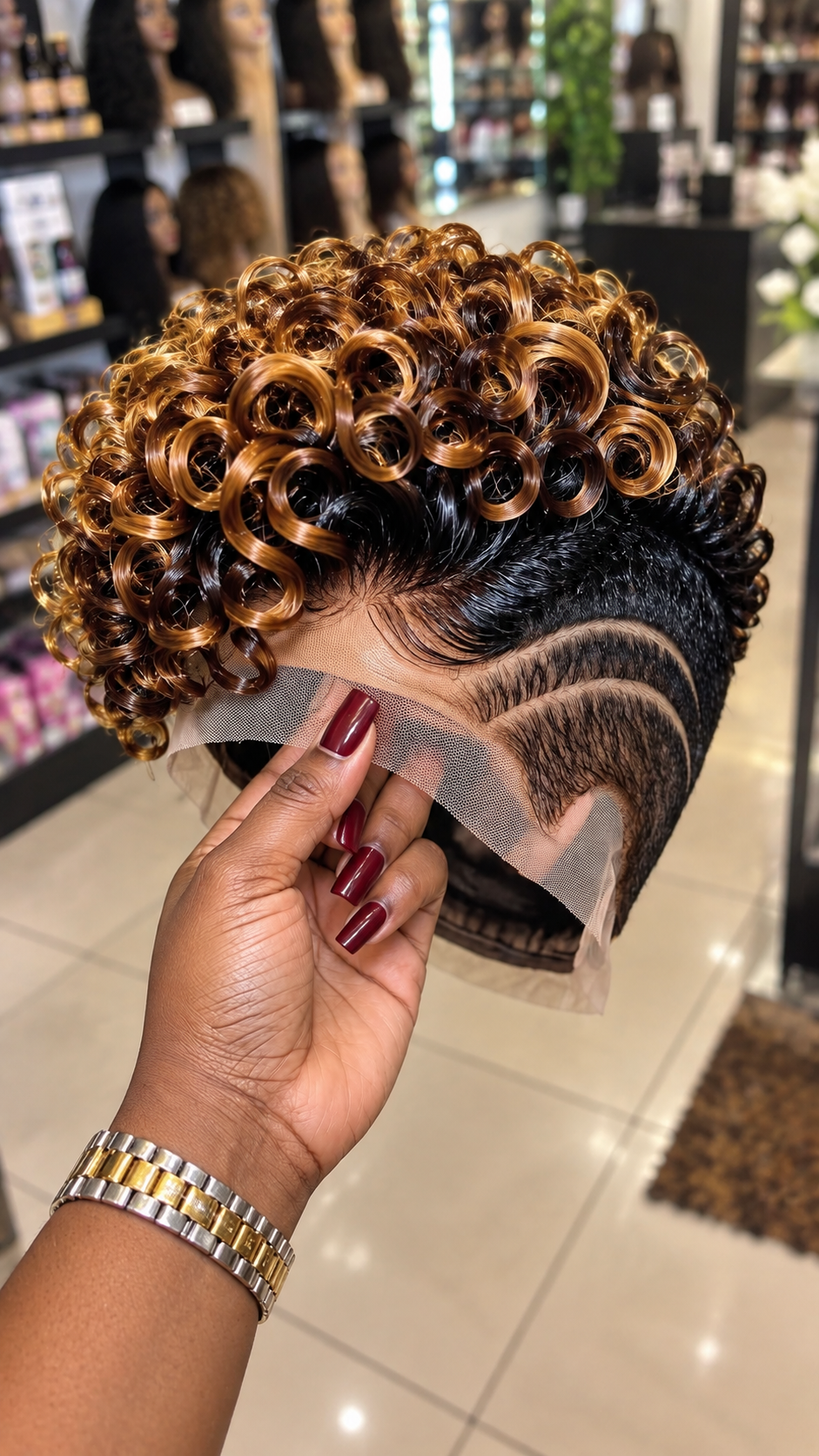
A successful custom wig purchase begins with knowing which details must survive the journey from an inspiration photograph to a finished hairpiece. In this golden caramel ringlet wig, the essential details are unusually easy to identify: a crown of large hollow circular curls, a deep jet-black foundation, a softly swept front transition and two prominent crescent-shaped side channels. The warm blonde and dark hair work together rather than competing, while the compact side leaves plenty of visual attention for the sculpted ringlets above.
The wig is photographed in a beauty supply store before installation. A hand holds the extended lace at the front, allowing the circular crown, temple carving and part of the interior cap to be seen simultaneously. This is useful for a buyer because the photograph reveals the appearance of the unit before lace trimming and final fitting. The image confirms visible lace and a structured hairpiece, but it does not establish the precise fiber, lace grade or whether the wig is suitable for adhesive-free wear.
What deserves particular attention is the pairing of golden caramel spirals with the black side. The upper curls contain lighter honey-gold surfaces and darker brown recesses, while the side remains closely arranged and almost entirely black. Two sweeping exposed lines follow the shape of the temple, creating a layered crescent arrangement without additional decorative marks. Together, these choices produce a wig whose construction is more specific than an ordinary blonde curly pixie.
The Buyer Should Identify the Non-Negotiable Details First
When ordering a custom wig from a photograph, it is tempting to begin with the color. In this case, the most useful starting point is the construction. The large circular curls are not interchangeable with loose ringlets or very small finger coils. Their hollow centers, rounded outer surfaces and closely arranged placement are essential to the upper silhouette.
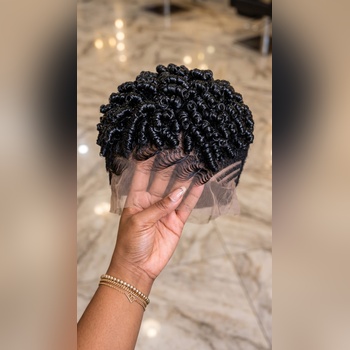
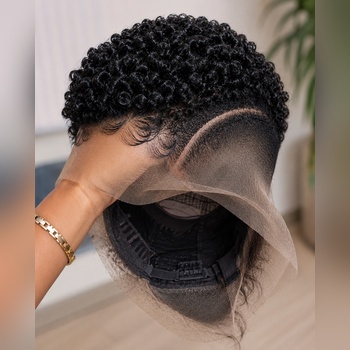
The second requirement is the black foundation. It remains visible beneath the ringlets and continues through the lower side, providing the contrast that makes both the golden crown and the carved lines stand out.
The third requirement is the side geometry. Two curved channels travel through the close dark hair, with a substantial retained panel separating them. Their proportions need to remain recognizable even when the wig is viewed from a natural side angle.
A seller should confirm these three characteristics before discussing optional adjustments. If one is changed substantially, the finished unit may no longer resemble the reference.
Large Hollow Ringlets Create the Crown’s Main Architecture
The crown contains numerous individually rolled curls with clearly visible circular centers. Several of the largest openings appear toward the forward and central upper sections, while smaller ringlets fill the surrounding spaces.
Unlike hanging ringlets, these curls remain arranged close to the rounded crown. Their outer ribbons rise enough to become visually prominent but do not extend into long lengths around the shoulders.
The openings inside the rings are especially important. They reveal darker strands and create contrast within the warm color. Filling every opening with additional hair would make the crown denser but could also remove the sculptural character that distinguishes this wig.
A custom stylist should therefore maintain a mixture of large and medium-sized loops with enough space for the individual formations to remain visible.
Golden Caramel and Dark Brown Need to Be Balanced
The upper curls appear in a warm golden caramel family, with honey, amber and light copper-brown reflections across their raised surfaces. Recessed portions are darker, ranging visually from rich brown to almost black where the deeper foundation shows through.
This color arrangement gives the ringlets depth without creating a rigid half-and-half split across the crown. Some curls appear brighter than their neighbors because they face the salon lighting more directly.
The photograph does not establish a specific manufacturer shade code or the number of colors used during production. For accurate ordering, a visual reference is more reliable than relying only on terms such as honey blonde, caramel blonde or golden brown.
Request a neutral-light photograph of the actual available hair, especially if avoiding an overly orange or pale blonde result is important.
Jet Black Roots Give the Golden Curls a Stronger Outline
Deep black is visible around the base of the ringlets and throughout the closely arranged side. This foundation makes the golden sections appear brighter by comparison and supplies dark interior spaces beneath the curls.
It also creates continuity between the crown and the temple artwork. Although the upper hair uses rounded forms and the lower side uses narrow curved channels, the black foundation connects both areas visually.
A recreation with golden color extending throughout the roots and side would have a different appearance. The exposed side lines might become less prominent, and the crown could lose some of its depth.
For a custom commission, black-root placement should be confirmed as a separate requirement instead of assumed from the reference photograph.
The Crown’s Volume Comes From Curl Placement, Not Excess Length
Although the ringlets create a full upper surface, the wig remains compact in silhouette. The curls are densely arranged around the crown rather than extending downward into a longer hairstyle.
The largest curls provide the main visual weight. Smaller loops fill gaps near the outer sections and help maintain a rounded shape. Their distribution gives the upper hair fullness without requiring exaggerated height.
A buyer should inspect the finished wig from above to determine whether the curl sizes are balanced. One oversized section or a large unfilled area can change the overall appearance.
The goal is a coherent crown in which prominent circular openings coexist with smaller supporting coils.
The Double Crescent Channels Are the Side’s Signature
The lower side contains two distinct sweeping exposed pathways. Their shape follows the rounded temple rather than cutting straight across the hair. The upper channel sits nearer the crown, while the lower follows a related route beneath it.
The pattern is recognizable because the dark hair between the channels remains substantial. That retained panel creates a layered crescent appearance and prevents the exposed areas from merging.
These are not three or four ordinary barber stripes, nor is the visible design a full circular spiral. Reproducing the reference means maintaining the two prominent arcs and their flowing direction.
During custom construction, the stylist should map the channels before permanently removing hair. On a wig, an overly wide path cannot be corrected through natural regrowth.
The Swept Front Hair Connects the Crown to the Side
Between the large golden curls and the temple channels, fine black strands travel backward in a coordinated direction. This section is flatter than the ringlet crown and creates an elegant transition into the close side.
The directional movement is important because it prevents the copper-gold ringlets from ending abruptly against the lace or carved hair. Instead, the hairstyle changes scale gradually: large circles above, elongated dark strands beneath and close hair along the side.
A custom stylist should preserve those separate areas during preparation. Turning every front strand into another circular curl would change the visual relationship between crown and temple.
Fitting Must Preserve the Position of Both Crescent Lines
The side artwork is fixed to the cap, which means the carved pattern moves whenever the wig is repositioned. If the unit sits too far forward, the crescents may approach the face differently. If the cap shifts backward, they move farther from their intended temple position.
This makes accurate sizing particularly important for buyers who want the side geometry to match the photograph.
Follow the supplier’s measurement instructions and confirm whether circumference, front-to-nape and ear-to-ear dimensions are required. A professional wig stylist can assist with these measurements before a custom order.
The final side alignment should be assessed on the wearer before additional cutting is considered.
What the Untrimmed Lace Reveals About the Installation Stage
The photograph shows a broad mesh perimeter beyond the hair-bearing front and around the side. This indicates that the lace has not yet been trimmed to an individual wearer’s final outline.
Retaining that material can be useful during professional installation. The stylist can establish the cap position, assess the front transition and then determine where the excess lace should be removed.
The mesh appears beige-brown under the shop lighting, but the image alone cannot establish its actual shade or commercial grade. The seller should confirm those details directly.
A lace front should not automatically be advertised as HD lace, and a partially visible interior cap does not prove that the unit can be worn securely without adhesive.
How to Choose Between Ready-Made Stock and a Custom Commission
If a seller has the exact wig available as finished inventory, the purchasing process can concentrate on inspecting the specific unit, confirming material and ensuring the cap will fit.
If the wig must be commissioned, the maker needs a more detailed construction brief. The buyer should specify large hollow golden ringlets, dark roots, closely arranged black side hair, swept front strands and two crescent-shaped channels.
Custom wig studios and salons experienced in sculpted ringlet crowns and precision wig cutting are appropriate places to inquire. A general wig retailer may offer a suitable foundation, but the completed side pattern and crown construction could require additional professional services.
When contacting sellers, ask whether their quotation covers the fully arranged hairpiece or only the base wig.
Approval Photographs Should Answer Specific Questions
An elevated crown photograph should show whether the ringlet centers remain open and whether the sizes vary naturally across the upper surface.
A direct side photograph should display the two curved channels, their spacing and the amount of black hair retained between them.
A rear three-quarter image should show how the curls continue around the back. The supplied photograph does not fully establish every rear detail.
Finally, request an underside photograph when cap construction, attachment components or lace specifications are important to the purchase.
Each image should help resolve a specific decision rather than merely repeat the same flattering angle.
Build a Price Quote Around the Labor That Matters
This design can require substantial work despite its compact length. The crown contains numerous individually arranged curls, the dark-root color balance must be maintained, and the side channels need precise placement.
The most useful quotation separates hair or fiber cost from styling, side customization, cap preparation and installation.
Estimated Custom Wig Pricing by Material and Craftsmanship
| Category | Illustrative Price Range | Possible Included Work |
|---|---|---|
| Premium Custom | $355–$635+ | Higher-grade hair, individual measurements, custom golden caramel coloring, hand-arranged hollow ringlets, precision double-crescent side detailing and personalized lace preparation. |
| Standard Custom | $215–$385 | Prepared two-tone ringlet crown, black side foundation, established curved channels and more standardized sizing. |
| Basic Human Hair | $125–$230 | A human-hair foundation that may require professional color work, ringlet construction, side customization and fitting. |
| Premium Synthetic | $85–$175 | A higher-quality pre-colored, pre-set alternative with potential advantages in retaining the circular curl pattern. |
| Basic Synthetic | $40–$100 | A lower-cost interpretation where ringlet variation, tonal depth, side precision or cap construction may be simplified. |
These figures are illustrative budgeting estimates rather than verified prices for the photographed unit. Material, seller location, customization, cap construction, labor, shipping and installation can change the final amount.
A cheaper base may require several specialist appointments before resembling the reference. Compare the complete expected cost rather than choosing by the initial wig price alone.
Human Hair and Synthetic Fiber Change the Maintenance Strategy
Human hair may offer greater flexibility for professional reconstruction of individual ringlets. If several curls loosen, a stylist may be able to reset them without rebuilding the entire crown.
However, achieving golden caramel color on a dark base may require processing, depending on the starting hair. Future heat and chemical work should be guided by the actual condition of the strands.
A quality synthetic option may retain its pre-set circular shape with less frequent professional resetting. The tradeoff is that substantial restyling and conventional recoloring may not be practical.
Since the material cannot be verified from the image, buyers should obtain the fiber specification before choosing maintenance products or heated tools.
A Preservation Plan for the Open Golden Rings
The largest ringlets are visually important because their hollow centers create much of the crown’s appearance. When a major opening collapses, that section can look noticeably different even if the surrounding curls remain intact.
Before washing, photograph the crown from above. During cleansing, avoid aggressive rubbing that mixes neighboring ringlets. Follow the instructions appropriate for the confirmed material.
After drying, identify which individual curls need attention. Reconstructing only displaced sections can reduce unnecessary handling and preserve the original placement.
Heavy waxes and oils should also be used cautiously because buildup can cause neighboring ribbons to adhere together and obscure their openings.
The Crescent Pattern Should Not Be Recut on a Calendar
Unlike natural growing hair, a wig does not need routine carving simply because several weeks have passed. The two exposed channels are already permanent parts of the construction.
If fine strands shift across the openings, repositioning may restore their appearance without cutting. When actual refinement is necessary, compare the side with the original photograph.
The most important precaution is to preserve the black hair separating the crescents. Gradually widening the channels can eventually remove the panel that makes them individually recognizable.
For a buyer, identifying a local professional who understands conservative wig-side maintenance can be useful before purchasing an expensive custom unit.
Installation and Storage Should Protect the Completed Styling
When the wig arrives, inspect its ringlets, root depth, side channels, lace and cap before allowing permanent modifications. If a made-to-order unit differs materially from what was approved, contact the seller before trimming.
The first installation appointment should establish cap placement and the position of the temple artwork. Once those details are correct, the stylist can prepare the lace and address any curls displaced during shipping.
Between wears, use a suitable wig stand or mannequin head with enough space for the raised circular coils. Avoid pressing the crown beneath other items or allowing the side to rest against a hard surface.
The cap and lace should be completely dry before storage. For travel, packaging should protect the ringlet openings rather than flattening them.
The Final Inspection Should Be About Accuracy, Not Added Drama
The defining quality of this wig is the balance between the golden caramel crown and the dark geometric side. The large hollow ringlets attract attention through color and circular construction. Black roots create depth beneath them, while two crescent-shaped channels introduce a flowing temple pattern without overwhelming the lower section.
For buyers, the most important checkpoints are the ringlet diameters, visible centers, golden-to-dark color balance, directional front strands, curvature of both side channels, retained black hair, lace condition and cap fit.
For wig businesses, individual overhead, side and underside photographs can communicate the value of the styling more effectively than a general claim that the product is a blonde curly wig. Buyers should understand what is completed, what can be customized and which specifications still require confirmation.
The strongest recreation is not necessarily the one with brighter blonde, larger curls or deeper carved channels. It is the one that faithfully preserves the relationship between the open golden ringlets, black foundation and double crescent artwork, while providing the construction and fitting information needed for a practical purchase.
Search Terms
golden caramel hollow ringlet wig · jet black root honey curls · double crescent temple wig · black side golden coil crown · sculpted blonde circular curls · two curved temple channels · caramel lace front hairpiece · untrimmed lace ringlet wig