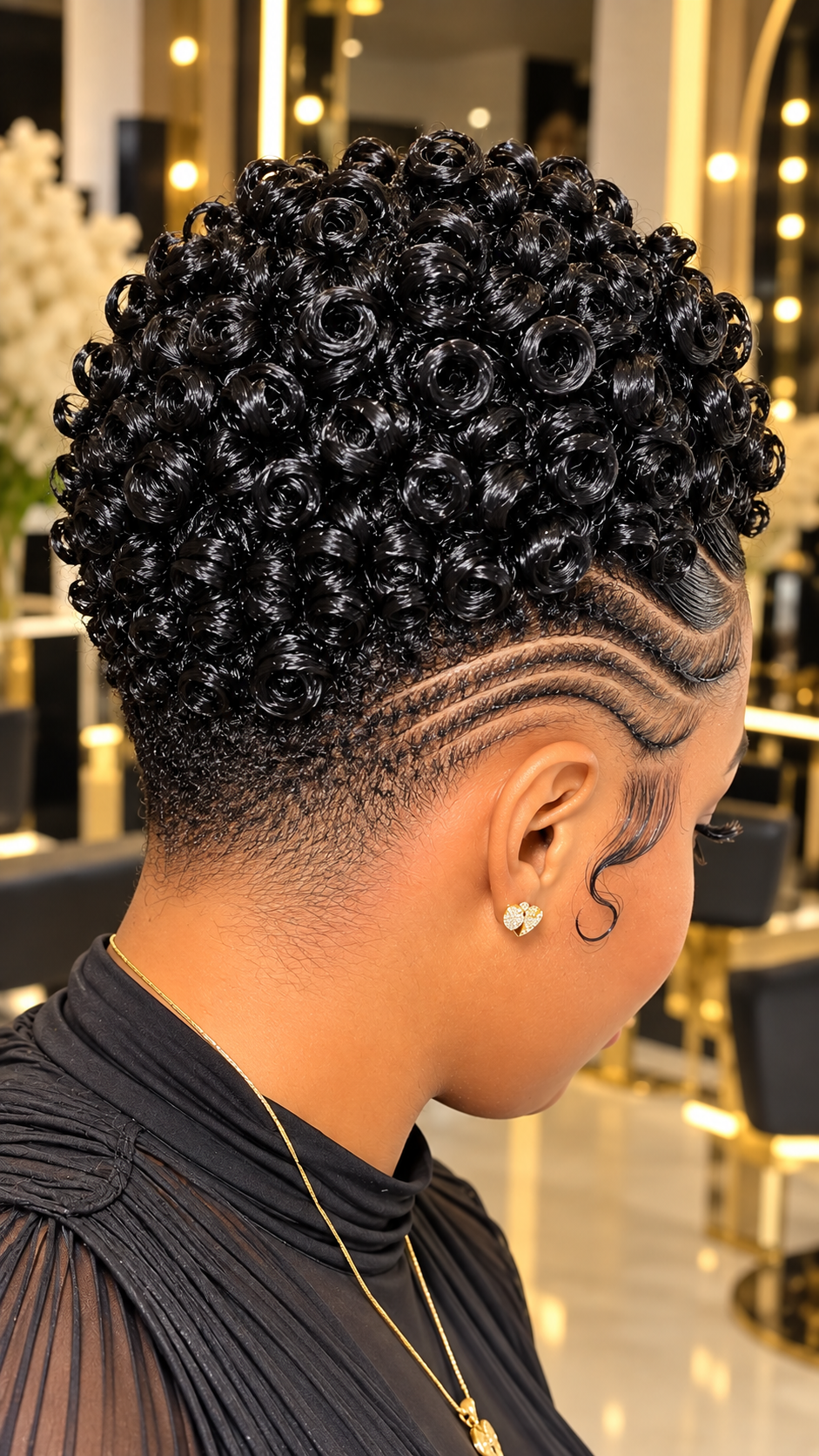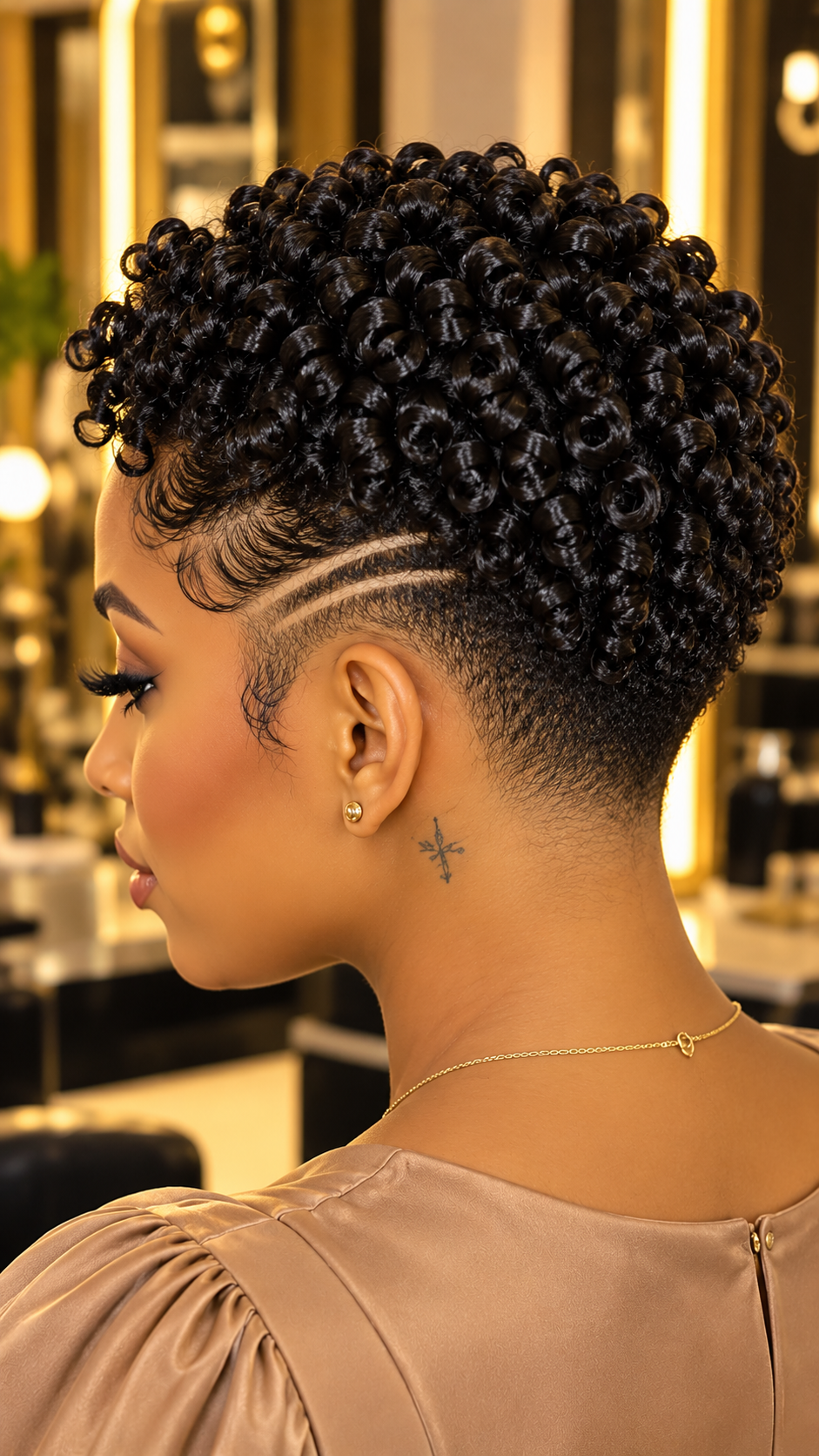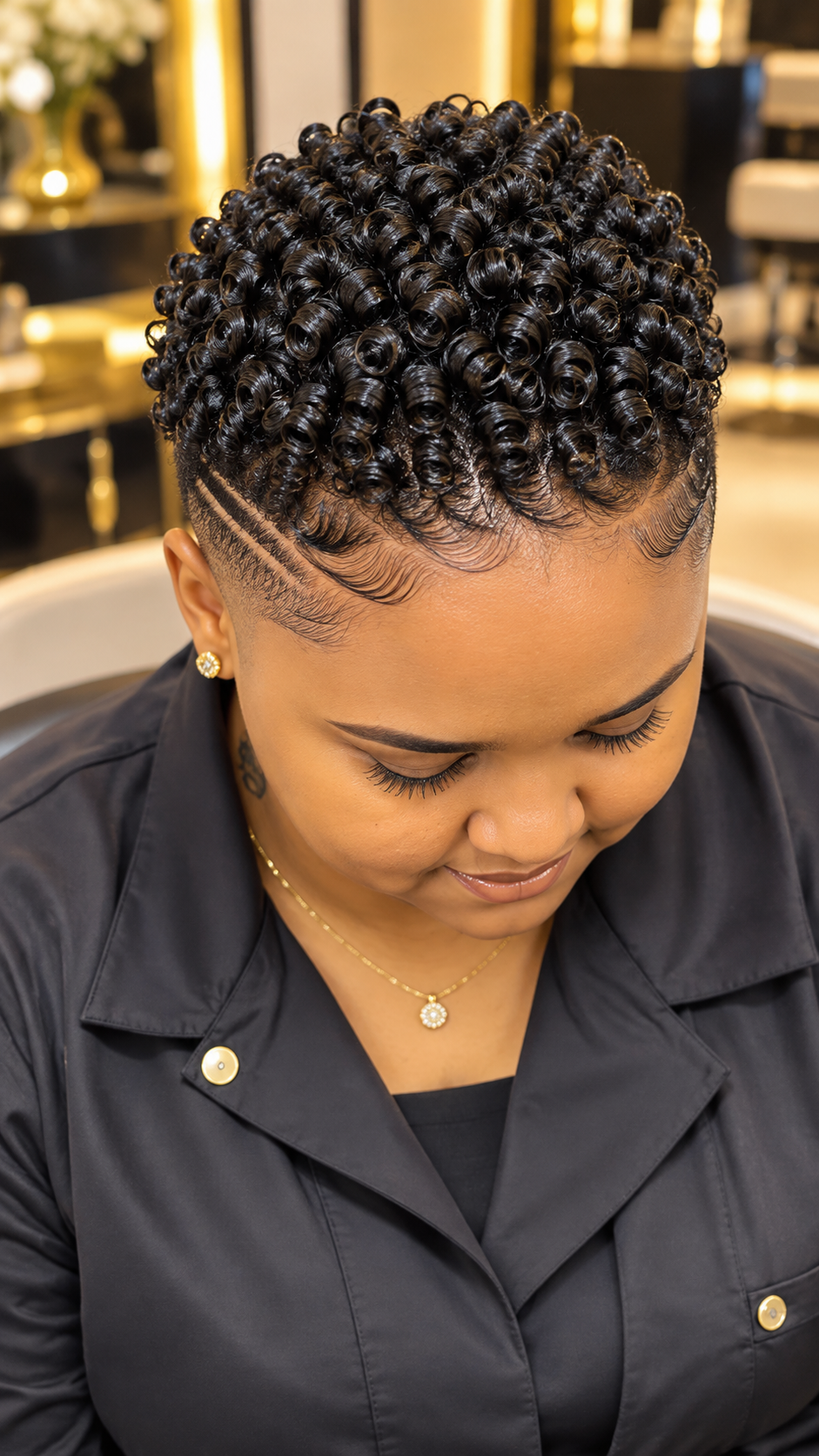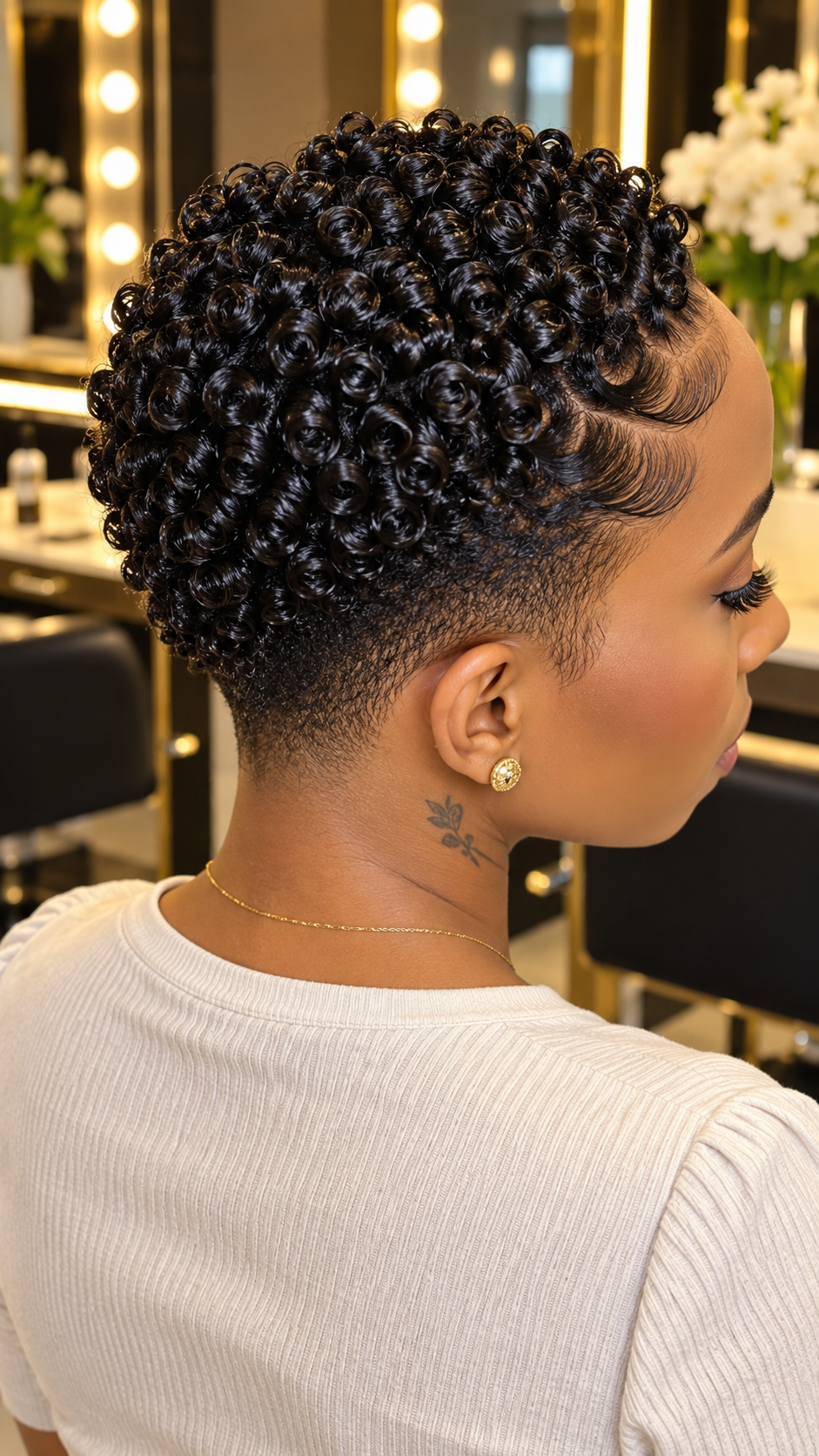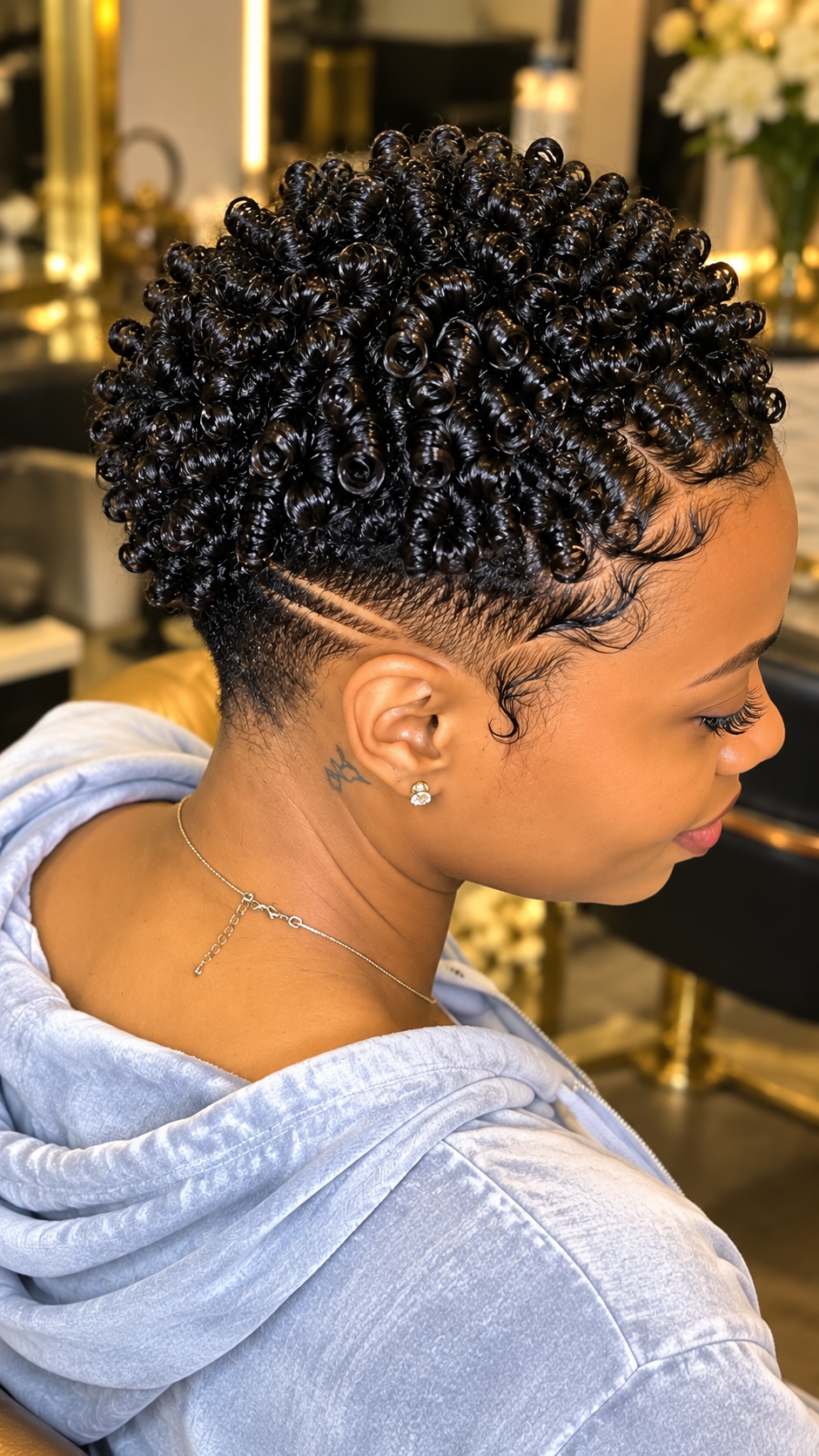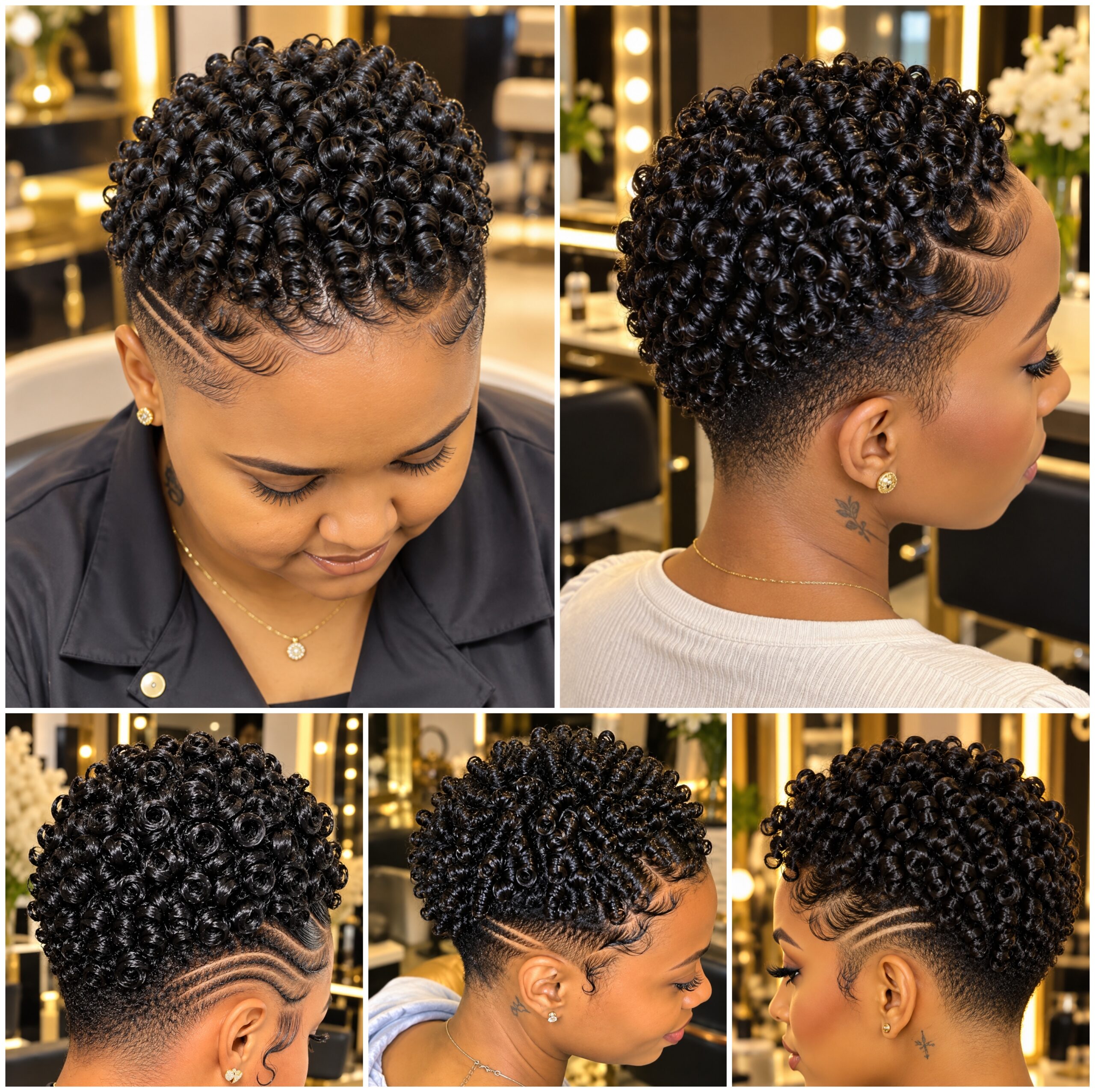
A great pixie haircut does not need dramatic length to create personality. The combination of a low taper and a lively crown of spiral coils offers a distinctive way to celebrate natural curls while keeping the sides and neckline closely shaped. The appeal comes from contrast: compact hair around the lower head supports a fuller collection of springy curls above, creating a balanced silhouette that can be adapted to different face shapes, curl patterns, and personal styling preferences.
For women with naturally curly or coily hair, this hairstyle offers an opportunity to retain visible curl movement without maintaining a longer haircut. The crown provides height and dimension, while the low taper reduces bulk around the ears and nape. Depending on the natural curl pattern, the upper coils may form tiny circular spirals, larger spring-shaped curls, or a combination of closely grouped ringlets.
The hairstyle can be created directly on natural hair or reproduced through a carefully constructed pixie wig. These two approaches involve different considerations. A natural haircut depends on the client’s existing hair density, growth pattern, and curl behavior, while a wig allows greater control over the starting shape, color, and arrangement.


Understanding those differences helps customers choose the right stylist, establish realistic expectations, and avoid ordering a wig that resembles the desired haircut only in its product description.
The Relationship Between a Low Taper and a Full Coil Crown
The defining characteristic of this hairstyle is the gradual reduction in hair length around the lower sides and back while maintaining longer curls across the upper head.
A low taper concentrates the shortest hair near the sideburns, lower temples, and neckline. Unlike a high fade, which removes considerable volume farther up the head, a low taper preserves more hair around the upper sides.
This allows the crown to remain visually connected to the surrounding hair rather than appearing as an isolated section sitting above extremely bare sides.
The upper curls provide the primary styling interest. Depending on the client’s hair, they may form compact spirals, springy finger coils, or naturally clustered ringlets.
The ideal transition should suit the wearer’s head shape. A very narrow crown may appear disproportionate on some people, while excessive upper volume can overwhelm a compact haircut.
For a balanced result, the barber and curl stylist should agree on the intended crown height before removing length from the sides.
Choosing the Right Coil Size for the Crown
Not all coily crowns create the same appearance. Curl diameter influences the hairstyle’s silhouette, movement, and maintenance requirements.
Fine Spring Coils for Intricate Detail
Small coils create a densely curled upper surface with numerous individual spirals. This approach works particularly well when the client wants visible curl detail without excessive height.
Hair with a naturally tight curl pattern may form small spirals through finger coiling or other appropriate setting techniques. The finished size depends on strand length, moisture, shrinkage, and the products used.
Fine coils can appear especially intricate when photographed close to the hair, but they may require patience during styling and separation.
Medium Ringlets for Noticeable Bounce
Medium-sized coils create more obvious circular formations. Their individual shapes are easier to distinguish, and the crown may appear more open than a densely packed collection of tiny curls.
This variation can be attractive for women who want a playful pixie silhouette with visible curl movement.
The final appearance depends on the hair’s natural elasticity. Coils that appear long while wet may contract considerably as they dry.
Mixed Coil Sizes for a Softer Silhouette
A combination of smaller and medium spirals can create a less uniform appearance. Larger curls may occupy the central crown, while smaller coils fill the surrounding sections.
This approach can be useful when the client’s natural hair has varying curl diameters across the head.
Rather than forcing every section into identical spirals, the stylist can work with the existing curl pattern while maintaining a consistent overall shape.
Where the Taper Should Begin
The location of the taper influences how the haircut looks from the front, side, and back.
For a traditional low taper, the shortest area remains relatively close to the lower hairline. The transition gradually moves into longer hair above.
A barber should avoid extending the fade too high if the client wants to retain fullness around the upper sides.
At the temples, the taper can create a subtle contour around the face. Near the ears, it can reduce unwanted bulk while preserving enough hair to connect with the upper curls.
At the nape, the taper can provide a neat transition into the neckline without removing excessive hair from the back of the head.
These details should be adjusted to the individual’s hair density and growth direction. A photograph of a low taper on one person does not guarantee identical results on another.
How Crown Height Changes the Overall Appearance
The crown can be styled relatively close to the head or allowed to rise into a fuller rounded shape.
A compact crown emphasizes the precision of the taper and the individual curl pattern. It can be a practical choice for women who prefer a hairstyle with limited outward projection.
A slightly elevated crown creates more contrast with the lower sides. It also allows larger coils to become more noticeable.
However, height should not be confused with excessive bulk. A well-proportioned pixie should follow the natural shape of the head rather than creating an unusually large upper silhouette.
For custom wig orders, crown height should be discussed in relation to cap dimensions. A hairstyle that looks proportionate on a mannequin may appear different on the intended wearer.
Natural Hair Versus a Pixie Wig
Choosing between a natural haircut and a wig depends on the customer’s goals, existing hair, and willingness to maintain the style.
A natural low taper requires cutting the sides and neckline. The upper hair must have enough length to form the desired coils after shrinkage.
This option may appeal to women who enjoy wearing their natural curls and are comfortable maintaining a tapered haircut.
A pixie wig provides an alternative for customers who do not want to cut their natural hair. It may also allow experimentation with different curl sizes or colors.
However, a wig must be constructed to reproduce the taper convincingly. A generic curly unit with uniformly dense sides will not necessarily create the same silhouette.
Buyers should evaluate the relationship between the crown and lower side sections rather than focusing only on the wig’s advertised length.
Finding a Barber Who Understands Coily Hair
A successful natural-hair version often requires both cutting precision and knowledge of curl behavior.
Look for barbers or natural-hair stylists who regularly work with tapered cuts on tightly curled hair.
Review their portfolios for examples of low tapers that retain substantial crown volume. Pay attention to the position of the fade around the ears and nape.
When booking, explain the desired relationship between the shorter sides and the longer coily crown.
Bring reference photographs showing the front, side, and back whenever possible.
If the crown will be finger-coiled, ask whether the barber provides curl styling or whether a separate natural-hair stylist should complete the upper section.
For first-time clients, discussing shrinkage before cutting is particularly important. Hair that appears long when stretched may look considerably shorter once the curls return to their natural shape.
Creating Bouncy Finger Coils on Natural Hair
Finger coils are one possible way to produce the springy upper appearance associated with this hairstyle.
The process generally begins with properly cleansed and conditioned hair. The stylist then works with manageable sections, applying products suited to the hair’s needs and the desired hold.
Individual sections can be rotated around a finger to encourage spiral formation. The appropriate section size depends on the desired coil diameter and the hair’s natural behavior.
Smaller sections typically produce finer coils, while larger sections may create broader spirals.
The hair should be allowed to dry sufficiently before excessive manipulation. Separating or stretching the coils too early can affect their appearance.
Product selection should account for scalp comfort, buildup, and the hair’s response to moisture. Heavy products are not automatically necessary for a successful result.
The stylist should also avoid placing unnecessary tension on fragile hairline areas.
Color Options That Complement a Coily Pixie
Natural black is a versatile choice because it emphasizes the spaces and reflections between individual curls.
Espresso and dark chocolate brown offer a similarly deep appearance with warmer reflections under daylight.
Mocha and cinnamon brown can make individual coils more noticeable, particularly when the crown receives direct light.
Copper and auburn introduce stronger warmth, while burgundy can create a deeper red appearance.
For women interested in lighter colors, honey blonde or caramel accents may emphasize selected curls without requiring a uniformly light crown.
These are possible styling choices rather than characteristics that every low taper pixie must contain.
When coloring natural hair, the stylist should evaluate previous chemical treatments and the condition of the curls. Lightening can affect hair strength and curl behavior.
For wigs, color options depend on the confirmed fiber material. Conventional human-hair coloring methods should not be assumed suitable for synthetic fibers.
Ordering a Wig That Resembles a Real Low Taper Haircut
The most important requirement is the distribution of hair length and density.
The upper section should contain enough hair to form visible springy coils, while the lower sides should appear closely arranged and proportionate.
Ask the supplier whether the wig was specifically constructed to resemble a tapered haircut or simply styled with curls across a standard cap.
Request photographs of the front, both sides, and rear. These views help establish whether the taper continues naturally around the head.
The underside should also be photographed so the buyer can inspect the cap construction and attachment system.
Do not assume that every tapered pixie wig includes lace, adjustable straps, or adhesive-free securing components. Those specifications must be confirmed for the individual product.
If a custom unit is being commissioned, provide head measurements and explain the desired crown height, curl diameter, and side density.
What to Ask Before Purchasing Online
Product photographs should be evaluated carefully, particularly when a listing uses broad descriptions such as curly pixie wig or natural hair wig.
Ask whether the photographs show the actual unit being sold. Confirm the hair material, cap size, available colors, and expected curl behavior after washing.
If lace is included, request information about its coverage, shade, and construction. A photograph alone cannot verify that the product uses HD lace.
For a ready-made wig, ask whether the crown curls can be restyled and whether the lower taper can be adjusted without exposing the cap.
For custom production, request written confirmation of the agreed hairstyle and any limitations related to the selected material.
Review the seller’s alteration and return policies before paying, especially for personalized products.
Illustrative Price Planning for Tapered Pixie Wigs
The price of a tapered pixie wig depends on the material, cap construction, curl arrangement, and degree of customization.
A unit with carefully arranged individual coils and a realistic lower taper may require more labor than a basic curly wig.
The following US dollar ranges are illustrative budgeting estimates, not verified live retail prices. They describe potential wig purchasing categories rather than the cost of a natural haircut.
| Wig Category | Illustrative USD Range | Potential Purchase Scope |
|---|---|---|
| Premium Custom | $290–$710+ | Individual cap sizing, specialized coil placement, tailored taper proportions, and detailed hairline customization. |
| Standard Custom | $150–$365 | Selected adjustments to curl size, crown density, side shape, and cap fit. |
| Basic Human Hair | $90–$245 | A human-hair base wig that may require additional cutting and professional coil setting. |
| Premium Synthetic | $60–$180 | A higher-grade synthetic option with potentially prearranged curls and a prepared tapered silhouette. |
| Basic Synthetic | $25–$95 | A budget alternative with potentially limited customization and curl-restyling flexibility. |
Actual quotations may differ substantially according to the supplier and the services included.
Installation, shipping, lace preparation, additional cutting, and future curl restoration may be charged separately.
For a natural haircut, barber pricing should be requested directly from the salon because it is a separate service from wig purchasing.
Planning the First Wig Fitting
After receiving a tapered pixie wig, inspect the upper curls and lower sides before making adjustments.
Check whether the crown has the expected height and whether the sides appear balanced.
At the salon, the stylist should position the cap and assess the hairline, temple coverage, and nape area.
If the wig includes lace, any necessary trimming should follow the fitting assessment.
Cutting the lower hair to create a stronger taper should be approached cautiously. Unlike natural hair, a wig may contain cap material immediately beneath the strands.
Ask the stylist whether the desired adjustment is possible without exposing the construction.
For adhesive-free installation, confirm that the cap and securing components are suitable for the wearer’s measurements and needs.
Maintaining Coil Bounce Between Appointments
The upper curls may require more attention than the tapered sides because their appearance depends on retaining individual spiral formations.
For natural hair, maintenance should be adapted to the hair’s moisture needs, curl pattern, and styling products.
Excessive brushing can separate carefully arranged finger coils. Gentle handling and appropriate nighttime protection may help reduce unnecessary disruption.
For wigs, the correct maintenance method depends on the confirmed material and how the curls were created.
Synthetic fibers should not be exposed to heat unless the manufacturer confirms the permitted temperature.
Human-hair wigs may allow more restyling flexibility, but previous chemical processing and the condition of the hair remain important.
Ask whether the wig can be washed without completely resetting the coils and how it should be stored to preserve the upper silhouette.
Keeping the Low Taper Proportionate as Hair Grows
For a natural haircut, the sides and neckline will gradually lose their freshly tapered appearance as the hair grows.
The upper coils may also change in shape as additional length develops.
Rather than following a rigid maintenance schedule, arrange barber appointments according to the desired silhouette and the rate of hair growth.
Some women prefer frequent minor adjustments around the ears and nape. Others allow a softer transition to develop between appointments.
The crown should be evaluated separately from the sides. Trimming the upper curls too frequently may reduce the length needed to achieve the desired spiral shape.
A stylist familiar with coily hair can help maintain the relationship between crown height and lower taper without unnecessarily removing length.
Who May Prefer This Hairstyle?
Low taper pixies with springy coil crowns may appeal to women who enjoy visible natural curl structure but do not want to maintain longer hairstyles.
The design offers flexibility in curl diameter, crown height, and color while retaining a recognizable compact silhouette.
Women who prefer subtle side styling may choose an uninterrupted taper, while those interested in additional decorative detail can discuss a carefully positioned parting with their stylist.
However, decorative lines are optional rather than an essential part of the haircut.
The hairstyle can also be adapted for wig wearers who want the appearance of a tapered natural haircut without cutting their own hair.
Its suitability depends on individual preferences, hair characteristics, cap fit where applicable, and the amount of styling maintenance the wearer is comfortable performing.
Making the Crown and Taper Work as One Hairstyle
The success of this pixie design depends on proportion. The upper coils should remain lively and recognizable, while the low taper provides a compact foundation around the sides and neckline.
Neither element should overwhelm the other. Excessive crown volume can make the haircut appear top-heavy, while an overly high fade can remove the gradual transition that distinguishes a low taper.
For natural hair, choosing a barber who understands curl shrinkage and tapered cutting is essential. For wigs, selecting a supplier who can reproduce the relationship between crown density and lower-side coverage is equally important.
Before committing to a haircut or custom wig, establish the desired coil diameter, upper height, side proportions, and maintenance expectations.
With these decisions made carefully, a low taper pixie with bouncy coils can deliver a distinctive combination of natural curl movement, compact styling, and individualized shape without relying on unnecessary length or elaborate decorative patterns.
Search Terms
Low taper pixie with springy coils · Natural black coily crown haircut · Tapered sides finger coil pixie · Compact spiral crown hairstyle · Curly pixie with low nape taper · Bouncy ringlet top tapered haircut · Natural hair low taper for women · Coily pixie wig with close sides