
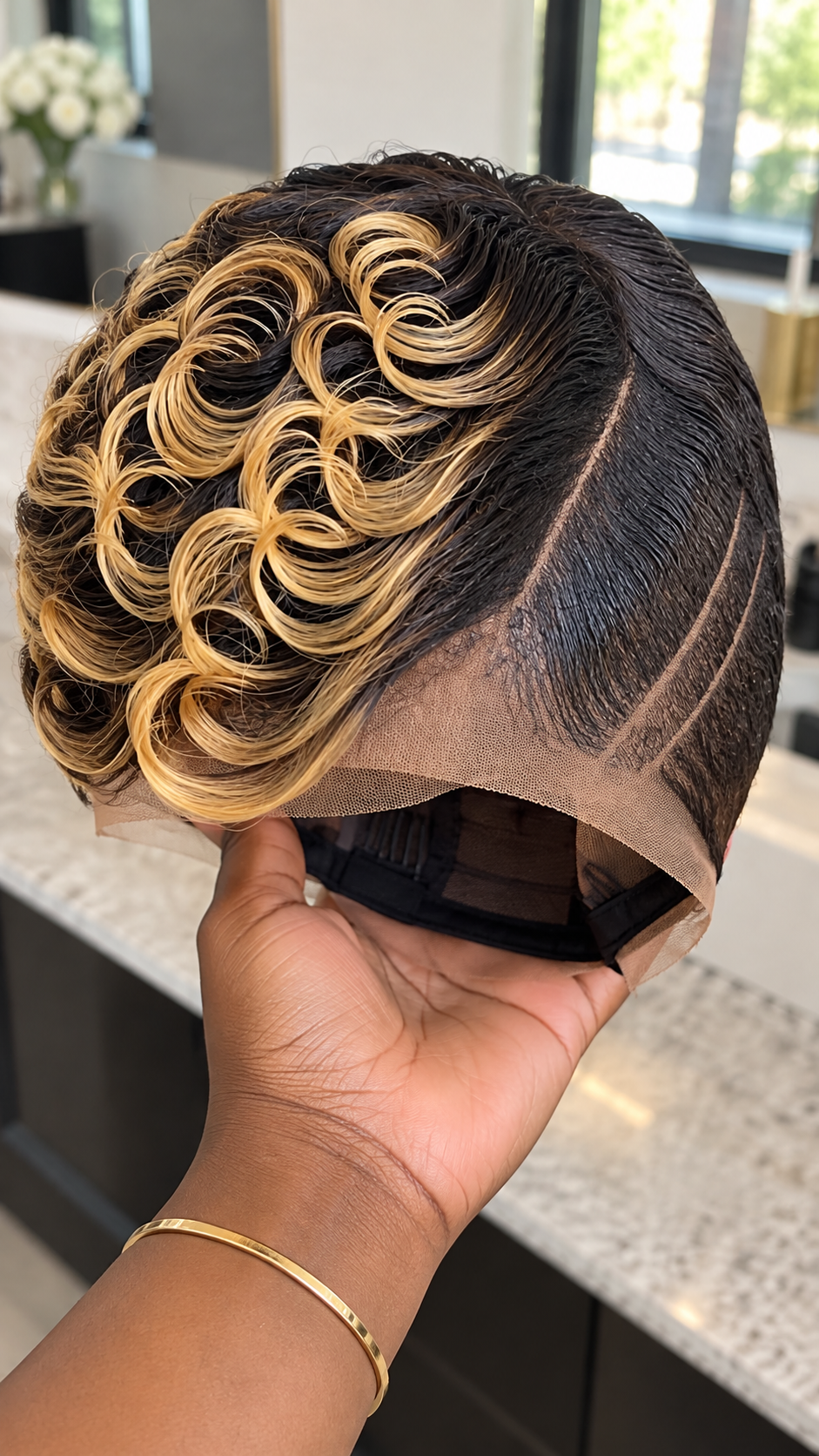
A hairstyle does not need a towering crown or dozens of identical ringlets to make a memorable impression. The wig pictured here takes a more artistic direction, combining sculptural champagne-honey curls on one side with a sleek jet-black panel on the other. Its striking contrast comes from the way the golden strands curve into loose, overlapping swirls, while the darker side remains closely arranged against the foundation. Two slender diagonal temple accents introduce a final touch of geometric precision.
Presented in hand against a softly blurred salon interior, the hairpiece has a compact, asymmetrical shape. The lighter curls occupy the upper left and sweep toward the front, creating rounded arcs rather than tight corkscrew spirals. The right side is dominated by glossy dark hair that travels diagonally backward, exposing a narrow scalp-toned separation between the contrasting styling zones. The untrimmed lace and partially visible interior cap indicate that final fitting is still required.
The design is especially relevant to women seeking a distinctive pixie-length wig with dramatic color contrast but manageable overall proportions. Unlike a fully blonde curly hairstyle, the dark foundation remains an essential part of the appearance. The blonde is concentrated into shaped ribbons, allowing individual curls to stand out against the black background.
The Asymmetrical Crown Creates the Main Visual Impact
The upper hairstyle contains broad, overlapping swirls concentrated toward one side of the crown. These curls do not form a uniform pattern of small circular coils. Instead, they bend into larger loops that overlap and change direction as they travel toward the front.


Some curls form nearly complete circles, while others resemble elongated waves with open ends. This variation makes the crown appear sculpted without becoming excessively bulky.
The hairstyle’s asymmetry is intentional. The lighter curls occupy a larger portion of one side, while the opposite side remains darker and more closely arranged.
A custom wig maker should preserve that relationship rather than distributing the blonde curls equally across the entire crown.
Champagne Honey Color Highlights the Swirling Strands
The lighter hair displays warm champagne, golden honey and pale caramel reflections. Several sections appear brighter near their curved outer surfaces, while deeper golden-brown strands remain visible between the loops.
The color is not distributed uniformly throughout the entire wig. Instead, the blonde follows selected strands across the sculpted crown.
This placement makes the curves easier to distinguish. Each highlighted section stands out against the darker hair beneath, emphasizing the movement of the curl.
For a custom order, the colorist should reproduce the localized champagne-honey arrangement rather than applying an all-over blonde shade.
The Black Foundation Gives the Blonde Its Depth
Deep black hair remains prominent beneath the golden swirls and across the entire visible side. This dark foundation is essential because it provides visual contrast between the lighter curls.
Several blonde sections curve over black strands, creating the appearance of layered ribbons. The darker recessed hair makes the upper curls appear more dimensional.
Without the black foundation, the crown would lose much of its distinctive contrast.
A faithful recreation should therefore preserve strong dark roots and the uninterrupted black side rather than extending the blonde color throughout every section.
The Crown Uses Broad Swirls Instead of Tiny Finger Coils
One of the most important characteristics is the size of the curls. The champagne-honey sections are broader and more elongated than the tightly wound corkscrews used in many traditional finger-coil pixie wigs.
Several loops form open circular shapes, but their strands remain relatively long and ribbon-like.
This creates a softer sculptural appearance while maintaining a compact silhouette.
A custom maker should understand the difference between these broad swirls and a dense crown of tiny spirals. Using the wrong curl diameter would change the hairstyle significantly.
The Blonde Curls Follow a Forward-Sweeping Direction
The highlighted strands are arranged to travel across the crown toward the front. Several loops overlap, creating a flowing pattern rather than standing individually upright.
This direction influences the overall silhouette. The front appears fuller and more expressive, while the darker side remains relatively flat.
A stylist recreating the design should plan the curl direction before setting the hair.
Randomly arranging the blonde sections could produce an attractive hairstyle, but it would not preserve the distinctive flow visible in the reference.
The Dark Side Is Closely Arranged and Directional
The right side contains fine jet-black strands that travel diagonally backward. These strands lie close to the foundation, creating a comparatively flat surface beside the raised blonde curls.
This dark panel establishes balance. It prevents the hairstyle from appearing equally full on every side and gives the highlighted curls space to remain prominent.
The tightly arranged strands also emphasize the curved boundary between the two styling sections.
A custom maker should avoid adding unnecessary volume to this area. Large curls on the dark side would change the intended asymmetry.
A Curved Division Separates the Two Styling Zones
Between the raised champagne-honey curls and the jet-black side lies an exposed diagonal part. Its route follows the contour of the wig rather than forming a perfectly straight line.
This separation has an important structural purpose. It establishes where the curled section ends and where the flatter side begins.
For made-to-order styling, the division should be positioned before the highlighted swirls are arranged.
Moving the part significantly could change the balance between blonde and black hair.
Two Slender Temple Accents Create Geometric Contrast
The closely arranged black side contains two narrow diagonal exposed lines. These accents follow the direction of the surrounding strands and extend backward across the temple region.
Their restrained width is important. They provide a geometric detail without overpowering the sculpted crown.
A custom stylist should preserve the paired arrangement instead of adding extra decorative stripes or widening the existing paths excessively.
The dark hair between the lines forms the boundary that keeps them separate and visible.
The Side Design Requires Conservative Cutting
Unlike natural hair growing from the scalp, a wig cannot replace strands removed during carving. The temple accents therefore require careful planning before permanent cutting.
The professional should map the intended line positions and preserve enough dark hair between them.
Repeatedly widening the channels during maintenance can alter the design and reduce the surrounding density.
If fine strands shift across an exposed line, repositioning may be preferable to cutting additional hair.
The Lower Side Remains Compact
The hair beneath the temple accents is closely arranged and follows the rounded shape of the foundation. Its dark color remains consistent with the upper side panel.
This compact lower area helps maintain the pixie silhouette without adding unnecessary bulk.
The visible side is not completely bare. Fine dark hair remains along the perimeter.
For a custom reproduction, the maker should retain enough lower density to support the carved accents while keeping the side flatter than the highlighted crown.
The Hairstyle Has Controlled Crown Height
Although the champagne-honey curls create substantial visual movement, they do not extend into an exaggerated high dome. The loops remain relatively close to the crown, following the head’s rounded proportions.
This controlled height makes the hairstyle distinctive without requiring excessive length.
A professional should preserve the compact silhouette rather than enlarging every swirl to increase volume.
The most important feature is the arrangement of the curls, not the amount of outward projection.
The Front Lace Remains Untrimmed
Beige-toned lace extends beyond the front and side hair-bearing areas. The mesh has not yet been cut to fit an individual wearer’s hairline.
This provides flexibility during installation. A stylist can establish the wig’s position before deciding where the excess lace should be removed.
The photograph shows a fine mesh appearance, but its commercial grade cannot be confirmed visually.
Buyers should request the actual lace material and available shade options rather than assuming the product uses HD lace.
The Interior Cap Is Partially Visible
A portion of the dark interior foundation can be seen beneath the untrimmed lace. However, the photograph does not reveal the complete fastening system or cap construction.
Before purchasing, customers should request a separate underside photograph of the actual unit.
The seller should confirm cap sizing, available adjustments and the intended installation method.
Visible lace does not automatically guarantee adhesive-free suitability.
Cap Fit Influences the Side Design’s Placement
The sculpted blonde crown, diagonal part and temple accents are fixed to the wig foundation. Their positions change if the cap sits too far forward or backward.
Correct measurements are therefore important for both comfort and visual accuracy.
For a custom order, follow the manufacturer’s sizing instructions. Circumference, front-to-nape and ear-to-ear measurements may be required depending on construction.
A professional wig stylist can assist with measuring before production begins.
Finding a Specialist for Sculptural Blonde Swirls
Custom lace-wig studios and salons experienced with artistic pixie styling are suitable places to begin.
The stylist should be capable of creating broad, open swirls rather than only tightly wound finger coils.
Experience with precision side detailing is also important because the black temple contains narrow carved accents.
When reviewing a portfolio, look for examples of asymmetrical curly crowns and carefully arranged dark side panels.
Where to Buy a Comparable Two-Tone Wig
Specialist wig makers, custom hairpiece studios and selected beauty supply retailers may offer comparable designs.
A ready-made black-and-blonde curly wig could provide a starting point, but it may not reproduce the exact placement of the golden swirls or temple lines.
Custom production offers greater control over color concentration, curl direction and side styling.
Before purchasing, confirm whether the quoted price includes the completed hairstyle or only the underlying wig.
How to Prepare a Custom Styling Brief
Begin with the color arrangement: champagne-honey curls concentrated toward one side of a predominantly jet-black foundation.
Specify broad, overlapping loops rather than tiny uniform spirals.
The opposite side should contain closely arranged black hair with a curved diagonal part separating it from the highlighted crown.
Two narrow exposed temple accents should complete the side design.
Finally, confirm hair material, cap dimensions, lace options and installation preferences.
Approval Photographs Should Show the Contrast Clearly
An elevated crown photograph should reveal the distribution of the blonde swirls and the darker sections beneath them.
A direct side image should show the black panel, curved division and paired temple accents.
A frontal photograph can document the direction of the highlighted curls.
A rear image can confirm whether the blonde and black styling continues coherently around the back.
An underside photograph should establish the actual cap construction.
Pricing Should Reflect Color Placement and Sculpted Styling
The price of this wig may reflect several types of professional work. The blonde swirls require careful arrangement, the dark side needs close directional styling, and the temple accents involve precision cutting.
Color processing, lace preparation and cap customization may contribute additional expenses.
Estimated Pricing for Champagne Honey Swirl Wigs
| Category | Illustrative Price Range | Potential Scope |
|---|---|---|
| Premium Custom | $350–$630+ | Higher-grade hair, personalized cap sizing, custom champagne-honey coloring, hand-arranged broad swirls, dark directional side styling, twin temple accents and lace preparation. |
| Standard Custom | $215–$380 | Prepared blonde swirl crown, black side panel, paired temple lines and standardized cap options. |
| Basic Human Hair | $125–$230 | A human-hair foundation requiring selective color work, swirl setting, side customization and professional fitting. |
| Premium Synthetic | $85–$170 | A quality pre-colored and pre-set alternative with potential shape-retention benefits and more limited future styling options. |
| Basic Synthetic | $40–$100 | A budget interpretation where curl placement, blonde color depth, side precision or cap construction may be simpler. |
These figures are illustrative budgeting estimates rather than verified prices for the photographed wig. Actual quotations depend on material, seller, location, customization labor, cap construction, shipping and installation.
Before comparing suppliers, confirm whether the complete two-tone styling and temple accents are included in the quoted price.
Human Hair May Allow Professional Swirl Restoration
A human-hair version may allow individual blonde swirls to be reset when they loosen, depending on the condition of the strands.
The lighter sections may have undergone processing, so heat should be selected according to their actual tolerance.
Targeted restoration can reduce unnecessary manipulation compared with rebuilding the entire crown.
Premium Synthetic Can Help Preserve Pre-Set Loops
A quality synthetic version may retain its broad curled arrangement with comparatively limited daily styling.
However, heat tolerance varies by fiber, and conventional permanent dye should not be assumed suitable.
The confirmed material should guide future maintenance decisions.
Washing Should Preserve the Overlapping Swirls
Before washing, photograph the crown from above to record the original direction of the highlighted curls.
During cleansing, avoid aggressive rubbing that can intertwine neighboring sections and disturb their open shapes.
Use care products appropriate for the confirmed material.
After drying, restore only the swirls that have shifted.
The Black Side Requires Different Care From the Blonde Crown
The dark panel should remain closely arranged and directional, while the blonde sections retain their larger curled forms.
Using the same styling technique across both areas could reduce the contrast between them.
If the black side becomes displaced, guide the strands back along their original direction rather than adding unnecessary curls.
Preserve the Blonde-to-Black Contrast
If a human-hair version eventually needs color refreshing, the lighter and darker sections should be evaluated separately.
Applying blonde uniformly through the wig could eliminate the black foundation that gives the swirls their depth.
A professional colorist should preserve the localized champagne-honey arrangement while protecting the dark side.
The Temple Accents Need Conservative Maintenance
The two exposed lines are permanent design elements. They should not be widened automatically during routine care.
If fine hair moves across the paths, careful repositioning may restore their visibility without cutting.
When professional refinement is required, use the original side photograph to preserve the widths and spacing.
Avoid Excessive Styling Product
The curled surfaces already reflect light strongly. Heavy oils and waxes can cause neighboring swirls to adhere together and lose their separation.
Residue may also reduce the visible contrast between the blonde and black sections.
Use products suitable for the confirmed hair or fiber and avoid unnecessary buildup.
Professional Installation Should Preserve the Asymmetry
When the wig arrives, inspect the highlighted curls, black side panel, temple accents, lace and cap before permanent alterations.
The installer should establish the final wearing position and confirm that the blonde crown sits in the intended location.
Only after alignment is approved should excess lace be trimmed and optional adjustments considered.
Storage Should Protect the Sculptural Crown
A suitable wig stand or mannequin head can help preserve the overlapping swirls between wears.
The dark side should remain free from pressure that could disturb its directional styling.
Make sure the cap and lace are fully dry before storage.
For transportation, use packaging deep enough to protect the highlighted loops without flattening them.
The Distinctive Appeal Comes From Asymmetrical Contrast
This champagne-honey wig combines broad golden swirls, a deep jet-black foundation, a sleek directional side and two narrow temple accents. The color is concentrated where the curls create the most visual movement, while the darker side maintains a compact silhouette.
For buyers, the essential quality checks are curl size, blonde placement, black foundation depth, parting direction, temple-line accuracy, lace condition and cap fit.
For wig businesses, detailed crown and side photographs can communicate the design more accurately than a generic two-tone curly-wig description. Verified material specifications and transparent customization pricing help customers make informed purchases.
A faithful recreation should preserve the asymmetrical arrangement without adding excessive volume, uniformly distributed blonde or unrelated decorative carving. The hairstyle’s appeal comes from the carefully coordinated relationship between sculpted honey swirls and closely arranged black hair.
Search Terms
champagne honey swirl pixie wig · jet black blonde sculpted crown · asymmetrical golden loop hairstyle · twin razor cut temple accents · broad honey ribbon curls · black directional side lace wig · two tone sculptural pixie hairpiece · untrimmed lace blonde swirl wig