
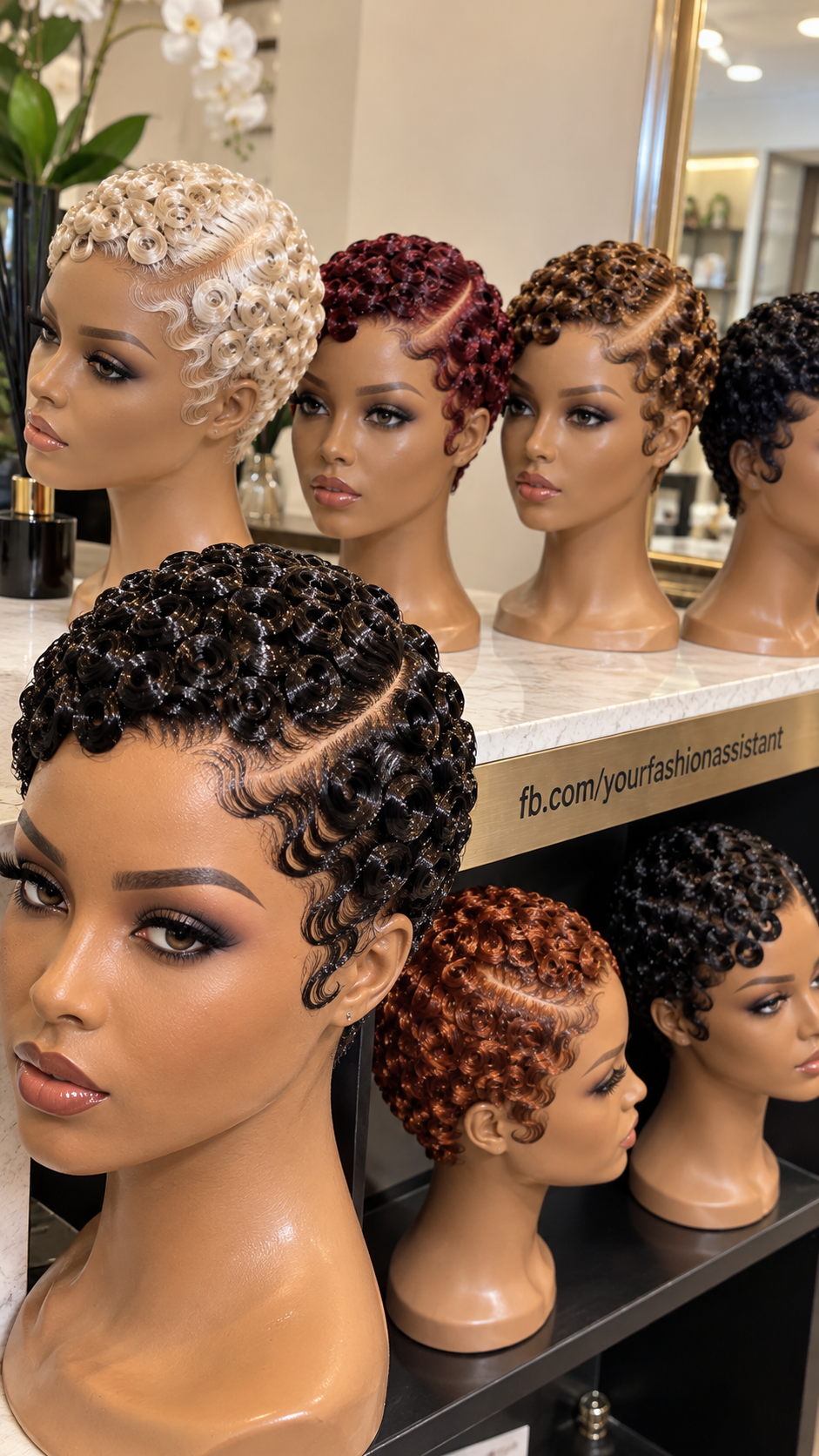
A salon display containing several sculpted finger-coil wigs offers something a single product photograph cannot: the chance to compare how different colors interact with the same general curl technique. This seven-wig collection brings together platinum blonde, deep burgundy, bronze brown, glossy black and copper-auburn designs. Each wig has a compact silhouette, carefully arranged circular coils and decorative finger-wave styling near the forehead or temple. Yet the individual units are not exact duplicates. Their curl sizes, side-part positions, wave arrangements and color intensity create noticeably different results.
The large black wig in the foreground is particularly useful for studying the construction. Its crown contains glossy circular curls with visible hollow centers, while a pronounced diagonal part separates the upper coil arrangement from elaborate waves around the forehead and ear. Behind it, the platinum-blonde unit demonstrates a brighter interpretation with closely placed pale curls and sweeping side movements. Burgundy and bronze-brown options provide richer color choices, while the copper and black wigs on the lower shelf offer additional variations in the same styling family.
These pieces are displayed on mannequin heads rather than shown from underneath. Their exterior appearance is visible, but the exact fiber composition, cap construction, lace grade and attachment systems cannot be established from this photograph. Buyers interested in a particular unit should request individual photographs and verified product information before ordering.
A Salon Collection Should Help Customers Choose a Curl Pattern Before a Color
One of the most useful ways to approach this display is to temporarily ignore the shades. Look first at the shape and distribution of the curls. Some crowns contain larger circular openings, while others use a denser arrangement of smaller ringlets. Several wigs also have prominent diagonal partings, but their positions and surrounding wave patterns differ.
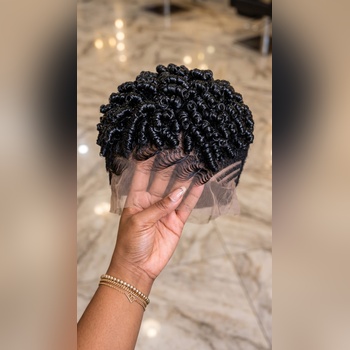
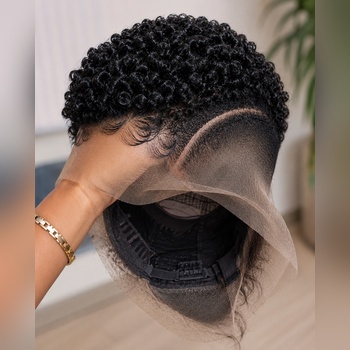
These construction choices affect the final appearance independently of color. A large open coil creates a stronger individual focal point, whereas a collection of smaller curls forms a more continuous rounded surface.
Customers can identify the crown they prefer and then ask whether that exact construction is available in another shade. This is more precise than choosing a blonde or burgundy wig based on color alone.
The Foreground Black Wig Has the Most Visible Crown Geometry
The large black unit positioned closest to the camera displays an especially noticeable arrangement of circular spirals. Several have wide open centers, while smaller curls fill the areas between them. The glossy surface catches bright reflections, making individual rings stand out against dark recessed spaces.
Its crown is full but remains compact around the head. The individual formations do not hang freely like longer conventional curls. Instead, they sit in a carefully arranged structure that follows the rounded upper silhouette.
The most important quality consideration is the spacing between the curls. Filling every opening with additional hair could make the crown appear denser while removing the distinctive ring pattern.
A customer commissioning this style should request mixed-diameter circular coils rather than simply asking for tightly curled black hair.
The Diagonal Part Gives the Black Wig Its Asymmetry
A pronounced parting travels diagonally through the foreground crown, separating the circular curl field from the flatter strands approaching the face. This division has an architectural purpose: it determines where the coils stop and where the sweeping finger-wave arrangement begins.
The part is not a conventional centered division. Its diagonal route creates a stronger concentration of curls on one side, producing an asymmetrical profile.
A stylist attempting to reproduce this wig should establish the parting before arranging the surrounding coils. Changing the angle after the crown has been completed could require substantial restyling.
For a custom order, an elevated photograph showing the full parting route can provide a useful reference.
The Forehead Waves Form a Separate Styling Zone
Near the front hairline, the foreground black wig changes from circular coils into elongated wave sections. Fine strands travel in parallel curves, following the forehead before bending toward the temple.
These movements are an important part of the hairstyle rather than incidental strands around the perimeter. They create a flowing transition between the larger crown curls and the face.
The wave structure also differs from ordinary baby hairs. Several sections are broad enough to form substantial visual shapes, giving the front a deliberate sculpted appearance.
A custom stylist should therefore maintain the distinction between the circular crown and the longer wave movements. Turning every section into a small spiral would change the reference considerably.
Platinum Blonde Reveals the Precision of Every Curl
The platinum-blonde wig at the upper left creates the brightest interpretation of this styling family. Its pale cream-to-pearl curls stand out clearly, making individual circular sections and their arrangement especially noticeable.
The lighter color also exposes the fine directional strands around the forehead and temple. Curves that may disappear into the shadow of black hair become more prominent on platinum blonde.
This visibility can be attractive for customers who want the styling itself to remain highly noticeable. However, it also means that inconsistencies in curl placement may become easier to see.
The photograph cannot establish whether the blonde is human hair or synthetic fiber. If human hair has been extensively lightened, future chemical and heat services may require particular care. If synthetic, the buyer needs the manufacturer’s fiber-specific maintenance instructions.
The Burgundy Wig Creates Rich Wine-Red Depth
Positioned behind the foreground piece, the burgundy wig introduces a dramatically different palette. Its curls appear within a deep wine-red family, with brighter cherry reflections across their outer surfaces and darker color inside the ringlets.
This produces dimensional contrast without requiring obvious blonde or copper streaks. The natural change in angle around each curl makes the color appear more varied.
The burgundy unit also contains a visible diagonal part and decorative curved strands along the forehead. Although these elements belong to the same broad styling family as the black wig, their scale and placement should be inspected separately.
Customers ordering burgundy should request a neutral-light image. Warm salon lighting can exaggerate red saturation and make deep wine hair appear considerably brighter.
Bronze Brown Offers a Warmer Alternative to Burgundy
The bronze-brown wig toward the upper right provides a different color balance. Golden-brown and caramel reflections are visible across its circular crown, while deeper brown remains in recessed sections.
Compared with burgundy, bronze places more emphasis on golden warmth than wine-red depth. Its lighter outer surfaces make the direction of individual curls easier to follow.
This can be a useful choice for customers seeking a warm shade without moving into platinum blonde or vivid copper-red.
When ordering, use the photograph as the primary reference because bronze, honey brown, caramel and golden chestnut are not standardized shade descriptions across suppliers.
The Upper Black Unit Uses a More Compact Curl Arrangement
A partially visible black wig at the far right of the upper row shows another interpretation with closely arranged dark curls. Although it shares a black color family with the large foreground piece, the visible curl field appears more compact.
This demonstrates why a shopper should not assume that every black finger-coil wig has the same construction. Even when color remains unchanged, curl diameter and crown distribution can create a noticeably different silhouette.
An individual photograph would be needed to compare its full parting and side arrangement accurately. The gallery alone does not reveal every detail of that particular unit.
Copper Auburn Makes the Lower-Shelf Wig Stand Out
The copper-auburn unit on the lower shelf introduces a warm reddish-orange color. Its tightly arranged curls form a rounded crown, while a visible directional part and curved perimeter strands help organize the front.
The raised surfaces catch orange-copper reflections, with darker auburn appearing inside the coils. This creates a vivid but compact hairstyle.
For customers who prefer brighter warmth, the copper version provides a different option from the richer burgundy and golden bronze units.
However, selecting copper should not mean ignoring the curl architecture. The buyer should still decide whether the visible ring sizes, front placement and overall crown density match the desired appearance.
The Lower Black Wig Shows the Importance of Individual Inspection
The lower-right black unit offers another compact spiral arrangement. Its visible crown contains dark circular coils, but the photograph does not show the complete front and opposite side.
That limitation is important for purchasing. A collection photograph demonstrates the available design family but cannot replace a detailed product inspection.
Once the buyer chooses a specific wig, the seller should provide its own front, side, rear and overhead photographs.
This prevents the customer from assuming that two similar-looking black wigs share identical parting, wave construction or cap details.
The Display Illustrates Different Levels of Curl Density
Across the seven units, the crowns vary in how closely the circular formations are arranged. Larger openings create stronger individual rings, while smaller coils produce a denser visual field.
There is no universal ideal density for this type of wig. The appropriate construction depends on whether the buyer wants prominent circular openings or a more continuous compact surface.
For custom orders, ask the maker to reproduce the actual curl scale visible in the chosen reference. A broad instruction requesting thick finger coils may not communicate the desired diameter or spacing.
Approval photographs taken from above are particularly useful because they reveal how the curls are distributed throughout the crown.
Different Hairline Wave Patterns Change the Overall Character
The mannequins also demonstrate variations in perimeter styling. Several have long sweeping waves that frame the forehead, while others use smaller curves concentrated near the temple.
These differences affect the overall appearance even when the crown curls are similar.
A customer may prefer the prominent forehead wave arrangement of the foreground black wig but want it paired with the bronze or burgundy palette. If customization is available, that combination can be discussed with the maker.
However, the stylist should confirm whether the selected foundation supports the desired wave arrangement before promising an exact recreation.
Buying One of These Wigs Starts With Identifying the Exact Mannequin
When communicating with a salon, identify the chosen unit by its position in the display and provide a cropped photograph of that specific hairstyle.
For example, asking for the black wig nearest the camera is more useful than requesting any black curly wig from the collection.
The customer should then confirm its crown construction, front-wave styling, material, available cap sizes and whether the product is ready-made or produced after ordering.
If the seller can customize the color, ask whether the change affects only the shade or also requires a different hair foundation.
Ask for an Actual Product Inspection Before Paying
A salon display can make multiple units appear consistent, but each piece should be evaluated individually before purchase.
For the selected wig, request a direct front view, both side profiles, a crown photograph and a rear image. These angles help reveal the curl placement and the continuity of the styling.
If the wig is advertised with lace or a particular cap system, ask for an additional underside photograph showing the actual construction.
The visible scalp-like partings on the mannequins do not independently establish lace grade, material quality or installation method.
Where to Buy Similar Sculpted Finger-Coil Wigs
Specialist wig makers, custom lace-wig studios, beauty supply stores and salons offering sculpted finger-coil styling are practical sources for this type of collection.
Ready-made units can be convenient when the customer already likes the exact crown, color and face-framing work. A made-to-order wig becomes more relevant when combining elements from different mannequins.
For local salon services, look for professionals experienced with compact spiral setting and directional finger waves rather than only general curly-wig installation.
Before booking, ask whether the unit arrives fully styled or requires additional crown construction. The amount of remaining work affects appointment duration and final cost.
Price Comparison Should Include the Completed Styling
The wigs are compact, but the curls are not necessarily quick to produce. Numerous individual ringlets, deliberate part placement and fine perimeter waves can require substantial professional attention.
Custom color can add further labor, particularly for platinum blonde, burgundy or copper options.
Estimated Prices for Multi-Color Finger-Coil Wig Collections
| Category | Illustrative Price Range | Potential Scope |
|---|---|---|
| Premium Custom | $335–$615+ | Higher-grade hair, personalized sizing, individual coil placement, selected color processing, diagonal parting, detailed forehead waves and lace preparation where applicable. |
| Standard Custom | $200–$360 | Prepared spiral crown, selected color, coordinated perimeter styling and standardized cap sizing options. |
| Basic Human Hair | $120–$220 | A human-hair foundation that may require additional curl construction, coloring, front-wave styling and professional fitting. |
| Premium Synthetic | $80–$160 | A higher-quality pre-set option with potential curl-retention advantages and more limited future styling flexibility. |
| Basic Synthetic | $40–$95 | A budget interpretation where coil variation, color depth, parting detail or cap construction may be simpler. |
These figures are illustrative budgeting estimates rather than verified prices for the photographed wigs. Actual costs depend on the supplier, country, hair or fiber, cap construction, color processing, customization labor, shipping and installation.
When comparing sellers, ask whether the listed price covers the finished coil crown and decorative wave arrangement. A lower-priced foundation requiring extensive styling may ultimately cost more than a prepared custom wig.
Material Choice Should Reflect the Desired Maintenance Routine
Human-hair units may offer greater flexibility when curls need professional resetting. Individual spiral sections can potentially be reconstructed as they loosen, depending on the hair’s condition and processing history.
Premium synthetic fibers may provide strong retention of pre-set curls, which can be convenient for buyers who prefer to preserve the original display arrangement.
However, synthetic heat resistance varies, and conventional permanent hair dye should not be assumed suitable.
The correct material choice depends on whether future restyling flexibility or easier preservation of the original crown is more important to the wearer.
The Best Maintenance Routine Begins With Curl Documentation
Before the first wash, photograph the wig from above and from the side. These images record the crown’s original curl placement, parting direction and decorative front strands.
During cleansing, avoid aggressive rubbing that can intertwine neighboring ringlets and close their circular openings. Use products appropriate for the confirmed material.
After drying, inspect which curls have actually shifted. Restoring only those sections can reduce unnecessary handling and preserve the original arrangement longer.
The elongated forehead waves should be maintained separately from the circular crown, following their original direction rather than being rolled into additional coils.
Color Maintenance Will Differ Between the Seven Options
The black wigs may require relatively little tonal maintenance compared with heavily processed light-colored human-hair units.
Burgundy and copper human hair can gradually change in color intensity with washing and heat. Blonde and silver units may require additional care depending on how their shades were achieved.
For any human-hair unit, future coloring should preserve the darker recessed areas that give the curls dimensional contrast.
Synthetic versions should be maintained according to the manufacturer’s fiber-specific instructions rather than treated as conventional dyeable human hair.
Storage Must Protect the Circular Curl Openings
A suitable wig stand or mannequin head provides support for the sculpted crown while reducing compression.
Large circular coils can lose their shape when other objects press against them. The side-wave sections also need space to retain their directional movement.
Store the wig only when the cap and hair are completely dry.
For transportation, choose packaging that provides adequate clearance around the crown rather than flattening the curls into a shallow container.
The Right Wig Is the One Whose Construction Matches the Buyer’s Priorities
This seven-piece display demonstrates that compact finger-coil wigs can have distinct identities even when they share a general styling technique. Platinum blonde makes the individual curls highly visible. Burgundy creates deep wine-red reflections. Bronze offers golden warmth, copper provides brighter reddish movement, and black emphasizes shadow and glossy circular structure.
For buyers, the most reliable selection process begins with curl diameter and crown density, continues through parting and forehead-wave arrangement, and finishes with color, verified material and cap specifications.
For wig businesses, displaying several carefully differentiated units together can help customers understand their options before commissioning a custom piece. Individual product photographs and accurate construction descriptions then turn that inspiration into a clear order.
The goal should not be to select a color and accept any hairstyle that resembles it. A successful purchase matches the specific circular crown, directional parting, face-framing waves and desired shade while providing enough construction information for appropriate fitting and future care.
Search Terms
platinum blonde sculpted coil wig · wine burgundy finger curl wig · bronze brown diagonal part wig · glossy black circular coil crown · copper auburn pixie ringlets · pearl blonde forehead wave wig · black sculpted temple curls · multicolor salon finger coil wigs
“`