
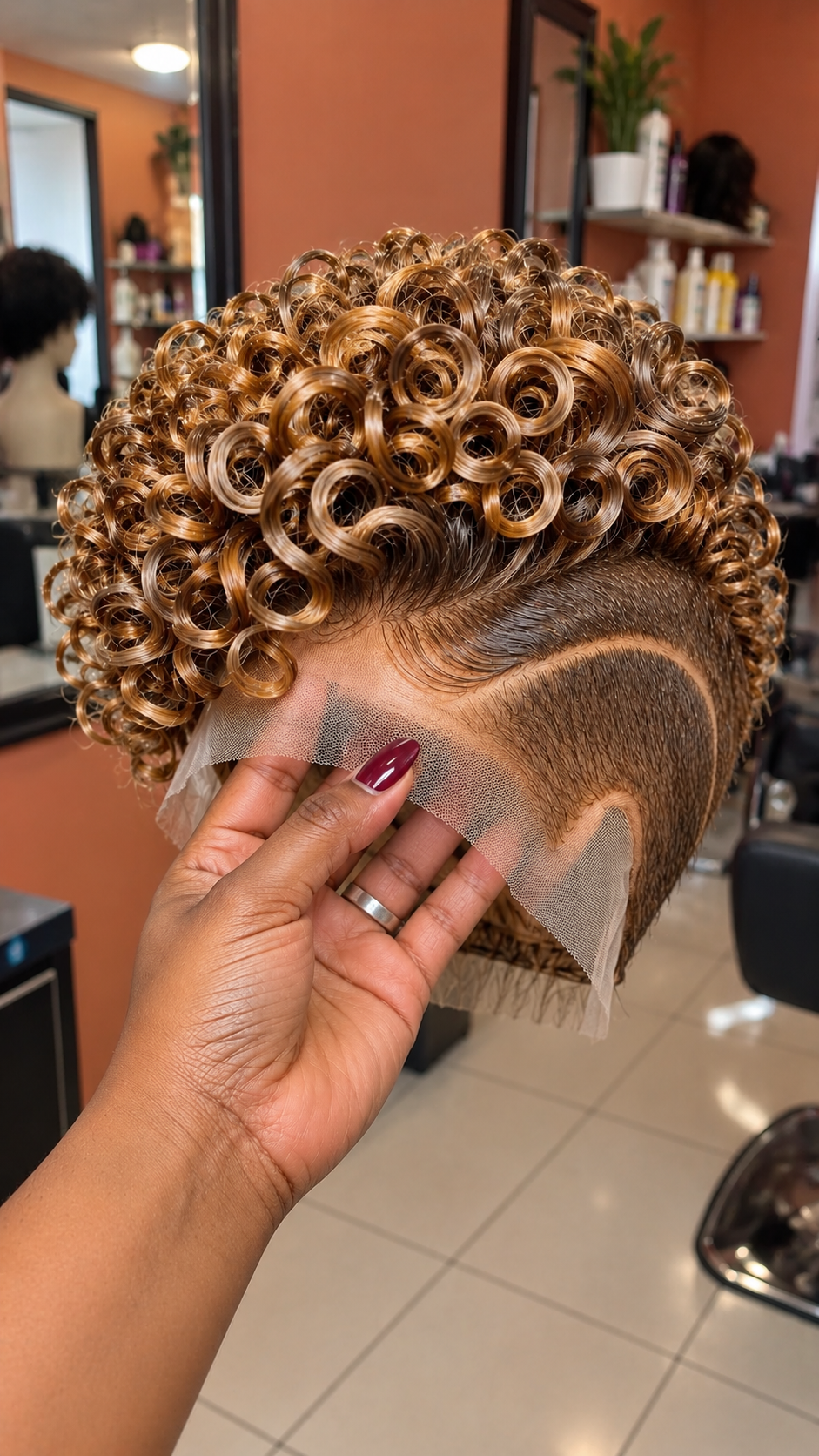
Imagine selecting a wig from a salon display and noticing that its most impressive detail is not visible from the front alone. This golden copper pixie combines an exceptionally dense arrangement of circular ringlets with a carefully shaped temple panel that introduces a bold, sweeping S-like curve. The hairstyle is designed to reward a closer look: the upper curls create a striking silhouette, while the side reveals an entirely different kind of precision.
The photograph captures the wig before installation, held in one hand inside a hair salon. An untrimmed section of beige lace extends beyond the hairline, allowing the viewer to examine the front and side boundaries. The upper hair consists of numerous glossy, tightly arranged circular loops in a warm golden copper shade. Beneath the curls, a darker, closely laid section follows the contour of the temple, interrupted by a broad curved separation that bends downward toward the lower side.
This is not simply a copper curly wig with a decorative line added afterward. Its appearance depends on the relationship between the elevated ringlets, the closely arranged hair at the side, and the dramatic curve separating the temple sections. Buyers seeking a comparable design should evaluate all three elements before choosing a ready-made product or commissioning a custom unit.
A Circular Crown That Creates Its Own Silhouette
The most immediately recognizable characteristic is the extraordinary number of rounded curls covering the upper portion of the wig. Instead of loose spirals hanging freely, the hair has been arranged into compact circular rings, many of which have clearly visible openings at their centers.
The loops overlap across the upper surface, creating an elevated, rounded profile. Some circles face the camera directly, while others tilt upward or sideways. This variation gives the arrangement depth and prevents the hairstyle from appearing like a simple collection of identical curls.
The front section contains several prominent rings positioned above the hairline. Moving across the upper surface, the curls continue in closely packed layers. Smaller loops appear around the outer edges, helping the arrangement transition into the surrounding hair.
The visible crown is relatively full, but its volume is organized rather than randomly distributed. Individual circles remain distinguishable despite their close spacing. This is an important consideration for anyone requesting the hairstyle from a wig maker.
A generic curly pixie may contain similar hair length or color, yet lack the distinctive circular construction. The visual identity here comes from the open ring shapes and the way they are stacked across the upper head.
Ring Diameter and Curl Consistency
The loops vary somewhat in size. Several central curls appear broader, while smaller rings occupy portions of the front and outer edge. Their circular openings are an essential part of the hairstyle’s appearance.
A custom stylist should discuss whether the buyer wants the same mixture of loop sizes or a more uniform arrangement. The reference shows an intentionally varied surface rather than perfectly identical circles.
The photograph does not establish which styling tools or setting methods were used. The curls might have been created through a specialized salon process, but the exact technique cannot be verified from appearance alone.
What matters when ordering is the visible result: compact open rings, an elevated rounded crown, and enough separation between neighboring curls for their individual shapes to remain apparent.
Golden Copper Coloring Without a Contrasting Highlight Pattern
The hairstyle displays a warm golden copper tone with amber-like reflections. The color is relatively consistent across the upper ringlets, although some strands appear lighter where the salon lighting strikes their curved surfaces.
These reflections create variations ranging from deeper copper brown to brighter golden orange. However, the photograph does not clearly establish a separate, deliberately placed highlight pattern.
The side section appears darker than the upper curls, with a brownish copper appearance. This difference helps distinguish the closely arranged temple hair from the elevated rings.
When discussing color with a seller, useful descriptions include golden copper, warm amber copper, and copper-brown roots or side hair. The precise color code should be confirmed through the seller’s own samples.
Customers should avoid assuming that a particular commercial shade number will reproduce the photograph exactly. Different manufacturers may use different numbering systems, and lighting can significantly affect the appearance of copper-colored hair.
Why This Shade Benefits From a Physical Color Sample
Golden copper can appear more orange under warm lighting and more brown in subdued conditions. A small sample or a photograph of the actual hair under daylight can help establish whether the proposed shade is close to the reference.
The customer should also ask whether the side hair will remain slightly darker than the ringlets. A completely uniform color might reduce the visual separation between the two styling areas.
If a custom maker proposes adding blonde streaks or deeper red accents, those changes should be considered optional interpretations rather than details required by the photograph.
The Temple Curve Is More Than an Ordinary Side Line
Beneath the copper ringlets, the hair follows a carefully arranged side pattern. A sweeping upper boundary separates the raised curls from a darker, closely laid temple panel.
Below that boundary, a prominent curved channel travels across the visible side. Its path rises and bends before descending toward the lower temple, producing an elongated S-like impression.
The hair inside the curved section is closely aligned, creating a contrasting surface beneath the highly dimensional curls. Near the lower portion, the pattern changes direction sharply, forming a distinctive tapered bend.
This is not a collection of several evenly spaced parallel lines. The photograph shows one dominant sweeping channel accompanied by the upper transition boundary and a lower directional change.
The exact method used to create the exposed channel cannot be confirmed. Because this is a wig, it should not automatically be described as a shaved design on a person’s natural scalp.
Preserving the Shape During Custom Styling
The position of the curve matters as much as its general shape. If it begins too low, the upper side panel may appear unusually large. If it ends too high, the dramatic downward movement may be lost.
A wig maker should use the reference photograph to establish the relationship between the curve, the front hairline, and the upper ringlets.
Customers should also confirm whether the design will appear on the left or right side when the wig is worn. The orientation of a wig being held for a photograph does not automatically establish the intended placement on the wearer’s head.
Before any permanent trimming or reshaping, the stylist should check how the curved channel sits relative to the customer’s temple and ear.
The Untrimmed Lace Offers a Useful Installation Clue
The photograph shows beige lace extending beyond the styled front and side hairline. The mesh is particularly visible beneath the front curls and along the lower edge of the temple section.
One hand supports the wig by holding this lace area, making the material and its untrimmed perimeter easy to observe.
The lace appears light beige against the darker hair, but its exact grade cannot be identified from the photograph. A fine-looking mesh is not sufficient evidence to classify it as HD lace.
Some hair and construction material can be seen behind the lace, although the photograph does not provide a complete view of the cap interior. The presence, number, and position of adjustment straps or attachment combs cannot be reliably established from this angle.
Before purchasing, buyers should request an underside photograph showing the full cap, lace dimensions, and any available adjustment hardware.
Fitting Before Trimming
The visible lace should not be cut immediately upon receiving the wig. First, check the cap against the wearer’s head measurements and determine how the front and side hairlines will sit.
This step is particularly important because the decorative temple curve approaches the lace perimeter. Incorrect positioning could make the pattern appear higher or lower than intended.
A professional wig stylist can help determine whether the lace needs trimming, whether the cap requires adjustment, and which attachment method is suitable.
The photograph alone does not prove that the unit is glueless or that it requires adhesive. Those details must be confirmed through the seller’s specifications and a proper fitting.
Buying This Hairstyle as a Custom Wig
The unusual circular ringlets and sculpted side pattern make this hairstyle a strong candidate for custom ordering. A ready-made copper pixie may offer similar coloring, but it may not reproduce the open circular loops or the distinctive temple curve.
Begin by contacting a wig maker or salon experienced in sculpted curls and precision side styling. Look for examples of completed wigs featuring circular coils, elevated pixie arrangements, and detailed temple designs.
Send the reference photograph and explain that the circular openings of the upper curls are essential. The stylist should not substitute ordinary loose curls unless the customer approves that change.
The same applies to the side pattern. A simple curved stripe may not capture the broad sweeping movement shown in the photograph.
Information to Request From the Seller
Ask whether the wig will be supplied fully styled, whether the copper shade is available, and whether the temple curve can be reproduced in the requested orientation.
Confirm the proposed hair material, cap measurements, lace dimensions, and any installation services included in the price.
Request photographs of the actual unit before shipping, especially a close-up of the upper rings and a side photograph showing the decorative channel.
If ordering from an online seller, check the customization policy, expected production time, shipping arrangements, and whether corrections are possible if the completed wig differs from the agreed reference.
Salon Booking and the Installation Sequence
Once the wig arrives, the first appointment should focus on fitting rather than immediately changing the hairstyle.
The stylist should inspect the lace, cap construction, and overall condition. The wig can then be positioned to assess how the copper ringlets frame the face and how the curved temple pattern aligns with the side of the head.
If the cap fits correctly, the stylist can proceed with any necessary lace preparation. Trimming should be conservative because removed lace cannot be restored easily.
Any additional styling should be discussed before the curls are manipulated. The upper rings appear deliberately arranged, and aggressive brushing could disrupt their circular shapes.
If the customer wants a lower profile or a modified temple outline, the stylist should explain how those changes would affect the reference design.
A separate follow-up appointment may be useful for evaluating how the hairstyle retains its shape after the first period of wear.
Illustrative Price Guide for Golden Copper Ringlet Wigs
The price of a comparable wig may depend on the hair material, cap construction, lace customization, and the time required to create the dense circular ringlets and sweeping temple pattern.
Because the upper surface contains numerous individual loops, specialized styling labor could represent a meaningful portion of the final cost.
The following USD amounts are illustrative planning ranges only. They are not verified live prices, seller quotations, or a valuation of the exact photographed unit.
| Wig Category | Illustrative USD Range | What May Affect the Price |
|---|---|---|
| Premium Custom | $360–$820+ | Individual circular curl arrangement, specialized copper coloring, custom cap work, and precise temple patterning. |
| Standard Custom | $180–$410 | Customized ringlet styling and a sweeping side channel on a suitable prepared wig foundation. |
| Basic Human Hair | $100–$255 | A potential base unit requiring additional styling and possibly coloring to approach the reference. |
| Premium Synthetic | $70–$185 | A possible pre-styled alternative if the fiber and construction can support compact circular curls. |
| Basic Synthetic | $25–$90 | A lower-cost copper curly option that may not reproduce the exact ring structure or temple curve. |
The photograph does not confirm whether the wig contains human hair, synthetic fiber, or a blend. These categories represent possible purchasing routes rather than verified characteristics of the displayed unit.
Installation, lace preparation, cap adjustment, shipping, and later restyling may involve additional charges. Buyers should request a detailed quotation explaining what is included.
For this hairstyle, paying for accurate ringlet construction may be more valuable than selecting a more expensive hair category without confirming the stylist’s ability to reproduce the design.
The Main Maintenance Challenge: Keeping the Rings Open
The upper curls have visible circular openings, and maintaining those openings is central to preserving the hairstyle.
Ordinary brushing could pull the rings apart or change their orientation. Frequent handling may also disturb the closely packed arrangement, particularly where neighboring curls overlap.
Customers should ask the maker whether the curls were set using a particular product or technique and whether they can be restored after cleansing.
If the wig is made from human hair, washing and conditioning should account for any coloring and setting processes used. The curls may require professional restyling after a full wash.
If synthetic fiber is used, heat tools should not be applied unless the manufacturer confirms the material’s heat tolerance.
Protecting the Copper Appearance
Warm copper shades can be visually sensitive to lighting and product buildup. Heavy styling products may change the way the hair reflects light, making the rings appear darker or less distinct.
For chemically colored human hair, ask the stylist about suitable cleansing products and the potential for color changes over time.
For synthetic alternatives, follow the manufacturer’s care instructions rather than attempting conventional hair dyeing or heat treatment.
The goal is to preserve both the warm color and the separation between the individual circular curls.
Keeping the Temple Pattern Visible
The curved side design depends on the neighboring strands remaining aligned. Repeated rubbing, combing, or manipulation may cause hair to shift across the exposed channel.
A stylist should explain how to refresh the lower side without disturbing the shape of the curve.
Because the channel is an important decorative element, customers should avoid cutting or removing hair from the temple area without professional guidance.
Any attempt to deepen the curve or alter its direction could permanently change the appearance of the wig.
Choosing This Look for Personal Style and Occasions
The golden copper coloring makes this wig visually prominent, while the compact pixie silhouette keeps the hair relatively close to the head compared with longer curly styles.
Its circular ringlets create a decorative upper profile that can work particularly well for portrait photography, celebrations, fashion events, and salon showcases.
The warm copper shade pairs naturally with black, cream, chocolate brown, and other neutral clothing colors. Simple accessories can allow the hairstyle’s intricate curl arrangement to remain the main point of attention.
For frequent everyday wear, the buyer should consider how much maintenance the sculpted rings require. A hairstyle with many individually arranged curls may demand more careful handling than an ordinary curly wig.
Customers who enjoy distinctive styling and are comfortable with occasional professional maintenance may find the design especially appealing.
Making the Final Purchase Decision
This wig stands apart because of its unusually dense circular ringlets and the broad, sweeping temple curve beneath them. The golden copper coloring strengthens the visual impact, but the design would remain recognizable because of its construction and side geometry.
A buyer should prioritize accurate photographs, confirmed cap specifications, and evidence that the chosen stylist can reproduce the open-ring arrangement.
The visible untrimmed lace also makes proper fitting an important part of the purchasing process. Installation decisions should be based on the actual cap and the wearer’s measurements rather than assumptions drawn from the photograph.
When comparing ready-made and custom options, consider whether the seller can deliver the hairstyle’s essential details: rounded copper rings, a raised upper silhouette, darker closely laid temple hair, and the distinctive sweeping curved channel.
Those elements, carefully reproduced and appropriately fitted, are what give this golden copper pixie its memorable salon-crafted appearance.
Search Terms
Golden copper circular ringlet wig · Amber copper open loop pixie · Sculpted S curve temple lace wig · Copper brown side channel hairstyle · Dense golden ring crown lace wig · Beige untrimmed lace copper pixie · Glossy orange copper spiral rings · Sweeping curved parting curly wig