
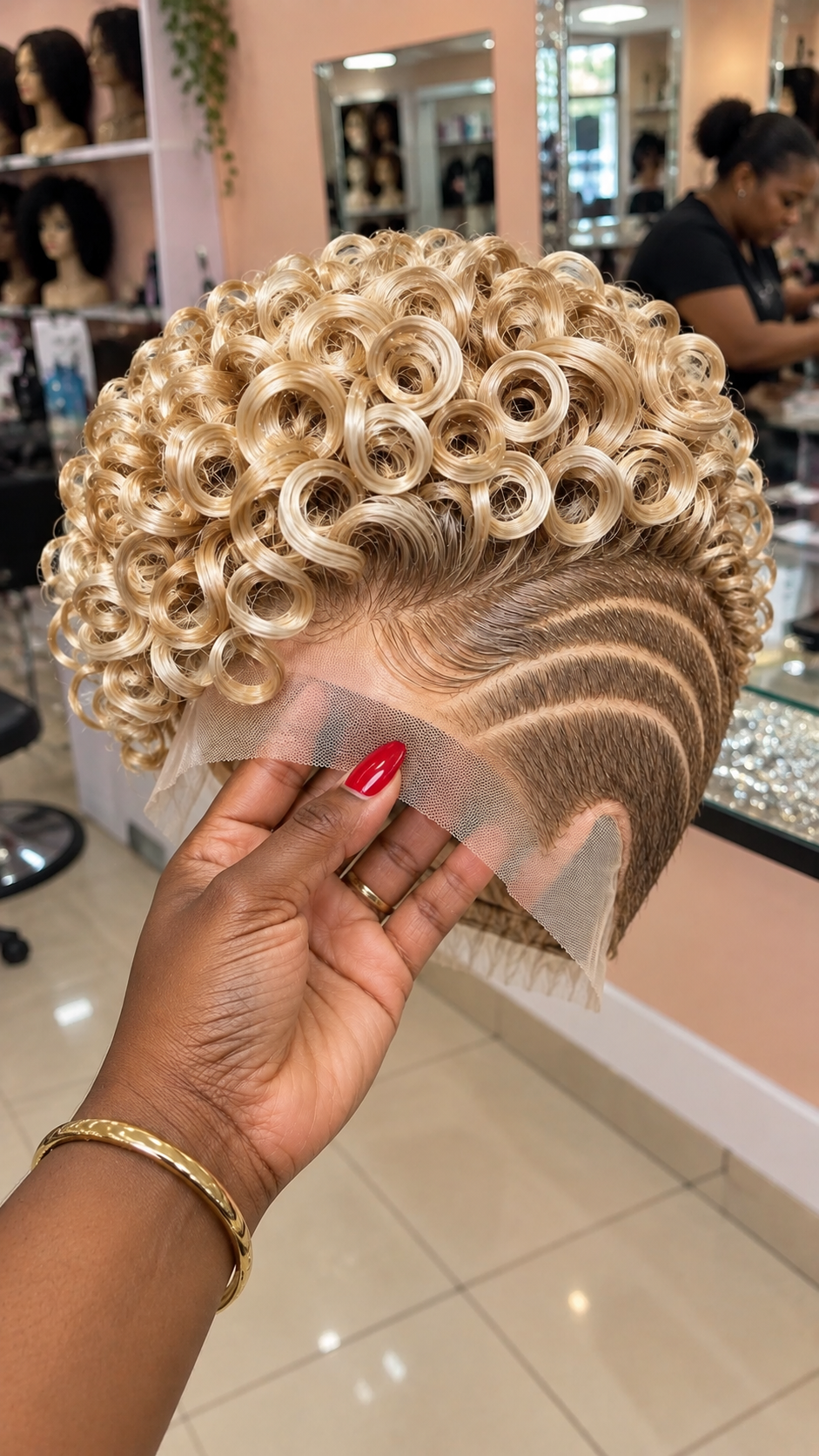
Three sweeping channels beneath a crown of tightly arranged blonde rings make this wig immediately recognizable. The design is built around a deliberate contrast: an abundant collection of circular curls above and a closely arranged side section divided by three parallel-looking curved partings. Rather than relying on a dramatic change in hair color, the hairstyle uses its construction to create visual interest from several angles.
The photograph captures the wig before installation, held in one hand inside a salon. A generous section of untrimmed tan lace extends beneath the front and around the visible side, while the upper hair forms a rounded arrangement of glossy, champagne-gold ringlets. The side hair is directed into narrow sections separated by exposed channels that curve toward the temple area.
For someone looking to buy this particular hairstyle, the most useful question is not simply whether a seller stocks blonde curly pixie wigs. It is whether the seller can reproduce the spacing of the three side channels, the circular openings of the crown curls, and the transition between the closely arranged hairline and the raised ringlets.
Those details are sufficiently distinctive that substituting a conventional curly blonde wig would change the result. A carefully chosen ready-made piece may work, but a custom order could be necessary when the exact side geometry matters.
The Three Curved Channels Are the Design’s Signature
The visible side contains three pale, curved separation channels. They begin near the forward upper side and travel backward in sweeping arcs, dividing the closely arranged blonde hair into narrow bands. The channels follow the rounded contour of the wig rather than forming straight horizontal lines.
The uppermost channel separates the raised crown area from the first closely arranged side section. Beneath it, the additional channels establish a layered pattern. Their spacing gives the side a distinctive appearance without requiring contrasting hair colors.
The lower portions of the curves become particularly interesting near the temple, where the hair sections turn downward and the exposed channels follow the change in direction. This creates a flowing geometric pattern that differs from ordinary straight side partings.
Although the design resembles the decorative line work sometimes seen in barbered pixie hairstyles, the photograph shows hair arranged on a wig foundation. It does not establish that the lines were cut into a naturally shaved scalp. A buyer should describe the visible result rather than assuming a particular construction technique.
Reproducing the Curves Without Changing Their Character
The position of the three channels matters more than simply increasing their visibility. If a stylist makes them excessively wide, the side may appear divided into disconnected sections. If they are too narrow, strands may overlap the exposed areas and make the pattern difficult to recognize.
The curves also need to remain consistent with the head’s contour. The photograph shows the wig supported in the hand, not fitted to a person, so the final appearance may change slightly when the cap is positioned on an actual head.
For custom work, ask the stylist to establish the channel placement during the initial fitting or construction stage. The surrounding hair should then be directed to support the curved pattern rather than styled independently and separated afterward.
A useful reference package would include this photograph, a direct side view, and a front-facing image of the same wig if the seller can provide them. Together, these angles would clarify where each channel begins and how the lines relate to the front hairline.
A Crown Built From Open Circular Ringlets
The upper section contains numerous tightly arranged circular curls with clearly visible central openings. Several ringlets resemble small polished rings, while others overlap to form larger clusters. Their sizes vary naturally across the crown, preventing the surface from appearing mechanically uniform.
At the front, individual curls project slightly forward and downward over the transition into the hairline. Higher on the crown, the ringlets are arranged in closely packed layers, creating a rounded silhouette with considerable visual detail.
The outer portions contain smaller and more closely grouped curls, while some of the central rings have broader openings. This variation creates depth without making the crown appear excessively tall.
The ringlets are noticeably different from loose spiral waves. Their circular construction is a defining element of the hairstyle. A wig with long, freely hanging curls would not reproduce the photographed appearance, even if it were the same blonde shade.
The polished surfaces reflect the salon lighting strongly, emphasizing the curved shape of each ring. However, this shine does not confirm whether the hair is human hair or synthetic fiber, nor does it establish which styling products were used.
Why Curl Diameter Should Be Discussed Before Ordering
A customer requesting this wig should explain that the crown needs recognizable circular openings rather than a mass of small, tightly compressed coils. The rings should remain individually visible, particularly around the front and upper center.
Very large curls could make the hairstyle appear oversized. Extremely small curls could eliminate the open-ring appearance and produce a different surface altogether.
Ask a custom wig maker whether the ringlets will be individually arranged and whether their placement can be reviewed before the piece is completed. A photograph of the crown during styling may help establish whether the intended shape is being achieved.
The visible crown is densely populated with curls, but the photograph does not reveal every rear section. Additional views would be necessary to confirm whether the same ringlet arrangement continues around the entire back.
Champagne Gold, Pale Honey, and the Effect of Light
The wig appears predominantly light champagne blonde with warm golden and pale honey reflections. Some ringlets look almost creamy blonde where the light strikes their upper surfaces, while deeper areas between the curls appear more golden.
The result is a luminous blonde appearance with subtle tonal variation. The photograph does not clearly establish a dark-root gradient or separate colored highlight panels. Much of the variation may come from lighting and the curved orientation of the hair.
This distinction is important for shoppers because color descriptions vary significantly between suppliers. One seller may classify a similar shade as champagne blonde, while another may use light golden blonde or pale honey blonde.
Instead of relying entirely on a color name, request photographs under neutral daylight. The warm interior of the salon may influence how golden the hair appears, especially where several curls overlap.
Buyers who want the pictured effect should avoid assuming that any platinum blonde or yellow-gold wig will be equivalent. Platinum may appear noticeably cooler, while a saturated golden shade could produce a deeper and warmer result.
For a custom order, ask the supplier to compare the available fiber or hair-color samples with the reference photograph. If the material requires coloring, confirm whether the proposed processing is compatible with the hair and whether it could affect the existing curl arrangement.
The Front Hairline Connects Two Different Styling Techniques
Between the ringlet crown and the exposed lace, the hair is arranged into a closely directed front section. Fine strands sweep backward and slightly sideways, creating a controlled transition into the raised curls.
This area has a different appearance from the crown. Rather than forming complete circular rings, the strands lie closer to the foundation and follow the contour of the forehead.
The change in direction helps establish a visual boundary between the hairline and the upper styling. It also allows the circular curls to remain prominent without completely covering the front edge.
Some fine strands are visible along the hairline, but the photograph does not justify claims about a particular pre-plucked hairline technique or specialized lace grade. Those details should be confirmed with the seller.
When commissioning a similar wig, the front should be discussed separately from the crown. A stylist who recreates the rings accurately but leaves the hairline arranged in an unrelated direction may produce a noticeably different result.
Examining the Untrimmed Lace Before Installation
A substantial tan mesh section extends beyond the styled front and side perimeter. The lace is clearly visible because the wig is being displayed before installation.
The exposed mesh offers useful information about the unfinished edge, but it does not establish the complete cap design. The photograph does not show enough of the underside to verify attachment combs, adjustable straps, elastic bands, or other internal hardware.
Nor does the image confirm HD lace. The exact lace type, dimensions, transparency, and construction should be established through product specifications or additional photographs.
The visible lace extends around the temple area, where the curved side channels are especially prominent. This makes accurate fitting particularly important because the position of the lace can affect how the side design aligns with the wearer’s face.
What to Request From the Seller
Ask for the cap circumference, front-to-nape measurement, ear-to-ear dimensions, and the depth of the lace area. A full underside photograph should show how the cap is assembled and whether any attachment hardware is included.
Request a close-up of the lace against a neutral background. This may help with preliminary evaluation, although an actual fitting remains the most reliable way to assess its appearance against the wearer’s skin.
The seller should also explain whether the wig is supplied with the lace untrimmed, as shown, and whether any hairline customization is included in the purchase price.
Do not assume that the wig can be worn without adhesive merely because lace is present. The appropriate attachment method depends on the verified construction, fit, and intended use.
Ordering a Matching Wig From a Salon or Online Supplier
There are two practical purchasing routes for this hairstyle. The first is finding a completed wig that already includes the ringlet crown and three curved side channels. The second is commissioning a custom piece from a wig maker capable of precision styling.
A ready-made product may be more convenient if the seller can demonstrate that the delivered item closely resembles the photograph. However, the buyer should examine actual product images rather than relying solely on a promotional reference.
For a custom commission, choose a specialist experienced in lace wig construction, sculpted pixie hairstyles, and decorative parting work. A professional who understands both curl placement and close-fitting side styling is particularly relevant to this design.
When contacting the stylist, explain that the three curved channels must remain visible beneath a rounded crown of open ringlets. Specify the champagne-gold color family and request a compact silhouette rather than an oversized curly hairstyle.
Ask whether the stylist can provide progress photographs before final completion. This can be useful for checking the spacing of the channels and the size of the crown rings while adjustments may still be possible.
Before making payment, confirm the fiber composition, cap specifications, customization scope, expected completion time, shipping arrangements, and return conditions. Do not rely on unverified claims about origin, durability, or material quality.
From Delivery to a Properly Positioned Hairline
When the wig arrives, inspect the ringlets before removing or modifying any part of the lace. Transportation can disturb carefully arranged curls, and it is better to identify any changes before installation.
Check that the three side channels remain distinct and that hair has not shifted across them. Compare the front transition with the reference photograph, paying particular attention to the direction of the fine strands beneath the ringlets.
During the fitting appointment, the stylist should position the wig so that the temple pattern follows the intended facial contour. The crown should remain balanced without leaning excessively toward one side.
Only after the correct position has been established should the lace be trimmed if necessary. Removing too much lace can be difficult or impossible to correct, especially near a detailed hairline.
The final installation method should be selected according to the actual cap construction and the wearer’s comfort. If the side channels shift noticeably after securing the wig, the position should be reassessed rather than attempting to conceal the misalignment with additional styling products.
Before leaving the salon, examine the result from the front, side, and three-quarter perspective. The crown should maintain its circular ringlets, while the curved channels remain recognizable without looking artificially widened.
Estimated Prices for a Triple-Parted Blonde Ringlet Wig
This hairstyle may involve more styling labor than a basic curly pixie because the crown contains numerous individually recognizable ringlets and the side requires three carefully positioned curved channels.
The blonde shade may also influence the cost depending on whether the chosen material is manufactured in the desired color or requires additional processing.
The following USD ranges are illustrative planning estimates, not verified current selling prices or quotations for the pictured wig. The image does not establish whether the photographed material is human hair or synthetic fiber.
| Wig Category | Illustrative USD Range | Potential Cost Considerations |
|---|---|---|
| Premium Custom | $380–$900+ | Individual cap specifications, specialist ringlet construction, triple curved parting work, and detailed lace preparation. |
| Standard Custom | $190–$430 | Custom crown styling, selected cap options, and adjustments to the side-channel arrangement. |
| Basic Human Hair | $110–$280 | Human-hair base unit that may require separate blonde coloring, curl setting, and precision side styling. |
| Premium Synthetic | $70–$185 | Higher-grade synthetic alternatives with prearranged curls and material-dependent styling flexibility. |
| Basic Synthetic | $30–$85 | Budget-oriented alternatives that may differ in ringlet accuracy, parting precision, and lace construction. |
These categories describe possible purchasing options rather than the confirmed composition of the photographed wig. Actual prices vary by seller, location, workmanship, and included services.
When comparing quotations, ask whether the advertised price includes the finished ringlet arrangement, all three curved channels, lace customization, and fitting. A less expensive base wig may require substantial additional salon labor to achieve the desired appearance.
Shipping, installation, color adjustments, and future restyling appointments may also increase the total expense. A detailed quotation is more useful than a single headline price when the hairstyle contains this much precision work.
Care Priorities for Closely Packed Circular Curls
The main maintenance concern is preserving the open shape of the ringlets. Repeated brushing, aggressive finger separation, or compressing the crown can change the arrangement and reduce the distinctive circular appearance.
Ask the supplier how the rings were formed and whether they can be safely repositioned. Some curl constructions may require professional resetting, while others may tolerate careful individual adjustments.
The three side channels require a different type of attention. Hair crossing the exposed areas can make the pattern less visible, so maintenance should preserve the direction of the closely arranged strands.
Cleaning methods must follow the confirmed material composition. Synthetic fibers should not be exposed to heated tools unless the manufacturer specifically permits them. Human hair may allow different styling techniques, but any previous lightening or chemical processing should be considered.
Because the blonde color is central to the appearance, use products appropriate for the actual fiber and any verified color treatment. Avoid assuming that products intended for bleached human hair are suitable for a synthetic wig.
When the wig is not being worn, support it without crushing the ringlets or pulling against the lace. A suitable wig stand or form may help preserve the rounded profile.
If the circular curls begin losing their individual openings, consider a professional maintenance appointment before attempting extensive restyling at home.
The Details That Should Determine the Final Purchase
A convincing reproduction of this hairstyle needs to succeed in three areas simultaneously. The ringlets must retain their open circular shape, the side channels must follow their distinctive curved arrangement, and the front hairline must connect naturally with the raised crown.
The champagne-gold color adds brightness, but it is the interaction between the curls and side geometry that gives the wig its identity. A product matching only the color and general length would be an incomplete substitute.
Before committing to an order, prioritize actual product photographs, reliable cap measurements, verified material information, and a stylist capable of explaining the construction. Those details provide a stronger basis for choosing a wig than broad promotional descriptions.
With accurate styling, careful lace preparation, and appropriate maintenance, this design can retain the distinctive relationship between its densely arranged blonde rings and its three sweeping side channels while being fitted to the individual wearer.
Search Terms
Champagne blonde triple curved parting wig · Pale honey circular ringlet pixie · Golden blonde three channel lace wig · Open barrel ring crown hairpiece · Blonde sculpted temple curve wig · Untrimmed tan lace champagne pixie · Closely arranged blonde side parting wig · Creamy gold spiral ringlet crown