
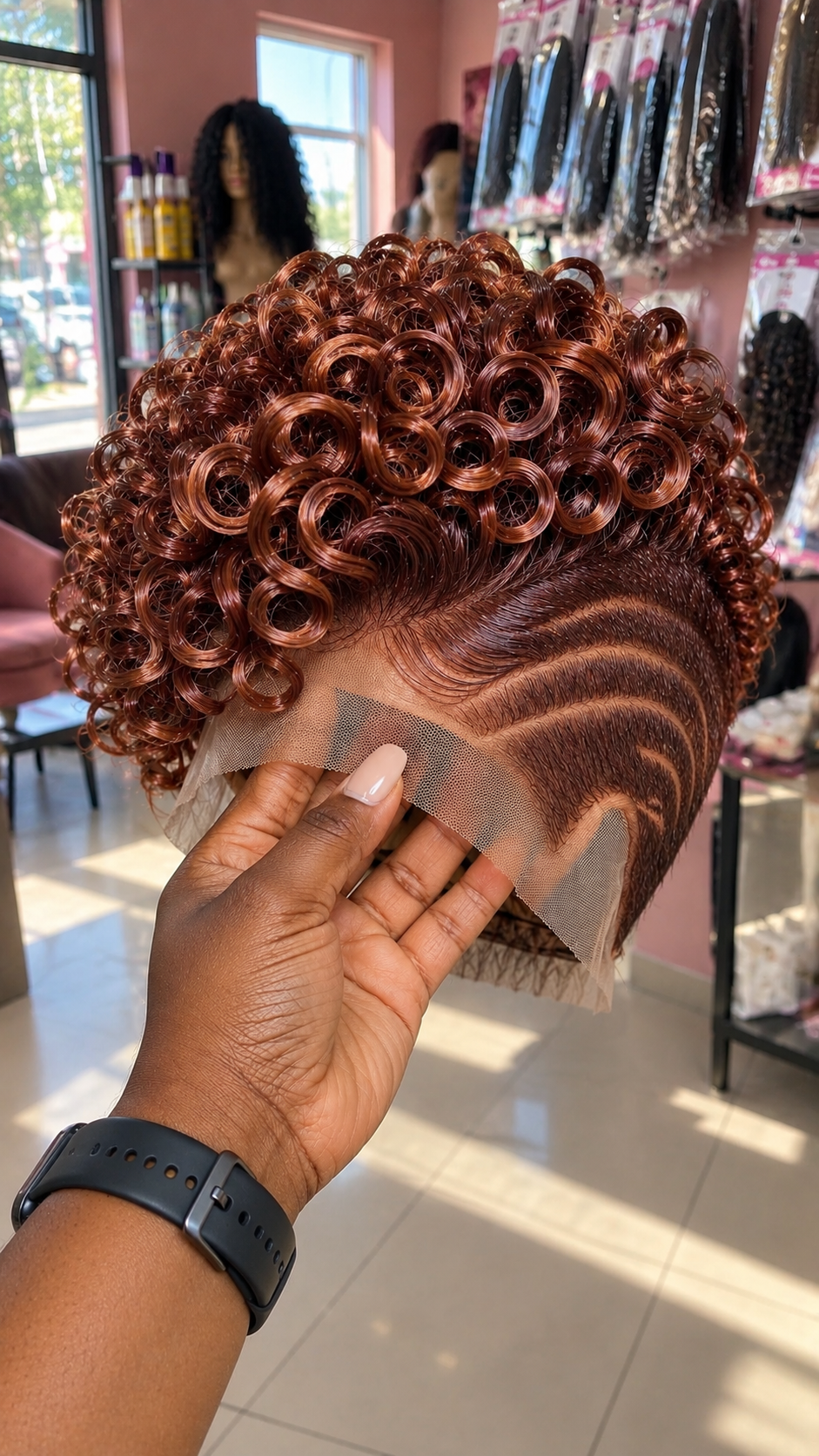
There is a remarkable difference between a curly wig that simply adds volume and one that uses every curl as part of a carefully arranged hairstyle. The cinnamon copper lace wig pictured here belongs to the second category. Its upper surface is filled with circular ringlets, many forming almost complete hollow loops, while the side introduces three sweeping carved channels that curve toward the temple. The result is a compact pixie silhouette with two distinct styling techniques sharing the same warm copper color.
Photographed inside a wig shop and held in one hand, the unit is shown before installation. The extended beige lace remains visible around the forehead and side, providing an unusually useful view of the relationship between the hairline, curl placement, and decorative side pattern. The image does not establish whether the fibers are human hair or synthetic, but it does show enough detail to help a buyer evaluate the hairstyle, communicate with a custom wig maker, and plan an appropriate fitting.
For customers searching for a copper curly pixie wig, the central purchasing question is not merely whether the color looks attractive. It is whether the supplier can reproduce the distinctive circular ringlets and preserve the sweeping side geometry without sacrificing the compact shape.
A Crown Built From Hollow Circular Ringlets
The most noticeable characteristic of this hairstyle is the arrangement of its curls. Rather than loose spirals falling downward, the upper hair forms numerous circular loops with visible openings. Some ringlets stand almost upright, while others overlap neighboring curls at slightly different angles.
This arrangement produces a rounded crown with considerable visual detail. The loops are concentrated across the top and continue toward the visible rear, creating a consistent curly surface without an exaggerated increase in height.
The front section has slightly larger and more prominent circular formations, making individual ringlets easier to distinguish. Smaller loops appear around the outer edges, where they help connect the upper hairstyle to the lower sections.
The curls also show a pronounced glossy appearance. Light reflects along the curved strands, emphasizing their circular construction and the warm reddish-copper coloring. The reflections do not establish the use of a particular styling product or fiber treatment.
Ringlet Diameter Matters More Than Generic Curl Labels
Online wig listings often describe very different hairstyles using the same terms, including curly pixie, spiral curl, or finger curl. Those descriptions may be too broad for someone attempting to purchase this exact design.
The photograph shows relatively organized, hollow circular formations. A wig with tightly packed spring coils, fluffy natural curls, or loose waves would create a different appearance even if its length and color were similar.
When discussing the hairstyle with a supplier, request a close photograph of the upper ringlets. Ask whether the loops are formed individually, whether they can be repositioned, and how the manufacturer recommends restoring their shape after handling.
It is also worth asking whether the displayed curl arrangement is representative of the actual product delivered. Some sellers photograph a specially styled sample while shipping units that require additional salon work.
Cinnamon Copper Color Without a Contrasting Dark Root
The visible color is predominantly a rich cinnamon copper with reddish-brown undertones. Certain ringlets appear brighter where the light catches them, while deeper auburn tones are visible in shaded areas between the curls.
Unlike a wig with black roots and separately colored copper tips, this unit appears to maintain a broadly consistent warm color across the visible hairstyle. The crown, front hairline area, and closely fitted side share related copper-brown tones.
That continuity is important because it allows the carved channels to stand out through changes in hair density rather than through contrasting dye.
The photographed color has a polished, metallic-looking reflection in places, particularly around the larger ringlets. However, those bright areas should not automatically be interpreted as separate blonde or rose-gold highlights.
Ordering a Similar Copper Shade
Customers should avoid relying entirely on a seller’s color name. Terms such as copper brown, ginger, auburn, and cinnamon can refer to noticeably different shades across wig catalogs.
A practical ordering method is to provide the photograph and request an actual sample image of the available color under neutral lighting. If the supplier offers color rings, ask which swatch most closely matches the warm reddish-copper appearance.
For custom human-hair orders, discuss whether the desired shade requires prior lightening or other chemical processing. For synthetic units, establish whether the selected color is manufactured into the fibers.
The material and coloring method should be confirmed before purchase, particularly if future recoloring is part of the customer’s plans.
The Triple Curved Side Pattern Is the Signature Detail
The visible side contains a striking arrangement of curved channels that follow the shape of the head. Three principal sweeping separations create a layered pattern, with the lowest section bending into a more pronounced hook-like curve near the temple area.
These channels are not ordinary parting lines across long hair. They resemble barber-inspired carved designs formed within a closely fitted section of hair. The lighter underlying surface becomes visible where the hair is separated or reduced.
The upper channel follows a broad arc beneath the curly crown. The middle channel runs along a related path, creating a narrow band of copper-colored hair between the two. The lower design turns more sharply, introducing a distinctive curved point toward the front side.
This arrangement gives the hairstyle an ornamental quality without requiring additional accessories. The pattern is created through the relationship between the darkened channels, the copper hair, and the natural curvature of the wig.
Why the Lower Curve Requires Particular Attention
The lowest carved section is especially important because it does not simply repeat the upper arcs. Its sharper change in direction gives the side design a recognizable ending.
If a custom wig maker substitutes three straight parallel lines, the result will not match the photograph. Likewise, replacing the lower curved detail with a conventional fade would remove one of the hairstyle’s main distinguishing elements.
For accurate reproduction, the stylist should study the spacing between the channels and the direction of the final curve. A side-profile photograph is more useful for this purpose than a front-facing portrait.
Any actual carving or hair removal must be planned around the wig’s construction. Excessive cutting may expose the cap or permanently alter the design. The safest approach is to work with a professional who understands both wig construction and precision barber styling.
Where the Circular Crown Meets the Sculpted Side
The transition between the upper ringlets and the lower side pattern is one of the most carefully balanced areas of this wig.
Along the boundary, the hair is directed backward and lies relatively close to the underlying shape. This flatter section creates visual space between the raised ringlets and the carved channels.
The front hairline also contains fine, curved strands arranged along the lace. These small formations follow the direction of the surrounding hair and contribute to the hairstyle’s front profile.
The photograph shows a compact design rather than a large, loosely hanging curly wig. The ringlets occupy the upper area, while the lower side remains closely fitted. Maintaining that contrast is essential for a convincing reproduction.
A supplier should therefore be asked to provide a complete side view of the finished unit. A crown photograph alone cannot demonstrate whether the lower pattern and upper curl placement are properly balanced.
Inspecting the Extended Lace Before Installation
The unit is displayed with untrimmed beige lace extending beyond the front and temple area. The mesh is particularly visible beneath the hairline and near the lower side design.
This presentation makes it possible to examine the location of the hairline before the lace is cut. Fine strands are visible along the front, and the lace continues below the carved pattern.
Although the mesh appears relatively fine, its exact material grade cannot be established from the photograph. Buyers should request the manufacturer’s lace specifications rather than assuming a particular lace category.
Only a limited portion of the underside is visible. The photograph does not clearly establish the complete cap structure, attachment combs, adjustable straps, or other security components.
Anyone considering adhesive-free installation should confirm whether the product is specifically constructed for that method. An extended lace front alone does not establish glueless compatibility.
Cap Measurements and Temple Placement
Because the decorative side pattern extends toward the temple, cap sizing is particularly important. A wig that sits too far forward, backward, or sideways may place the curved design in an unintended position.
Before ordering, provide the measurements requested by the wig maker, including head circumference and relevant front-to-back or ear-to-ear dimensions.
Ask whether the side design is available on a standard cap or requires customized placement. If the buyer has a specific preference for which side displays the pattern, that detail should be confirmed before production.
The image shows one side clearly but does not establish whether the opposite side carries an identical design.
Choosing Between a Salon-Made Unit and an Online Wig
Customers seeking this hairstyle have several possible purchasing routes, but the level of customization required should guide the decision.
A ready-made copper curly pixie may provide a similar color and compact silhouette. However, the circular ringlets and triple curved side pattern may not be included.
A custom wig maker can potentially coordinate the curl arrangement, side design, and cap measurements during production. This may be preferable for customers who consider the carved geometry essential.
Local wig boutiques are useful when the buyer wants to inspect lace color, cap fit, and curl placement before paying. Online suppliers can offer a wider selection, but detailed photographs and reliable communication become more important.
When searching, use descriptions that combine the ringlet style with the curved side pattern rather than relying on color alone.
Questions That Reveal Whether a Seller Understands the Design
Ask whether the seller can provide an actual photograph of the unit from the front, visible side, opposite side, and rear. Request a close-up of the circular curls and a separate view of the carved channels.
Confirm whether the side pattern is produced during construction or added afterward. Also establish whether the wig arrives fully styled and whether the curls can be maintained without professional resetting.
Request written information about fiber type, cap size, lace dimensions, installation requirements, and the supplier’s return or adjustment policy.
For custom orders, consider asking for photographs before the unit is shipped. This provides an opportunity to identify significant differences while the wig is still with the maker.
Illustrative Pricing for Copper Ringlet Pixie Wigs
The following USD amounts are hypothetical planning ranges rather than live product prices. They are intended to illustrate how different construction and styling choices may affect a purchase budget.
| Wig Category | Illustrative Price Range | Possible Inclusions and Limitations |
|---|---|---|
| Premium Custom | $300–$680+ | Personalized cap measurements, detailed circular ringlet styling, copper color coordination, and specialist curved side carving. |
| Standard Custom | $170–$350 | Selected customization options with styled ringlets and a simplified or individually arranged side pattern. |
| Basic Human Hair | $90–$240 | A human-hair starting unit that may need additional curl setting, coloring, and side detailing. |
| Premium Synthetic | $65–$165 | Preformed copper curls with possible decorative side styling, depending on the manufacturer. |
| Basic Synthetic | $25–$80 | A budget-friendly copper pixie alternative that may not reproduce the circular loops or carved geometry accurately. |
These categories describe potential buying options and do not identify the material used in the photographed wig.
For this design, labor may be a substantial part of the total cost. Individually arranged circular ringlets require attention to shape and placement, while the curved side channels demand precision.
The final price may also depend on lace dimensions, cap construction, hair density, color processing, and whether the wig is delivered ready to wear.
Ask sellers to distinguish the base unit price from installation, lace trimming, shipping, taxes, and any later salon services. Comparing complete costs is more useful than comparing advertised wig prices alone.
Booking the Right Professional for the First Fitting
The ideal appointment is with a wig stylist experienced in lace installation and sculpted pixie hairstyles. If the side pattern needs additional work, a barber familiar with wig units may also be helpful.
Bring the reference photograph to the appointment and explain which elements must remain unchanged. The circular ringlets, copper color, and triple curved channels are the central design details.
The stylist should begin by checking the cap fit and aligning the hairline. The position of the curved side pattern should be evaluated before trimming the lace.
Once the correct placement is established, any excess lace can be carefully addressed using an appropriate technique. Trimming too close to the hairline may damage the delicate front strands or reduce the available fitting margin.
The ringlets should be handled gently during installation. Excessive pressure against the crown can flatten the circular openings, while unnecessary manipulation may disturb the arrangement.
If the unit arrives with compressed curls, ask the supplier or stylist how they should be restored. The appropriate method depends on the confirmed fiber and styling process.
Maintaining the Circular Openings Between Wears
The most important maintenance challenge is preserving the ringlets as recognizable circles. Unlike loose curls that can tolerate some separation, these loops depend on their arranged shape.
Repeated brushing or pulling through the crown may stretch individual rings and disturb their placement. Heavy styling products may also collect between neighboring loops, making them appear less distinct.
Handle the curls individually when necessary and follow the care instructions supplied for the actual material.
If the wig is human hair, an experienced stylist may be able to reset displaced curls with suitable techniques. Previously colored hair should be treated with consideration for its processing history.
If the wig is synthetic, avoid heat tools unless the manufacturer explicitly confirms compatibility and provides safe temperature guidance.
Protecting the Curved Side Channels
The lower design requires a different approach from the ringlet crown. Hair should not be brushed indiscriminately across the carved channels because displaced strands may obscure the intended pattern.
If the channels become less visible, determine whether the problem is temporary strand movement or an actual change in the hair arrangement. Avoid attempting to deepen the lines with scissors or clippers without professional advice.
When the wig is not being worn, place it on a suitable stand that supports its shape without pressing against the side. Keep the crown free from objects that could compress the ringlets.
Careful handling is especially important around the lace, where pulling on the edge can affect the delicate hairline.
A Distinctive Copper Pixie for Buyers Who Value Detail
This hairstyle is particularly appealing to customers who enjoy structured curls and decorative barber-inspired patterns within a compact silhouette. The cinnamon copper color gives the ringlets warmth, while the carved side adds a strong visual signature.
The design can suit occasions where the hairstyle itself is intended to be a prominent part of the overall appearance, but its practicality depends on the wearer’s preferences, cap comfort, and maintenance requirements.
Before purchasing, buyers should decide which details are essential and which can be adapted. Some may prioritize the circular copper curls, while others may consider the triple curved side pattern indispensable.
That decision helps determine whether a ready-made wig is sufficient or whether a custom commission is worth the additional expense.
The strongest reproduction will preserve the relationship between the raised circular crown, closely fitted copper side, curved channels, and fine front hairline. With accurate reference photographs, verified construction details, and careful professional fitting, buyers can approach this distinctive pixie design with a clearer understanding of both its appearance and the work required to achieve it.
Search Terms
Cinnamon copper circular ringlet wig · Triple curved line pixie lace wig · Auburn hollow loop crown hairstyle · Copper brown carved temple wig · Beige lace front with copper baby hairs · Sculpted circular curl pixie unit · Ginger copper side arc design wig · Glossy reddish brown ringlet crown