
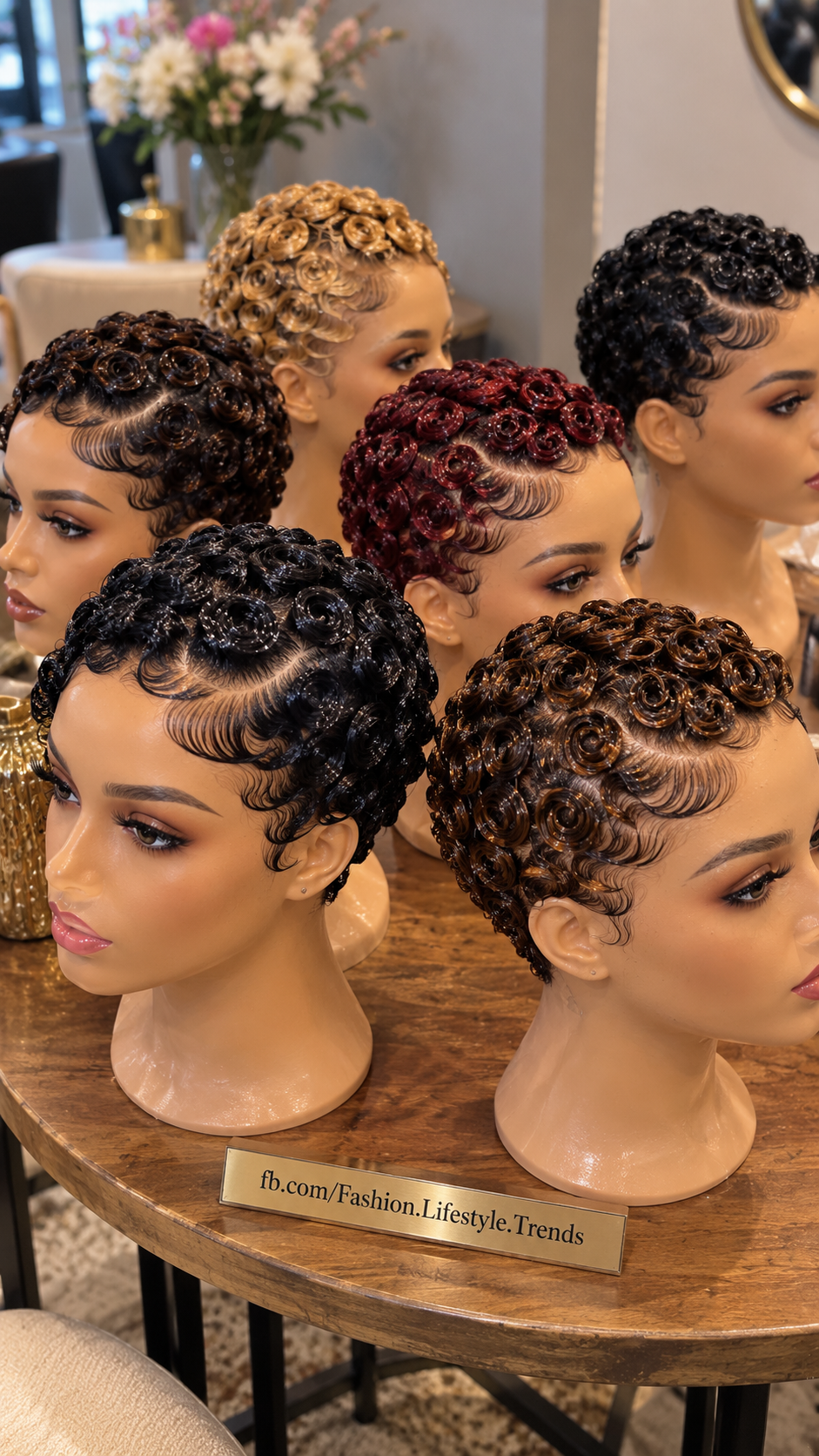
This six-wig salon display is particularly useful for comparing how color changes a compact finger-coil crown without requiring a completely different hairstyle. The collection includes glossy black, deep burgundy, honey-golden blonde, dark chocolate brown and warmer chestnut-brown options. Across the mannequins, circular coils dominate the crown while sweeping strands near the forehead and temple create a second, flatter pattern. The result is a group in which color matters, but coil placement, part direction and front styling remain equally important purchasing decisions.
The foreground black and chestnut units provide the clearest comparison. Both use highly visible circular crown formations, yet the black wig depends on reflected light and deep shadow to separate its rings. The chestnut version reveals those same kinds of curves through warm brown highlights. Behind them, burgundy produces a wine-red interpretation, while the honey-blonde mannequin demonstrates what happens when most of the dark visual weight is removed. These differences make the display useful for a customer deciding not only which shade they like, but also how strongly they want each curl to appear.
The wigs are photographed as finished pieces on mannequin heads. Their underside construction is concealed, so the exact cap and lace specifications cannot be verified from this image. The visible scalp-like areas around the directional divisions are not enough to justify an HD lace claim. Material information should be obtained from the seller for the exact wig being purchased.
Start With How Visible You Want Each Individual Coil to Be
Color has a direct effect on the way the circular crown is perceived. On the foreground black unit, the rings appear deep and highly reflective. Their centers become almost completely dark, while narrow bands of salon light travel around the outer curves. This gives the crown strong depth.
The chestnut-brown wig beside it behaves differently. Warm reflections make the outer edges of the rings easier to follow, and the darker brown interiors preserve enough contrast for the circular openings to remain obvious. Burgundy sits somewhere between these approaches, combining deep shadow with brighter red reflections.
The honey-blonde option produces the least shadow-dependent result. Because the hair is much lighter, the physical direction of the strands becomes immediately visible. For buyers, this means color can be selected partly according to how graphic or subtle they want the coil construction to appear.
The Foreground Black Wig Uses Large Rings as Its Main Visual Language
The black unit closest to the camera contains a mixture of medium and larger circular coils. Several rings have wide open centers, particularly across the upper crown. Smaller formations fill transitional spaces near the sides.
This mixture is important. If every ring were identical, the crown could look mechanically repeated. Varying the diameter allows the circular pattern to adapt to the rounded head shape while maintaining a coherent design.
A buyer commissioning this crown should show the maker an elevated reference photograph. Simply requesting finger coils does not communicate the desired ring diameter, density or spacing accurately enough.
Negative Space Keeps the Black Crown From Becoming Too Heavy
The spaces inside and between the black rings are part of the styling. They allow each coil to retain its identity. Adding more hair indiscriminately could close those spaces and turn the crown into a dense curl mass rather than a collection of individual circular formations.
This is worth remembering when evaluating custom wig quality. More density is not automatically better. For this particular style, controlled spacing is valuable because the open ring structure is one of the main visual characteristics.
The same principle applies to styling products. Excessive gel, oil or holding product can bind neighboring strands together and gradually reduce the visible openings.
Chestnut Brown Reveals the Ring Pattern Through Warm Reflection
The foreground brown wig uses a rich chestnut-to-chocolate palette. Its raised surfaces catch warm brown reflections while deeper areas remain darker. The effect gives the crown dimension without requiring obvious blonde highlights.
This color also makes the front directional strands easier to see. Fine brown arcs move from the crown toward the forehead and temple, creating a visible transition between the circular upper construction and flatter side work.
Customers ordering this shade should use the image as their primary color reference. Terms such as chestnut, chocolate, mocha and warm brown can represent noticeably different colors depending on the supplier.
Burgundy Creates a Richer Contrast Around the Face
The burgundy mannequin in the center uses deep wine-red hair across the crown. Raised coils catch brighter cherry and ruby reflections, while their interiors remain much darker. This produces a naturally varied surface without requiring a second highlight color.
The warm red palette also makes the fine strands near the forehead particularly visible. Instead of disappearing into the crown, those sections create a clear frame around the face.
Burgundy should ideally be approved under neutral lighting before a custom order is finalized. Warm salon bulbs can intensify red tones, while daylight may reveal a deeper wine, plum or brown-red base.
Honey Blonde Makes Curl Placement the Main Attraction
The honey-golden blonde mannequin at the rear provides the brightest interpretation in the collection. Circular coils remain densely arranged, but the pale color makes their physical shape much easier to inspect.
The lighter shade also reveals the perimeter strands more clearly. Curves that might disappear into a black crown remain visible against the mannequin’s complexion and exposed part area.
If a similar wig is made from human hair, the buyer should ask how the blonde shade was achieved and what care limitations apply. If it is synthetic, the fiber specification should be confirmed before heated styling. The image itself cannot determine the material.
The Directional Division Controls Where the Crown Opens
Several wigs show an exposed route through the crown rather than an uninterrupted field of curls. This division gives the circular sections a directional starting point and creates room for the flatter front strands.
Changing the position of that path can substantially alter the wig even when the color and coil diameter remain unchanged. A deeper side placement creates a larger curl field on the opposite side, while a more central position distributes the crown differently.
For a custom order, part placement should therefore be discussed before the final curl map is completed. An overhead approval photograph is the easiest way to confirm it.
The Forehead Work Uses Elongated Curves Instead of Additional Rings
The strands immediately beside the directional division do not simply repeat the crown coils. They extend into longer, parallel curves that travel toward the forehead. Near the temple, those arcs become smaller again.
This creates a useful three-stage rhythm: circular crown rings, elongated front waves and compact temple curls. The change in scale gives the hairstyle more structure than an all-over coil arrangement.
When maintaining the wig, the long front sections should not automatically be rolled into circles. Their flatter direction is intentional and should remain distinct from the crown.
Temple Placement Can Change the Character of the Same Crown
Small side curls sit close to the temple on several mannequins. Although these sections use relatively little hair, their position can have a large effect because they sit directly beside the face.
A buyer who likes the crown but wants a quieter perimeter can ask the stylist to reduce the amount of temple detailing during custom construction. Someone who prefers a more decorative profile can use the foreground black or chestnut units as references for stronger side movement.
These decisions are easier to make before construction than after a finished wig has been cut or permanently set.
Use the Six Mannequins as a Component Library
The collection becomes more useful when each mannequin is treated as a source of individual ideas rather than as an unchangeable package. A customer might want the large ring distribution of the foreground black wig, the burgundy color of the center mannequin and the quieter perimeter of the rear black unit.
Whether those elements can be combined depends on the maker, but identifying them separately creates a precise consultation. The stylist can explain which combinations are realistic and which would require a different base.
This approach is particularly helpful for social-media orders, where vague instructions such as “make the red one like the black one” can easily lead to misunderstandings.
Ready-Made Buyers Should Ask for the Exact Unit, Not a Similar Example
If the salon is selling one of the displayed wigs, request photographs of that exact piece before paying. Inspiration images demonstrate a style family, but they do not confirm the condition or construction of the inventory unit that will actually be shipped.
A useful photo set includes a direct front view, both side profiles, an elevated crown angle and the rear. Those images allow the buyer to inspect coil density, directional division and perimeter work.
If the seller advertises lace or another specific cap construction, request an additional underside photograph with the wig removed from the mannequin.
Custom Buyers Need a Production Brief Instead of a Color Name
A strong order brief can begin with the crown: mixed-diameter circular coils with visible openings rather than one uniform ring size. Next, specify the directional division and how much of the crown should remain on either side.
The third requirement is the front: elongated curved strands leading toward smaller temple sections. Only after those structural choices are clear should the final shade be specified as glossy black, deep burgundy, honey blonde, chocolate brown or chestnut brown.
Cap measurements, verified material, available lace options and whether the wig arrives fully arranged can then be added as practical specifications.
Price Differences Often Reflect Styling Time More Than Hair Length
These wigs use compact lengths, but their production can still require considerable hand work. Circular sections need individual placement, the crown density must be balanced, the front waves need directional control and custom color can add another stage of labor.
| Category | Estimated Price Range | What May Be Included |
|---|---|---|
| Premium Custom | $320–$570+ | Higher-grade hair, individualized sizing, planned coil mapping, custom shade selection, directional front work and detailed professional preparation. |
| Standard Custom | $190–$340 | Prepared circular crown, selected color and established face-framing arrangement with more standardized sizing. |
| Basic Human Hair | $115–$205 | A human-hair foundation requiring additional salon work for coil formation, color adjustment or front styling. |
| Premium Synthetic | $75–$145 | A quality pre-set option designed to retain its ring arrangement with relatively limited daily manipulation. |
| Basic Synthetic | $35–$85 | A lower-cost interpretation where coil variation, color depth or individualized perimeter work may be simpler. |
These are broad budgeting ranges rather than confirmed prices for the exact wigs pictured. Hair source, fiber, coloring, cap construction, labor market, seller location, shipping and installation can all change the total.
When comparing quotations, ask how much styling is already completed. A basic human-hair unit that still needs several hours of professional coil setting may ultimately cost more than a higher-priced wig that arrives ready for fitting.
Booking Should Match the Wig’s Stage of Completion
A finished display wig may require only fitting and small corrections after transport. In that situation, the salon should preserve the existing ring map rather than automatically restyling the entire crown.
An unfinished foundation requires a different booking. Creating mixed-size coils and directional front waves can take substantial time, especially if color work is also required.
Tell the stylist what has already been completed before scheduling. This helps determine whether a standard fitting appointment is enough or whether a longer customization session is needed.
Human Hair Is Useful for Buyers Who Expect Future Reshaping
A human-hair version can offer greater flexibility if the wearer expects the circular sections to be professionally rebuilt over time. Individual coils can potentially be reset as they relax, depending on the quality and processing history of the hair.
That processing history matters particularly for burgundy and honey-blonde units. Colored or lightened hair may require more conservative heat than minimally processed dark hair.
Ask the seller or stylist for care recommendations specific to the actual unit rather than assuming every human-hair wig tolerates the same routine.
Premium Synthetic Can Be Practical When Shape Retention Is the Priority
A pre-set synthetic wig can appeal to a buyer who wants the ring crown to remain close to its original arrangement. Quality fibers may hold circular formations with less frequent professional rebuilding.
The tradeoff is reduced freedom for major changes. Heat tolerance varies, and recoloring options may be limited. Confirm the exact fiber before attempting either.
The material decision should therefore reflect how the customer intends to use the wig rather than treating one category as automatically superior.
Take an Overhead Photograph Before the First Wash
The most useful maintenance reference is a clear image of the original crown. Photograph where the largest rings sit, how the smaller coils fill the gaps and where the directional division travels.
A side photograph should record the long forehead arcs and temple sections. Together, these images create a practical map for later maintenance.
If the crown loosens during washing, the stylist can restore the original arrangement instead of inventing a slightly different pattern each time.
Clean the Crown Without Collapsing the Circular Openings
Aggressive rubbing through the entire top can combine neighboring coils and eliminate their open centers. Cleansing should respect the crown as a collection of individual styling sections.
Use products appropriate for the confirmed material and avoid unnecessary manipulation. After drying, identify only the sections that have shifted and work on those individually.
This preservation-first approach reduces heat, handling and the likelihood of gradually changing the original design.
Maintain the Front Waves Separately From the Ring Crown
The elongated strands near the forehead need a different maintenance approach from the circular upper sections. Their purpose is to remain flatter and travel through broad arcs.
If one section lifts or moves, restore its direction rather than turning it into another ring. Repeated cutting should also be avoided because the length is necessary for those broad curves.
The smaller temple pieces can then be adjusted separately so the transition remains gradual.
Color Care Should Preserve Tonal Depth Inside the Coils
On burgundy and brown human-hair units, the deepest portions of the rings contribute significantly to the crown’s dimensional appearance. A future color refresh should avoid turning every strand into one flat bright shade.
Honey-blonde human hair may require particularly careful assessment before additional chemical processing. If the unit is synthetic, standard permanent hair color should not be assumed suitable.
Professional evaluation is worthwhile when the original shade placement is one of the main reasons the wig was purchased.
Storage Should Protect Both Ring Diameter and Temple Direction
An appropriate wig stand or mannequin head gives the crown enough room to retain its circular openings. Laying the wig beneath other items can flatten the rings even if the hair itself remains undamaged.
The side also needs clearance so the temple waves are not pressed against a wall. Make sure the unit is completely dry before storage.
For travel, use packaging with enough depth to prevent crown compression. Preserving the physical arrangement can reduce the need for expensive salon reconstruction.
The Best Choice Comes From Matching Color to the Desired Coil Visibility
Each shade in this collection changes the same broad finger-coil concept in a different way. Black creates deep shadow and mirror-like reflections. Burgundy gives the rings wine-red tonal variation. Chestnut brown adds warm depth, honey blonde exposes strand direction, and the other dark units demonstrate that coil density can change even when the palette remains similar.
For buyers, the most reliable order of decisions is crown density first, ring diameter second, front and temple direction third, and color fourth. Once those visual elements are settled, verified material and cap information can complete the order.
For wig businesses, this kind of display can become an effective consultation tool when each unit is photographed individually and its real specifications are documented accurately. Customers can compare the craftsmanship rather than simply picking a color, while the salon can distinguish ready-made inventory from more expensive custom combinations. That creates a clearer route from inspiration to an order that genuinely reflects the customer’s chosen crown, perimeter and shade.
Search Terms
glossy black finger coil wig · burgundy ring crown wig · honey blonde circular coil wig · chestnut brown finger curl wig · mixed diameter coil crown · sweeping temple wave wig · side directed finger coils · compact salon coil wig