
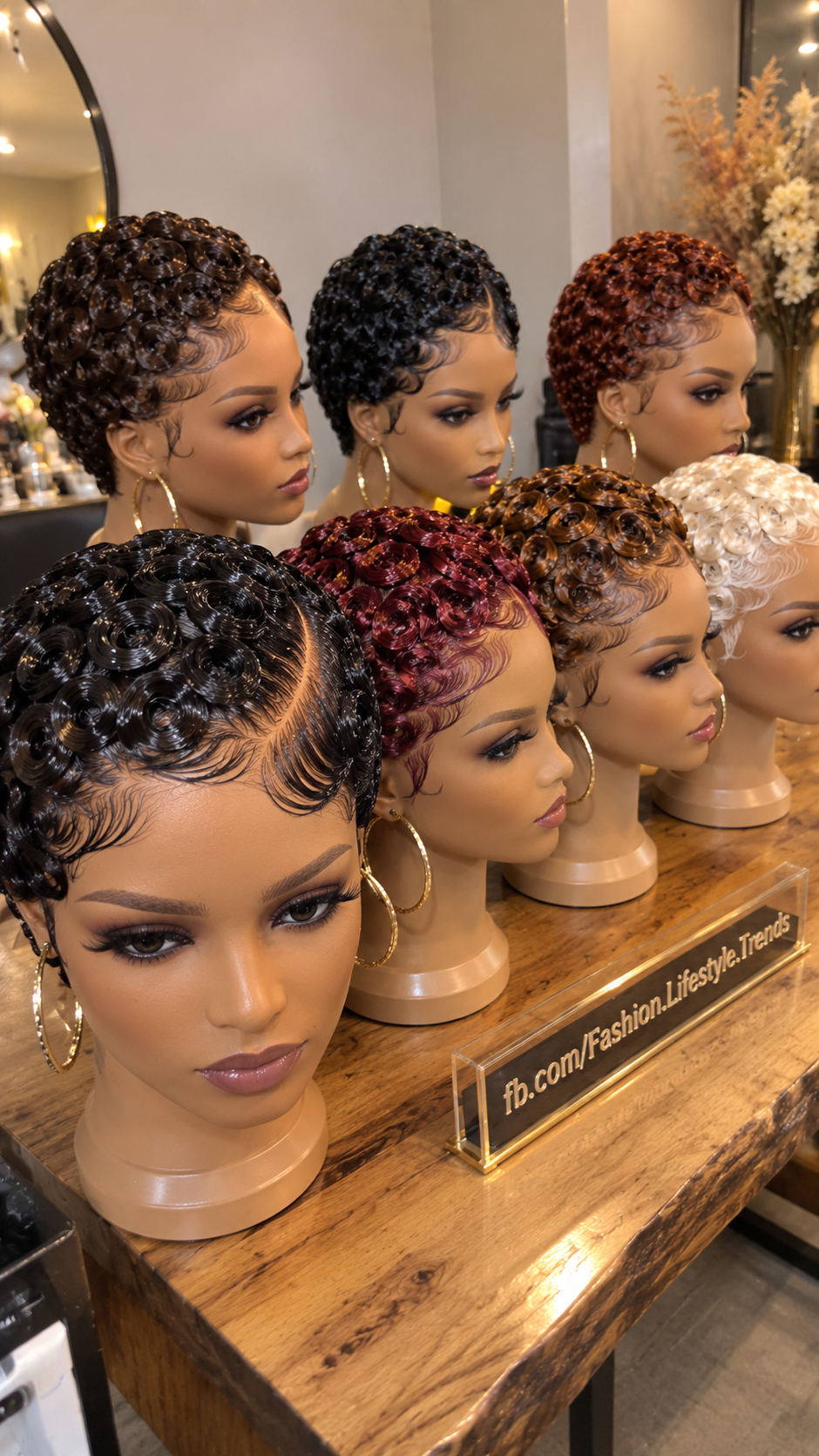
This seven-wig salon display is a strong reference for buyers who already know they want a compact finger-coil crown but have not decided how color should influence the final appearance. The collection moves through glossy black, espresso brown, burgundy, warm bronze-copper and pale pearl blonde. More importantly, the wigs demonstrate several approaches to coil density and face-framing movement. Some crowns are packed with prominent circular rings, while others use smaller coils across the upper surface. Around the forehead and temples, elongated wave sections create another layer of styling that changes how each color frames the face.
The foreground black unit immediately establishes the most dramatic interpretation. Large circular coils cover much of the crown, with clearly visible openings and intense reflected shine. A directional separation organizes the upper surface, while long black arcs travel across the forehead before turning into smaller movements around the temple. The burgundy unit beside it uses a related circular language, but its wine-red color makes every bend easier to distinguish. Bronze-brown, deep brown and pearl-blonde alternatives then demonstrate how dramatically the same broad styling family can change without adding length.
These wigs are shown as finished mannequin displays rather than from the underside. Their exact cap construction and lace specifications cannot be verified from the photograph. Visible scalp-like areas or parting do not automatically prove that a particular unit uses HD lace. Anyone purchasing one of these wigs should request construction information for the exact piece rather than applying one assumption to the entire collection.
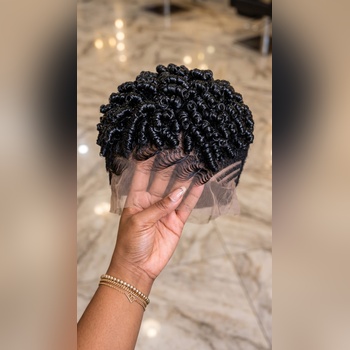
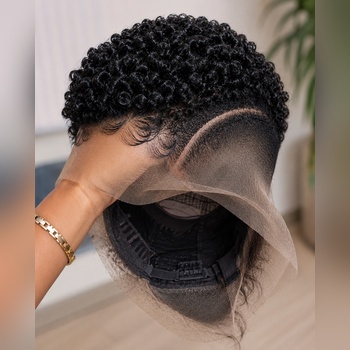
Begin With the Crown Density Instead of the Shade
The most useful first comparison is the number and scale of coils across each crown. The foreground black wig uses large open rings mixed with smaller surrounding sections. This creates substantial visual activity without turning the entire top into one continuous mass.
The black mannequin farther back uses a denser field of smaller coils. From a distance, that crown reads as more compact because individual openings attract less attention. The dark brown and copper units also demonstrate different balances between large and small circular formations.
This gives buyers a practical choice before color even enters the conversation. Someone who wants each individual ring to become a focal point may prefer the larger foreground construction. Someone who wants a quieter compact surface may choose a denser small-coil arrangement.
A custom maker should receive an elevated photograph of the preferred crown because terms such as finger curls or ring coils do not communicate diameter and spacing accurately enough on their own.
The Foreground Black Wig Makes Negative Space Part of the Design
The glossy black crown succeeds partly because not every space has been filled with hair. Dark openings remain inside the rings, and narrow gaps separate neighboring sections. These areas allow the eye to identify each circular formation.
Increasing density indiscriminately could actually weaken the design. Additional strands might close the centers of the rings and create a heavier surface. The current balance allows the black crown to appear rich without becoming visually crowded.
This principle is useful when evaluating custom work. A buyer should look beyond the amount of hair and ask whether the individual coils remain recognizable. More density is not automatically higher quality when the intended style depends on carefully separated sections.
Black Relies on Reflection Rather Than Highlight Color
The foreground wig remains predominantly deep black, yet the crown never looks flat. Salon lighting creates bright reflections across the curved outer surfaces, while the recessed areas stay nearly black. Every ring therefore develops its own light-and-shadow pattern.
This is one reason the wig does not need blonde or copper streaks to reveal its construction. The circular geometry already creates enough visual variation.
For maintenance, this also means shine products should be used conservatively. Excessive oil or wax can bind neighboring strands together and close the gaps that make the ring pattern readable. A clean reflective surface is more useful than a heavily coated one.
Espresso Brown Softens the Contrast Without Losing the Coil Pattern
The deep brown wig in the upper left portion of the display creates a quieter interpretation. Its crown remains dark, but warmer brown reflections appear across the raised surfaces. The effect is less severe than jet black while preserving enough shadow to distinguish individual rings.
This can be an appealing choice for customers who want a natural-looking dark palette but prefer visible warmth under salon or daylight conditions. The brown also interacts gently with the elongated perimeter strands, making their direction easier to see than on the deepest black sections.
Shade names should still be confirmed visually. Espresso, chocolate and dark brown can refer to different tones depending on the supplier, so a photograph of the actual available hair is preferable to relying on a label.
Burgundy Turns the Circular Crown Into a Tonal Display
The burgundy unit near the foreground uses color to reveal nearly every curve. Deep portions appear wine-red, while raised sections catch brighter cherry and ruby reflections. The result creates tonal variation without adding a separate highlight shade.
The circular construction remains prominent, but the color also makes the perimeter styling more visible. Long burgundy strands sweep around the forehead, and smaller curved pieces appear closer to the side.
A buyer ordering burgundy remotely should request an image under neutral light. Warm salon lighting can make wine shades look brighter and redder, while daylight may reveal a deeper plum or merlot base.
It is also useful to ask whether the desired color is uniform or includes darker root depth. That choice can change the dimensional appearance of the crown substantially.
Bronze-Copper Places Warmth Directly Around the Face
The warm bronze and copper units offer a different type of impact. Their circular sections reflect golden-brown, caramel and reddish tones, making the individual rings highly visible. Because the color is lighter than black or burgundy, the face-framing waves also become more prominent.
This can change how the wig is perceived even if the crown dimensions remain similar. On black hair, shadow dominates the recessed sections. On bronze, warm reflection becomes a larger part of the visual effect.
Customers should send the reference photograph when requesting this palette because words such as bronze, copper, cinnamon, caramel and auburn can overlap between wig suppliers. Visual matching is more dependable than terminology.
Pearl Blonde Makes Construction the Most Exposed
The pale wig at the far right provides the brightest option in the display. Its light strands reveal the shape of the coils without depending heavily on shadow. Individual ring edges and front curves are visible almost immediately.
This increased visibility places more responsibility on precise styling. A misplaced section or inconsistent transition may stand out more clearly than it would on black hair.
Care requirements depend on the material. If the wig is human hair, buyers should ask how the pale shade was achieved and what heat limitations apply. If it is synthetic, the fiber type should be confirmed before hot tools are used. Neither conclusion can be reached from the display photograph alone.
The Forehead Waves Should Be Chosen as Their Own Component
The front styling deserves separate attention from the crown. On several mannequins, long parallel strands move across the forehead in broad curves. These sections are flatter and more elongated than the circular coils above them.
This creates a deliberate difference in scale. The crown rotates through compact rings, while the front stretches those curves into longer directional movements. Smaller strands near the temple then complete the transition.
A customer can therefore prefer the crown from one mannequin and the forehead treatment from another. A custom consultation should identify those choices explicitly instead of assuming that selecting a color automatically determines every other part of the wig.
Temple Curls Control the Final Face-Framing Transition
Several units show smaller curved pieces close to the temple and ear. These sections bridge the gap between the broad forehead waves and the compact rear of the wig.
Their scale matters. Making them too large can crowd the side of the face, while removing them entirely can cause the long front arcs to end abruptly.
During maintenance, these pieces should be preserved conservatively. Wig hair does not regenerate after trimming, so repeated shortening can gradually change the proportions of the face-framing area.
The Same Color Can Support Different Crown Maps
The presence of multiple dark wigs in one display demonstrates an important point: choosing black does not automatically determine the hairstyle. One black unit may have large open rings, while another uses smaller coils and a different distribution around the front.
This gives salons an opportunity to organize inventory by construction first and color second. Customers can select a crown reference and then ask which colors are available for that specific arrangement.
For custom businesses, this system also reduces ordering errors. A customer saying “I want the black one in burgundy” may actually be referring to its crown map, not merely its overall silhouette.
Build the Custom Order in Four Decisions
The first decision is coil scale. Choose whether the crown should emphasize large open rings, smaller compact coils or a mixture of both. The second is density: determine how much visible spacing should remain between sections.
The third decision is face framing. Specify the direction and width of the long forehead arcs and the amount of smaller temple work. The fourth is color, selected from black, espresso brown, burgundy, bronze-copper, pearl blonde or another confirmed option.
After those visual decisions, practical specifications can be added: cap size, hair or fiber type, confirmed lace construction if applicable, and whether the wig will arrive fully arranged.
This sequence creates a much clearer production brief than sending a group photograph with no explanation of which mannequin provides the actual reference.
Individual Product Photography Should Follow the Gallery Selection
A group image is excellent for comparing possibilities, but once the customer selects a unit, the seller should document that wig individually. A front photograph alone is not enough.
An elevated crown view should show coil density and spacing. Both side profiles should reveal the face-framing work, and a rear view should show how the circular sections continue around the back.
If a seller makes specific claims about lace or cap construction, request an off-mannequin photograph of the exact unit. Styling photography and construction verification serve different purposes and should not be treated as interchangeable.
Where to Buy Depends on Whether the Customer Wants Stock or Custom Work
A ready-made salon unit is useful when the customer already likes the exact combination of color, coil density and perimeter styling. In that situation, the priority is confirming sizing, material and what fitting services remain necessary.
A custom wig maker becomes more valuable when the customer wants to combine elements from several mannequins. For example, they may request the large black crown map in burgundy or the bronze color with a quieter forehead arrangement.
Another option is to purchase a suitable base and work with a local wig stylist. This gives the professional direct access to the wearer during final fitting, although the total cost of construction should be estimated before assuming that this route is cheaper.
Booking Should Reflect the Amount of Styling Still Required
A finished display wig may need only fitting and minor restoration after transport. If the circular crown is already arranged correctly, there is little reason to dismantle it during installation.
An unfinished human-hair foundation requires a very different appointment. Building the ring map and face-framing waves can take substantial time and may require more than one service depending on color work.
When booking, tell the salon whether the wig arrives pre-set. This allows them to reserve appropriate time and assign a stylist experienced with the required level of construction.
Pricing Should Be Compared by Completed Craftsmanship
The compact size of these wigs does not automatically make them low-labor products. Creating dozens of circular sections, varying their diameter, arranging forehead waves and applying custom color can require considerable professional time.
| Category | Estimated Price Range | What May Be Included |
|---|---|---|
| Premium Custom | $325–$585+ | Higher-grade hair, individualized sizing, custom color, hand-mapped mixed-size coils, personalized density and detailed face-framing work. |
| Standard Custom | $195–$345 | Prepared finger-coil crown, selected color and planned perimeter styling with more standardized sizing. |
| Basic Human Hair | $115–$210 | A human-hair foundation requiring additional professional coil setting, color work or front styling. |
| Premium Synthetic | $75–$150 | A higher-quality pre-set option intended to retain circular coils with less frequent professional reconstruction. |
| Basic Synthetic | $35–$85 | A budget version where coil variation, density control, color depth or perimeter detail may be simpler. |
These ranges are broad budgeting references rather than confirmed prices for the wigs shown. Hair source, fiber, coloring, cap construction, seller location, labor, shipping and professional fitting can all alter the final total.
Ask what arrives completed. A $150 foundation requiring extensive coil setting and color work should not be compared directly with a $300 unit whose crown and perimeter have already been professionally arranged.
Human Hair Is Best Evaluated by Future Styling Plans
Human hair can be valuable for someone who wants the freedom to refresh or alter the coil arrangement professionally. Individual sections can potentially be rebuilt as they relax, depending on the condition of the hair.
Color processing affects future care. Burgundy, bronze and especially pale blonde human hair may require more conservative heat than minimally processed black hair.
The buyer should obtain care recommendations for the exact unit instead of relying on a universal temperature or maintenance routine.
Premium Synthetic Can Favor Shape Retention
A quality synthetic wig may suit a wearer whose priority is keeping the crown close to its original display arrangement. Pre-set circular sections can require less frequent reconstruction.
The tradeoff is reduced flexibility. Heat resistance varies, and major recoloring may not be practical. Fiber specifications should be confirmed before attempting either.
This makes material choice a question of future use rather than a simple hierarchy where one option is automatically better.
Photograph the Crown Before Beginning Home Maintenance
An overhead photograph records which coils are large, where smaller sections sit and how the perimeter transitions into the crown. Side photographs capture the forehead arcs and temple pieces.
These images become valuable after washing or travel. Instead of guessing how the hair originally sat, the wearer or stylist can rebuild only the sections that have changed.
This also reduces unnecessary manipulation and helps preserve the original salon construction for longer.
Clean Circular Coils as Separate Styling Sections
Aggressive rubbing can intertwine neighboring rings and remove the open centers that make them recognizable. Cleansing should follow the instructions for the confirmed hair or fiber and avoid treating the crown as one loose mass.
Once the wig is dry, inspect individual sections. If only a few rings have shifted, repair those rather than resetting the entire crown.
The same approach applies to the long front waves. They should retain their elongated direction rather than being converted into small coils after every wash.
Color Maintenance Should Follow the Needs of Each Shade
Black may require little tonal maintenance compared with processed burgundy, copper or blonde human hair. The colored units can gradually change with washing, heat and environmental exposure.
When refreshing burgundy or bronze, preserve the depth inside the coils rather than automatically applying one flat bright shade. Pale blonde should be assessed carefully before additional chemical processing.
For synthetic units, only use methods appropriate for the confirmed fiber. Conventional permanent hair color is not automatically suitable.
Do Not Let Product Buildup Close the Ring Centers
The circular openings are an important visual characteristic, particularly on the large black and burgundy coils. Heavy styling products can make strands adhere together and gradually close those spaces.
Use product sparingly and cleanse buildup appropriately. Shine should support the construction rather than obscure it.
When a coil begins losing shape, resetting its direction is usually more useful than simply adding more holding product on top.
Store the Wig According to Its Crown Volume
A compact wig still needs sufficient storage space when the crown contains raised rings. An appropriate wig stand or mannequin head helps preserve the circular sections without compressing them.
Keep the sides clear as well so the temple waves are not pressed against a wall or another unit. The wig should be completely dry before storage.
For travel, use packaging with enough depth to protect the highest coils. Physical preservation reduces the need for expensive corrective styling later.
The Strongest Choice Is the Crown and Color Combination That Work Together
This collection demonstrates how the same general finger-coil idea can shift dramatically through a few carefully chosen variables. Large black rings create bold light-and-shadow contrast. Burgundy adds wine-red depth. Espresso brown offers a quieter natural warmth. Bronze-copper increases visibility around the face, while pearl blonde makes every curve easy to inspect.
For buyers, the smartest process is to select coil scale and density first, then decide on the forehead and temple movement, and finally choose the color. Ask for individual photographs of the exact wig and verify construction claims separately before paying.
For wig businesses, presenting the collection as a set of customizable components can make ordering clearer and reduce misunderstandings. Customers can point to the crown they want, identify a color from another unit if customization permits, understand the price difference between stock and custom work, and book the correct salon service. The display then becomes more than an attractive gallery; it becomes a practical tool for building a precisely specified wig order.
Search Terms
large ring finger coil wig · glossy black sculpted coil crown · burgundy circular curl wig · espresso finger coil wig · bronze