
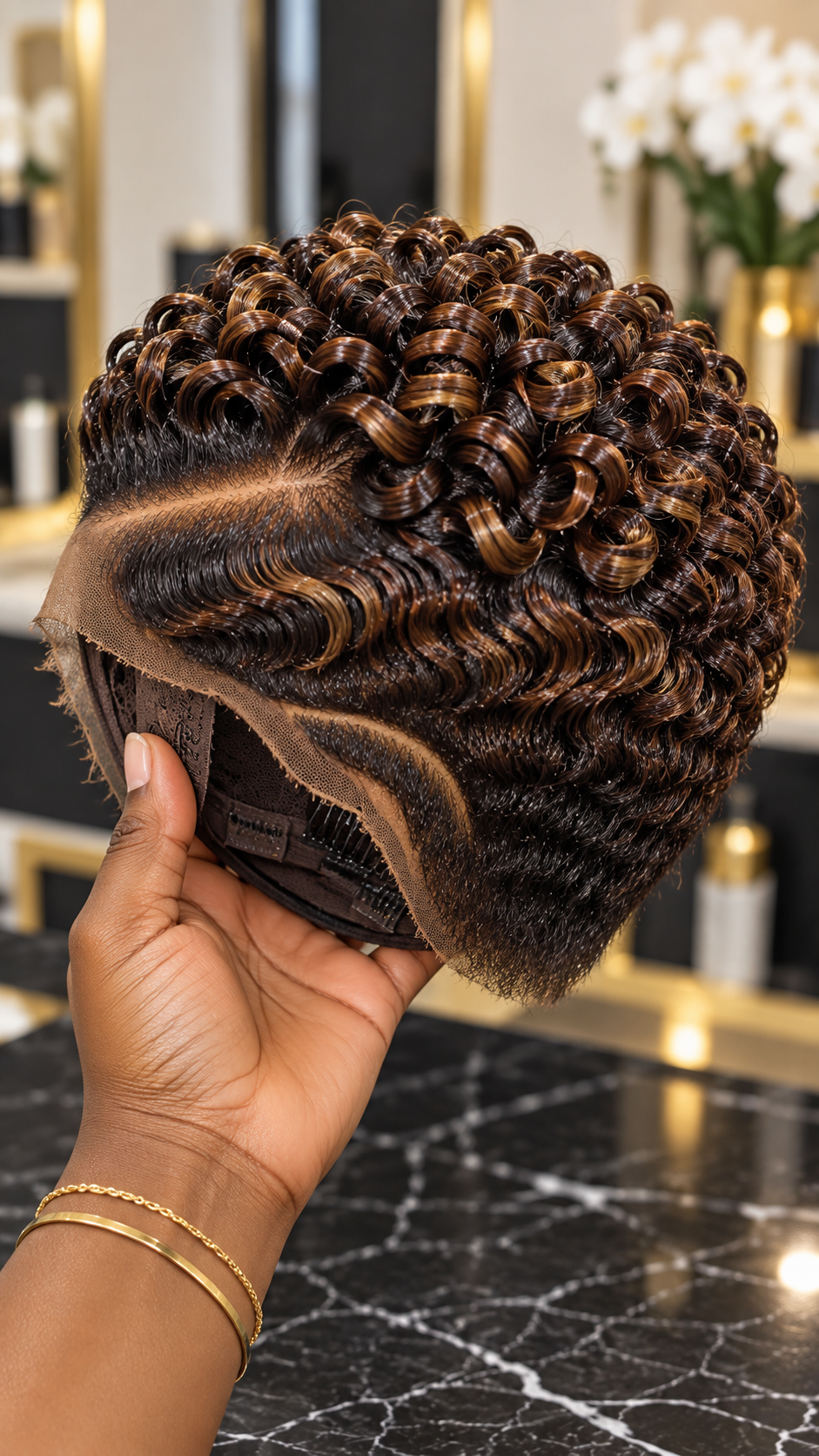
This chocolate-brown wig takes a noticeably different route from the salon-gallery pieces built around a simple diagonal part and repeated circular curls. Here, the crown is densely populated with individually rolled loops, but the lower front and side introduce broad sculpted wave panels that travel horizontally around the unit. Warm caramel-brown ribbons appear selectively through the darker chocolate foundation, following the curves of the coils rather than appearing as random highlights. The result is a compact wig whose visual identity comes from three separate elements working together: a crowded loop crown, directional wave work below it, and controlled warm color placement.
The photograph is especially useful for evaluating the unit because it is being held before installation. The front lace remains untrimmed, part of the interior cap is visible, and the lower side has not been hidden against a wearer’s skin. An internal comb can also be seen. These details help separate what can actually be confirmed from what would otherwise be guesswork. Lace is clearly part of the construction, but the photograph does not provide enough evidence to classify it as HD lace.
Caramel Placement Follows the Movement of the Hair
The lighter brown is not scattered evenly throughout the unit. Instead, caramel and amber-brown strands appear along selected circular coils and wave ridges. As each section bends, the lighter color follows that bend and makes the shape easier to read.
This is particularly effective across the crown. Deep chocolate remains inside the loops and around the roots, while warmer ribbons occupy portions of the outer surfaces. The contrast gives individual coils depth without turning the entire wig into a high-highlighted piece.
A custom order should therefore specify placement rather than merely asking for brown highlights. Conventional straight streaks would produce a very different result. The desired effect is a dark chocolate foundation with warm caramel accents integrated into the circular and waved construction.
The Crown Uses a Dense Collection of Open Loops
The upper surface contains a large number of rolled sections. Some are broad enough to reveal dark open centers, while others are tighter and occupy the spaces between the larger forms. This creates a crown that feels full without becoming one continuous curl mass.
The mixture of sizes is important. Large rings provide recognizable focal points, but smaller loops allow the pattern to follow the rounded shape of the wig. If every section were made with one identical diameter, the crown could appear repetitive and mechanically arranged.
For buyers ordering remotely, an overhead approval photograph would be particularly valuable. It should reveal whether the maker has preserved the mixed-scale arrangement rather than simply filling the crown with uniform curls.
Dark Centers Give the Warm Rings Their Depth
The most effective caramel sections retain a deeper interior. Light brown appears across the outer bend, but dark chocolate remains visible beneath it. That relationship gives the rings a three-dimensional appearance.
This also explains why increasing the amount of caramel is not automatically an improvement. If too much of the dark foundation were replaced, the contrast between the outer ribbon and inner recess would become weaker.
A colorist recreating the unit should therefore treat the dark hair as part of the design rather than as unfinished material waiting to be lightened.
The Lower Front Changes From Rings Into Parallel Waves
One of the most distinctive parts of the wig appears beneath the circular crown. Instead of continuing with more rings, the strands are arranged into long sculpted waves. Several ridges move in parallel, producing a flowing band around the front and side.
This creates a major change in scale. The crown is busy and rotational, while the lower section is broader and more directional. The contrast keeps the compact hairstyle from becoming visually overloaded.
The caramel accents continue through portions of these waves, making their curves especially easy to follow. The lighter strands sit along selected ridges while darker chocolate occupies the valleys between them.
The Wave Panel Is More Important Than a Conventional Side Part
On many compact coil wigs, a narrow exposed part is the dominant feature separating the crown from the side. This unit relies more heavily on an entire sculpted wave panel. The directional strands occupy substantial visual space and create a transition zone rather than a simple line.
That difference should be communicated clearly during customization. Asking only for a side part would not describe the broad sequence of waves visible here. The stylist needs to reproduce the actual directional panel and its relationship with the loop crown above it.
The Lower Side Becomes Progressively More Compact
Below the waved area, the hair moves closer to the foundation. Density remains visible, but the strands no longer project outward like the crown. This reduction in height helps create a controlled silhouette around the lower portion of the wig.
The transition is gradual rather than abrupt. Larger loops dominate above, sculpted waves occupy the middle, and close strands finish the lower side. Each zone has its own scale and direction.
This three-level construction is one reason the unit should not be treated as a generic curly wig. Its appearance depends on preserving the relationship between those zones.
The Warm Brown Palette Avoids an Overly Bright Result
Although caramel accents are clearly visible, the wig remains predominantly dark brown. This keeps the overall palette rich rather than turning it into a blonde-highlighted crown.
The warm strands range visually from caramel and amber to copper-brown depending on how the salon light hits them. Because lighting can exaggerate warmth, customers should request an additional neutral-light photograph before approving a custom color.
Shade names alone can also be misleading. Caramel, chestnut, honey brown and amber brown often overlap between suppliers. The reference image is a more dependable guide than terminology.
The Front Lace Is Still in a Pre-Installation State
A visible lace perimeter extends beyond the hair-bearing front. This indicates that the final fitting and trimming have not yet taken place. For a buyer using a professional stylist, leaving the lace untrimmed can provide useful flexibility.
The unit can first be positioned so the crown and sculpted side sit correctly. The stylist can then decide where the final lace boundary should fall. Trimming the lace before establishing placement removes some of that flexibility.
The apparent mesh color in the photograph should not be treated as proof of a particular lace shade. Lighting, skin nearby and camera processing can alter how the material appears. Buyers should ask the seller which actual lace shades are available.
The Visible Interior Gives Buyers Useful Questions to Ask
Part of the cap can be seen beneath the lifted unit, including an internal comb. This is useful because many finished mannequin photographs conceal the entire interior.
The photograph does not show every part of the cap, however, so buyers should still ask for a full underside image if construction matters to their purchasing decision. Confirm the cap size, available adjustment system, comb placement and lace specifications for the exact unit.
If a customer does not use internal combs, that preference can also be discussed with a custom maker before the wig is completed.
Cap Fit Influences the Position of the Wave Panel
The sculpted lower section is fixed to the wig foundation. If the cap sits too far backward or forward, the wave panel shifts with it. Correct sizing therefore affects the visual placement of the hairstyle, not merely comfort.
For custom sizing, follow the maker’s own measurement instructions rather than assuming every medium or large cap has identical dimensions. Circumference may be accompanied by ear-to-ear and front-to-nape measurements depending on the construction.
A local wig stylist can assist with measurements before ordering when precision placement is especially important.
A Useful Order Brief Separates Color From Construction
The first specification should describe the crown: densely arranged circular loops with a mixture of diameters and visible open centers. The second should identify the broad sculpted wave panel beneath the crown and the progressively closer lower side.
The third specification is color. Request a deep chocolate or espresso-brown foundation with selective caramel-to-amber ribbons following portions of the coils and wave ridges. The lighter color should support the movement rather than appearing as unrelated straight streaks.
After those appearance decisions are established, discuss cap measurements, lace shade, interior attachment preferences and whether the unit should arrive with the lace untrimmed.
Where to Buy Depends on Whether the Color Placement Must Be Custom
A ready-made wig is the simplest choice if the seller already has a unit with the desired crown density, wave panel and brown placement. Ask for photographs of the exact available piece rather than relying on a previous example.
A specialist wig maker becomes more useful when the customer wants to change the amount of caramel, adjust the crown density or reproduce the wave panel to a particular proportion. In that case, the photograph can serve as a production reference.
Another option is to purchase a compatible human-hair base and work with a local wig stylist and colorist. Before choosing this route, request estimates for both color and construction so the true finished cost is understood.
Approval Photos Should Show the Color From Above and From the Side
An overhead photograph can reveal whether the caramel strands have been integrated into the loop map correctly. It also shows whether the crown contains the intended mixture of larger and smaller circles.
A side photograph should focus on the sculpted wave panel. Check that the warm ribbons continue naturally through selected ridges without turning the entire lower section light brown.
A neutral-light image is also useful for final color approval. Warm salon lighting can make caramel appear considerably more copper or orange than it does in daylight.
Pricing Should Reflect the Work Hidden Inside a Compact Silhouette
The wig does not use long lengths of hair, but that does not make it a simple unit to produce. The crown requires many individually arranged loops, the wave panel needs controlled directional setting, and the caramel placement adds another level of customization.
| Category | Estimated Price Range | Possible Scope |
|---|---|---|
| Premium Custom | $340–$595+ | Higher-grade hair, personalized cap sizing, planned chocolate-and-caramel placement, mixed-size loop mapping, sculpted wave panels and detailed lace preparation. |
| Standard Custom | $205–$355 | Prepared brown loop crown, selective warm ribbons and established side-wave construction with more standardized sizing. |
| Basic Human Hair | $120–$220 | A restylable human-hair foundation requiring professional coloring, loop setting, wave construction and fitting. |
| Premium Synthetic | $80–$160 | A pre-colored and pre-set option that may retain the circular crown and wave panel with less frequent rebuilding. |
| Basic Synthetic | $40–$90 | A budget interpretation where color placement, coil variation, side-wave detail or cap construction may be simpler. |
These are broad budgeting ranges rather than confirmed prices for the photographed wig. Hair source, fiber, color processing, cap construction, seller location, labor, shipping and fitting can all affect the final amount.
When comparing quotations, ask whether both the loop crown and sculpted lower waves are already completed. A cheaper foundation that requires several hours of local construction and color work may ultimately cost more than a finished custom unit.
Human Hair Makes Selective Reconstruction Easier
A human-hair version can be useful for a wearer who expects the crown to be professionally refreshed over time. Individual loops can potentially be rebuilt as they relax, and the wave panel can be reset without redesigning the entire wig.
The caramel sections may have undergone additional processing, so heat should be selected according to the condition of the hair. Repeated maximum-temperature styling can reduce longevity, particularly in lighter treated strands.
When color eventually needs refreshing, the stylist should preserve the selective ribbon placement rather than covering the crown with one uniform brown formula.
Premium Synthetic Can Preserve the Color Map With Less Dye Maintenance
A quality pre-colored synthetic version may appeal to customers who want the chocolate-and-caramel relationship to remain stable without repeated coloring. Pre-set fiber can also help the loops retain their arrangement.
The limitation is future flexibility. Heat tolerance varies, and conventional permanent hair dye should not be assumed suitable. Confirm the fiber before attempting significant changes.
The best material depends on whether future restyling freedom or preservation of the original configuration is the greater priority.
The Crown Should Be Washed as a Map of Individual Sections
Before the first wash, photograph the wig from above. Record the position of the largest loops, the smaller filler coils and the placement of the caramel ribbons. A side photograph should capture the wave panel.
During cleansing, avoid aggressively rubbing the circular sections together. That can close their centers and mix neighboring coils. Use products suitable for the confirmed material and handle the lace gently.
After drying, repair only the areas that have shifted. Preserving most of the original arrangement reduces unnecessary heat and handling.
The Wave Panel Needs a Different Maintenance Technique
The lower sculpted waves should not be treated like the circular crown. Their strands need to remain elongated and directional. Rolling them into rings would remove the contrast between the upper and lower styling zones.
If one ridge loses its path, reset it along the existing curve. The original side photograph can guide the direction and spacing.
This section also benefits from product restraint. Heavy holding products can merge neighboring ridges and make the panel look like one solid mass.
Caramel Ribbons Should Stay Selective During Color Refresh
The lighter brown is most effective because it does not dominate every strand. Future color work should preserve that restraint. Turning the entire crown caramel would eliminate the deep chocolate contrast that gives the loops their dimensional appearance.
A professional colorist can use photographs of the original unit to identify which areas were intended to remain dark. This is particularly useful if the warm sections fade at a different rate from the foundation.
For synthetic fiber, follow the manufacturer’s care limitations rather than attempting standard human-hair recoloring techniques.
Product Buildup Can Hide the Detail That Makes the Wig Valuable
The hair has a highly reflective surface, but more shine product is not always better. Heavy oils can collect inside the open loops and along the valleys of the wave panel.
As residue builds, individual sections may begin sticking together. This reduces both the circular openings above and the parallel wave definition below.
Use only what the material requires. When buildup is the cause of dullness, appropriate cleansing can restore the appearance more effectively than adding another layer of product.
Book Fitting Before Making Permanent Perimeter Changes
When the wig arrives, inspect the color placement, crown, wave panel, lace and cap before cutting anything. If a custom unit differs significantly from the approved photographs, contact the seller before altering it.
Once the construction has been accepted, a wig stylist can establish the final cap position and prepare the lace. The sculpted areas should be preserved unless an actual correction is needed.
This order of work protects the original design and reduces the chance of making irreversible changes before the unit has even been fitted properly.
Storage Should Protect Two Different Types of Styling
The crown needs enough vertical clearance to preserve its open loops, while the lower side needs enough lateral clearance to keep the wave panel from being flattened. A suitable wig stand or mannequin head can support both requirements.
Avoid stacking other hairpieces on top and do not press the side firmly against a wall. The unit should be completely dry before storage.
For travel, use packaging deep enough to prevent crown compression. Maintaining the original physical shape is generally easier and less expensive than paying for repeated professional reconstruction.
The Strength of This Wig Comes From Coordinated Contrast
This design works because several contrasts are controlled rather than exaggerated. Chocolate roots sit beneath caramel ribbons. Open circular loops dominate the crown while elongated waves occupy the lower front and side. Dense upper construction gradually gives way to a closer lower section, and the visible lace remains untrimmed so final placement can still be customized.
For buyers, the quality checklist should focus on those relationships. Examine the placement of the warm ribbons, the mixture of coil sizes, the open centers, the direction of the sculpted waves, the lower density, the lace perimeter and the actual cap specifications. Confirm material claims directly rather than assuming them from appearance.
For wig businesses, this type of unit benefits from detailed pre-installation photography because much of its craftsmanship is easier to understand before the lace is trimmed and the wig is worn. Showing the crown from above, the wave panel from the side and the interior construction separately can help customers see exactly what they are paying for while making custom ordering and salon booking far clearer.
Search Terms
chocolate brown finger coil wig · caramel ribbon coil crown · sculpted side wave wig · mixed size brown loop wig · espresso root caramel wig · open ring crown hairpiece · directional finger wave lace wig · untrimmed lace brown wig