
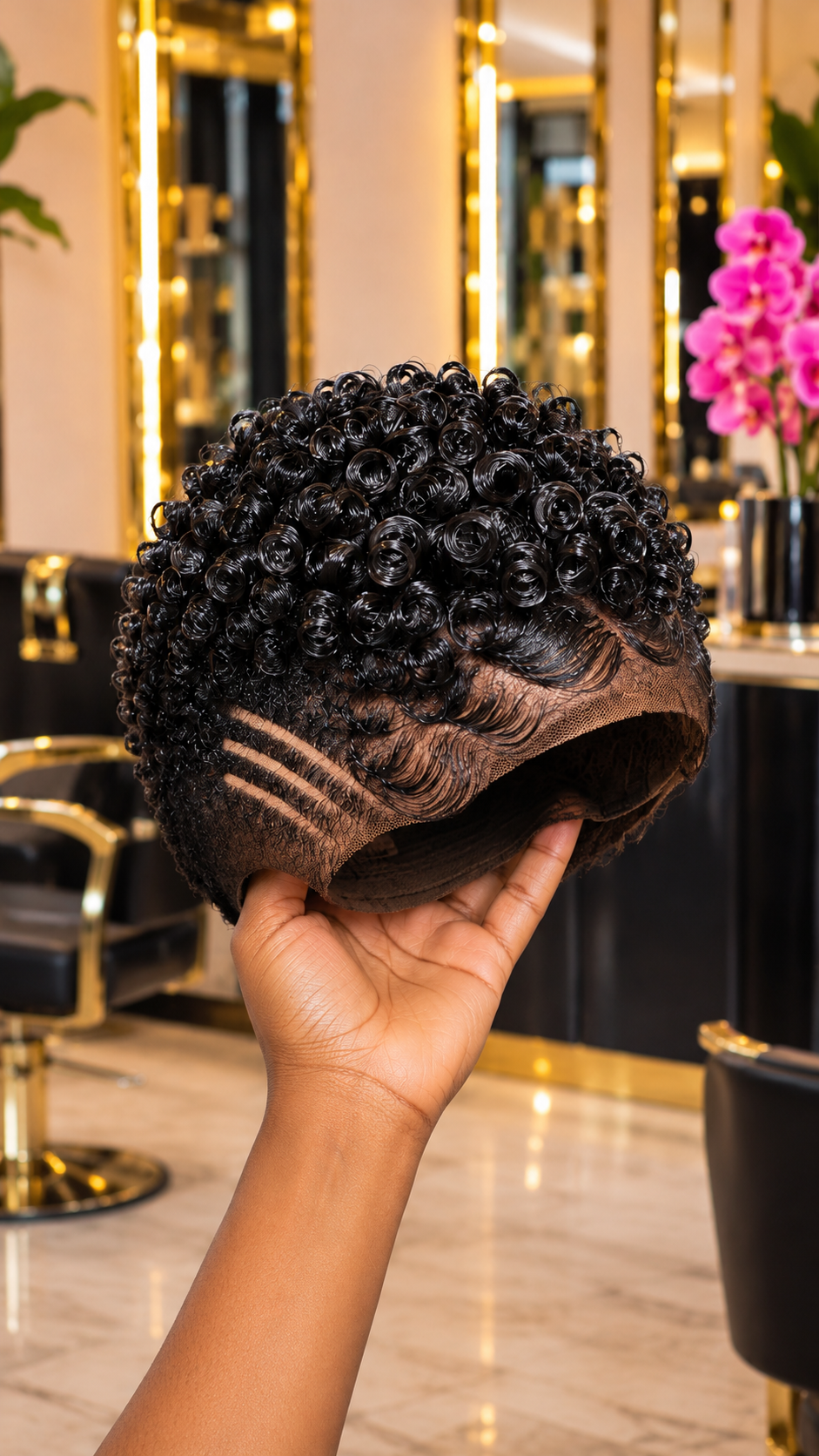
Three narrow lines can completely change the personality of a curly pixie. In this striking black wig, the decorative temple stripes sit beneath a densely arranged crown of glossy circular coils, creating a hairstyle that feels both playful and precisely sculpted. The upper curls provide fullness, the lower side creates contrast, and the delicate waves near the front soften the transition between the two.
The photograph shows a compact, jet black wig held in one hand inside a salon with golden mirrors, black styling chairs, and warm lighting. Its rounded crown contains numerous small ring-shaped curls with visible openings. The lower side is much closer to the cap, allowing three distinct diagonal stripes to stand out against the dark hair. Along the front, fine strands form sweeping curves across a visible beige-brown lace perimeter.
Unlike pixies built around large ribbon curls or widely spaced spiral roses, this hairstyle concentrates many smaller coils into a tightly packed silhouette. The individual curls remain recognizable despite their close arrangement, and their glossy surfaces produce bright reflections against the nearly black spaces between them.


The wig is displayed before installation, with the front opening and part of the dark interior foundation visible. The picture establishes the appearance of the curls, temple detailing, and untrimmed lace, but it does not establish the fiber type, precise lace grade, complete fastening system, or manufacturer.
For shoppers, the three-line temple arrangement is the most important detail to get right. A wig with the correct black color and circular curls may still look noticeably different if the stripes are missing, incorrectly spaced, or placed at another angle.
The Temple Stripes Are the Design’s Signature
The visible side contains three exposed, light-colored channels arranged diagonally beneath the upper curls. Each stripe follows a similar downward-slanting direction, while the dark hair between them creates separation.
The lines appear relatively narrow. They are not broad shaved panels, and they do not extend across the entire head. Instead, they occupy a concentrated area near the temple, creating a distinct accent within the compact silhouette.
The upper stripe is positioned closest to the curly crown. Two additional stripes follow beneath it, continuing the pattern through the closely fitted lower section. Their arrangement becomes especially noticeable because the surrounding hair appears much shorter and flatter than the ringlets above.
This is an important distinction when discussing the hairstyle with a barber or wig maker. Asking for a side design without specifying the number and orientation of the lines could produce a very different result.
The Importance of Keeping All Three Lines Separate
For a convincing reproduction, the dark bands of hair between the stripes should remain visible. If the channels are widened excessively, the pattern may lose its three-part structure.
On natural hair, an experienced barber can assess how the design fits within the available temple area. On a wig, additional caution is necessary because removing strands may expose the underlying foundation.
The image does not reveal whether the stripes were formed by cutting, selective hair placement, or another construction technique. A prospective buyer should therefore ask the wig maker how the pattern is produced.
Request an enlarged photograph of the side design before approving a custom order. This is especially helpful for checking whether all three stripes remain distinct and follow the desired angle.
A Crown Filled with Compact Circular Coils
Above the temple detailing, the hairstyle becomes densely curled. Numerous small coils cover the top, forming a rounded silhouette that rises above the closely fitted side.
Many individual curls resemble hollow circular rings. Their strands travel around small central openings, creating a pattern that looks intricate even from a distance. Some curls face the camera directly, while others tilt backward or sideways.
The coil diameter varies slightly throughout the visible section. Larger circular openings appear in several areas near the upper front, while smaller, closely layered curls fill the surrounding spaces.
This variation prevents the crown from appearing completely uniform. It also creates subtle changes in the way light travels across the black strands.
The crown contains considerable visible density, but the curls remain compact rather than hanging downward in long spirals. That combination gives the hairstyle fullness without extending far beyond the head.
Choosing the Right Coil Diameter
When searching for a similar wig, curl diameter is worth examining closely. A large finger-coil pixie may have the same overall shape but produce broader openings and a less concentrated surface.
Likewise, a loose curly pixie may lack the circular formations shown here. Ordinary spring curls can extend outward or downward, whereas these compact coils remain tightly arranged around the crown.
Ask a supplier for a close-up photograph from above. This view should reveal whether the coils have recognizable circular openings and whether the density is consistent across the top.
The photograph shows only part of the rear, so a complete back view should also be requested before ordering.
The Front Waves Create a Softer Boundary
One of the more delicate parts of the design is the narrow section of hair beneath the front coils. Instead of continuing into small circular ringlets, these strands lie closer to the lace and follow curved paths toward the forehead.
Several fine waves sweep across the front, producing gentle arcs that connect visually with the fuller crown. Their appearance is more restrained than oversized baby-hair loops or elaborate forehead spirals.
The waves become narrower toward the temple, where the hair transitions into the closely fitted side. This gives the hairstyle a continuous appearance despite the differences in curl size and strand direction.
These front details are worth preserving during customization. Removing too much hair or adding large decorative curls could alter the intended balance between the crown and temple pattern.
Hairline Placement Before Lace Trimming
The photograph shows an extended lace perimeter beneath the front waves. The excess mesh has not been trimmed to match a wearer’s forehead.
During the first fitting, a stylist should establish the correct wearing position before removing unnecessary lace. This helps preserve the fine strands near the perimeter.
The position of the lace also influences where the three temple stripes sit relative to the wearer’s face.
Cutting too much lace before fitting may reduce the available adjustment margin. Professional guidance is particularly useful when a hairstyle contains decorative strands close to the edge.
Jet Black Hair Makes the Curl Pattern Stand Out
The hair appears predominantly deep jet black. There are no clearly visible blonde, red, silver, or contrasting color sections.
The bright areas across the crown are reflections following the curved strands. Under the warm salon lighting, the black coils develop narrow highlights that make their circular shapes easier to distinguish.
Dark shadows remain visible inside many of the curl openings, adding depth to the tightly packed arrangement.
The side is less reflective because its strands lie closer to the foundation. This difference enhances the contrast between the raised crown and the three temple stripes.
The glossy appearance does not prove that the wig is made from human hair. Synthetic fibers can also produce a polished reflective surface, so material specifications should be confirmed with the supplier.
The Compact Side Supports the Raised Crown
The lower side appears closely fitted, with shorter-looking strands lying near the underlying cap. This gives the hairstyle a tapered appearance beneath the dense upper curls.
Its role is particularly important because the three stripes require a relatively flat section to remain visible.
If the side were covered with longer curls, the decorative channels might become obscured. If it were excessively sparse, unwanted areas of the foundation could become noticeable.
The reference strikes a visual balance between dark hair coverage and exposed decorative channels.
Customers commissioning a custom unit should ask how the side density will be managed. The solution may involve construction choices rather than simply cutting an existing curly wig.
The Visible Foundation Needs Closer Inspection
The wig is held with its opening facing toward the viewer, revealing a dark interior foundation. The lower edge and inner fabric are visible, but the complete cap construction cannot be examined from this angle.
In particular, the photograph does not clearly confirm the number of internal combs, adjustable straps, clips, or other fastening components.
A buyer should request an underside photograph showing the cap fully opened. This can help establish what is included and whether the construction is suitable for the intended installation method.
The presence of lace around the front does not automatically establish that the entire unit is a frontal, closure, or particular lace grade.
If the seller describes the wig as glueless, request confirmation of how it is intended to stay secure without adhesive.
Cap Fit Can Affect the Temple Design
Even a carefully made wig can look different if its cap is too large or too small.
A loose cap may move during wear, changing the position of the front waves and three decorative stripes. A tight cap may create discomfort or distort the intended shape.
Provide the measurements required by the maker, including head circumference and any additional dimensions needed for the chosen construction.
For a custom order, discuss the position of the temple design in relation to the ear and front hairline. That information can be particularly useful when the wearer has a specific preference for where the stripes should appear.
Where to Buy or Commission a Similar Pixie
Finding this hairstyle requires more careful searching than purchasing a conventional curly wig. The three temple stripes and compact circular coils are essential characteristics, and not every black pixie will include them.
Local wig boutiques are useful for inspecting the actual cap, lace, and curl pattern. Specialist wig makers may be better equipped to create the decorative side work during production.
Online suppliers can also be considered, particularly those offering custom sculpted pixie hairstyles. However, promotional images should not be treated as proof that the exact unit is available.
Ask for photographs of the item being offered, including its front, both sides, rear, crown, and interior.
The photograph does not identify a verified seller or current listing, so no specific product availability can be established from it.
What to Include in Your Order Message
Describe the requested wig as a jet black sculpted pixie with densely arranged circular coils, a closely fitted lower side, and three diagonal temple stripes.
Explain that the forehead strands should form relatively fine sweeping waves rather than large decorative curls.
Ask whether the maker can maintain the spacing between all three side channels and reproduce the rounded crown silhouette.
Confirm the fiber, cap measurements, lace specifications, and installation requirements.
Before paying, establish the delivery schedule, revision policy, and whether a photograph of the completed wig will be available for approval.
Price Expectations for Triple-Stripe Coil Pixies
The following figures are illustrative USD planning ranges, not verified retail prices for the pictured wig. Costs can vary significantly according to the supplier, construction, fiber, and amount of specialist styling required.
| Wig Category | Illustrative USD Range | Typical Considerations |
|---|---|---|
| Premium Custom | $350–$850+ | Individual cap sizing, detailed miniature coil placement, three carefully positioned temple stripes, and professional hairline finishing. |
| Standard Custom | $190–$450 | Selected cap construction with personalized crown curls and decorative side channels. |
| Basic Human Hair | $110–$290 | A human-hair starting unit that may need cutting, curl setting, and additional temple work. |
| Premium Synthetic | $85–$215 | A manufactured curly pixie with preformed coils and varying levels of side detail. |
| Basic Synthetic | $35–$100 | A lower-cost black pixie that may not reproduce the three-line temple pattern or individual curl arrangement. |
The decorative stripes may increase the amount of work involved because the maker must preserve sufficient hair coverage between the channels.
Creating numerous small circular coils may also require considerable styling time, particularly for individually arranged designs.
Installation, lace customization, shipping, taxes, and future maintenance may be charged separately.
Ask whether the quoted price includes the finished hairstyle or only a base unit requiring additional salon work.
Booking the Right Professional for Installation
A wig stylist experienced in lace fitting and sculpted pixie hairstyles is a suitable starting point for installation.
When booking by phone, WhatsApp, or direct message, explain that the unit includes fine forehead waves and a decorative three-line temple design.
Ask whether the appointment includes fitting, lace trimming, securing the cap, and minor styling adjustments.
If the temple pattern needs modification, the stylist should first evaluate the foundation. A barber experienced only in natural-hair fades may not have the construction knowledge needed to alter a wig safely.
The fitting should begin with cap positioning and comfort. Once the temple stripes sit correctly, the stylist can assess the lace and determine whether any adjustment is necessary.
Care Priorities for Closely Packed Ringlets
The upper curls are the part of the hairstyle most likely to change appearance through handling. Their small circular openings depend on the strands remaining grouped in their intended formations.
Repeated brushing can separate the coils and reduce their compact shape. Heavy styling products may also accumulate between neighboring curls, making their individual openings less apparent.
Handle the wig by supporting its cap rather than pulling on the curls. If a coil becomes displaced, follow the manufacturer’s care instructions before attempting to restore it.
For confirmed human hair, professional resetting may be possible using appropriate methods and taking account of any chemical processing history.
For synthetic fibers, heat and other reshaping techniques should be used only when the manufacturer specifically confirms compatibility.
Keeping the Three Side Stripes Visible
The temple detailing requires a different approach from the curled crown. The narrow channels may become partially obscured if neighboring strands move across them.
If the lines appear less distinct, ask a professional whether the hair can be repositioned without cutting.
Do not deepen the stripes with scissors or clippers simply to restore contrast. Unlike natural hair, strands removed from the wig will not grow back.
The closely fitted lower section should be protected from unnecessary thinning, particularly where the lace or foundation may be close to the surface.
Storage, Travel, and Daily Wearing
A wig stand sized appropriately for the cap can help protect the rounded silhouette between wears. Avoid stacking accessories or other wigs on top of the compact coils.
For travel, choose packaging that provides space around the crown and keeps the front lace away from rough edges.
Before wearing the unit again, inspect the curl arrangement, lace perimeter, and temple stripes. A quick visual check may reveal displaced strands that can be addressed before installation.
The hairstyle may suit women who prefer a compact appearance with substantial styling detail. The close-fitting side minimizes loose hair around the temple, while the dense crown supplies fullness.
Its main limitation is the care required to preserve intricate curls and exposed channels. Buyers who prefer minimal styling may want to discuss how much resetting the unit requires after washing.
Choosing a Reproduction That Respects the Original Design
The defining character of this wig comes from three elements working together: numerous compact black ringlets, softly arranged forehead waves, and three diagonal temple stripes.
The crown should remain rounded rather than excessively tall or long. The lower side should preserve sufficient coverage to frame the decorative lines, and the front waves should remain delicate rather than becoming oversized loops.
Before ordering, verify the material, lace construction, cap measurements, and available fastening components. Additional photographs of the rear and opposite side are valuable because the reference does not reveal those areas completely.
Whether purchasing a ready-made unit or commissioning custom work, prioritizing accurate curl size, temple geometry, and cap fit will make the biggest difference to the finished result.
Search Terms
Jet black triple stripe pixie wig · Black miniature ringlet crown · Three diagonal temple lines hairstyle · Compact black coil lace wig · Glossy circular corkscrew pixie · Feathered front wave black wig · Triple razor arc curly side · Dark cap sculpted coil pixie