
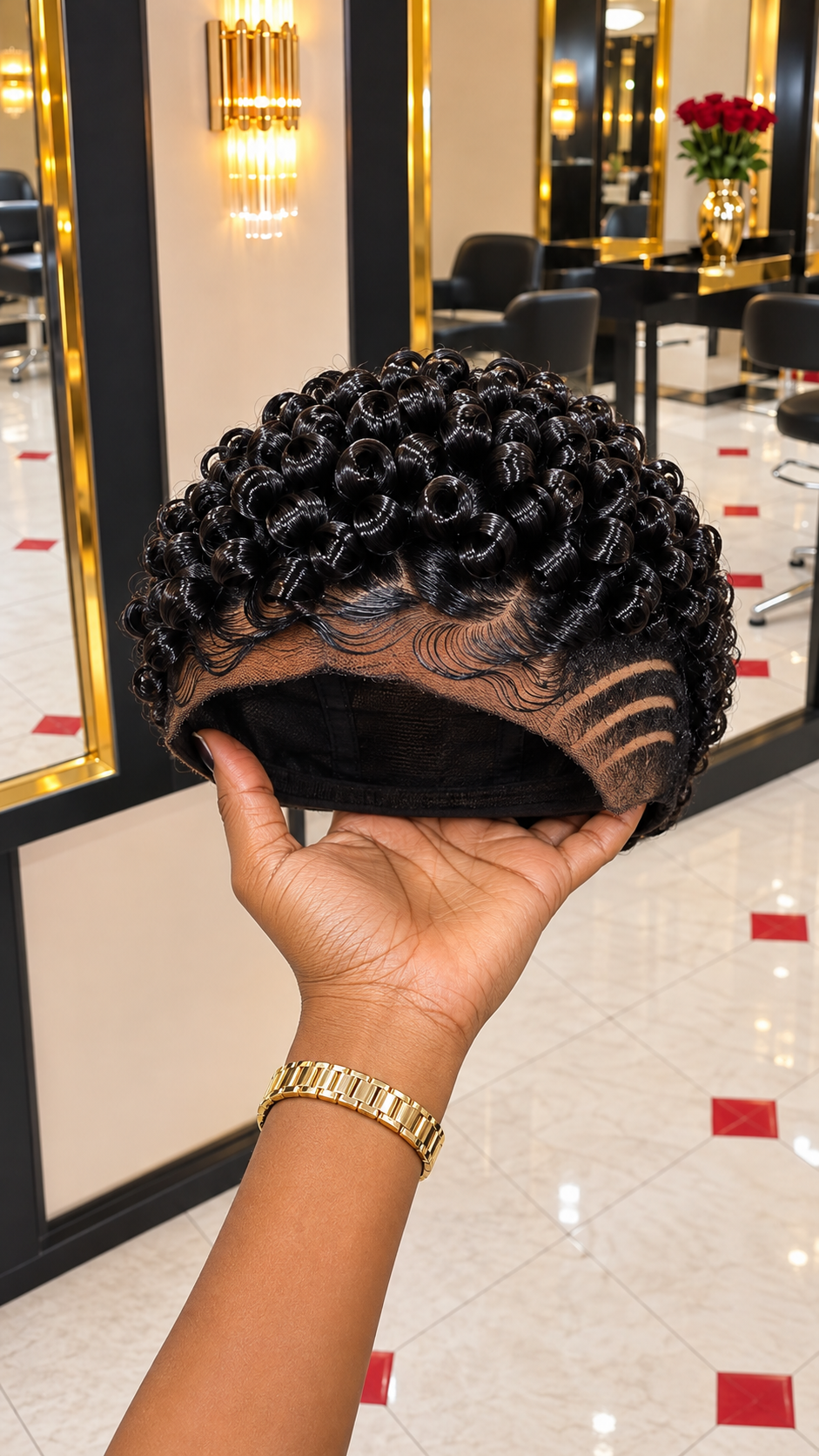
Short hairstyles can be remarkably expressive when beautiful curls meet carefully sculpted hairline details. This jet black pixie wig combines a rounded crown of glossy spiral coils with flowing finger waves and three striking curved lines along the temple. The contrast between the abundant curls and the closely arranged side hair creates a sophisticated silhouette that feels both fashionable and artistic.
The photograph shows a short black wig supported in one hand inside a beautifully decorated salon. The crown is covered with compact circular curls, each carefully arranged to create a rich, rounded shape. Beneath these glossy coils, delicate finger waves sweep across the forehead, while three parallel arcs decorate the visible temple. The wig also features an exposed lace perimeter and a dark interior cap, showing the hairpiece before its final installation.
What makes this hairstyle especially attractive is the balance between its different styling techniques. The crown provides fullness through tightly sculpted spiral curls, while the front introduces graceful movement through fine, flowing strands. The temple artwork adds a distinctive finishing detail without overwhelming the overall shape.


For women who appreciate short black curly pixie wigs, this design offers an appealing alternative to ordinary loose curls. Its compact proportions, glossy finish, and carefully arranged decorative details make it suitable for elegant occasions, professional portraits, beauty photography, and everyday styling for those comfortable with maintaining structured curls.
A Rounded Crown Filled with Glossy Spiral Coils
The most prominent feature is the abundance of circular spiral curls covering the upper crown. These coils are arranged closely together, creating a rounded silhouette with considerable visual depth.
Unlike loose curls that fall naturally in different directions, these formations appear deliberately shaped. Many have clearly visible circular openings, with strands wrapping around the center to form compact loops.
The curls vary slightly in diameter. Some are broader and more pronounced, while smaller coils occupy the spaces between them. This variation keeps the crown from appearing excessively uniform and allows the curls to follow the rounded foundation.
Another attractive quality is the hair’s rich jet black coloring. Warm reflections from the salon lighting illuminate the curved surfaces, producing an almost polished appearance. The darker areas inside the curls create natural contrast, emphasizing their individual spiral shapes.
For a similar hairstyle, maintaining the curl formation is essential. Simply applying a curling product to a short wig may not reproduce the carefully sculpted arrangement. A professional stylist experienced with finger coils or circular curl setting can help achieve the required definition.
Triple Temple Arcs Create a Distinctive Side Profile
Three curved lines positioned along the visible temple give this hairstyle its most recognizable decorative element. These arcs travel backward in parallel directions through the closely arranged black hair.
The upper line follows a broad, gentle curve, while the additional lines mirror its movement beneath it. Their placement creates a layered pattern that complements the rounded curls above.
The lines appear as narrow scalp-toned separations within the dark side section. They are carefully spaced, allowing each curve to remain individually recognizable.
Unlike sharply angular barber designs, the arcs have a flowing character. This makes them particularly suitable for a hairstyle dominated by circular curls and graceful finger waves.
The surrounding side hair remains close to the foundation, providing a contrasting background for the decorative pattern. If the lower section contained loose, voluminous curls, the arcs would become less noticeable.
Women interested in recreating this design should show their stylist a clear side-view photograph. The placement, curvature, and spacing of the three lines are important because even small changes can noticeably alter the final appearance.
Soft Finger Waves Frame the Forehead
Across the front hairline, fine black strands are arranged into beautiful sweeping finger waves. These delicate formations introduce a softer element beneath the closely packed spiral crown.
The waves follow smooth, flowing directions, creating overlapping curves that move toward the temple. Some strands form elongated S-shaped patterns, while others turn into smaller decorative loops.
This arrangement contrasts with the raised circular coils. The crown curls provide rounded fullness, while the forehead waves remain comparatively flat and emphasize directional movement.
The visible hairline is particularly attractive because the individual strands retain their separation. Rather than appearing as one thick section, the waves show fine lines that follow coordinated curves.
Recreating this effect requires attention to product application and strand placement. Excessive gel can make the front appear heavy, while insufficient hold may allow the delicate waves to lose their shape.
A suitable styling product should provide controlled definition without obscuring the fine hairline details. The exact product depends on whether the wig contains human hair or synthetic fiber.
The Compact Pixie Silhouette Keeps Everything Balanced
Although the hairstyle contains numerous curls, its overall shape remains relatively short. The rounded crown rises above the closely arranged sides without creating excessive height.
This balanced proportion is central to its appeal. The upper curls create enough fullness to attract attention, while the lower sections maintain a compact appearance.
The hair does not extend into long hanging ringlets. Instead, the circular formations follow the shape of the wig, allowing the hairstyle to retain a recognizable pixie silhouette.
The transition between the crown and temple is particularly important. The lower curls become more compact as they approach the decorative side artwork, helping the three curved lines remain visible.
For custom production, customers should request the same overall proportions rather than simply asking for maximum volume. Excessive density could overwhelm the temple design, while an insufficient number of curls might leave unwanted gaps across the crown.
The aim is a rounded, well-proportioned hairstyle in which the coils, forehead waves, and temple arcs complement one another.
Understanding the Lace and Cap Construction
The photograph clearly reveals a lace perimeter extending beyond the styled front hairline. This material remains untrimmed because the wig is being displayed before its final fitting.
The lace allows the stylist to position the hairpiece and prepare the front edge according to the wearer’s measurements and preferred installation technique.
A dark interior cap is also visible beneath the hair. The cap supports the sculpted crown and helps maintain the overall shape of the hairstyle.
Although the photograph shows the foundation, it does not establish every construction specification. In particular, the exact commercial lace grade, fiber composition, and complete fastening system cannot be confirmed through visual inspection alone.
Customers should ask the supplier whether a similar unit uses lace-front, frontal, closure, or another construction. Each option offers different possibilities for fitting and styling.
A lace-front foundation may be suitable for a decorative hairline, while some custom designs require additional lace coverage to support more extensive side detailing.
The choice should depend on the intended appearance rather than selecting a construction solely because it is advertised as premium.
Can This Hairstyle Be Made Glueless?
Women who prefer convenient installation may be interested in a glueless version of this short pixie. Depending on the foundation, some wigs can be manufactured with adjustable components, elastic bands, and securing features that reduce or eliminate the need for adhesive.
However, the presence of an interior cap does not automatically establish that the photographed wig is suitable for glueless wear.
A properly fitted foundation is especially important when the hairstyle includes carefully positioned forehead waves and temple artwork. If the wig shifts during wear, the decorative details may no longer sit in their intended locations.
Before purchasing, customers should confirm the available fastening system and provide accurate head measurements.
A glueless construction may be convenient for women who regularly remove their wigs, while professional adhesive installation can be appropriate for other preferences.
The best choice depends on comfort, wearing habits, the foundation’s design, and professional recommendations.
Choosing Hair Density, Length, and Material
The hairstyle requires enough hair to produce numerous rounded coils without making the crown excessively bulky. Density should therefore be selected according to the finished curl arrangement rather than a numerical percentage alone.
Very high density may cause neighboring coils to overlap too heavily, reducing their individual definition. Lower density could create visible gaps between the circular formations.
The starting hair length also affects the final appearance. Although the finished hairstyle is short, the strands must be long enough to form complete circular curls.
Different areas may require different lengths. The crown needs sufficient material for the spiral formations, while the lower side should remain compact enough to reveal the three curved lines.
Human hair may offer greater flexibility for professional restyling, depending on its quality and processing history. Some synthetic fibers can maintain pre-set curls effectively, although their heat tolerance and reshaping options vary.
The photograph does not establish which material has been used. Customers should verify the fiber composition before purchasing or attempting any heat-based styling.
For a custom order, the most useful approach is to provide photographs showing the desired crown, temple, and front hairline, then ask the wig maker to recommend suitable density and lengths.
Where To Buy This Wig
Women interested in this hairstyle can explore specialist wig boutiques, professional lace-wig manufacturers, custom wig makers, and salons experienced with sculpted pixie designs.
Standard short curly wigs may provide a suitable foundation, but they do not necessarily include the circular crown styling or decorative temple arcs shown here.
Custom production is often worth considering when exact curl placement and side detailing are priorities.
Online marketplaces and independent beauty businesses may advertise related styles under terms such as short finger coil wig, sculpted pixie lace wig, or black curly pixie with temple designs.
Before ordering, request actual product photographs rather than relying entirely on promotional illustrations. The seller should be able to provide a frontal image, side view, crown photograph, and picture of the interior construction.
It is also advisable to confirm the available cap sizes, hair material, lace color, customization options, shipping charges, and return policy.
When contacting a seller through WhatsApp, Instagram direct messages, or a business phone number, describe the desired hairstyle clearly and attach the reference photograph.
Ask whether the quoted price includes the completed sculpted curls and temple artwork. Some sellers provide unfinished foundations that require additional salon styling.
Booking a Salon Appointment for This Style
Creating a similar look requires a professional who understands detailed curl setting, finger-wave styling, and precise side artwork.
A conventional curly-wig installation may not include all these services. Some salons specialize in wig customization, while others focus primarily on fitting and securing completed units.
During consultation, explain that the hairstyle combines a short rounded crown of glossy spiral coils with a flowing forehead hairline and three parallel curved temple lines.
The stylist should evaluate the wig foundation before confirming that the side pattern can be recreated accurately.
Customers may also request this appearance on natural hair, provided their existing length and texture allow the desired curl formation and lower-side detailing.
For natural hair, an experienced barber may create the lower taper or decorative lines, while a natural-hair stylist forms the crown coils.
Ask whether washing, conditioning, cutting, curl setting, lace preparation, and installation are included in the appointment. Confirm the total service price before work begins.
A professional should also explain how the hairstyle can be maintained after the appointment, particularly if the individual coils require periodic restoration.
Estimated Prices for Short Sculpted Pixie Wigs
The cost of a similar wig depends on the hair material, cap construction, density, lace preparation, and labor involved in sculpting the curls and decorative side details.
The following figures are illustrative budgeting ranges in US dollars, not verified prices for the photographed hairpiece. Custom quotations may differ considerably.
| Price Tier | Estimated Range | Typical Options |
|---|---|---|
| Budget | $45–$100 | Basic synthetic short curly wig with simplified coil styling and limited customization. |
| Value | $100–$190 | Improved synthetic or blended construction with more carefully arranged curls and basic hairline work. |
| Mid | $190–$330 | Selected human-hair or higher-grade options with professional coil setting and decorative side styling. |
| Premium | $330–$540 | Custom foundation, individually sculpted curls, refined finger waves, and precise temple arcs. |
| Salon-Grade | $540–$860+ | Personalized measurements, specialist construction, extensive hand styling, professional fitting, and finishing services. |
Natural-hair salon services are usually priced separately from complete custom wig purchases. Customers should confirm all charges, including installation, maintenance, shipping, and taxes.
Daily Maintenance for the Spiral Crown
Structured spiral curls require gentle handling to maintain their original circular shapes. Aggressive brushing can separate the strands and cause neighboring coils to lose their definition.
After each wear, examine the crown for flattened curls or displaced sections. Minor adjustments may be sufficient when only a few formations have shifted.
The appropriate maintenance method depends on the hair material. Human-hair units may support professional curl resetting, while synthetic wigs require techniques compatible with their specific fibers.
Excessive styling products can create buildup and make the individual curls appear less distinct. Use products recommended for the confirmed material rather than repeatedly applying heavy oils solely to increase shine.
When washing becomes necessary, avoid vigorous rubbing that could disturb the sculpted crown. Allow the wig to dry without compressing its rounded surface.
For extensive curl distortion, professional restoration may be more effective than attempting to reshape the entire hairstyle at home.
Protecting the Finger Waves and Temple Artwork
The front finger waves and three decorative side arcs require a different maintenance approach from the raised curls above them.
The forehead strands should remain aligned in their original sweeping directions. Repeated brushing, excessive product application, or unnecessary handling may disturb their delicate arrangement.
The curved temple lines should retain their spacing and position. If the lines have been created through trimming, further cutting could permanently widen the pattern.
For a wig, fine strands surrounding the arcs may be carefully repositioned rather than automatically removed.
When arranging professional maintenance, provide the original photograph so the stylist can follow the intended curves.
For women wearing the style on natural hair, the temple details may gradually lose definition as the hair grows. A barber can refresh the pattern during a future appointment.
Regular attention to these smaller details helps maintain the hairstyle’s distinctive appearance without requiring the entire crown to be restyled.
Storing the Wig to Preserve Its Rounded Shape
Proper storage is especially important for structured curls because pressure can flatten the circular formations.
A suitable wig stand or mannequin head can help maintain the crown between wears. Avoid placing heavy objects on the hair or stacking the wig beneath other hairpieces.
The front finger waves should remain free from unnecessary compression, and the lace foundation should be protected against stretching or accidental tearing.
Before extended storage, ensure the wig is completely dry. Moisture trapped inside the cap can create unwanted odors and affect the condition of the foundation.
For transportation, use packaging that provides sufficient clearance around the upper curls.
When removing the wig from storage, inspect the crown and hairline before attempting any adjustments. Often, only small sections require attention.
Advantages and Limitations of This Hairstyle
One of the greatest advantages is the combination of decorative detail and short proportions. The rounded spiral crown creates fullness without requiring long hair around the shoulders.
The consistent black color allows the precise curl arrangement to remain the main attraction, while the three temple arcs provide individuality.
A removable wig also offers the possibility of enjoying an elaborate short hairstyle without permanently cutting natural hair.
The design can be especially attractive for celebrations, salon photography, personal portraits, and women who enjoy sculpted hairstyles.
However, the structured coils require more careful maintenance than ordinary loose curls. The finger waves may need occasional restoration, and the side artwork depends on accurate strand placement.
Custom construction can also involve additional costs because of the labor required to achieve the detailed arrangement.
Women who prefer changing their hairstyles frequently may find a less structured wig easier to restyle.
These considerations should be balanced against the desired appearance, maintenance routine, and available budget.
A Beautiful Combination of Spiral Curls and Artistic Detail
This jet black pixie demonstrates how professional curl setting and carefully positioned temple artwork can transform a compact hairstyle into something especially distinctive.
The glossy circular coils create a full, rounded crown, while the delicately arranged forehead waves introduce graceful movement. Three parallel temple arcs add a striking side accent that complements the curves of the upper curls.
For women considering a similar wig, the most important details are the size and placement of the spiral coils, the compact lower silhouette, the direction of the finger waves, and the precise shape of the temple lines.
Buyers should also confirm the hair material, cap measurements, lace construction, and available customization services before ordering.
For salons and wig businesses, photographs showing the front, crown, side, rear, and interior foundation can help customers appreciate the level of craftsmanship involved.
Whether purchased as a completed custom wig or recreated through professional natural-hair styling, this combination of rich black coils, flowing finger waves, and triple temple arcs offers a memorable short hairstyle with beautiful proportions and remarkable decorative detail.
Search Terms
jet black spiral pixie wig · triple temple arc hairstyle · short glossy finger coil wig · black pixie with curved side lines · sculpted spiral curls with finger waves · compact black lace front pixie · three temple stripes curly haircut · rounded coil crown short wig