
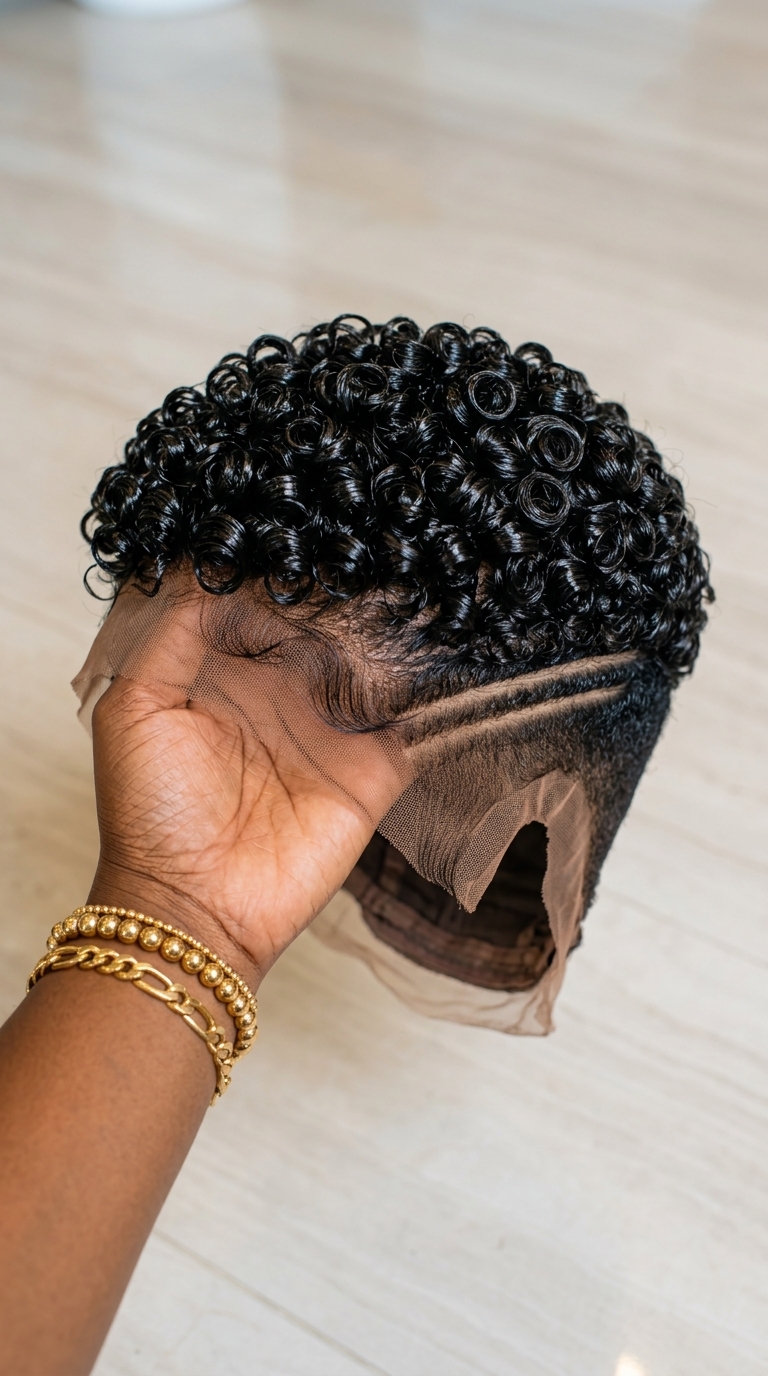
Give this unit ten seconds on its side and the coils stop being the story. The story is the line where the springs end and the short hair begins.
What This Photo Is Actually Showing
The crown is a packed cap of tight, glossy black spring coils. That is the listing shot everyone wants. Under the hand, the lace is pulled forward so you can see the first rows and the leftover flap. That part of the photo is familiar.
The useful part is the temple.
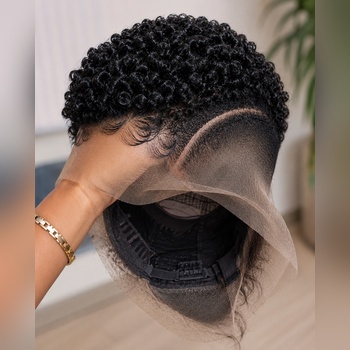
Look at the right edge of the unit. The coils do not wrap all the way around. They stop. Short, faded hair takes over, with two or three carved lines cut through that faded panel. The silhouette is not “all curl.” It is curl on top and a barbered side.
Those two textures were not grown together. They were built next to each other. If the join is clean, the unit looks like a cut. If the join is blunt, it looks like a coil cap sitting on a fade that does not belong to it.
This is the inspection most buyers skip because the coils are louder.
The Join Is The Product. The Coils Are The Costume.
A compact coil cap hides gaps. Shadow falls between the springs, so the crown looks solid from above. The temple cannot hide anything. Short hair has no coil to throw shadow. Every millimetre of the fade is readable.
Three things have to be true at that join or the unit fails in daylight:
The coil density has to taper before the fade starts. If full springs sit right against the short panel, you get a shelf. The shelf photographs as volume. On a head it photographs as two haircuts.
The fade has to be knotted down, not only clipper-cut on top of a thick edge. A knotted fade can melt toward skin. A cut fade stops on a hard line and stays there.
The carved lines have to sit inside the faded panel, not across the coil mass. Lines cut through springs disappear into the curl. Lines cut through short hair stay graphic — and stay visible when the coils loosen after a wash.
This photo is styled. Gel is holding the springs tight and the side is freshly lined. You cannot tell from one frame whether the fade is knotted or cut. You can tell that the maker wanted you to see a barber finish. Ask for a dry close-up of that temple with no product. If they will not send it, assume the join is a styling step, not a construction step.
Carved Lines On A Coil Cap Are Not Free Detail
The lines on this side are the same family as every other carved pixie in this series: they are the sharpest thing in the photo and the least permanent thing on the unit if they were only razored into grown hair.
On a coil cap they do extra work. They lock the wear direction. Rotate the unit and the fade sits on the wrong side of the face. The coils will still look like coils. The graphic half will look lost.
They also set a maintenance schedule the coils do not need. Tight springs can be refreshed with water and product. A carved fade cannot. Once the line blurs, you either recut it or live with a soft smudge next to a defined crown. That contrast ages faster than an all-coil unit.
Price the lines as a recurring appointment, not as a feature included in the tag. A $20–$50 lineup every two or three wears is part of the cost of this silhouette. If you will not maintain the side, buy the coil cap without the carve.
The Lace Flap And The Fade Are Two Different Edges
The hand is holding a wide, untrimmed lace panel. Most of that panel will be cut off. That is assembly margin. It is not extra wig.
The fade is a different edge. It is already short. You cannot “trim it to fit” the way you trim lace. If the faded panel is too high, too square, or too far forward for your ear and jaw, a stylist can recut it — but they cannot add hair back. The lace is generous. The fade is finite.
Buyers mix these two up because both show as “edge” in a hand-held shot. Treat them separately:
Lace: cut after you have tried the unit on. Leave enough to melt. Throw the rest away.
Fade: judge before you buy. Height, square vs taper, and how close the short hair sits to the coil mass are permanent decisions on a wig.
Black hair hides a blunt fade in a salon photo the same way it hides a blunt hairline. Daylight against your own skin will not.
Tight Coils Still Hide The Cap. Flip It Anyway.
Small spring coils look dense from above and hide the interior. This photo already does you a favour: the lace is lifted, the dark cap is visible, and you can see that this is a glueless-style construction with an open interior.
Use that view. Check whether the first row on the lace is finer than the coil mass behind it. Check whether the cap prints dark through the mesh at the temple, where there is no coil to cover it. The side has less hair to hide a coarse lace or a dark cap. The crown will forgive. The fade will not.
If the seller only sends the coil-from-above shot, you are missing the half of the unit that actually decides whether this looks like a haircut or a costume.
How Much A Coil-And-Fade Pixie Costs
Human-hair tight-coil pixies with a lace front commonly sit between $160 and $280. A clean knotted fade and a usable first-row taper sit at the top of that band. Synthetic versions of the same spring-coil look usually sit between $40 and $90.
The carved lines add almost nothing to construction cost. They are a finishing step. Do not pay a premium for the graphic side unless the fade itself is knotted and the join is tapered. You can have lines drawn on a cheap cut fade. That is not the same unit.
Do not pay a human-hair premium for wet-look coil definition alone. That finish is cheap to spray on. The money is in the join, the lace tint, and whether the short side was built or only clipped.
Where To Buy This Coil-And-Fade Cap
Buy from a seller who can show the same unit from three angles: crown, temple join, and lace down on a head or hand. One beauty shot of the springs is not enough for this silhouette.
[WhatsApp: +XX XXX XXX XX XX]
Ask for a dry close-up of the fade with no gel in the lines. Ask whether the short panel is knotted to the lace or only cut. Those are different products.
Confirm cap size against your head circumference. A compact coil cap has almost no length to hide a high hairline. A carved side has even less. Straps fine-tune two to three centimetres. They do not fix a wrong base, and they do not move a fade that sits too far forward on your ear.
Shipping And What Arrives
These units travel in a bag that flattens the coils and can crease the lace. That is transit, not the finished shape. When it arrives, compare three things to the listing before you cut the lace: coil spring, the join where curl meets fade, and whether the carved lines are still sharp or already soft from packing.
If the fade is higher, squarer, or more blunt than the photo, use the return window. Product will not grow hair back into a short panel.
Before You Pay
Find the join. If the coils sit full-density against the short hair, expect a shelf after the first wash.
Ask if the fade is knotted or clipper-cut.
Treat the carved lines as maintenance, not as a permanent design.
Measure your head. This shape sits close. Wrong size shows on the fade first.
Search Terms
coil fade pixie wig
tight coil carved side pixie
black spring coil temple fade
curl to fade join wig
carved line coil cap
glueless black coil pixie
short fade curly pixie wig
compact coil cap lace front
Final Thoughts
The coils sell the photo. The side decides whether you can wear it as a haircut.
If the springs do not taper into the fade, you are buying two finishes stacked on one cap. That stack looks expensive in a hand-held shot and cheap on a forehead by week two. Check where the curl stops before you pay for how shiny it looks while it is still packed.