
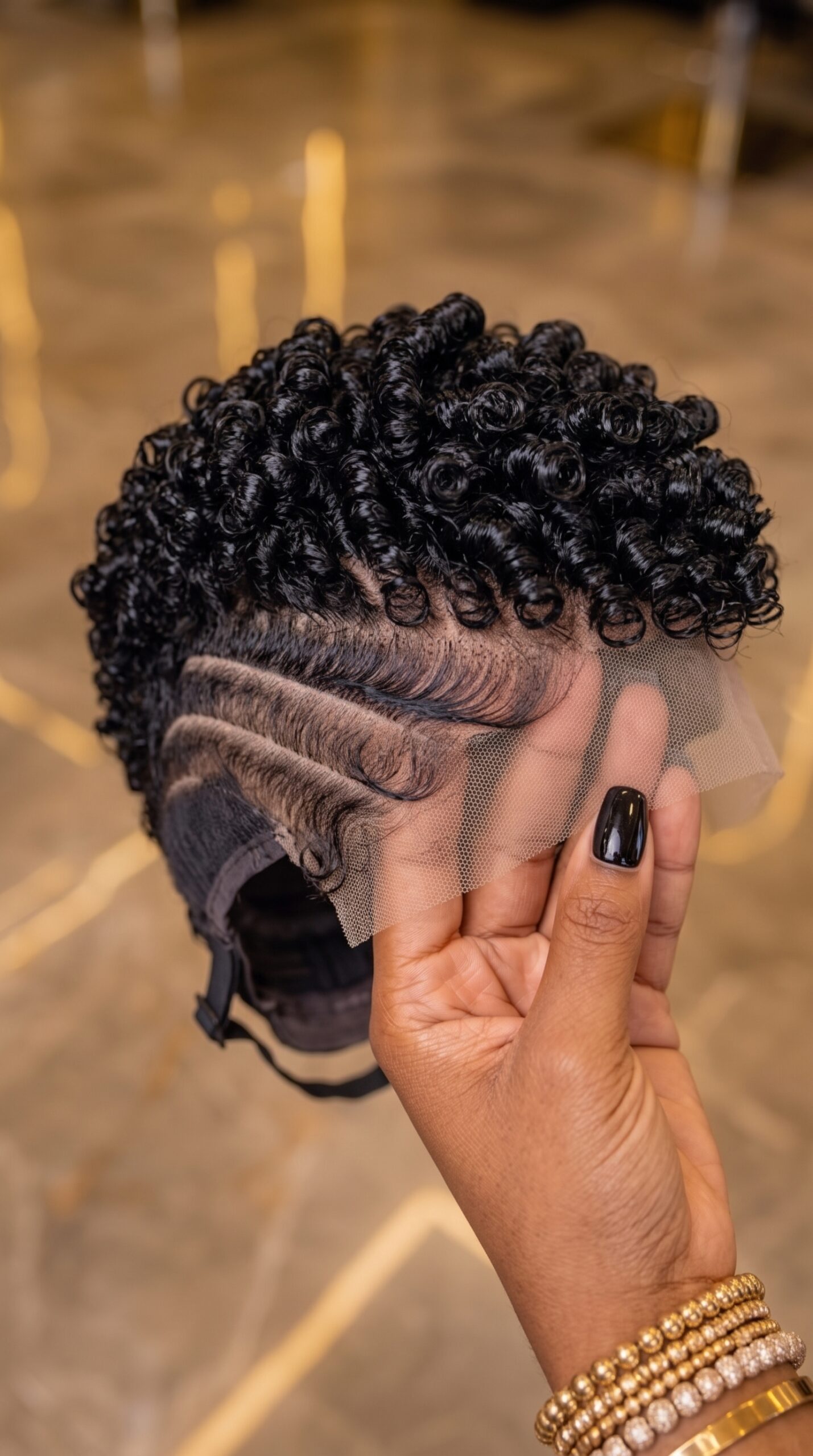
Sellers hold a unit like this up to the camera and let the coils do the talking. What they are actually showing you, if you look past the shine, is a sheet of hexagonal holes and a dark cap sitting behind them.
That is the useful half of the picture.
What This Photo Is Really Selling
The crown is a packed cap of tight, glossy black spring coils. They sit close to the scalp, they catch the overhead lights, and they hide almost everything underneath. That is why this angle works in a listing. Tight coils throw shadow into their own gaps. Density looks higher than it is. Fibre looks richer than it may be.
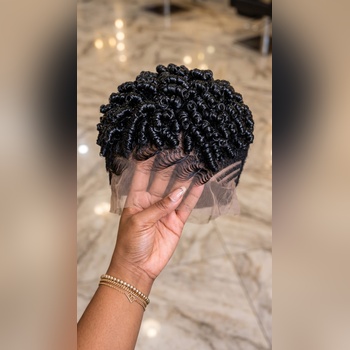
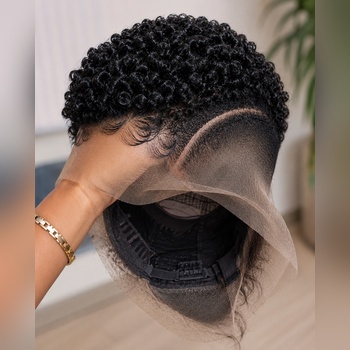
The hand is doing the honest work. Fingers are pushing the lace forward so you can see three things at once: the mesh itself, the first rows of hair tied into that mesh, and the dark grey-brown cap behind both.
If you only remember the coils, you will buy a photograph. If you remember the mesh and the cap colour, you will buy a construction.
This is not a carved-side unit. There is no razor line locking the wear direction. The silhouette is a compact coil cap with a wide, untrimmed lace flap. That changes the inspection list. You are not judging a design. You are judging whether this lace can disappear on a forehead.
You Can Count The Holes. That Is The Point.
Look at the flap in the fingers. The mesh is coarse enough that the honeycomb is readable from a normal viewing distance. That is not an insult by itself. It is information.
Fine mesh hides thousands of tiny holes in every inch and melts when the tint is right. Coarser mesh shows a few larger holes you can pick out with your eye. This photo is the second case. The hand behind the lace is not a styling trick. It is a transparency test the seller accidentally gave you.
A listing that says “HD” while the photo shows countable hexagons is using a marketing word, not a measurement. HD, Swiss, and transparent are not industry standards. They are labels. The photo is the spec.
Hold the same test against skin, not against a hand in a marble lobby. A hand is darker and closer than a forehead in daylight. Mesh that vanishes on fingers can still print as a pale film on a lighter or cooler undertone. Mesh that looks coarse here will not become invisible later. It will only get a tint and a hope.
Ask for one still of the lace laid on the seller’s forehead, outdoors, no extra gel on the edge. If they will not take that photo, treat “HD” as decoration.
The Dark Cap Is Sitting In The Same Frame As The Sheer Lace
Behind the honeycomb is a dark cap. You can see it at the temple and along the lower edge where the lace meets the interior. That contrast matters more on a black unit than buyers expect.
Sheer lace is supposed to read as scalp. A dark cap reads as a shadow box. When the two sit on top of each other, the lace does not melt. It becomes a window onto something that is not skin.
On jet-black coils this is easy to miss in a beauty shot. The hair is dark, the cap is dark, the lobby is gold. Everything compresses into one expensive-looking brown-black. On a real hairline the layers separate. The lace stays slightly grey or beige. The cap stays darker. The knots sit as specks between them.
Two fixes exist, and neither is free:
Tint the lace to the wearer’s skin, not to the hair colour.
Keep the interior cap from sitting directly under the first centimetre of lace. Some caps do this well. Many cheap glueless caps do not.
If the seller only photographs the unit in the hand, you cannot tell which of those two they did. The dark band under the flap in this frame is a warning, not a defect you can ignore.
The S-Waves On The Lace Are Not The Hairline
Look at the strip of hair sitting on the mesh, just behind the empty flap. It is not coil. It is finer, directional, and pressed into shallow S-curves so the front can pretend to grow out of skin.
That strip is a styling step. Product and a comb create it. The first wash takes most of it off. What you keep is whatever single-knot taper and baby hair the maker actually tied into the first row.
Two failures hide in this zone:
The coil mass starts too close to the lace. After the waves rinse out, the front reads as a helmet of springs sitting on a hard edge.
The first row is blunt. There is nothing fine enough to lay again. You are left with a line.
Black hair hides both failures in a salon photo. Studio light and gel fill the gaps. Daylight on a forehead opens them. Judge the first centimetre dry, on skin, after you have asked what the edge looks like washed.
Do not confuse pre-plucked with pre-laid. Pre-plucked means the density was reduced at the factory. Pre-laid means someone put product on it for the photo. This unit is showing you the second. Ask whether the first exists.
Leftover Lace Is Not Extra Wig
The flap past the fingers is assembly margin. Most of it gets cut off. You are not paying for that panel. You are paying for the knots along the first centimetre and for whether those knots were bleached or tinted dark enough to vanish on black hair.
A wide uncut flap makes a listing look generous. It is the same trick as a long receipt tape. The useful part is short. Trim after you have seen the unit on a head or against a hand in daylight. Cut first and you cannot return it looking like the photo.
On a compact coil cap this matters more than on a long unit. There is no length to drape over a bad cut. A high trim shows. A crooked trim shows. A trim that leaves coarse mesh on the temple shows.
Tight Coils Hide Construction Until The Lace Moves
Small spring coils do two jobs at once. They look dense from above, and they throw shadow into the gaps between curls. Both effects hide the cap.
A looser spiral leaves channels you can see through. A tight coil does not. Buyers who only judge the crown miss knots that speckle in daylight, a hairline thinner than the coil mass behind it, and a wefted interior that only appears once the lace is folded forward.
If the seller will not send a lace-up and a lace-down photo of the same unit, treat the listing as incomplete. One beauty shot of wet-look springs is a costume. The flap in this photo is the product.
After one wash, human-hair springs usually open a few millimetres and lose the bottle shine. That is normal. Synthetic springs can hold this exact pack forever and still look like plastic once the lobby lights are gone. The photo cannot tell you which fibre you are looking at. The wash can.
How Much A Tight Coil Cap Like This Costs
Human-hair tight-coil pixie units with a lace front commonly sit between $160 and $280. Units with genuinely fine, well-tinted lace and a clean first-row taper sit at the top of that band, and sometimes above it. Synthetic versions of the same compact coil look usually sit between $40 and $90.
The price gap is not the shine. Tight black coils photograph glossy whether the fibre is human or synthetic. The gap is what happens after the first wash, and whether the lace you can count in this photo was ever going to melt.
Do not pay a human-hair premium for a photo of wet-look definition and a wide uncut flap. Definition is cheap to spray on. Lace width is leftover factory margin. Pay for knot work, tint, and a cap that does not print through the mesh.
If the seller cannot show a dry, washed close-up of the same unit, assume you are pricing the costume.
Where To Buy This Coil Cap
Buy from a seller who shows three views of the same unit: lace lifted, lace down on a head or hand, and the interior cap. A single beauty shot of the coils is not enough for this silhouette.
[WhatsApp: +XX XXX XXX XX XX]
Ask for a short clip of the lace being moved so you can see how the first row behaves when the mesh flexes. Still photos freeze the best second. Video shows whether the edge is hair or product.
Confirm cap size against your head circumference before you order. Compact coil caps have almost no hair length to disguise a high or sliding hairline. Straps fine-tune two to three centimetres. They do not fix a wrong base. Glueless only works if the base already fits.
Vet the seller on returns for lace colour and cap size. Those two faults cannot be styled out. A unit that arrives with countable mesh and a dark cap printing through is not a “needs more gel” problem. It is a construction problem.
Shipping And What Arrives
Shipping for this weight class is usually modest. The risk is not the postage. The risk is receiving a unit whose lace front does not match the hand-held photo once it is on your head.
Units like this often travel in a plastic bag that flattens the coils and creases the lace. That is transit packaging, not storage. When it arrives, take the listing photos out and compare three things before you cut anything: coil spring, first-row taper, and whether the mesh still looks like the honeycomb in this frame. If the lace is coarser or the cap darker than advertised, use the return window. Do not “see how it looks with product.” Product hides the complaint you will want to make later.
Before You Pay
Count the holes in the lace photo. If you can pick them out at listing size, ask what “HD” is supposed to mean on this unit.
Look for the dark cap under the flap. If it prints through the mesh in the seller’s own photo, it will print on a forehead.
Separate the S-wave strip from the coil mass. Ask what the first centimetre looks like after one wash.
Confirm human hair versus synthetic. Tight black coils look alike in one lit frame.
Measure your head. This shape sits close. Wrong size shows immediately.
Search Terms
tight coil pixie wig
black spring coil lace front
compact coil cap human hair
countable mesh lace pixie
dark cap lace front pixie
pre laid edge tight curl pixie
glueless black coil pixie wig
untrimmed lace curly pixie
short coil cap lace inspection
honeycomb lace tight curl wig
Final Thoughts
The coils in this photo are the costume. The flap in the hand is the product. If those two views do not agree — dense, glossy crown and a mesh that can actually disappear on skin — walk away.
A tight black coil cap cannot hide a coarse lace or a dark cap once it is on a real forehead. The hexagonal holes you can already count are not going to get smaller after checkout. Tint, taper, and cap colour are the purchase. Everything else is the lobby.