
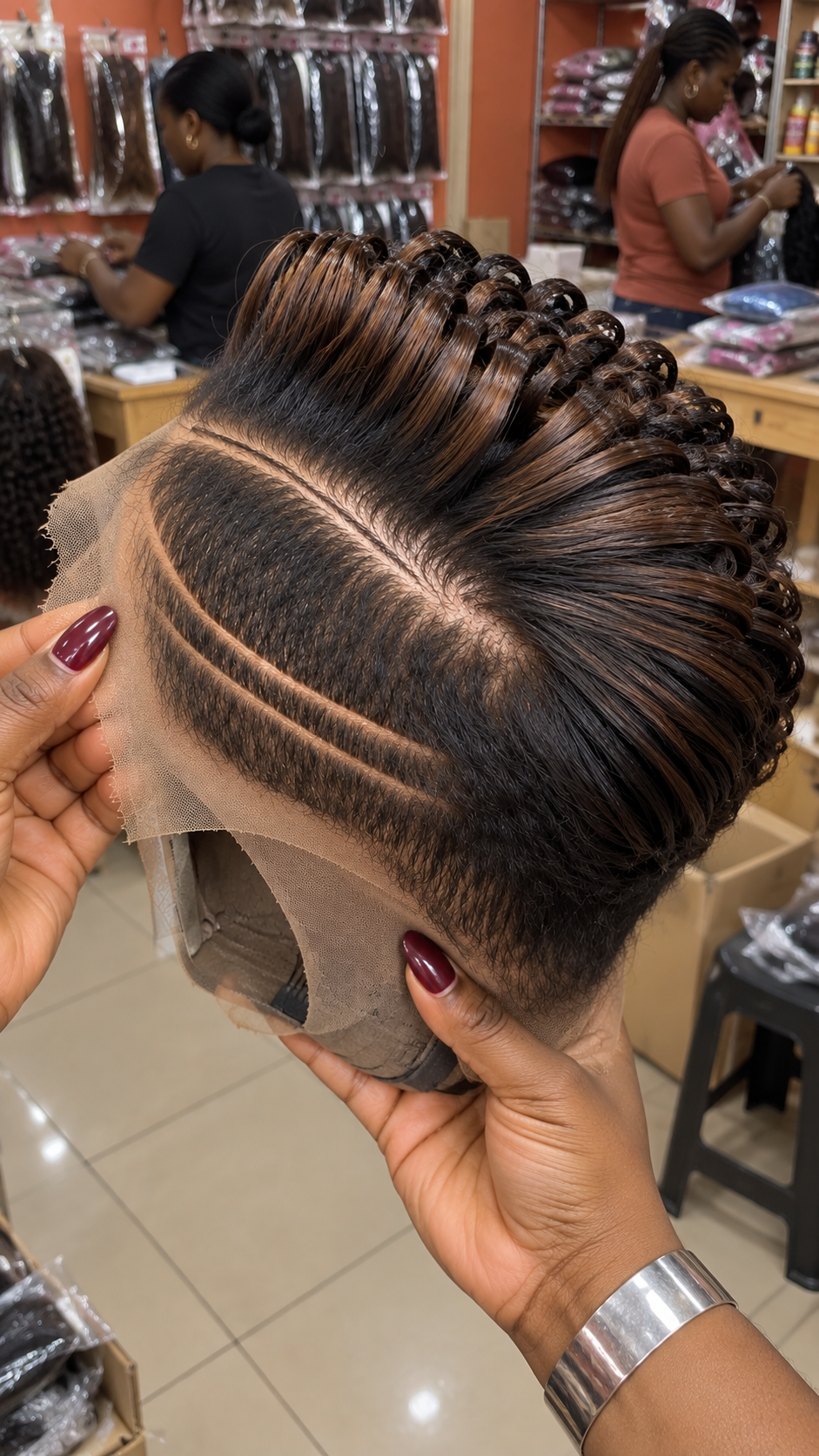
This wig uses color placement in a particularly controlled way. Warm mocha-brown ribbons travel through a much deeper espresso foundation across the sculpted crown, while the lower side remains predominantly dark and close to the base. Two long curved paths then travel through that compact side, giving the profile movement without turning the lower section into an overly busy pattern. The combination creates a useful balance: the crown attracts attention through alternating brown and dark strands, while the side relies on proportion, spacing and negative space.
The photograph is also valuable because the unit has not yet been installed. Excess lace remains around the perimeter, portions of the interior foundation are visible, and the transition between the close side and heavier crown can be examined directly. This makes it possible to discuss the construction without guessing about details hidden after fitting. Lace is visibly present, but the photograph alone does not verify that it is HD lace. Any premium lace classification should come from the seller’s actual specification.
The Mocha Placement Is Following the Crown Architecture
The warm brown is not distributed randomly through the wig. It appears most strongly across selected upper ribbons, tracing the direction in which those sections rise and bend backward. Dark espresso strands remain visible underneath, between the folds and around the roots.
This makes the lighter color functional as well as decorative. Each mocha section helps reveal the shape of its corresponding loop. Where a ribbon curves, the warm reflection follows it; where the hair drops into a recessed area, the deeper foundation becomes more prominent.
A buyer commissioning this look should therefore avoid describing it only as a black-and-brown wig. That description could produce chunky highlights, scattered streaks or an even mixture of both colors. The important requirement is directional placement: warm mocha should participate in the loop construction while dark espresso remains the structural foundation.
The Front Uses Elongated Sections Before the Crown Becomes More Intricate
The forward crown contains several long sections that rise relatively upright before turning toward the rear. Their strands remain aligned closely enough to create ribbon-like surfaces rather than fluffy curl clusters. This gives the front a strong directional quality.
These sections are also where the contrast between mocha and espresso is especially easy to see. Warm brown occupies much of the visible surface, while the roots remain darker. The result creates height without requiring an extremely large silhouette.
The spacing matters as much as the height. Narrow dark recesses remain between several neighboring sections, preventing the crown from becoming one continuous mass. A stylist rebuilding this wig should preserve those spaces rather than simply increasing volume.
The Center Introduces More Overlap and Deeper Shadow
Moving toward the middle of the crown, the sections begin to overlap more strongly. Some loops are wider, others bend farther backward, and dark interiors become increasingly visible beneath the brown surfaces.
This gives the central crown greater depth than the forward area. The hair is still moving in one overall direction, but individual pieces interact rather than standing as an isolated row.
A recreation should retain this controlled variation. Repeating one identical loop size across the entire top might look orderly, but it would remove the gradual development visible in the reference.
The Rear Uses Smaller Loops to Complete the Silhouette
Toward the back, the styling becomes noticeably tighter. Smaller curled sections gather around the rear contour and reduce the projection of the crown. Mocha-brown strands continue through this area, but the increased density of the smaller forms also reveals more of the deep foundation.
This is an important proportion choice. Large loops are effective at the front because they establish the main architecture. Repeating them unchanged around the rear would make the wig unnecessarily bulky.
For custom orders, a rear three-quarter approval photograph is worth requesting. It can show whether the maker has completed this scale transition instead of leaving the back comparatively plain.
The Dark Root Base Prevents the Brown From Becoming Flat
The espresso foundation connects every part of the wig. It appears beneath the mocha crown, dominates the compact side and remains visible around the rear. This continuity prevents the brown ribbons from looking like unrelated pieces placed on top of another hairstyle.
The root depth also creates shadow. Without that shadow, the warm sections would have less visual separation from one another. A lighter all-over brown could still be attractive, but it would not reproduce the same dimensional effect.
When discussing color with a seller, request a dark espresso or natural deep-brown base with warm mocha ribbons rather than asking for one uniform brown shade.
The Upper Separation Establishes a Clear Crown Boundary
A narrow exposed route travels beneath the crown and separates the longer upper hair from the close side. This boundary follows the rounded shape of the wig rather than moving horizontally across it.
Its function is primarily architectural. The crown has considerable movement, so the exposed division creates a clear point where that movement ends and the quieter side begins.
During customization, this boundary should be preserved independently from the lower carved path. Although both appear as exposed lines, they serve different purposes and do not need identical widths.
The Lower Curve Gives the Side a Longer Visual Sweep
Beneath the main crown boundary is another long curved pathway. It travels through the compact lower side and follows the contour toward the rear. The line remains relatively narrow, with substantial dark hair preserved on either side.
This creates a layered profile without overwhelming the side. Instead of several competing razor designs, the unit relies on two major directional routes and lets the dark panels between them remain visible.
That restraint should be protected during future maintenance. Widening the lower channel substantially would change the balance and reduce the amount of espresso hair that currently separates the exposed areas.
The Dark Panel Between the Paths Is a Design Element
The strip of close dark hair between the two pathways is not leftover space. It is one of the elements that makes the side readable. Its density creates contrast against both exposed routes and gives the profile a layered appearance.
Repeated cutting can gradually make this panel narrower. Once that happens, the two lines may begin to merge visually and the side loses its original proportions.
A barber maintaining the wig should therefore use the original photograph as a reference. When a line appears less visible, displaced strands should be repositioned before any additional hair is removed.
The Fine Front Transition Should Not Be Over-Customized
Near the front lace boundary, finer strands appear before the density increases toward the dark side panel and sculpted crown. This gradual change helps prevent the front from looking abruptly heavy.
During fitting, the stylist should assess those strands in relation to the wearer’s actual placement. Automatically removing them to create a harder edge could change the balance between the lace perimeter and the heavier construction behind it.
A conservative first fitting is particularly useful with a detailed wig because material can always be reduced later, while hair removed unnecessarily cannot be restored easily.
The Uncut Lace Leaves Room for Individual Placement
The lace extends beyond the hair-bearing perimeter and has clearly not reached its final installed state. For a customer using a professional wig stylist, this provides useful flexibility.
The unit can first be positioned so the crown and side paths sit correctly. The stylist can then establish where the final lace edge should fall. This order is preferable to cutting the perimeter while the wig is loose and discovering afterward that the side needs to shift.
The apparent lace tone should not be treated as a guaranteed match for every wearer. Ask the seller about actual lace shade options and material specifications rather than judging only from the photograph.
Cap Measurements Matter Because the Side Geometry Cannot Move Independently
The exposed paths are built into the unit, so their final position depends on the cap. If the wig is too loose and shifts backward, the entire side composition moves backward with it. If it sits too far forward, the lines move closer to the face.
For a custom order, follow the maker’s measurement instructions carefully. Depending on the construction, circumference, ear-to-ear and front-to-nape measurements may all be useful.
A wig stylist can assist with measurement before ordering when necessary. This can be a sensible investment when the side geometry is one of the primary reasons for choosing the design.
Build the Order Around Placement Rather Than Generic Color Names
A clear production brief should begin with the dark espresso foundation. The second requirement is warm mocha-brown placement through selected crown ribbons. The third is the crown progression: elongated forward sections, broader overlapping middle loops and tighter rear work.
The lower specification should identify the compact dark side, the main separation beneath the crown and the second sweeping curved path. Finally, cap sizing, lace shade and delivery state can be discussed.
This level of detail helps prevent substitutions. A seller might otherwise match the brown color but use random highlights, or reproduce the side lines while simplifying the crown. Breaking the design into components gives both parties a practical approval checklist.
Choose the Seller by Their Crown Work, Not Only Their Color Portfolio
Color matching is only one skill required here. A maker may be excellent at creating brown highlights but less experienced with sculpted loop construction. Another may build beautiful crowns but have limited experience with precision side work.
Before commissioning an expensive version, look for previous examples that demonstrate similar directional crown styling. If the side paths will also be completed remotely, examples of close-side customization are valuable.
If no single maker offers both skills, the work can be divided. The wig maker can complete the crown and color, while a local wig stylist or barber handles conservative final fitting and side refinement.
Approval Should Include an Elevated Side Angle
The best approval image for this design is taken slightly above the side. That angle shows the mocha placement, crown spacing, main separation and lower curved path simultaneously.
A direct rear three-quarter image should also be requested so the buyer can inspect the smaller loop work. If color accuracy is important, ask for an additional photograph under neutral light because warm salon lighting can make mocha appear more copper than it actually is.
For a custom order, make sure the photographs show the actual unit being shipped rather than only an example used to advertise the style.
Price Should Reflect Color Placement and Crown Labor Together
The compact dimensions of the wig can hide how much detailed work is involved. The crown requires section-by-section formation, the mocha color needs deliberate placement, the close side needs controlled density and the two exposed paths need accurate spacing.
| Category | Estimated Price Range | Possible Scope |
|---|---|---|
| Premium Custom | $330–$575+ | Higher-grade hair, personalized sizing, planned mocha placement, hand-shaped crown loops, precision side work and detailed lace preparation. |
| Standard Custom | $200–$345 | Prepared espresso-and-mocha crown with established side paths and more standardized cap options. |
| Basic Human Hair | $120–$215 | A human-hair base requiring additional color work, crown setting, side refinement and professional fitting. |
| Premium Synthetic | $80–$150 | A pre-colored, pre-set interpretation that may retain its loop arrangement with less frequent salon resetting. |
| Basic Synthetic | $40–$85 | A lower-cost version where color placement, crown separation, side precision or cap construction may be simplified. |
These ranges are broad planning estimates rather than verified prices for the exact unit shown. Hair source, fiber, color processing, cap construction, seller location, labor, shipping and installation can all change the final amount.
Ask sellers to state which customization is already included. A low-priced foundation requiring separate highlighting, crown setting and barber work is not financially equivalent to a completed custom wig.
Human Hair Offers Flexibility for Future Crown Work
A human-hair version can suit a wearer who expects professional restyling over time. If individual loops begin to relax, a stylist can potentially reset them while preserving the original directional map.
Color processing should still be considered. The mocha ribbons may have undergone treatment, so repeated excessive heat can reduce hair quality. Appropriate temperatures should be selected according to the condition of the strands.
If the warm brown eventually fades, refreshing should follow the existing placement rather than turning the entire crown into one uniform shade.
Premium Synthetic Can Reduce the Need for Repeated Setting
A pre-set synthetic version may appeal to someone whose priority is retaining the original loop sequence. Quality synthetic fiber can hold arranged forms well, and pre-colored brown placement may require less tonal maintenance.
The limitation is flexibility. Heat tolerance varies, and conventional hair dye should not be assumed suitable. The fiber needs to be identified before major alterations are attempted.
The best material therefore depends on whether the wearer values future restyling freedom or easier preservation of the initial design.
Wash According to the Existing Loop Sequence
Before the first wash, photograph the crown from above, the side and the rear. These images record where the largest sections sit and where the construction begins tightening toward the back.
During cleansing, avoid aggressive circular rubbing through the upper hair. Neighboring sections can become intertwined and lose their individual paths. Use products suitable for the confirmed material and handle the lace gently.
After drying, restore only the sections that have moved. Rebuilding the entire crown unnecessarily creates additional manipulation and can gradually change the original spacing.
Preserve the Mocha Placement During Color Maintenance
The warm ribbons should continue tracing the crown movement over time. If a human-hair unit eventually needs color refreshing, the colorist should work from photographs of the original placement.
A blanket brown formula may be easier to apply, but it could erase the dark-root contrast and reduce the visible relationship between color and loop direction.
For synthetic versions, follow fiber-specific care. Standard permanent dye is not automatically appropriate and may damage the unit.
Keep Styling Product Out of the Dark Recesses
The crown has considerable shine, but heavy product can cause problems. Oils and thick holding products may collect where the loops overlap, causing neighboring sections to adhere together.
Use only the amount required for control. If the wig begins to look dull because of buildup, appropriate cleansing can sometimes restore the reflective surface more effectively than adding additional shine product.
The compact side should also remain relatively light in product so its fine strands and exposed pathways stay visible.
Side Maintenance Should Be Based on Visibility, Not a Calendar
There is no reason to recut the two paths automatically every few weeks. Wig hair does not grow in the same way natural hair does. If the lines remain visible, leaving them alone preserves the original density.
When fine strands shift across an exposed area, repositioning may be enough. If actual cutting becomes necessary, use the reference photograph to preserve the initial width and spacing.
This maintenance strategy helps protect the dark panel between the two paths and extends the useful life of the side design.
Fitting Comes Before Optional Barber Refinement
Inspect the wig as soon as it arrives. Check the mocha placement, crown progression, side paths, lace and cap before altering anything. If the custom order differs materially from the approved design, contact the seller first.
Once the unit passes inspection, a wig stylist can establish the final cap position and trim the lace as appropriate. Only then should additional barber refinement be considered.
If the side already matches the reference, the best decision may be to make no additional cuts at all.
Store the Wig With Space Around the Rear Loops
The large forward ribbons need vertical clearance, but the rear is equally important. Smaller loop work can flatten if the wig is pushed against a hard surface or stored beneath other items.
A suitable wig stand or mannequin head supports the entire crown. Make sure the cap and lace are fully dry before storage.
During transport, use packaging deep enough to avoid compressing the upper construction. Preventing damage is easier than repeatedly paying to have a complex crown rebuilt.
The Best Version Keeps the Brown Color Integrated With the Structure
This wig succeeds because the mocha is not simply added on top of an unrelated black base. The warm ribbons follow the crown’s movement, dark espresso roots create depth underneath, the rear becomes progressively tighter and the compact side carries two restrained curved paths without becoming overcrowded.
For buyers, those relationships provide the most useful quality checklist. Look at color placement, root depth, loop spacing, rear compression, side density, pathway width, lace condition and cap sizing. Confirm construction claims directly with the seller instead of relying on assumptions from a product photograph.
For wig businesses, showing these details clearly can communicate why the unit requires skilled work even though its overall dimensions are compact. Accurate descriptions, multiple construction angles, transparent customization options and practical fitting information allow the craftsmanship to sell the wig rather than exaggerated terminology.
Search Terms
mocha ribbon crown wig · espresso root brown wig · twin curved side path wig · brown loop crown lace wig · dark base mocha hairpiece · sculpted caramel brown loops · close side double path wig · untrimmed lace espresso wig