
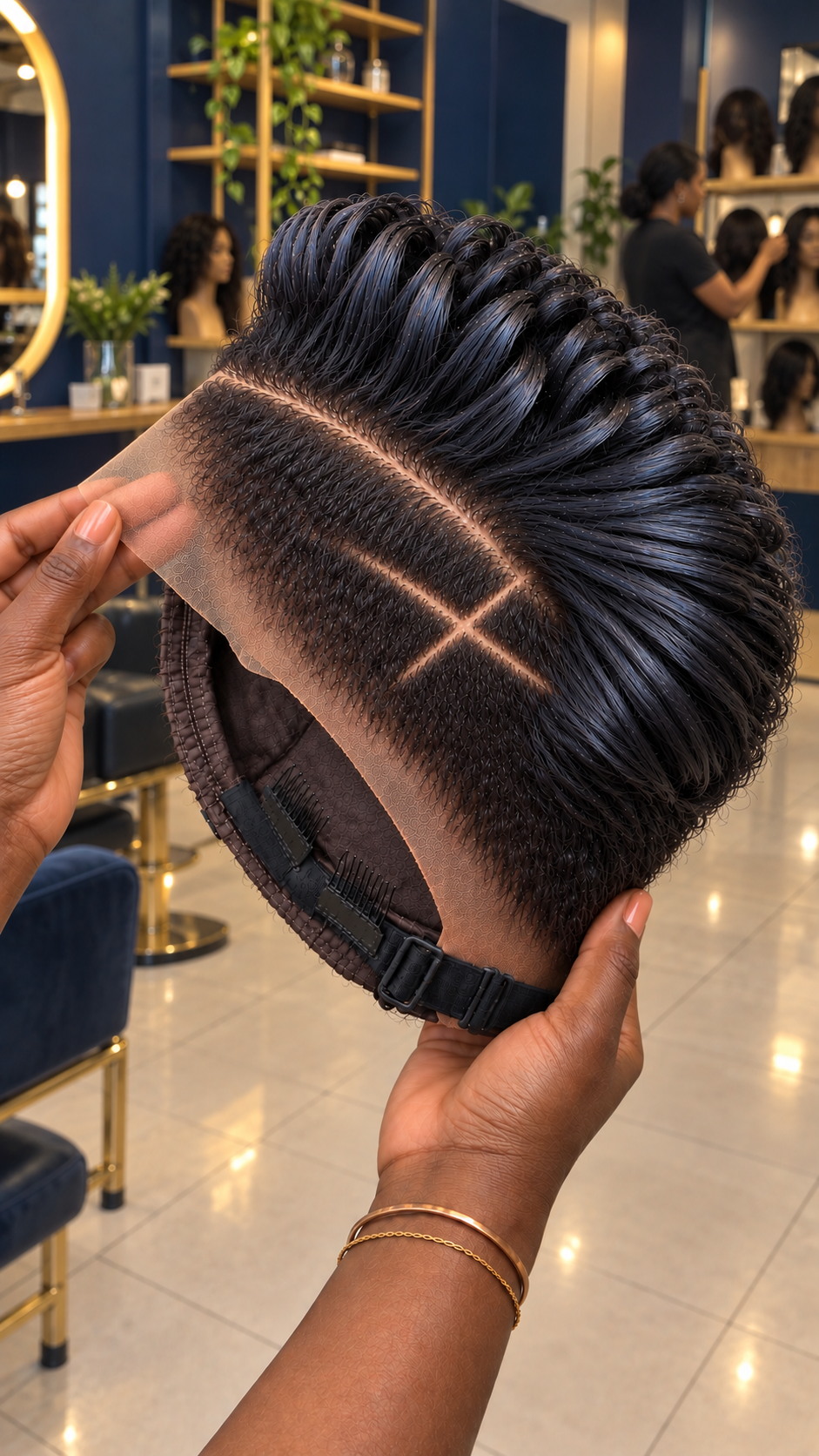
This midnight-black wig shifts attention away from color experimentation and toward construction accuracy. The crown is arranged into a sequence of glossy backward loops, while the lower side stays extremely close to the foundation. Between those two zones, exposed pathways form a distinctive geometric composition: a long diagonal division is intersected by another narrow path, creating a cross-like junction before the lines continue through the compact side. That intersection gives this unit an identity that should not be confused with the curved double-line or triple-arc patterns used on other sculpted wigs.
The photograph is also unusually helpful for understanding the unit before installation. The lace remains untrimmed, the interior cap is visible, adjustable hardware can be seen at the lower edge, and the close side is unobstructed. These details allow a buyer to evaluate more than the finished hairstyle. At the same time, the photograph does not establish a specific premium lace classification. Lace is clearly present, but describing it as HD lace would require direct confirmation from the seller or manufacturer.
The Cross-Line Junction Is the Side’s Main Signature
The most recognizable detail appears where two exposed pathways meet. One long line travels diagonally beneath the crown, while another intersects it from a different direction. Their meeting point creates an angular cross-like structure within the otherwise dark side panel.
This is important because a generic request for “two lines” would not describe the design accurately. Two parallel lines would produce a completely different profile. The defining characteristic here is intersection: the pathways meet rather than simply following one another.
The reference photograph should therefore accompany any barber or custom-wig request. The professional needs to see where the junction sits, which line continues farther and how much dark hair remains around the exposed geometry.
Dark Hair Between the Paths Gives the Geometry Its Shape
The exposed lines are only half of the side design. Dense black hair remains in several distinct panels around them. These dark areas create the negative-space contrast that makes the intersection visible.
If the pathways were widened substantially, those panels would shrink and the side could begin to look like one large exposed section. Maintaining narrow, deliberate channels preserves the geometric character.
This is especially important during maintenance. Wig hair does not regenerate, so repeatedly deepening the paths at every appointment can permanently change their proportions. A barber should first reposition any strands that have moved across the lines before deciding that additional cutting is necessary.
The Upper Boundary Separates Precision Work From Crown Movement
A long exposed route beneath the crown creates a clear transition from the compact side into the heavier upper hair. This boundary follows the head shape and helps frame the loop construction above it.
Its purpose is partly structural. The crown needs a visual starting point, and the exposed boundary supplies one without requiring color contrast. Above it, hair immediately becomes longer and more directional; below it, density remains close and controlled.
For custom production, this main boundary should be mapped before smaller intersecting details are finalized. Establishing the crown edge first ensures that enough side area remains for the cross-line composition.
The Crown Is Organized Into Broad Backward Loops
The upper styling contains large black sections that rise from the foundation and bend backward. Individual strands within each section travel together, giving the loops a ribbon-like appearance. These are open sculpted bends rather than small conventional curls.
Several forward loops stand relatively upright before turning toward the rear. This creates elevation while still maintaining a compact overall silhouette. The open centers and dark gaps between neighboring sections help each loop remain individually readable.
Because the wig is essentially monochromatic, spacing is particularly important. There are no copper, blonde or red highlights available to separate one section from another. Shape, reflected light and shadow have to do that work instead.
Midnight Black Produces Its Own Highlight Pattern
The hair appears extremely dark, but the glossy crown reflects cooler blue-black and charcoal highlights where salon light reaches the raised surfaces. Recessed areas remain nearly black. This creates tonal depth without introducing an actual second color.
The effect should not be recreated by saturating the wig with oil. Heavy product can make neighboring sections adhere together and eliminate the dark gaps that currently separate the loops.
For a buyer who wants this appearance, the priority should be a rich black foundation with a reflective but controlled surface. The crown construction will then create the visible variation naturally as light moves across it.
The Loop Scale Gradually Changes Toward the Rear
The largest folds occupy the forward and central crown. Moving backward, the sections become more compact and sit closer to the head. Smaller curled ends appear around the rear, helping the styling follow the cap’s rounded contour.
This reduction prevents the back from becoming excessively bulky. It also creates a visual progression from strong forward architecture into tighter finishing work.
When ordering remotely, request a rear three-quarter photograph of the actual unit. A front or side image alone may not reveal whether the maker has completed this transition accurately.
The Close Side Requires Density Control Rather Than Added Volume
Below the crown, the hair changes dramatically in scale. Fine black strands sit close to the foundation and create a dark surface around the exposed paths. The goal here is not fullness. The goal is enough density to make the geometric lines readable.
If the side were left longer, strands could fall over the cross-line design and obscure it. If it were cut too aggressively, the underlying foundation could become overly visible and the dark panels would lose strength.
A professional maintaining this section should therefore work conservatively. The close side is a permanent component of the wig, not natural hair that can simply grow back after an overly aggressive cut.
The Front Transition Is Finer Than the Main Crown
Near the lace boundary, the density becomes lighter before gradually increasing toward the side panel and upper construction. This creates a useful transition instead of placing the heaviest hair directly against the perimeter.
During fitting, those finer strands should be evaluated on the wearer. Removing them indiscriminately can create an unnecessarily abrupt front edge. The stylist should first establish where the wig naturally sits and then determine what, if anything, requires adjustment.
This is another reason untrimmed lace can be useful. The installer retains more control over the final relationship between the perimeter and the wearer’s own proportions.
The Visible Lace Is Ready for Custom Fitting
The lace extends substantially beyond the hair-bearing edge. Rather than being a defect, that indicates the photographed unit is still at a pre-installation stage. The excess material can be adapted during professional fitting.
A stylist should position the wig before trimming. The front alignment, side geometry and cap tension can all be checked together. Only after those elements are correct should the final lace boundary be established.
The photograph cannot reliably determine how transparent the lace will appear on every wearer. Buyers should ask the seller about actual lace shades and material specifications instead of relying solely on a brightly lit product image.
The Interior Hardware Adds a Practical Ordering Question
Unlike many exterior-only product photographs, this image exposes part of the inner cap. Adjustable strap hardware and internal comb components are visible near the lower portion. This gives the buyer some evidence that the unit includes mechanical adjustment and anchoring elements.
However, the complete interior is not shown, so additional cap characteristics should still be confirmed with the seller. Ask about available cap sizes, adjustability and whether the internal components correspond to the exact unit being purchased.
Customers who dislike or do not use internal combs can also discuss that preference with a custom maker before construction rather than discovering the configuration after delivery.
Cap Position Directly Controls Where the Cross Design Lands
The intersecting side paths are fixed to the wig. If the cap shifts, the artwork shifts with it. This makes sizing particularly important for a unit whose lower geometry is one of its main attractions.
A cap that sits too far forward can move the intersection closer to the face. A loose unit that slides backward can move the entire composition away from its intended position. Neither problem can be corrected simply by making the lines deeper.
Follow the maker’s measurement guide carefully. When available, a local wig stylist can take measurements before ordering and help determine whether a standard or customized cap is the better option.
Turn the Reference Into a Geometry-First Order Brief
For this particular wig, begin the order with construction rather than color. Specify a midnight or natural-black crown with broad backward loops and progressively tighter rear work. Then describe the compact close side.
The geometric requirement should be explicit: one principal diagonal separation combined with an intersecting pathway that forms a cross-like junction. Mention that the exposed paths should remain relatively narrow and that substantial dark hair needs to remain around them.
After the exterior is agreed upon, discuss lace shade, cap measurements, internal adjustment preferences and whether the unit should arrive with its lace untrimmed.
This specification is far more precise than requesting a black sculpted wig with lines and reduces the risk of receiving ordinary parallel carving.
Ask the Maker for a Direct Side Approval Image
The most valuable approval photograph for this unit is a clear side view. The camera should capture the full crown boundary and the intersection below it. This allows the buyer to compare line placement and dark-panel proportions directly with the reference.
An elevated photograph should accompany it to show crown spacing, while a rear three-quarter image can verify the reduction in loop scale toward the back.
If the wig is custom-made, request images of the actual finished unit rather than only examples of previous work. That distinction is especially important when the side geometry is highly specific.
A Barber and Wig Stylist May Have Different Roles
A wig stylist can handle cap fit, lace placement and crown preservation, while someone experienced in precision cutting may be better suited to refining the side geometry. If two professionals are involved, they should work in the correct order.
Fit the unit first. Once its position is stable, assess whether the cross-line design requires any refinement at all. If it already sits correctly and matches the reference, unnecessary cutting should be avoided.
If the geometry is intentionally left conservative by the maker, the barber can refine it after seeing exactly where the unit sits relative to the wearer’s temple and ear.
The Price Is Largely Paying for Precision
This unit does not rely on expensive multi-color processing, so the customization budget is concentrated elsewhere. Crown setting, side density control, geometric mapping, cap preparation and lace work can represent a significant portion of the labor.
| Category | Estimated Price Range | What May Account for the Cost |
|---|---|---|
| Premium Custom | $305–$535+ | Higher-grade hair, individualized sizing, hand-arranged loop crown, precision intersecting side geometry, density refinement and detailed lace preparation. |
| Standard Custom | $185–$320 | Prepared black crown construction and mapped side design with more standardized cap and fitting options. |
| Basic Human Hair | $110–$200 | A human-hair foundation that may require separate professional crown setting, side carving and lace fitting. |
| Premium Synthetic | $75–$145 | A quality pre-set interpretation where the crown can retain its loop sequence with less frequent resetting. |
| Basic Synthetic | $35–$80 | A budget version where crown separation, side density, line precision or cap construction may be simplified. |
These are broad planning ranges rather than confirmed prices for the exact photographed unit. Hair source, fiber, cap construction, seller location, labor, lace selection, shipping and installation can all change the final amount.
When comparing quotations, ask whether the crown and cross-line side design are already completed. A lower-priced base requiring both services locally may ultimately cost more than a finished custom unit.
Human Hair Is Valuable When the Crown Will Need Future Resetting
A human-hair version can suit someone who wants the large loops professionally refreshed over time. Individual sections can potentially be rebuilt when they relax, provided the hair is suitable for the intended styling method.
Heat should still be conservative and appropriate to the quality of the hair. Repeated maximum-temperature styling is unnecessary and can reduce longevity.
Because the color is dark, there may be less need for regular color maintenance than with vivid or highly lightened units. That can shift the long-term maintenance budget toward shape preservation instead.
Premium Synthetic Can Be Attractive for Shape Retention
A quality synthetic version may appeal to someone who wants the loop sequence to remain largely pre-set. When the fiber is manufactured for shape retention, less professional resetting may be required.
The limitation is future flexibility. Heat resistance varies and recoloring options can be restricted. Always confirm the fiber before using hot tools.
Choosing between human hair and synthetic should therefore depend on whether the buyer values future restyling or easier preservation of the original arrangement.
Record the Crown Map Before Washing
Before the first full wash, photograph the wig from above and from the side. The images should record the size and direction of the forward loops, the spaces between them and the point where the rear begins to tighten.
During cleansing, avoid scrubbing neighboring sections together. This can collapse the dark spaces that make the monochromatic crown readable. Follow the care instructions appropriate for the confirmed material.
After drying, restore only the sections that have moved. Rebuilding the entire crown after every wash creates unnecessary manipulation.
Keep the Black Surface Reflective Without Heavy Buildup
The crown has a glossy appearance, but product saturation can work against it. Heavy oil or wax may cause strands from neighboring loops to stick together and reduce the visible separation.
Use product sparingly and remove buildup when necessary. A clean reflective surface often displays the midnight-black hair more effectively than repeated layers of shine product.
The close side should also remain light enough in product for its fine strand pattern to stay visible around the geometric paths.
The Cross-Line Pattern Needs Conservative Long-Term Care
The side geometry should be treated almost like permanent artwork. It does not need to be made deeper at every maintenance visit. If strands move into an exposed pathway, repositioning may restore clarity.
When cutting is genuinely necessary, the original side photograph should be used as a guide. Pay particular attention to the intersection. If one pathway becomes wider than the other or the meeting point shifts, the character of the design changes quickly.
Preserving the dark panels around the junction extends the useful life of the original geometry.
Book Installation Before Scheduling Optional Side Refinement
Once the wig arrives, inspect the crown, side design, lace, cap and visible hardware before making permanent alterations. If the custom order differs substantially from what was approved, contact the seller before trimming.
After inspection, the wig stylist can establish the final cap position and prepare the lace. Only then should optional barber work be considered.
This sequence avoids carving the side according to a loose unit that later sits differently on the wearer’s head.
Storage Should Protect the Open Loop Centers
The broad upper sections need enough room to remain open. Store the unit on an appropriate wig stand or mannequin head rather than compressing it beneath other hairpieces.
The rear should also have clearance so its tighter loop work does not flatten against a wall. Make sure the cap and lace are fully dry before storage.
For travel, choose a container with enough depth to preserve crown height. Preventing compression is considerably easier than reconstructing a complex monochromatic crown afterward.
The Black Palette Makes Construction the Entire Story
This wig demonstrates how much can be achieved without vivid color. Midnight-black hair keeps attention on the broad crown loops, close side density and unusual intersecting geometry. Light creates subtle blue-black reflections across the upper surfaces, but the design never depends on contrasting highlights to explain itself.
For buyers, the key comparison points are therefore structural: loop spacing, gradual rear compression, the principal crown boundary, the intersecting side paths, preserved dark panels, cap sizing and the visible pre-installation lace. Those characteristics should be checked before approving a custom unit.
For wig businesses, this is a strong candidate for detailed side photography because the craftsmanship is easy to miss in a generic front portrait. Showing the cross-line construction, interior adjustment hardware and untrimmed perimeter can help customers understand where the value lies. Accurate material information and conservative fitting guidance then complete the product story without relying on claims the photograph cannot verify.
Search Terms
midnight black loop crown wig · intersecting side line wig · cross pattern side wig · black sculpted lace wig · diagonal carved side hairpiece · close side geometric wig · backward black loop crown · untrimmed lace black wig