
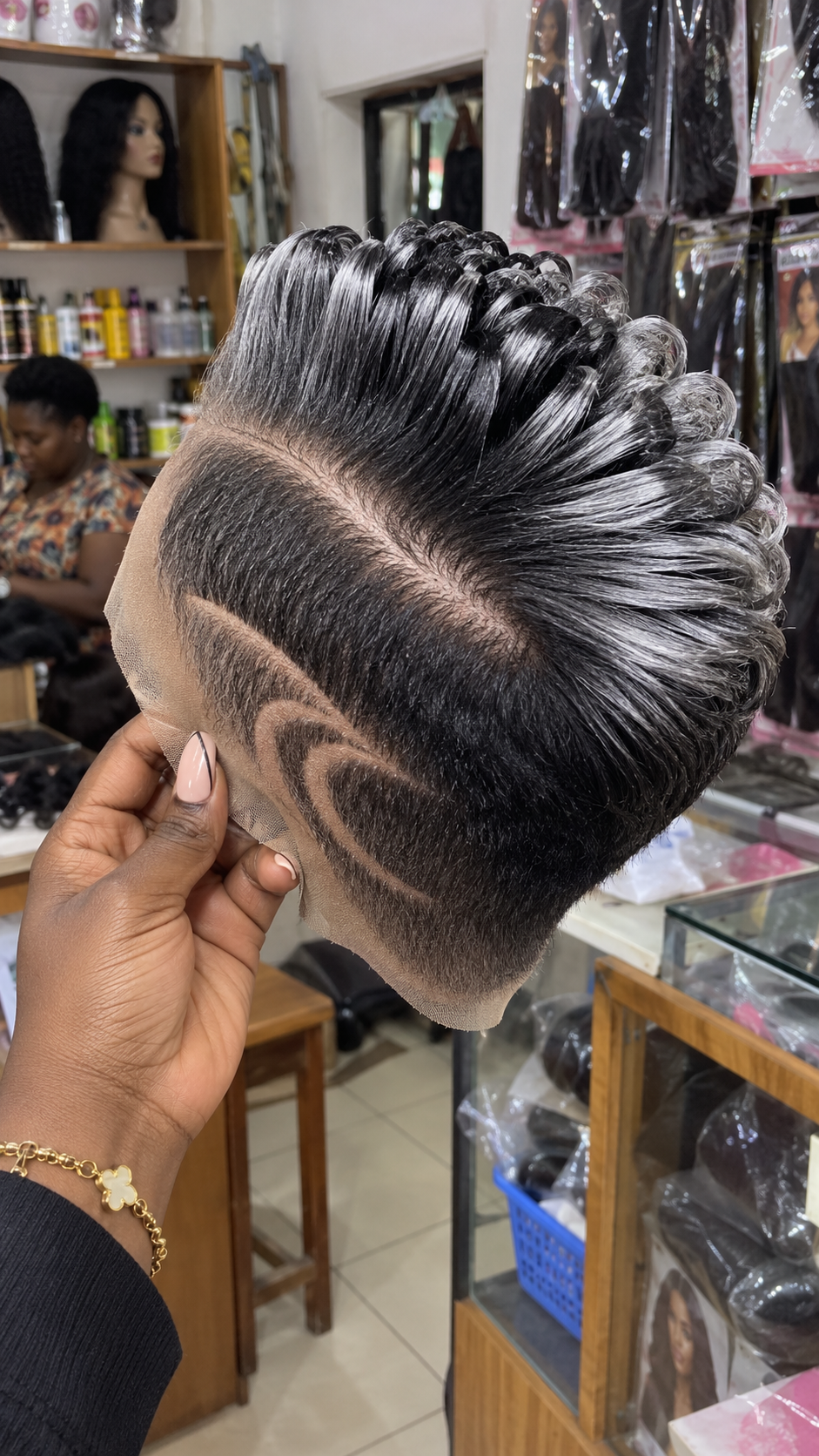
This black-to-silver wig is built around two different kinds of contrast. The crown uses color contrast, moving from a deep black foundation into increasingly visible silver and pearl-gray strands toward the rear. The lower side uses shape contrast instead: dense close hair is interrupted by a long sweeping division and a smaller nested curve. Together, those elements create a piece that looks substantially different depending on whether it is viewed from the crown or from the side.
The photograph captures the unit before installation, which makes several practical details easier to examine. Lace extends beyond the hair-bearing perimeter, the side design is already established, and the crown can be studied without a wearer’s head concealing the construction. The lace is visibly present, but its exact grade cannot be determined from this image. It should therefore be described as a lace construction unless the seller separately confirms a more specific material such as HD lace.
Silver Appears Gradually Instead of Dividing the Crown in Half
The color transition is one of the most interesting aspects of this unit. The forward crown remains predominantly black, with only cool reflections appearing across the glossy surface. Moving toward the middle and rear, silver becomes progressively stronger. By the back portion, several looped sections contain obvious gray, silver and pale pearl strands.
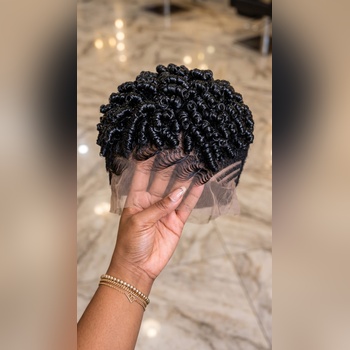
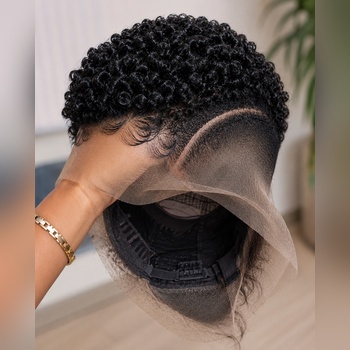
This creates a directional color story rather than a rigid two-color split. There is no single line where black suddenly stops and silver begins. Dark strands continue through the transition area while lighter pieces become increasingly prominent.
That distinction should be included in a custom order. A simple request for “black and silver” could produce alternating streaks, a half-and-half layout or silver highlights scattered evenly throughout the wig. The reference instead uses a gradual concentration of silver toward the rear.
The Black Forward Crown Establishes the Main Architecture
The front contains large upright sections that rise from a dark root foundation before folding backward. These sections are broad and ribbon-like, with individual strands traveling together rather than separating into fluffy curls.
The black color makes the open spaces between the loops especially important. Dark recesses remain visible inside and between neighboring sections, helping the crown retain depth even before the silver transition becomes noticeable.
The tallest loops occupy the forward area. Their height gives the crown its primary silhouette without requiring the same projection throughout the entire wig.
The Middle Crown Introduces the First Strong Silver Movement
As the styling travels backward, lighter strands begin appearing more clearly across the outer surfaces of the loops. Black remains visible underneath, producing a salt-and-pepper transition rather than an immediate move into solid gray.
The change in color coincides with a change in direction. The loops begin leaning farther backward and following the rounded contour of the wig. This makes the color transition feel integrated into the construction rather than applied independently.
A maker reproducing this unit should therefore map the color and loop direction together. If silver is placed in the correct general area but ignores the movement of the crown, the result can look more like ordinary highlighting.
The Rear Uses Pearl-Silver Loops as a Visual Endpoint
The rear portion contains the clearest silver sections. Pale gray and pearl-like strands wrap through smaller loop formations, creating a noticeably brighter area than the front. Dark hair remains mixed through the base, preventing the rear from becoming completely white.
The smaller loop scale is important. Bright color naturally attracts attention, so keeping the rear forms compact prevents the silver area from visually overpowering the rest of the wig.
For remote ordering, a rear three-quarter approval photograph is essential. It should show both the amount of silver and the way those lighter strands are integrated into the tighter loop construction.
The Gradient Depends on Keeping the Roots Dark
Deep roots visually connect the black front, transitional middle and silver rear. Without that shared dark foundation, the crown could appear as several unrelated color sections.
The root depth also creates shadow beneath the lighter strands. This is particularly useful around the silver rear because pale hair can otherwise lose dimensional contrast under bright salon lighting.
When requesting a recreation, specify that the silver should emerge from a dark foundation rather than replacing the roots entirely. This gives the color transition much more depth.
The Side Remains Predominantly Black
While the crown becomes increasingly silver toward the back, the close side stays largely within a deep black-to-charcoal family. This creates a strong foundation underneath the brighter upper hair.
The decision also keeps the carved geometry easy to read. Pale silver across the side could reduce the contrast between the hair and exposed pathways, whereas the dark base makes those lines immediately visible.
A custom colorist should therefore avoid automatically extending the crown’s silver placement through the entire lower section. The darker side is part of the intended color balance.
A Long Sweeping Division Establishes the Side Direction
The first major exposed path begins near the forward side and travels diagonally toward the rear. It follows the contour of the wig rather than moving as a straight horizontal stripe.
This pathway creates a broad dark panel above it. That panel visually connects to the crown roots and gives the lower geometry enough surrounding density to remain clear.
The width of the division is controlled. It is visible without becoming so broad that it removes a large portion of the side. Maintaining that proportion is important during future barber work.
The Nested Inner Curve Gives the Side Its Distinctive Identity
Beneath the longer sweeping path sits a smaller curved design. This inner shape follows a related direction but bends more tightly, creating a nested appearance. The combination is different from ordinary parallel double lines because the lower element is shorter and more enclosed.
The dark hair preserved between the outer and inner curves gives both paths clear boundaries. That negative space is essential to the design.
A custom maker should receive the reference photograph rather than only the instruction “two curved lines.” The relative lengths and curvature distinguish this pattern from simpler double-channel styles.
The Side Design Should Not Be Expanded During Maintenance
The nested curve is particularly vulnerable to over-cutting because its surrounding dark panels are relatively compact. If the exposed paths are widened repeatedly, the dark section between them can gradually disappear.
When the geometry begins looking less crisp, first inspect whether fine hairs have shifted across the exposed areas. Repositioning may restore the original pattern without removing anything.
If cutting is genuinely necessary, the original side photograph should be used as a width and curvature guide. Maintenance should restore the design rather than enlarge it.
The Visible Lace Shows the Wig Is Still Customizable
Lace extends beyond the front and side perimeter, indicating that the unit has not yet been trimmed for a specific wearer. This provides useful flexibility during fitting.
A wig stylist can position the cap, check the relationship between the crown and side geometry, and then determine where the final lace boundary should sit. Cutting before positioning would remove some of that flexibility.
Fine strands appear near portions of the front transition. They should be evaluated on the wearer rather than automatically removed, particularly because the heavier crown begins relatively close behind them.
Lace Shade and Lace Grade Should Be Confirmed Separately
The mesh appears warm beige under the salon lighting, but photographs can alter perceived lace color considerably. Buyers should ask which actual lace shades the seller offers rather than relying solely on the image.
The same principle applies to lace grade. A fine-looking mesh is not automatically HD lace. If a listing uses that terminology, the seller should be able to verify the material specification.
This distinction protects buyers from paying a premium for a claim that cannot be established visually.
Cap Fit Determines Where the Nested Curve Will Sit
The side artwork is attached permanently to the wig foundation. If the cap sits too far forward, the nested curve moves toward the face. If the unit shifts backward, the entire design moves with it.
Accurate measurements therefore affect appearance as well as comfort. Follow the maker’s own cap-sizing instructions and provide all requested dimensions.
For a higher-priced custom order, having a local wig stylist take the measurements can be worthwhile. Correct sizing reduces the temptation to reposition the unit unnaturally during installation.
Order the Wig as a Color Progression, Not a Color Pair
The color specification should begin with a predominantly black forward crown. The middle should introduce increasing charcoal and silver strands, while the rear should contain the strongest pearl-silver concentration. Dark roots should continue underneath all three zones.
The crown specification should separately identify the broad forward loops, backward middle movement and tighter rear forms. The side specification should describe the dark compact foundation, long sweeping division and smaller nested inner curve.
Finally, discuss lace shade, cap size and whether the unit should arrive with its lace untrimmed. Breaking the order into these categories makes approval considerably easier.
Choose a Maker Who Can Handle Both Gradient Placement and Crown Shape
Silver coloring alone is not enough to reproduce this reference. The lighter strands need to appear in the correct areas and follow the loop construction. A maker who specializes only in color may produce an attractive gradient but miss the crown architecture.
Likewise, someone skilled at sculpted crowns may not automatically reproduce a controlled black-to-silver transition. Ask for portfolio examples showing both directional color placement and structured wig styling.
If necessary, the work can be divided between a wig maker, color specialist and local barber, provided everyone works from the same reference.
Approval Photos Should Include the Black Side and Silver Rear
One photograph cannot fully communicate this unit. Request a forward-side image showing the predominantly black crown, an elevated view showing the transition, and a rear three-quarter image emphasizing the silver loops.
A separate side photograph should clearly capture the nested carved design. This allows the buyer to inspect both color and geometry before shipping.
When color accuracy matters, request at least one neutral-light photograph. Silver can appear blue, gray or nearly white depending on the lighting and camera processing.
The Price Reflects Gradient Work, Crown Construction and Side Precision
This design concentrates several forms of skilled labor into a compact unit. The crown requires section-by-section shaping, silver placement needs controlled progression, the close side requires density management, and the nested geometry must be mapped accurately.
| Category | Estimated Price Range | Potential Scope |
|---|---|---|
| Premium Custom | $350–$610+ | Higher-grade hair, personalized sizing, controlled black-to-silver placement, hand-arranged crown loops, precision nested side work and detailed lace preparation. |
| Standard Custom | $215–$365 | Prepared gradient crown and established curved side design with more standardized cap options. |
| Basic Human Hair | $125–$225 | A human-hair base requiring professional lightening, silver toning, crown setting, side work and fitting. |
| Premium Synthetic | $85–$165 | A pre-colored, pre-set option that may preserve the silver placement and loop architecture with less color maintenance. |
| Basic Synthetic | $40–$95 | A budget interpretation where gradient placement, crown complexity, side precision or lace construction may be simpler. |
These figures are broad planning estimates rather than confirmed prices for the photographed unit. Hair source, fiber, coloring process, cap construction, labor, seller location, shipping and installation can all affect the total.
Ask whether the black-to-silver coloring, crown setting and nested side design are included before comparing quotations. A low-priced dark base can become considerably more expensive after professional lightening and customization.
Human Hair Silver Requires Careful Processing Decisions
If the wig is human hair, producing pale silver from a dark starting point may require substantial processing. That history matters later when heat or additional color work is considered.
A stylist should evaluate the condition of the silver sections before using high temperatures. The lighter rear may require more conservative treatment than the predominantly black front.
If the silver tone fades or becomes warm, professional toning should preserve the directional placement rather than converting the entire crown into one gray shade.
Pre-Colored Synthetic Fiber Can Be Practical for Silver Placement
A quality synthetic version may be attractive for buyers who want the black-to-silver progression without repeated toning. Pre-colored fibers can maintain a stable shade, and pre-set loops may also retain their shape effectively.
The tradeoff is reduced flexibility. Heat tolerance varies, and conventional human-hair coloring methods should not be assumed suitable.
Confirm the fiber specification before purchasing if future restyling is important.
Wash the Wig Without Mixing the Silver Rear Into the Black Front
Before washing, photograph the crown from above and both sides. These images record not only loop placement but also the color map.
During cleansing, avoid aggressive rubbing between sections. Mixing the loops can blur the intended black-to-silver progression and make reconstruction more difficult.
After drying, restore displaced sections according to their original direction. The silver loops should return to the rear concentration rather than being redistributed randomly through the crown.
Silver Sections Need Product Restraint
Heavy oils and styling products can alter the appearance of pale silver hair, making it look darker or causing strands to clump together. Product buildup may also reduce the crisp contrast between silver surfaces and dark roots.
Use only what the confirmed material requires. If the crown becomes dull, appropriate cleansing may be preferable to adding additional shine products.
The close dark side should likewise remain free from heavy buildup so the nested curve stays visually clear.
Book Color Maintenance Separately From Side Maintenance
The silver rear may eventually need tonal attention even when the side geometry remains perfect. Conversely, a few side strands may shift while the color remains unchanged. There is no reason to combine every type of maintenance into one aggressive service.
A colorist can assess silver toning, a wig stylist can inspect the crown, and a barber can refine the side only when necessary. Separating these tasks reduces unnecessary manipulation.
For a new unit, fitting should happen before any optional barber refinement so the nested design can be evaluated in its final position.
Store the Silver Rear Without Compression
The smaller pale loops at the back are particularly vulnerable to being crushed during storage. A wig stand or suitable mannequin head gives them enough room to retain their shape.
Avoid stacking other units on top and keep the wig fully dry before storage. Pale silver sections should also be kept away from surfaces that could transfer pigment.
During travel, use packaging deep enough to protect both the large black front loops and smaller silver rear forms.
The Most Important Detail Is the Relationship Between Color and Direction
This wig is not simply black hair with gray added to the ends. The color progression follows the architecture of the crown. Dark forward loops establish the main structure, silver becomes increasingly visible as the sections travel backward, and pale rear loops provide a bright endpoint. Beneath that movement, a dark close side supports a sweeping division and smaller nested curve.
For buyers, that relationship should become the quality checklist. Examine where the silver begins, how much dark root remains, whether the loop scale changes toward the rear, how the side curves are spaced, and whether the lace and cap specifications have been confirmed directly.
For wig businesses, multiple pre-installation angles can communicate this craftsmanship far better than a generic black-and-silver description. Showing the color progression, nested side geometry and visible lace while clearly separating verified specifications from visual observations gives customers a more accurate understanding of what they are ordering.
Search Terms
black to silver loop crown wig · pearl silver rear curl wig · dark root silver lace wig · nested curved side design wig · black gray sculpted crown wig · sweeping side curve hairpiece · silver gradient loop wig · untrimmed lace black silver wig