
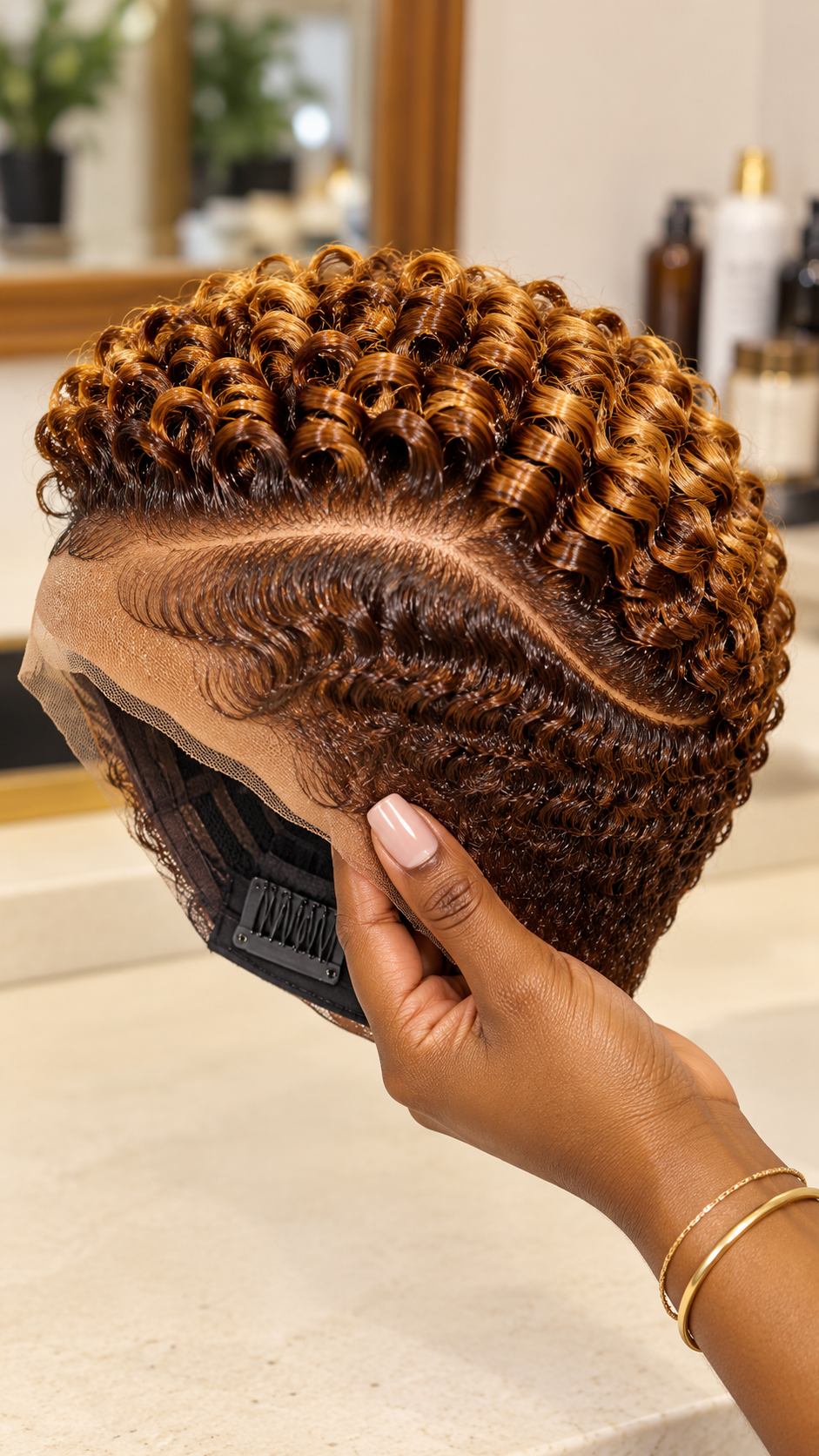
A striking wig does not always need a complicated collection of carved patterns or several contrasting colors. Sometimes the most convincing design is one in which the crown, front hairline and side styling appear to have been planned as a single composition. This golden-amber spiral wig demonstrates that approach through a densely arranged crown of glossy tubular curls, a pronounced curved parting and an elongated S-wave section that travels across the temple.
The photograph reveals a warm honey-brown and amber-copper palette, with deeper chestnut tones inside the spirals and brighter golden reflections across their outer surfaces. Rather than dividing the wig into sharply separated color blocks, the tonal variation follows the hair’s movement. Each raised curl catches the light differently, producing a lively crown without introducing unrelated highlight streaks.
Equally important is the pre-installation presentation. The wig is held above a salon counter, leaving its untrimmed lace, dark interior foundation and a comb attachment visible. This allows a potential buyer to consider how the unit is constructed and how much fitting work may remain. The photograph confirms the presence of lace but does not establish its commercial grade. A seller should not describe it as HD lace without independent product verification.
Golden Amber Creates Movement Without a Harsh Color Division
The color story begins with warm brown rather than bright blonde. Near the roots and inside many spiral openings, the hair appears chestnut or deeper amber-brown. Across the raised surfaces, the tone becomes brighter, reflecting golden honey and copper warmth.


This relationship is particularly effective on circular hair structures. Every spiral contains several changing angles, so the same group of strands can appear dark inside the opening and brighter where the curl faces the light.
For a custom order, this means that color distribution matters as much as the chosen shade. A uniform golden-brown wig would not necessarily reproduce the same appearance. The darker interior depth should remain visible, particularly around the roots and recessed curl sections.
Customers should request a neutral-light photograph before approving the final shade. Warm salon lighting can intensify golden and copper reflections, making a brown wig appear brighter than it will under daylight.
The Crown Resembles a Collection of Individually Rolled Ribbons
The upper section contains numerous tightly arranged spirals with visible hollow centers. The hair does not fall in loose, hanging ringlets. Instead, the curls remain close to the rounded crown while projecting enough to create a substantial sculpted surface.
Some spirals are relatively broad, with clearly visible openings. Others are narrower and occupy spaces between the larger formations. This difference in diameter helps the crown adapt to the head shape without appearing mechanically repeated.
From the front, the larger spirals establish a rounded upper silhouette. Toward the side and rear, smaller curled sections contribute density while keeping the overall profile controlled.
For a buyer seeking this precise appearance, the most useful reference is an elevated photograph that shows the entire curl map. A generic request for spiral curls may produce longer, looser or more vertically hanging hair than the compact formations visible here.
The Curl Openings Are Part of the Craftsmanship
One detail that deserves particular attention is the amount of space preserved inside the individual spirals. Many curls retain recognizable circular openings rather than collapsing into dense bundles.
Those openings allow light to reach different surfaces and create the alternating dark and bright reflections that make the golden-amber palette interesting.
Excessive density could reduce this effect. Adding more hair between the spirals might make the crown appear fuller, but it could also hide the individual rolled structures.
A professional recreation should therefore prioritize controlled placement over maximum volume. The goal is a compact, richly populated crown in which the individual formations remain recognizable.
The Curved Parting Controls the Direction of the Entire Front
One of the most recognizable structural details is the exposed curved part that begins near the forward side and travels diagonally toward the rear. This division separates the spiral crown from the flatter wave arrangement below it.
The line is not simply a decorative stripe. Its position determines how the upper curls approach the forehead and where the longer directional strands begin.
If the parting were moved substantially toward the center, the balance between crown and temple would change. A straighter division would also alter the flowing appearance of the front.
For made-to-order work, the stylist should establish the parting route before completing the surrounding curls. That allows the crown and side-wave sections to be built around the same directional plan.
The Temple S-Wave Provides a Different Kind of Movement
Beneath the curved parting, the hair forms an elongated S-shaped wave. Unlike the circular spirals above it, this section is arranged in flatter, parallel strands that sweep across the front and continue toward the side.
The distinction gives the wig its characteristic profile. The crown is rotational and densely curled, while the temple section is elongated and directional.
Warm golden reflections travel along the wave ridges, making their bends especially visible. Darker brown remains within the recessed areas, adding depth without requiring another hair color.
This side section should not be mistaken for a group of ordinary small curls. Its long flowing structure is a major design component and should be preserved during both construction and maintenance.
The Wave Panel Gradually Becomes Smaller Near the Ear
As the broad temple wave approaches the lower side, its movement becomes tighter and more compact. Smaller curls occupy the area beneath and behind the larger S-shaped section.
This transition prevents the long front wave from ending abruptly. It also allows the lower side to remain close to the cap without appearing disconnected from the sculpted crown.
A stylist recreating the unit should maintain this progression rather than applying the same curl size everywhere. The visual hierarchy depends on the difference between large crown spirals, elongated front waves and compact lower curls.
The Lower Side Preserves a Dense Curled Surface
Below the main wave section, the hair becomes considerably smaller in scale. Fine compact curls create a dense brown surface that follows the foundation.
This lower area does not display the same open spiral centers as the crown. Its purpose is to complete the silhouette and support the larger styling above it.
The compact density also helps the exposed parting remain visually prominent. If the lower section were made equally bulky, the contrast between crown and side would weaken.
For maintenance, this area should not be repeatedly shortened without a specific reason. Wig hair cannot naturally regrow, so unnecessary cutting may gradually reduce the density that gives the side its finished appearance.
Golden Reflections Make Styling Consistency More Visible
Warm amber and honey tones make the direction of individual strands easier to follow than on an entirely black wig. This is an advantage for displaying craftsmanship, but it also means that misplaced curls may become more noticeable.
A spiral that points against the general crown direction can interrupt the visual rhythm. Similarly, a poorly arranged section within the temple wave may become obvious because the reflected golden strands no longer follow the neighboring ridges.
This makes approval photography particularly important. The buyer should examine not only the overall silhouette but also whether the curls and waves maintain consistent directional relationships.
The Untrimmed Lace Allows the Front to Be Positioned First
A broad section of mesh remains visible beyond the front hair-bearing area. This indicates that the unit is still at a pre-installation stage.
For professional fitting, retaining the extra lace can be useful. The stylist can place the wig on the wearer, evaluate the position of the curved parting and temple wave, and then determine where the excess mesh should be removed.
Cutting the lace before establishing the final cap position may unnecessarily reduce fitting flexibility.
The mesh appears within a warm beige-brown family in the photograph, but its actual shade and material should be confirmed with the seller. Camera processing and surrounding lighting can change how lace appears.
The Visible Interior Comb Deserves Attention
Part of the dark interior cap is exposed beneath the wig, including a comb-style attachment near the lower edge.
This is useful purchasing information because internal attachments can influence how a wearer chooses to secure the unit. Some customers prefer combs, while others may want alternative arrangements depending on their hair and comfort preferences.
The photograph does not show the entire underside, so the total number and placement of attachments cannot be confirmed from this view alone.
Before purchasing, request a complete interior photograph and ask about cap sizing, adjustment options and available attachment configurations.
Cap Measurements Affect the Temple-Wave Position
The curved parting and sculpted wave are attached to the wig foundation. Their position cannot be changed independently simply by moving the hair after installation.
If the cap sits too far forward, the temple wave may extend farther toward the face than intended. If it sits too far backward, the directional styling may no longer frame the temple as shown in the reference.
For custom sizing, follow the maker’s measurement instructions carefully. Depending on the cap construction, measurements may include circumference, ear-to-ear distance and front-to-nape length.
A local wig stylist can help with these measurements before ordering, particularly when precise front placement is important.
Commissioning the Crown Requires More Than a Color Photograph
For a custom order, begin with the crown structure. Specify compact open spirals, a mixture of curl diameters and a rounded silhouette that remains relatively close to the head.
Next, describe the warm color arrangement: chestnut-brown depth beneath golden-amber and honey-copper reflections. The color should follow the raised spiral surfaces rather than appearing as random pale highlights.
The third requirement is the front architecture. Include the long curved parting, broad S-wave temple panel and progressively smaller lower curls.
Finally, confirm cap measurements, available lace shades, interior attachments and whether the lace should remain untrimmed for professional fitting.
Separating these requirements gives the maker a clearer production target and makes it easier to identify any differences during approval.
Finding a Specialist Who Understands Spiral Setting
Not every wig stylist who works with curly hair specializes in compact sculpted spiral construction. The difference is important because this crown requires individual sections to retain their rolled shape while remaining arranged closely together.
Look for wig makers or salon professionals whose portfolios show similar open spiral formations, sculpted front waves and carefully controlled crown density.
A general hair-extension retailer may have suitable base units, but additional specialist styling could still be necessary to reproduce the exact appearance.
If purchasing through an online marketplace or social-media seller, request photographs of the actual finished unit and confirm whether the displayed styling is included in the price.
The Approval Process Should Examine Three Different Angles
The first useful photograph is an overhead crown view. It should show how the spirals are distributed and whether larger and smaller openings are balanced.
The second is a direct side view, which should reveal the curved parting, S-wave temple panel and compact lower curls.
The third is a rear three-quarter view. This confirms whether the crown continues naturally toward the back instead of becoming unfinished outside the primary camera angle.
For color accuracy, request at least one of these photographs under neutral lighting. This helps distinguish actual golden-amber coloring from the additional warmth created by salon illumination.
Custom Wig Pricing Should Reflect Curl Construction and Fitting Work
The compact dimensions of this wig can make it appear less labor-intensive than longer hairstyles. However, creating numerous individual spirals, arranging a consistent crown map, forming the S-wave temple and preparing the lace may require substantial professional work.
Material choice also affects cost. Human hair may offer more future restyling options, while synthetic fibers can be manufactured with pre-set curls. Neither material can be confirmed from this photograph.
Estimated Pricing for Golden-Amber Spiral Wig Customization
| Wig Category | Illustrative Price Range | Typical Considerations |
|---|---|---|
| Premium Custom | $345–$615+ | Higher-grade hair, individual cap measurements, custom golden-amber color placement, hand-arranged spiral crown, detailed temple-wave styling and personalized lace preparation. |
| Standard Custom | $210–$365 | Prepared spiral crown, warm brown coloring, established side-wave styling and more standardized cap options. |
| Basic Human Hair | $125–$225 | A human-hair foundation that may require separate coloring, spiral setting, wave construction and professional fitting. |
| Premium Synthetic | $85–$165 | A higher-quality pre-colored option with pre-set spiral formations and potentially reduced need for repeated crown reconstruction. |
| Basic Synthetic | $40–$95 | A budget interpretation that may simplify coil variation, warm tonal depth, front-wave detail or cap construction. |
These figures are illustrative budgeting estimates, not verified quotations for the photographed unit. Actual costs depend on hair or fiber, cap construction, labor, supplier, location, shipping and installation.
When comparing sellers, ask whether the quoted price includes the completed spiral crown and sculpted temple wave. An inexpensive foundation that still needs extensive salon work may ultimately cost more than a finished custom piece.
Human Hair and Synthetic Fiber Create Different Ownership Costs
A human-hair version can be useful for customers who expect professional resetting over time. If individual spirals relax, a stylist may be able to reconstruct selected sections using methods appropriate for the hair’s condition.
Color processing should still be considered. Golden-amber hair may have undergone lightening or coloring, which can influence future heat tolerance and maintenance needs.
A pre-set synthetic version may offer more stable curl retention with less frequent professional work. However, heat tolerance varies and conventional permanent hair dye should not be assumed suitable.
The best choice depends on whether the customer prioritizes future styling flexibility or preservation of the original arrangement.
Maintenance Should Begin With the Front Wave Rather Than the Entire Crown
Because the S-wave temple is highly visible, even a small change in its direction can alter the wig’s appearance. During routine inspection, check whether the long wave ridges still follow their original route.
If only a few strands have moved, a stylist may be able to reposition them without disturbing the crown.
This targeted approach is preferable to repeatedly resetting every spiral simply because one front section needs attention.
The Spiral Crown Should Be Cleaned Without Excessive Friction
Before washing, photograph the original curl arrangement from above and from the side. These images provide a practical restoration reference.
During cleansing, avoid aggressive circular rubbing that can intertwine neighboring spirals and close their open centers. Use products and methods appropriate for the confirmed hair or fiber.
After drying, inspect which sections have actually changed. Repairing only displaced curls can help preserve the original crown while reducing unnecessary manipulation.
Heavy Styling Product Can Reduce the Golden-Brown Dimension
The hair already has a strong reflective appearance. Applying excessive oils, waxes or holding products can cause neighboring strands to adhere together and reduce the visible openings inside the spirals.
Product buildup may also make the lighter amber reflections appear darker or less distinct.
Use only what the material requires. If the hair loses clarity because of residue, appropriate cleansing may be more useful than adding another layer of shine product.
Color Refreshing Should Preserve the Darker Curl Interiors
On a human-hair version, the warm golden tones may eventually fade or change with washing and heat exposure. A professional colorist should assess the existing placement before applying additional pigment.
The deeper chestnut sections inside the spirals contribute to the crown’s dimensional appearance. Coloring the entire unit one uniformly bright golden shade could reduce that contrast.
A targeted refresh may preserve the original relationship more effectively, depending on the condition of the hair and how the color was created.
Professional Booking Should Follow the Wig’s Actual Condition
When the wig arrives, inspect the crown, front wave, lace, cap and visible attachment components before making permanent alterations.
If the styling remains intact, the first salon appointment can focus on fitting and preparing the lace. If several spirals have shifted during shipping, those areas can be addressed separately.
If the unit is purchased as an unfinished base, book a longer customization service and explain that the desired result includes individually rolled spirals and an elongated S-wave temple.
Providing the reference photograph in advance helps the stylist understand the complexity of the requested work and allocate appropriate appointment time.
Storage Should Protect the Open Spirals and the Sweeping Side
A suitable wig stand or mannequin head can support the crown without compressing the raised curls. The side should also remain clear of surrounding objects so the S-wave panel is not flattened.
Store the wig only when the cap and lace are fully dry. Avoid stacking other hairpieces on top of it.
For travel, choose packaging with enough depth to protect the crown. Reconstructing numerous spirals after compression can be more demanding than preventing the damage in the first place.
A Golden-Amber Wig Worth Buying Should Retain Its Architectural Balance
The appeal of this unit is not simply its warm color. Golden reflections reveal a carefully arranged spiral crown, while darker chestnut interiors provide shadow. A long curved part establishes the front direction, and the S-wave temple introduces elongated movement before the hair settles into smaller