
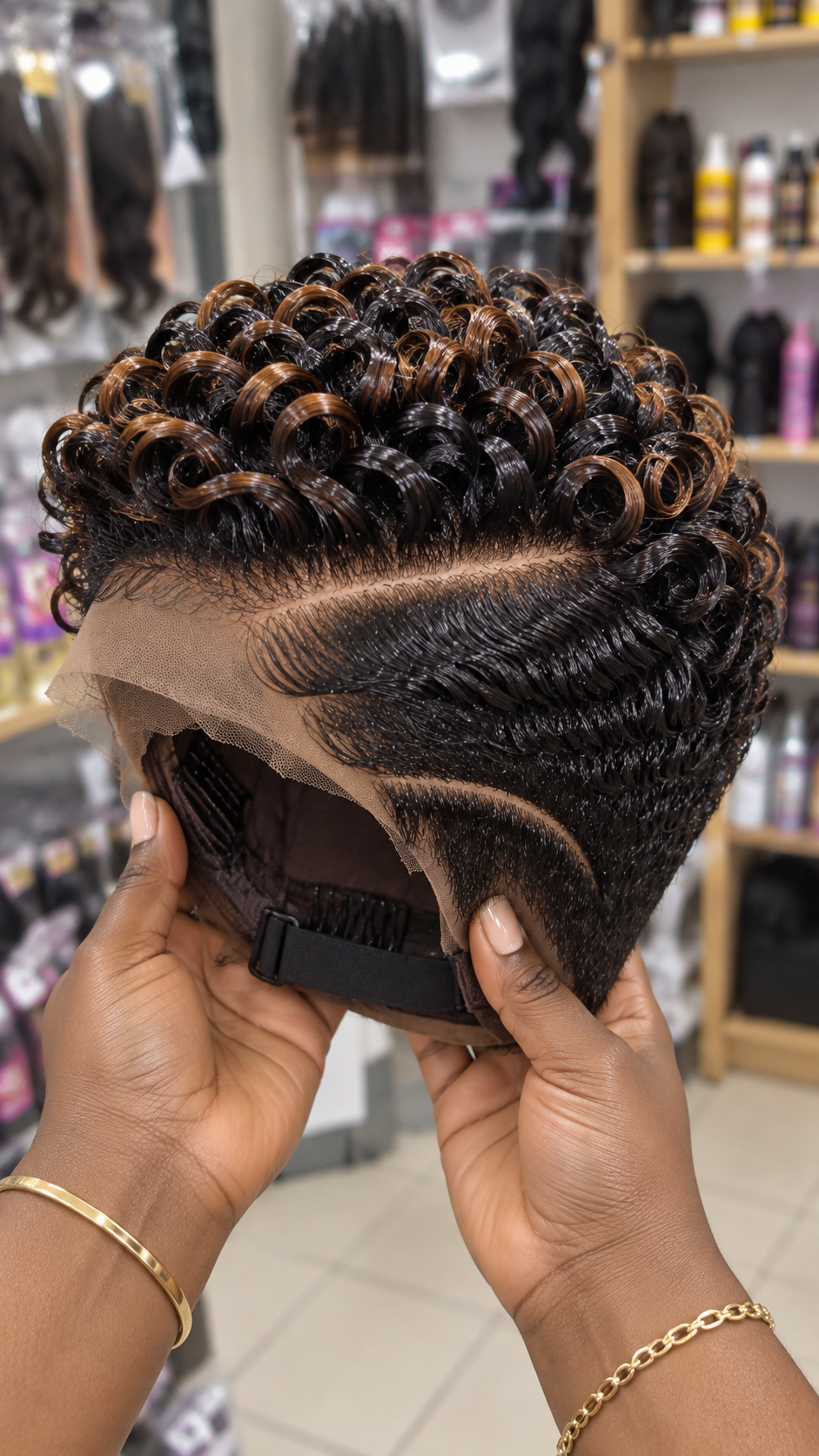
A hairstyle can make its strongest impression through the relationship between two completely different forms of hair artistry. In this particular lace wig, tightly arranged circular ringlets rise across the upper head while carefully directed waves create a striking architectural pattern along the temple. The contrast is immediately noticeable: the upper section has movement, dimension, and contrasting caramel-brown accents, whereas the lower section follows the head with sleek, controlled strands and visible curved separations.
The photograph captures the wig before installation, held open by two hands inside a hair retail environment. This perspective is particularly useful for prospective buyers because it reveals more than the hairstyle alone. The untrimmed lace extends beyond the front hairline, the dark cap interior is partially exposed, and an adjustable fastening strap is visible near the lower opening. These details provide practical information for discussing fit, finishing requirements, and installation with a wig stylist.
Rather than treating this design as an ordinary curly pixie, it is more accurate to examine how its circular upper arrangement, selective caramel coloring, and carefully separated temple waves work together. Reproducing that combination requires attention to proportions, hair direction, and the relationship between the lace front and the sculpted side sections.
The Circular Ringlet Arrangement Creates Its Own Visual Rhythm
The most recognizable element is the collection of glossy, rounded loops covering the crown. Individual sections of hair have been arranged into compact circular formations, with several appearing almost like miniature rings or rolled ribbons. Their placement creates a dense, layered appearance without relying on long hanging curls.
Some loops face the camera directly, revealing their hollow centers. Others tilt sideways or overlap neighboring sections. This variation gives the upper silhouette a lively appearance while maintaining a relatively compact shape. The visible ringlets are not uniformly positioned, and their different orientations help prevent the hairstyle from resembling a simple row of identical curls.
The dark hair beneath the caramel accents contributes considerable depth. Light catches the curved surfaces of the ringlets, producing bright reflections along the outer edges and deeper shadows inside the circular openings. This interplay makes the individual formations easier to distinguish.
A customer ordering this style should pay particular attention to ringlet diameter, spacing, and projection above the head. A maker who uses considerably larger curls could change the entire silhouette. Similarly, loosely arranged spirals may fall outward instead of maintaining the compact circular appearance visible in the photograph.
The desired result is a closely coordinated collection of rounded loops that remains visually connected to the lower sculpted sections. A successful reproduction depends on maintaining that balance rather than simply increasing the number of curls.
Caramel Accents Are Concentrated Within the Dark Ringlet Structure
The coloring deserves careful examination because it is not a uniform brown hairstyle. The dominant shade appears very dark brown to black, with warm caramel-brown accents distributed through selected upper loops. These lighter sections are especially visible where the hair curves toward the light.
Several ringlets display caramel coloring along portions of their circular surfaces, while nearby loops remain predominantly dark. The arrangement creates an alternating impression of warmth and depth. It does not resemble a complete blonde crown or an evenly lightened top section.
The lower temple area remains predominantly dark, making the contrast between the decorative upper loops and the sculpted waves more pronounced. The photograph does not establish the exact coloring method, whether the lighter sections were processed before styling, or whether multiple hair colors were combined during construction.
Matching the Color Without Losing the Original Character
When commissioning a similar wig, provide the stylist with a close photograph of the upper loops and request a color-placement discussion before production begins. Describing the desired result merely as black and brown hair leaves considerable room for interpretation.
A more useful instruction would specify a dark overall foundation, selective warm caramel accents within the circular crown arrangement, and predominantly dark temple sections. The amount of lighter hair matters just as much as the shade itself.
Ask to see the proposed hair colors under ordinary indoor lighting and near natural daylight. Warm highlights can appear substantially different under yellow salon lamps, cool retail lighting, and direct sunlight.
For buyers considering human hair, previous coloring and processing should be discussed before requesting further lightening. For synthetic options, the seller must confirm whether the desired combination is available in the manufactured fibers. Dye compatibility cannot be assumed.
Reading the Temple Design as a Sequence of Directional Waves
Below the circular crown, the hairstyle changes dramatically. The visible temple contains a broad, glossy finger-wave-inspired section that follows a curved path across the side of the wig. Its strands lie close together, forming a coordinated directional pattern.
A pale exposed channel separates the upper portion of this wave panel from the hair above it. Farther down, another curved separation creates a distinct boundary around a smaller dark section near the lower temple. These channels are important to the design because they make the different directions of the hair visually readable.
The image shows two prominent curved separation paths on the visible side. They should not automatically be described as shaved razor lines. On a wig, similar effects may be created through controlled parting, exposed foundation areas, hair placement, or other construction techniques.
The broad middle wave sweeps diagonally and curves downward toward the temple. Its direction contrasts with the upright circular loops above, producing an intentional transition from raised volume to close-fitting hair.
The lower visible section follows the contour toward the ear area and contains tightly directed dark strands. This gives the side an orderly, tapered appearance, although the photograph does not establish how the unseen rear section has been constructed.
Why the Width of Each Separation Matters
Small changes in the exposed channels can noticeably alter this hairstyle. A separation that becomes too wide may make the side look disconnected. A channel that is too narrow can disappear beneath neighboring strands, reducing the visibility of the wave arrangement.
For custom production, ask the stylist to recreate the visible spacing rather than adding extra decorative lines. The reference does not show an elaborate network of crossing razor patterns, and introducing additional lines would change the character of the design.
The stylist should also confirm whether the temple waves will remain stable after fitting the wig to the customer’s head. A cap that stretches or shifts may affect the positioning of carefully arranged hair sections.
The Untrimmed Lace Reveals an Important Installation Stage
The extended lace across the front is one of the clearest indications that this wig has not yet received its final wearer-specific finishing. A beige-toned mesh projects beyond the styled hairline, particularly around the visible forehead and temple area.
The mesh is visibly different from the dark hair and the interior cap. Its appearance in this photograph confirms the presence of lace, but does not establish that it is HD lace, transparent lace, or any particular commercial lace grade.
Along the upper front boundary, fine dark hairs create a delicate transition between the ringlet area and the mesh. The stylist will need to consider how these hairs should sit once the wig is positioned on a real forehead.
The most important fitting decision is where the actual hairline should rest. Trimming lace before checking the position can remove material needed for an accurate fit. Because the temple styling extends close to the front perimeter, an overly aggressive cut could also interfere with the intended outline.
A suitable installation appointment should begin with examining the wig on the wearer, assessing the cap position, and identifying the appropriate lace-trimming boundary. Any additional hairline customization should be agreed upon before irreversible work begins.
What the Interior Photograph Tells a Careful Buyer
The lower opening exposes part of a dark fabric cap. A black adjustable strap with fastening hardware is visible across the interior, and a section of internal construction appears along the nearby edge.
These are useful observations, but they do not confirm every component of the cap. The photograph does not provide a complete underside view, so the number and placement of internal combs, the full ventilation arrangement, and the complete cap structure remain uncertain.
Likewise, the visible adjustment strap does not establish that the wig can be worn securely without adhesive by every customer. Security depends on head measurements, cap construction, the wearer’s hair preparation, and the manufacturer’s intended attachment method.
Before purchasing, request a photograph of the entire interior with the wig turned inside out. Ask for the cap circumference, available adjustment range, lace coverage, and any combs or other securing components.
If a seller advertises the wig as glueless, ask how that claim is supported by its actual construction and fitting requirements. A visible strap is helpful, but it is not a substitute for a proper fit assessment.
Commissioning the Design Through a Wig Maker or Salon
This hairstyle is particularly suited to a reference-based ordering conversation because its distinctive appearance depends on several elements being reproduced together. A buyer seeking a close match should avoid selecting a generic curly pixie and expecting the salon to recreate the remaining details automatically.
Begin by sending the full reference photograph to a wig maker who has experience with sculpted finger waves and compact ringlet styling. Ask whether the maker can reproduce the crown arrangement, selective caramel coloring, and temple geometry as a coordinated design.
Request examples of completed work showing similar circular curls and close-fitting wave panels. General photographs of ordinary curly wigs may not demonstrate the specific technical ability needed here.
The next discussion should cover cap measurements and the proposed material. If a custom cap is offered, the maker may request circumference, front-to-nape, ear-to-ear, and other measurements according to their fitting method. Follow the seller’s measurement instructions rather than estimating a size from the photograph.
Before paying a deposit, establish which services are included: hair coloring, loop formation, side styling, lace preparation, final fitting, and any adjustments. A wig supplied with untrimmed lace may still require a separate installation appointment.
For online orders, ask for current photographs or a short video of the actual unit when possible. The video should show the crown from above, the visible temple at close range, the front hairline, and the underside. A rear view is especially valuable because the reference photograph does not fully reveal the back.
Ready-Made Availability Versus a Reference-Based Custom Order
A ready-made wig may offer a faster purchasing route if its ringlet pattern and temple arrangement already resemble the reference. However, finding the correct general silhouette does not guarantee matching color placement or the same curved side separations.
Custom production offers greater control over these details, but the buyer should establish realistic tolerances. Hand-arranged loops can vary slightly in orientation, and the appearance of the temple pattern may change with cap size.
A practical approach is to prioritize the elements that give the hairstyle its identity: compact circular ringlets, a dark foundation with selective caramel accents, and the two prominent curved temple separations. These should be discussed before minor finishing preferences.
If the customer already owns a similar wig, a skilled stylist may be able to assess whether restyling is possible. That decision depends on the existing hair length, density, fiber compatibility, and construction. Not every ready-made unit can be safely converted into this arrangement.
Budgeting for Circular Styling and Temple Precision
The following USD figures are illustrative planning ranges, not verified prices for the photographed wig or live quotations from a particular supplier. Actual costs vary by country, material, workmanship, cap construction, coloring, and included services.
| Wig Category | Illustrative USD Range | Potential Scope |
|---|---|---|
| Premium Custom | $280–$650+ | Individualized cap planning, detailed loop styling, selective coloring, and extensive finishing work, subject to the maker’s quotation. |
| Standard Custom | $150–$320 | Reference-based crown styling and temple detailing with a more limited customization package. |
| Basic Human Hair | $90–$210 | A simpler human-hair base that may require additional coloring and salon styling to approach the reference. |
| Premium Synthetic | $65–$160 | A higher-priced manufactured-fiber option with prearranged curls or wave detailing, depending on availability. |
| Basic Synthetic | $25–$80 | An entry-level alternative that may approximate the silhouette without reproducing the intricate loop and temple arrangement. |
These categories describe possible purchasing options; the photograph alone cannot identify the wig’s fiber composition or its retail price.
For this particular design, the amount of styling labor may have a substantial influence on the final quotation. Forming numerous circular loops, arranging contrasting hair colors, and maintaining the curved temple pattern all require time and control.
Ask whether the quoted amount covers the finished wig only or also includes a fitting appointment, lace trimming, shipping, taxes, and subsequent adjustments. When comparing two quotations, examine the scope of work rather than assuming that the higher price automatically indicates better craftsmanship.
Protecting the Ringlets Without Disturbing Their Shape
The most delicate maintenance concern is the upper collection of circular loops. Brushing through these formations as though they were loose everyday curls could pull apart the arranged sections and change their appearance.
Before cleaning, determine the actual fiber type and ask the maker how the loops were secured. Some sculpted hairstyles rely on styling products, setting techniques, or internal support methods that require particular handling.
Avoid directing strong heat onto the loops without confirmed material compatibility. Synthetic fibers may have strict temperature limitations, while human hair can also suffer from excessive heat or repeated processing.
Where cleaning is necessary, follow the manufacturer’s instructions and minimize unnecessary manipulation of the circular sections. If the loops begin to lose their original shape, professional restyling may be preferable to repeated home attempts.
Keeping the Caramel Sections Visually Distinct
The warm accents contribute to the hairstyle’s appearance because they sit among much darker ringlets. Product buildup can reduce the visible contrast by making the surfaces appear dull or coated.
Choose care products according to the confirmed hair material and coloring history. Do not assume that ordinary hair dye, color-depositing products, or strong cleansing treatments are appropriate for the wig.
If the caramel shade changes over time, consult the original maker before attempting recoloring. The lighter sections are selectively positioned, and uncontrolled color application could affect the surrounding dark hair.
Preserving the Side Waves Between Salon Visits
The temple arrangement requires a different maintenance strategy from the crown. Its appearance depends on strands remaining closely directed along curved paths, with the exposed channels clearly visible.
Repeated rubbing, forceful combing, or pressure from unsuitable headwear may disturb this placement. If the wig is worn frequently, ask the stylist whether the wave panel can be refreshed without dismantling the upper ringlets.
A correctly sized wig stand may help support the overall silhouette when the unit is not being worn, provided it does not stretch the cap or press against the styling. Avoid compressing the circular crown under heavy objects.
When transporting the wig, prioritize protecting the ringlet height and the visible temple contours. A container that forces the upper loops flat could create unnecessary restoration work.
The Final Fitting Should Respect the Original Proportions
The most useful finishing appointment is not necessarily the one that adds the greatest amount of customization. For this wig, successful installation means keeping the compact ringlets, caramel accents, and curved temple sections in their intended relationship.
The stylist should first position the cap securely and check the hairline. Only then should the lace be trimmed as appropriate. The temple pattern can be assessed after the wig sits at the correct height, because even a small positional change may alter how the waves frame the face.
Additional shaping should be conservative. Removing too much hair from the side may weaken the visual connection between the lower wave panel and the upper crown. Likewise, expanding the ringlets to create extra height could produce a hairstyle noticeably different from the reference.
Before leaving the salon, the customer should inspect the result from the front, the styled side, and above. Photographs taken under ordinary lighting can help document the intended loop arrangement for future appointments.
This design demonstrates why buying a distinctive wig involves more than selecting a color and general haircut category. Its identity comes from the precision of the circular crown, the deliberate placement of caramel among dark strands, and the directional artistry of the temple waves. A buyer who communicates those priorities, verifies the cap details, and arranges careful fitting will be better positioned to obtain a faithful result without unnecessary alterations.
Search Terms
Caramel brown ribbon ringlet lace wig · Black circular loop pixie wig · Sculpted temple finger wave wig · Two curved side parting lace wig · Dark crown wig with caramel accents · Untrimmed beige lace curly wig · Adjustable strap sculpted pixie wig · Glossy rolled ringlet crown hairstyle