
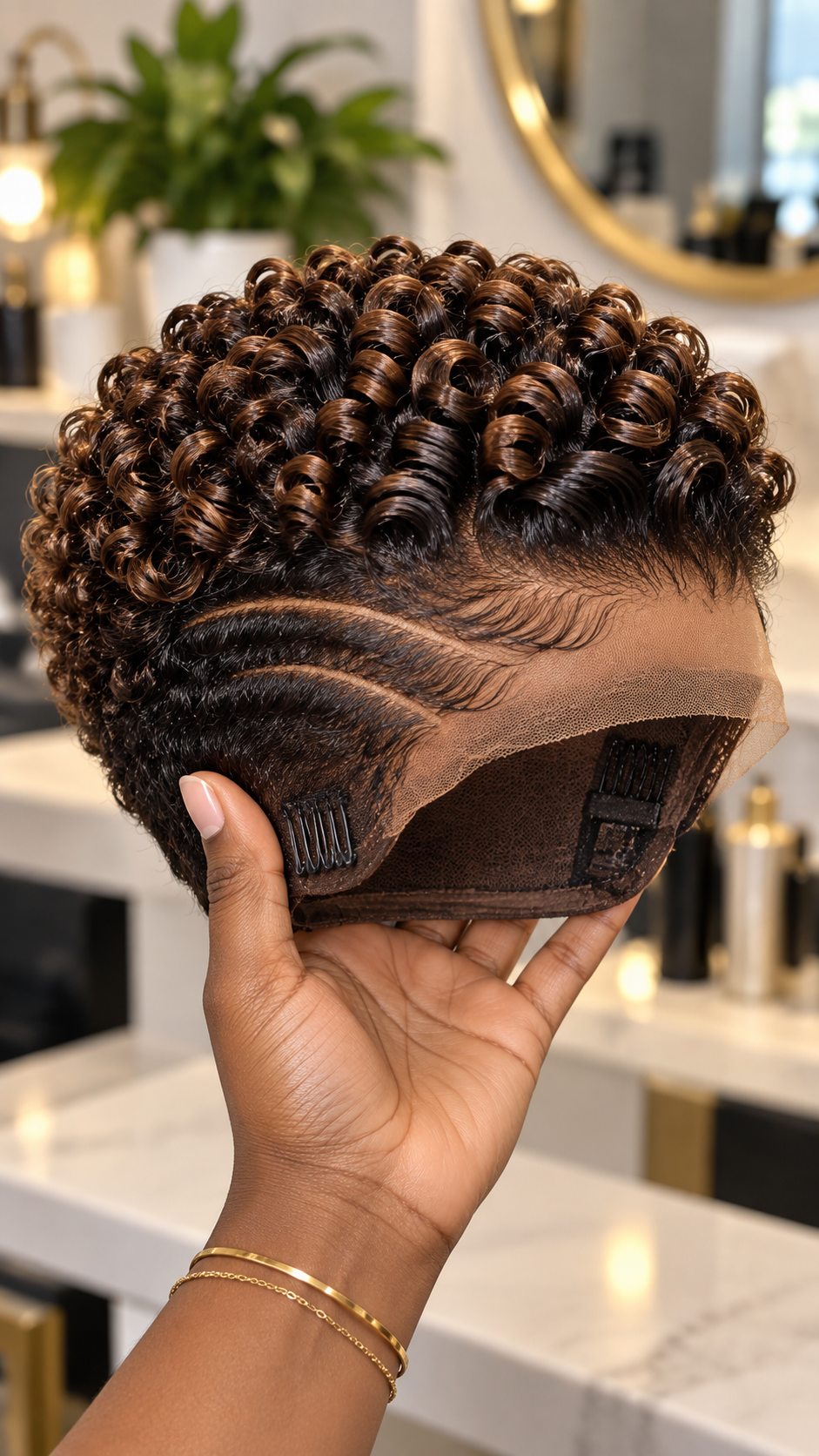
This espresso-and-toffee wig is built around a clear separation of responsibilities between the crown and the side. The upper surface carries dozens of compact spiral coils, with warm toffee-brown reflections running through a much deeper espresso foundation. Below that dense curl field, the construction becomes dramatically calmer: two long swept channels travel through close dark hair, while fine directional strands soften the transition near the front. The contrast is what gives this unit its identity. The crown is busy, rounded and reflective; the side is controlled, elongated and architectural.
The photograph is especially useful because the wig is shown before installation and from an angle that exposes both the exterior styling and part of the interior. The lace remains untrimmed across the front, the inner brown cap can be seen clearly, and comb-style attachment pieces are visible near the lower perimeter. Those elements can be described from the image with confidence. The exact commercial grade of the lace cannot be established visually, however, so there is no basis for calling it HD lace unless the seller specifically confirms that material.
Toffee Appears as Light Across the Spirals Rather Than a Flat Color Block
The upper color is richer than a simple medium brown. Deep espresso remains visible inside the curls and close to the roots, while raised sections reflect warmer toffee, caramel-brown and chestnut tones. The brighter color therefore follows the physical direction of the hair.
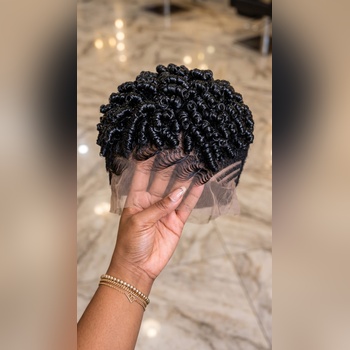
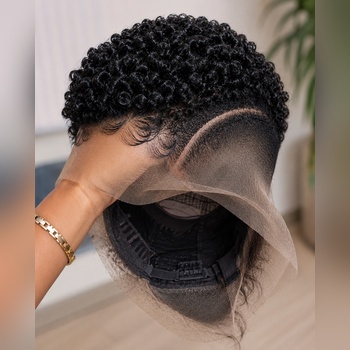
This makes each spiral easier to distinguish. A coil may appear almost espresso inside its opening, then become warm brown as the strand turns toward the light. The effect produces dimension without requiring pale blonde streaks.
For custom ordering, the useful instruction is not merely “brown with highlights.” That wording could produce straight streaks or randomly distributed lighter pieces. A more accurate brief would request a deep espresso foundation with warm toffee-brown illumination concentrated through the raised spiral surfaces.
The Crown Is Dense Without Losing Its Open Centers
The crown contains a substantial number of curls, yet many individual spirals remain easy to identify. Their centers are not completely filled, and small dark spaces survive between neighboring sections.
This balance matters. Increasing the density further might make the wig appear fuller in a technical sense while reducing the clarity of the curl map. The open centers are part of what makes the crown look sculpted rather than simply curly.
A custom maker should therefore work toward controlled density. The objective is enough hair to create a rich crown while preserving the circular openings and separations that allow the individual coils to remain visible.
Coil Diameter Changes Across the Upper Surface
The spirals are related but not identical. Larger open loops appear through the central and forward crown, while smaller formations fill the outer areas and help the pattern follow the rounded shape of the cap.
This variation prevents mechanical repetition. A crown made from one identical curl diameter can resemble rows of matching rollers. Here, several sizes interact while remaining part of one coherent pattern.
An overhead approval photograph is useful for custom work because it reveals this distribution far more accurately than a frontal image. The buyer can check whether larger and smaller coils have been balanced rather than uniformly repeated.
The Front Edge of the Crown Becomes More Directional
As the curls approach the front, the construction begins changing. Large circular forms give way to finer strands that travel forward and sideways toward the lace perimeter. This creates a gradual transition rather than placing the heaviest spirals directly against the front.
Those directional strands help connect the crown with the side design. They also give the installer more flexibility because the front does not begin with one rigid row of dense curls.
During fitting, these finer hairs should be evaluated before any thinning or removal takes place. Their usefulness becomes clearer once the cap is positioned on the wearer.
The Side Uses Two Long Swept Channels Instead of Small Decorative Marks
The most recognizable side detail is a pair of long exposed paths. Both travel in broad curves beneath the crown, creating a layered sweep rather than a collection of small carved accents.
The upper channel establishes the strongest boundary. A second route follows below it, maintaining a similar direction while sitting closer to the lower perimeter. Together they create movement without overcrowding the compact side.
This pattern should not be described simply as “two lines” when ordering. Their length, curvature and relationship with the crown are what distinguish them from ordinary parallel barber stripes.
The Dark Hair Between the Channels Is Essential
A substantial espresso panel remains between the two exposed routes. That retained hair keeps the channels visually separate and gives the side a layered appearance.
If future barber work gradually widens both paths, the dark middle section can become too narrow. Eventually the channels may appear to merge into one broad exposed area.
Maintenance should therefore prioritize the preserved hair as much as the exposed lines. When fine strands shift into a channel, repositioning them should be attempted before additional cutting.
The Upper Channel Creates a Boundary for the Spiral Crown
The first swept route does more than decorate the side. It establishes where the raised curl field ends. Above it, the hair quickly gains height and moves into the spiral crown. Below it, the strands stay considerably closer to the cap.
This makes the line structural as well as decorative. Its position influences the apparent size of the crown and the amount of compact side visible underneath.
Moving the channel substantially upward would reduce the crown visually. Moving it downward would enlarge the upper panel. A faithful recreation should therefore preserve its relationship with both zones.
The Lower Sweep Creates a Softer Second Layer
The second channel sits within a quieter area of the side. It follows the broad direction of the upper route but does not need to be identical in width or curvature.
The effect is more organic than two perfectly parallel machine-cut stripes. The lines respond to the rounded cap and gradually change their spacing as they travel backward.
That subtle variation should be retained. Making the two channels mechanically parallel from beginning to end could remove some of the natural flow visible in the reference.
The Lower Perimeter Keeps a Dense Espresso Finish
Beneath the second channel, dark hair remains visible rather than giving way to a largely exposed foundation. This lower panel visually anchors the side and connects with the dark root depth of the crown.
The strands are close enough to preserve a compact silhouette but dense enough to avoid an unfinished appearance. This balance is important for the overall profile.
Repeated trimming should be conservative because wig hair will not naturally replace what has been removed. Once this lower panel becomes too sparse, restoring its original density may require reconstruction.
The Untrimmed Lace Preserves Installation Options
A broad section of lace remains visible across the front. This shows that the final perimeter has not yet been customized to a particular wearer.
For professional installation, that can be an advantage. The wig stylist can first establish cap position and evaluate where the twin side channels land. Only after the placement is correct should the excess lace be trimmed.
The mesh appears warm beige-brown in the photograph, but lighting and camera processing can influence perceived color. Buyers should ask which lace shades the maker actually offers instead of relying solely on the image.
The Photograph Confirms Interior Comb Attachments
Unlike a mannequin-only product photograph, this angle exposes part of the inside. Comb-style attachment pieces are clearly visible near the lower interior perimeter.
This is useful information for buyers. Some wearers actively use internal combs for additional security, while others prefer not to use them. A custom maker may be able to alter the internal arrangement if that preference is discussed before production.
The complete interior is not visible, so customers who care about the attachment system should still request a full underside photograph of the exact unit.
The Brown Interior Cap Should Be Included in Product Documentation
The exposed underside also reveals a dark brown structured foundation beneath the hair. This demonstrates that the sculpted exterior is supported by a constructed cap rather than being presented only as loose styling.
For online selling, documenting the underside separately can help customers compare products more intelligently. Two wigs with similar spiral crowns can use different cap structures, attachment arrangements and sizing systems.
A serious product listing should therefore distinguish exterior styling from interior construction instead of assuming that attractive crown photographs provide all necessary information.
Cap Position Controls the Side Design
The twin swept channels are permanently attached to the foundation. They cannot be repositioned independently after installation. If the cap sits too far forward or backward, both channels move with it.
This makes accurate sizing particularly important. A beautiful side design can look incorrectly placed if the wig itself does not sit where the maker intended.
For custom orders, follow the manufacturer’s measurement guide carefully. If several dimensions are requested, provide all of them rather than relying only on circumference.
A Production Brief Should Separate Curl, Color and Side Geometry
The crown specification should request densely arranged open spirals with mixed diameters and a controlled rounded silhouette. The color specification should identify deep espresso roots with warmer toffee or chestnut reflections through the raised surfaces.
The side specification should describe two long swept channels with substantial dark hair retained between and beneath them. Fine directional front strands should remain visible near the lace transition.
After these exterior elements are agreed upon, cap sizing, available lace shade and internal attachment preferences can be discussed separately.
Choose a Wig Maker Who Can Control Curl Repetition
The challenge in this crown is not simply creating a curl. It is repeating a recognizable spiral language dozens of times without making the result mechanically uniform.
Ask potential makers for overhead examples of their work. Look for open centers, varied diameter, consistent shine and enough separation between neighboring sections.
A maker whose portfolio contains only loose curls may not automatically reproduce this tightly organized sculpted crown accurately.
Side Precision May Require a Different Specialist
A wig maker can be highly skilled at cap construction and spiral setting while having less experience with precision side channels. In that case, the final refinement can potentially be handled by a local professional familiar with wig hair.
If work is divided between specialists, fit the wig before additional side cutting. The barber should see where the channels naturally sit on the wearer before making irreversible changes.
If the existing side already matches the reference, preservation is preferable to cutting simply because a barber appointment has been scheduled.
Approval Images Should Include a True Side View
An overhead photograph is useful for checking the spiral crown, but it cannot fully verify the twin channels. Request a direct side image of the actual finished unit before shipment.
Check the width of both paths, their curvature and the amount of espresso hair preserved between them. The upper route should remain connected visually to the crown boundary, while the lower route should create a distinct second layer.
A rear three-quarter photograph can then verify how the curls reduce and settle around the back.
Neutral Light Is Better for Judging Toffee Depth
Warm salon lighting can make brown hair appear significantly more copper or golden. This reference clearly contains warm reflections, but the exact balance between espresso, chestnut and toffee should be checked under more neutral illumination before a custom order is approved.
Ask the seller for a daylight or neutral indoor photograph. This is particularly valuable if the buyer wants warm brown without drifting into bright copper.
Keeping the approved photograph with the order also provides a useful reference if future color maintenance is required.
Pricing Should Reflect the Number of Hand-Arranged Spirals
The compact dimensions of the unit do not mean that production is simple. The crown contains many individually formed coils, the brown tonal relationship needs to remain consistent, and the side channels require controlled placement.
| Category | Estimated Price Range | Potential Scope |
|---|---|---|
| Premium Custom | $330–$590+ | Higher-grade hair, personalized cap sizing, custom espresso-to-toffee coloring, hand-mapped spiral crown, precision twin side channels and detailed lace preparation. |
| Standard Custom | $200–$350 | Prepared brown spiral crown, established side channels and more standardized cap and fitting options. |
| Basic Human Hair | $120–$215 | A human-hair foundation requiring additional color work, spiral setting, side detailing and professional fitting. |
| Premium Synthetic | $80–$155 | A pre-colored and pre-set option that may retain its spiral crown with less frequent professional reconstruction. |
| Basic Synthetic | $40–$90 | A budget interpretation where tonal depth, spiral separation, channel precision or interior construction may be simpler. |
These are broad budgeting references rather than verified prices for the photographed wig. Hair source, fiber, color processing, cap construction, lace specification, labor, seller location, shipping and installation can all change the final total.
Ask for an itemized quotation when comparing custom options. A cheaper foundation that still requires coloring, spiral construction and side work should not be compared directly with a completed unit whose price includes those services.
Human Hair Makes Selective Crown Repair More Practical
A human-hair version can offer useful flexibility when individual spirals loosen over time. A stylist can potentially isolate the affected sections and restore them without dismantling the entire crown.
The toffee areas may have undergone color processing, so heat should still be selected according to the actual condition of the hair. Human hair does not mean unlimited temperature tolerance.
Selective repair can reduce salon time and preserve the original coil map more effectively than rebuilding every section routinely.
Premium Synthetic Can Favor Long-Term Shape Retention
A quality pre-set synthetic version may suit a wearer who wants the spiral arrangement to remain close to its original form. The warm brown palette can also be manufactured into the fiber rather than requiring repeated color services.
The tradeoff is reduced flexibility for future changes. Heat tolerance varies and conventional permanent hair dye should not be assumed compatible.
Material choice should therefore reflect whether the wearer prioritizes restyling freedom or preservation of the original crown.
Photograph the Crown Map Before Washing
Take an overhead photograph before the first full cleanse. Record the largest spirals, smaller filler sections and the overall direction of the crown. A direct side image should document both channels.
These photographs become a restoration guide if the hair shifts during washing or travel. They are also useful if another stylist maintains the wig later.
Preserving an accurate visual record reduces the chance of the crown and side gradually changing from appointment to appointment.
Wash the Spirals Without Closing Their Centers
Vigorous rubbing can intertwine neighboring curls and eliminate the open spaces that give the crown its sculpted appearance. Clean according to the confirmed hair or fiber and minimize unnecessary friction.
After drying, identify which sections actually need attention. If most spirals remain intact, leave them in place.
This selective approach limits heat and handling while helping the crown retain its original density distribution.
Maintain the Twin Channels Only When They Actually Need It
Wig side designs do not grow out like natural barber cuts. There is therefore no reason to deepen the channels according to a fixed haircut schedule.
If fine strands move across an exposed path, reposition them first. Only use cutting when the original line genuinely requires refinement.
When cutting is necessary, preserve the dark middle panel. That retained espresso hair is what keeps the two routes visually separate.
Color Refresh Should Preserve Espresso Inside the Spirals
If a human-hair version eventually loses some of its warm tone, the entire crown should not automatically be covered with one light brown formula. The deeper espresso sections are essential to the dimensional effect.
A colorist can evaluate which raised surfaces need refreshing while maintaining darker interiors and roots. This keeps the color connected to the curl architecture.
For synthetic versions, follow fiber-specific recommendations and avoid standard permanent coloring methods unless the manufacturer explicitly permits them.
Use Shine Products Sparingly on the Coil Field
The crown already reflects light strongly. Heavy oil can collect inside the spirals, darken the toffee reflections and cause neighboring strands to stick together.
Use only what the material requires. If residue begins affecting the appearance, suitable cleansing can restore separation more effectively than adding another layer of product.
The fine side hair also benefits from minimal buildup because the channels need crisp contrast against the dark panels.
Fit the Cap Before Trimming the Lace or Altering the Side
When the unit arrives, inspect the crown, color, side channels, lace and interior attachments before making permanent changes. Any major discrepancy from an approved custom order should be discussed with the seller first.
Once the wig is accepted, establish its final cap position. The stylist can then trim the lace according to the wearer and evaluate whether the side needs any refinement.
This sequence protects both the fitting options and the carefully positioned side architecture.
Storage Should Protect the Circular Openings
A suitable wig stand or mannequin head gives the spiral crown enough room to retain its open centers. Avoid stacking other units on top or pressing the crown into a shallow container.
The side also needs clearance so fine strands are not pushed across the exposed channels. Store the wig only after the cap and lace are completely dry.
During travel, choose packaging with enough depth to protect the crown rather than compressing it for convenience