
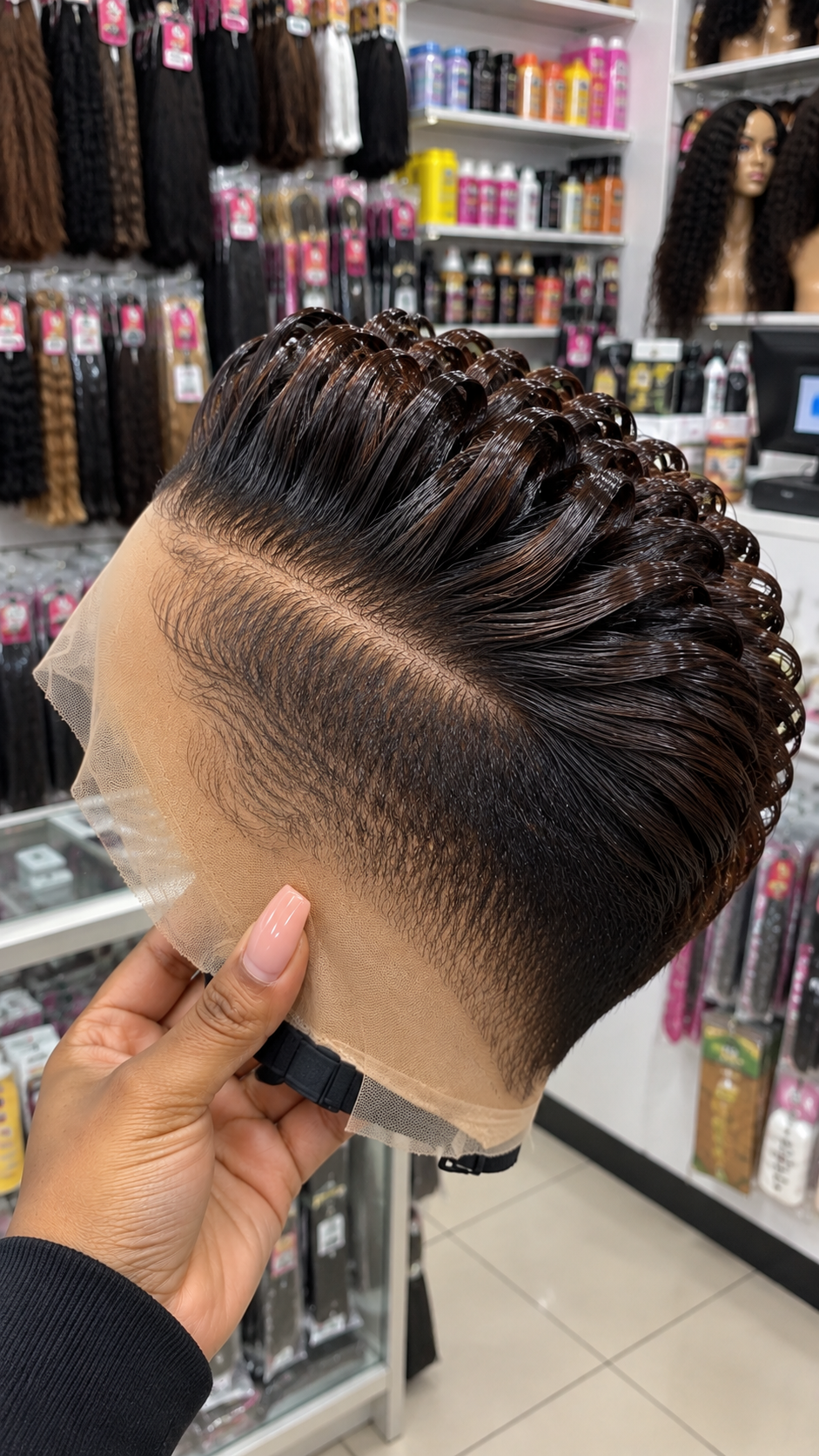
Not every striking pixie wig needs carved lines, dramatic color contrasts, or an elaborate temple pattern. Sometimes the strongest design decision is knowing where to leave the hair uninterrupted. The espresso brown lace wig in this photograph demonstrates that approach through a closely tapered side, a gradually rising upper section, and glossy backward-swept strands that develop into compact circular loops across the crown.
Its appearance depends on the transition between three different areas: a fine front hairline, a closely fitted side with no visible decorative carving, and a raised upper hairstyle arranged into elongated curves. Rather than relying on sharp geometric channels, the wig creates contrast through changes in hair length, direction, and elevation.
The unit is displayed by hand inside a hair retail shop, with its untrimmed beige lace and part of the fastening system visible. Because it is photographed before installation, buyers can study the underlying silhouette and consider whether the hairstyle would suit their preferred cap fit, maintenance routine, and installation method.


For someone considering a brown pixie lace wig, this design offers a useful lesson: a carefully balanced taper and consistent backward movement can be just as distinctive as more heavily decorated hairstyles.
The Absence of Carved Lines Is an Important Design Choice
The visible side of this wig is closely fitted, with fine dark brown hair gradually increasing in length toward the upper section. There are no clearly visible shaved stripes, parallel channels, curved razor patterns, or decorative cutouts.
This is worth emphasizing because many sculpted pixie wigs incorporate barber-inspired side designs. In this example, the lower area is intentionally uninterrupted, allowing the viewer to follow the natural progression from the finer hairline to the denser upper hair.
The side appears darker than the crown because the hair is shorter and the underlying surface is more visible. Its color remains within the same deep brown family rather than changing into a separate contrasting shade.
The lower portion has a close, tapered appearance, while the upper boundary gradually transitions into longer strands. There is no abrupt horizontal division between the two areas.
Why an Uninterrupted Side Can Be Easier to Personalize
A wig without carved channels may provide greater styling flexibility, depending on its construction. The wearer can retain the understated tapered appearance without committing to a specific decorative pattern.
However, this does not mean the side can automatically be cut or reshaped. The feasibility of further customization depends on the hair placement, density, and cap materials beneath it.
Before requesting additional barber work, ask the wig maker whether the side contains sufficient hair coverage for the intended alteration. Cutting into a thinly covered area may expose the underlying cap.
For buyers who prefer the original appearance, the uninterrupted taper should be preserved rather than treated as an unfinished section awaiting decoration.
Following the Hair From the Front Toward the Crown
The upper styling begins with strands directed backward from the front. These strands are relatively elongated and closely arranged near their starting point, producing a controlled surface before rising into larger curves.
As the hair travels toward the crown, it develops into overlapping ribbon-like formations. Several sections bend upward and curl into compact loops, creating elevation without forming a large rounded mass.
The movement is continuous. The front does not consist of a separate fringe, and the upper hair is not divided by a clearly exposed central part.
Instead, the strands travel in a broadly coordinated direction, with slight variations in their individual curves. This gives the hairstyle an organized appearance while allowing the loops to remain visually distinct.
The raised curls are particularly noticeable toward the upper rear edge, where multiple circular formations overlap. The exact styling across the back cannot be confirmed because the photograph does not provide a complete rear view.
Understanding the Ribbon-Like Curl Formation
The upper sections differ from tightly packed natural coils. Their strands appear elongated and grouped into broader curved formations before developing into loops.
Some curls create visible circular openings, while others form partial arcs that connect with neighboring sections. This variation contributes to the layered appearance of the crown.
When comparing similar products, buyers should look beyond general descriptions such as curly pixie or finger curl wig. The direction of the strands and the placement of the loops are more useful indicators of whether another unit resembles this design.
A wig with loose forward-facing curls may have a comparable length but an entirely different silhouette. Likewise, a crown covered with small upright spirals would not reproduce the same backward movement.
Espresso Brown With Subtle Warm Reflections
The visible hair is predominantly very dark espresso brown, with warmer chocolate-brown reflections appearing across the glossy upper sections. Some areas approach black in the shadows, while individual curved strands catch enough light to reveal brown undertones.
The color is not arranged as a dramatic blonde ombre or a series of contrasting highlights. Instead, the tonal variation appears relatively restrained.
The upper strands show more visible brown reflection because their curved surfaces face the light. The closely tapered side remains darker and less reflective.
This difference should not automatically be interpreted as separate dye placement. Lighting, hair direction, and the reflective surface of the strands can influence how the color appears in a photograph.
Choosing Between Natural Black and Espresso Brown
Buyers who want this appearance should compare dark brown and natural black options carefully. Under indoor lighting, the two can look similar, but their appearance may differ considerably in daylight.
Request an actual photograph of the proposed wig color rather than relying only on a digital color chart. Ask the supplier to show the hair under neutral lighting without heavy filters.
If the product is offered in several dark shades, compare the roots and crown together. The reference shows a broadly consistent dark color family, so an unexpectedly bright brown crown may change the overall impression.
The photograph cannot establish whether the color comes from natural pigmentation, dye, or manufactured synthetic fibers. That information should be obtained directly from the seller.
The Hairline Is Designed to Blend Into the Taper
Along the front edge, fine strands extend toward the beige lace. The hairline appears less dense than the upper crown, allowing the transition into the closely fitted side to remain gradual.
There is no prominent row of elaborate curled baby hairs dominating the front. Instead, the visible fine strands follow the general backward direction of the hairstyle.
This relatively restrained hairline complements the uninterrupted side. Both areas emphasize a gradual change in hair density rather than decorative separation.
The lace remains untrimmed and extends beyond the visible hairline. Its beige color is clearly distinguishable from the dark brown hair.
Although the mesh appears fine, the exact lace specification cannot be established from the image. Buyers should request confirmation of the material and construction rather than assuming a particular lace grade.
Visible Fastening Hardware and Cap Considerations
The photograph provides a partial view of the wig’s lower construction. Near the bottom edge, a black adjustable strap and fastening components are visible beneath the lace.
This is a useful detail because it indicates that the unit includes at least some adjustment hardware. However, the photograph does not reveal every internal component or establish the complete cap construction.
The presence of a strap does not automatically guarantee that the wig can be worn securely without adhesive. Fit, cap design, intended fastening method, and the wearer’s activity level all matter.
Checking the Cap Before Ordering
Ask the supplier for a full interior photograph showing the cap turned inside out. The image should reveal the complete adjustment system, attachment points, and construction seams.
Confirm the available cap sizes and request the manufacturer’s measurement guidance. Head circumference is important, but additional dimensions may be needed to establish a comfortable fit.
Because this hairstyle relies on the position of the upper sweep, an incorrectly sized cap may affect the direction in which the hair appears to travel.
A unit that sits too far forward may bring the raised crown closer to the forehead than intended. A cap that shifts backward may expose an unwanted amount of the natural hairline.
For adhesive-free wear, request explicit confirmation that the wig is designed for that installation method and ask which security components are included.
Buying a Wig Based on Silhouette Rather Than Decoration
When shopping for this hairstyle, prioritize the overall shape before evaluating minor styling details. The essential silhouette consists of a closely fitted side, a gradually rising upper section, and backward-directed strands that end in compact loops.
A ready-made wig may be a suitable option if those proportions are already present. Unlike a design requiring elaborate side carving, this hairstyle does not depend on reproducing a complex decorative pattern.
Nevertheless, the upper curl arrangement may still require specialist work. A generic curly pixie may have the correct color and approximate length but lack the elongated backward sweep.
Custom construction becomes more attractive when the buyer wants specific crown elevation, cap measurements, or hairline placement.
Evaluating Product Photographs Before Payment
Ask for a side photograph taken at approximately the same angle as the reference. This makes it easier to compare the taper and upper elevation.
Request a front view to examine the hairline and determine whether the strands travel backward as intended.
A photograph from above can reveal whether the crown loops are distributed consistently or concentrated in only one area.
Finally, obtain a rear view. The current image does not establish the complete back shape, so the seller should show how the tapered section and upper curls continue around the head.
These photographs provide more useful information than a listing description that simply promises a fashionable pixie wig.
When a Custom Wig Maker Is Worth Considering
A specialist wig maker may be the better choice for customers who want precise control over the relationship between the taper and the raised crown.
During the consultation, explain that the side should remain free from carved decorative lines. This prevents the supplier from adding barber-inspired details that are not present in the reference.
Specify the dark espresso-brown appearance, backward-directed upper strands, compact curled loops, and relatively fine front hairline.
Ask whether the proposed hairstyle will arrive fully arranged or require additional salon finishing after delivery.
Custom buyers should also clarify the revision policy. A change in crown height or curl direction can significantly affect the appearance even when the hair color remains accurate.
Before shipment, request photographs of the completed unit from several angles. This provides an opportunity to identify substantial differences while the wig is still with the maker.
Illustrative Pricing for Espresso Brown Pixie Lace Wigs
The following USD ranges are examples for purchase planning, not verified current prices or quotations for the photographed product. The actual cost depends on material, cap construction, styling labor, supplier, and included services.
| Wig Category | Illustrative Price Range | Relevant Purchasing Considerations |
|---|---|---|
| Premium Custom | $260–$590+ | Individual cap sizing, carefully arranged backward crown loops, refined taper placement, and personalized hairline work. |
| Standard Custom | $145–$310 | Selected cap options with controlled crown styling and a closely fitted side. |
| Basic Human Hair | $85–$220 | A human-hair starting unit that may need specialist cutting and curl arrangement. |
| Premium Synthetic | $60–$145 | A preformed dark brown pixie with a similar swept crown, subject to available manufacturer designs. |
| Basic Synthetic | $25–$70 | A lower-cost dark pixie alternative that may not reproduce the precise crown movement. |
The photograph does not establish whether the displayed wig belongs to any particular material category. The table presents possible buying routes rather than a classification of the pictured product.
Compared with a design requiring multiple carved side channels or elaborate color processing, this wig may involve fewer decorative customization steps. However, carefully arranging the upper strands and achieving a convincing taper can still require significant labor.
Cap sizing, lace dimensions, hairline customization, and the quality of the base unit may also affect the final quotation.
Ask whether the quoted price includes the finished hairstyle, shipping, taxes, and any installation services. A low advertised price may exclude the professional work needed to achieve the reference appearance.
Preparing for a Salon Fitting
The first fitting should focus on cap placement and the relationship between the hairline and the tapered side.
A wig stylist can assess whether the cap sits comfortably and whether the upper sweep follows the intended direction when worn.
Before cutting the lace, the stylist should establish the correct position along the forehead and temples. Trimming excess lace prematurely can reduce the available fitting margin and may damage the delicate front hairline.
The adjustable hardware should be checked for comfort and security. Excessive tension may cause discomfort, while insufficient tension may allow the wig to shift.
Once the cap position is satisfactory, the stylist can inspect the upper curls for any changes caused by shipping or handling.
Restyling methods should be selected only after confirming the hair fiber and manufacturer’s care instructions. Heat compatibility cannot be determined from the photograph.
Preserving the Backward Sweep During Regular Use
The main styling challenge is maintaining the direction of the upper strands. Repeatedly brushing the hair forward can disturb the coordinated movement and change the shape of the crown.
Likewise, pulling through the raised loops may loosen their circular arrangement and reduce the intended elevation.
Rather than treating the entire upper section as ordinary loose curls, handle the grouped strands carefully and avoid unnecessary separation.
If the wig contains human hair, a professional stylist may be able to restore the arrangement using suitable setting methods. The exact approach should account for any prior coloring or processing.
If the wig contains synthetic fibers, do not assume that conventional curling irons or heated brushes are appropriate. Some fibers tolerate controlled temperatures, while others may deform permanently.
Keeping the Tapered Side Consistent
The closely fitted side should remain relatively flat against the cap. Heavy products or excessive manipulation may alter the way the fine strands lie.
Avoid attempting to create a sharper fade through additional cutting unless the wig maker confirms that the construction supports it.
Unlike natural hair growing from the scalp, a wig does not automatically replace strands removed during cutting. An overly aggressive adjustment can create permanent gaps.
When storing the unit, support the cap on an appropriately sized wig stand. Avoid pressing the upper loops against a flat surface or compressing the side beneath other objects.
Deciding Whether This Understated Pixie Fits Your Needs
This hairstyle offers an appealing option for customers who prefer controlled styling without decorative side carving. Its visual character comes from the gradual taper, deep brown color, and carefully arranged crown movement.
The compact silhouette may appeal to people seeking a hairstyle that does not rely on excessive length or volume. At the same time, the raised loops provide enough visual detail to distinguish it from a basic cropped wig.
Its practicality will depend on cap comfort, installation requirements, and how reliably the upper styling retains its shape between wears.
Before purchasing, establish the material, cap dimensions, fastening method, and whether the hairstyle is delivered ready for installation. Request complete photographs rather than relying on a single side view.
The most important design elements are the uninterrupted tapered side, fine dark hairline, coordinated backward sweep, and compact espresso-brown crown loops. Preserving those relationships will help a buyer identify a suitable ready-made unit or communicate accurately with a custom wig maker.
Search Terms
Espresso brown slicked back pixie wig · Dark chocolate crown loop lace wig · No carved lines tapered side wig · Backward swept ribbon curl pixie · Untrimmed beige lace dark brown wig · Adjustable black strap pixie unit · Glossy espresso circular crown curls · Natural tapered temple lace hairstyle