
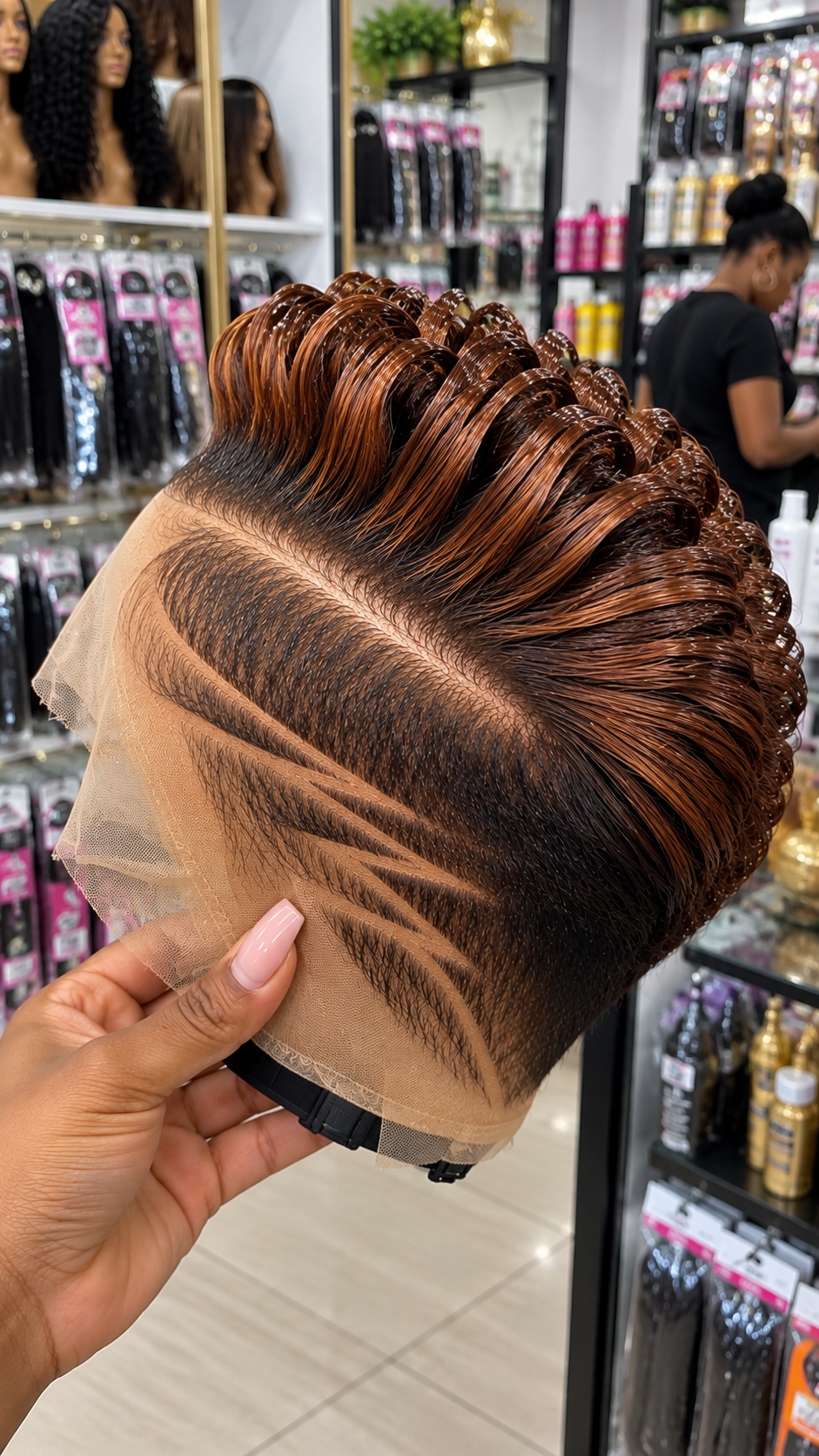
The most interesting aspect of this copper chestnut wig is how its side detailing changes the way the upper hairstyle is perceived. The raised curls are arranged in broad, backward-flowing ribbons, while the closely arranged lower hair is interrupted by several sweeping separation channels. Together, these elements create a sculptural pixie design in which the color, hair direction, and side geometry work as one composition.
Photographed inside a beauty supply store, the wig is held in one hand with the tan lace extending beyond the styled perimeter. The viewing angle provides a particularly useful look at the relationship between the copper-brown upper hair, the darker side section, and the curved channels that separate the lower strands. A portion of black adjustment hardware is also visible beneath the lace near the lower edge.
Unlike a conventional curly pixie, this hairstyle does not rely on small ringlets distributed evenly across the head. Its upper section consists of elongated, polished ribbon loops that rise from the front and travel backward. Beneath them, the hair becomes progressively closer to the foundation, with decorative channels creating a layered side pattern.


For buyers considering a similar wig, the challenge is finding a product that reproduces the directional styling rather than merely matching the copper color. A wig with the same shade but loose curls, straight side partings, or an oversized crown would produce a noticeably different result.
The Copper Color Is Concentrated Where the Hair Moves
The visible upper hair appears predominantly warm copper chestnut, with auburn and reddish-brown reflections following the curved surfaces of the ribbon loops. Some strands look brighter and more copper-toned under the shop lighting, while the recessed areas appear deeper brown.
The lower side section is considerably darker, approaching espresso brown in several areas. This contrast makes the raised upper hairstyle appear more prominent without introducing a completely separate blonde or brightly colored section.
The photograph suggests a relationship between the warm upper color and the darker foundation, but it does not establish a precise root-color formula. Some of the darker appearance may result from hair density, strand direction, and shadow.
For purchasing purposes, describe the shade as copper chestnut or warm auburn brown rather than assuming a specific commercial color code. Different suppliers may use these names for substantially different tones.
A daylight photograph is especially valuable because copper shades can appear more orange, red, or brown depending on the surrounding lighting. The warm interior illumination in the reference may emphasize the reddish reflections.
Choosing Between Auburn and Copper Chestnut
Auburn generally suggests a reddish-brown appearance, while copper chestnut emphasizes a warmer brown base with copper reflections. The photographed wig sits visually between these descriptions, making both useful when searching for comparable products.
However, shoppers should avoid relying exclusively on color names. Request an actual product photograph or a material swatch whenever possible.
For a custom commission, the stylist should understand that the upper loops carry the most visible copper reflections, while the lower side appears darker. A uniformly bright copper wig would alter the balance between the upper and lower sections.
If coloring is required, confirm the material composition first. Synthetic fibers and human hair have different processing limitations, and the photograph does not establish which material was used.
Reading the Side Design as a Series of Hair Sections
The side arrangement is unusually detailed. A broad, curved separation channel sits beneath the raised upper hair, establishing the boundary between the crown and the closely directed side strands.
Below it, another prominent channel travels across the side, following a similar sweeping direction before curving downward. A further narrow curved separation is visible toward the lower portion, creating a layered pattern that extends toward the front perimeter.
These channels are not perfectly straight or evenly spaced. Their changing curvature is part of the design. The upper separation is relatively broad and follows the lifted hairstyle, while the lower channels become more decorative as they approach the front side.
The darker hair between the channels is arranged in compact bands. Fine strands follow the direction of each section, producing a closely controlled appearance that contrasts with the elevated loops above.
Because this is a wig displayed before installation, the channels should not automatically be described as shaved lines on a natural scalp. The visible effect comes from exposed separation areas within the styled hair, although the exact construction technique cannot be confirmed from the photograph.
Why the Curved Geometry Should Not Be Simplified
A common mistake when recreating this type of hairstyle is replacing the curved channels with ordinary parallel straight lines. That would remove the flowing relationship between the side design and the backward movement of the upper hair.
The channels should follow the contour of the head and maintain their changing direction. Their spacing should also preserve the narrow bands of darker hair between them.
For custom work, ask the stylist to establish the side geometry before completing the upper styling. The channels influence where the surrounding hair must travel, so treating them as a final decorative addition may produce a less accurate result.
A direct side photograph would help confirm the complete path of the lower curves. The current image reveals the visible arrangement clearly but does not establish how the design continues around the opposite side or rear.
Broad Ribbon Loops Give the Crown Its Height
The upper section contains elongated, rounded curls that rise from the front and sweep backward. Several loops have large openings, while others overlap closely to create a continuous elevated ridge.
The hair is arranged in relatively broad sections rather than numerous tiny coils. This gives the curls a ribbon-like appearance, with polished strands traveling together along each curved surface.
The front loops are especially prominent because they lift away from the hairline before bending toward the crown. Farther back, the curls become more closely grouped, creating a compact continuation of the hairstyle.
The copper reflections emphasize the direction of these loops. Light travels along their curved surfaces, making the upper arrangement appear layered and dimensional.
The crown has noticeable height, but the volume remains concentrated above the side channels. The lower hair stays close to the foundation, preventing the entire wig from appearing excessively full.
Maintaining the Difference Between Loops and Ordinary Curls
When ordering this design, request sculpted ribbon loops with a backward direction rather than generic curly hair. The distinction matters because loose curls may fall in several directions and obscure the structured silhouette.
The stylist should preserve recognizable openings between the upper loops. If the curls become too tightly packed, the individual shapes may disappear. If they become excessively large, the crown may appear disproportionate to the lower side.
Ask for photographs from the front, side, and three-quarter angle before approving a custom order. These views can help establish whether the loops remain balanced across the visible crown.
The photograph does not reveal the complete rear styling, so a rear view should be requested before assuming that the same arrangement continues uniformly around the back.
The Darker Side Creates a Controlled Transition
Beneath the upper separation, the hair becomes considerably closer to the wig foundation. The strands appear predominantly dark brown, with some warmer reflections near the boundary between the upper and lower sections.
The close arrangement gives the side a tapered visual effect. However, the image does not prove that the hair was created using a conventional barber fade or a particular cutting technique.
The side contains fine strands directed along the curved sections, and the density appears to vary toward the lower perimeter. This contributes to the impression of a compact, head-following shape.
For a buyer, the most important detail is the relationship between the darker side and the raised copper loops. If the lower hair is made too bulky, the contrast between the sections may disappear.
Ask the seller for a close-up of the side under neutral lighting. This can help determine whether the darker appearance comes from an intentional color difference or primarily from the way the strands are arranged.
Visible Lace and Adjustment Hardware
The wig is shown before installation, with a substantial section of tan mesh extending beyond the styled front and side. The lace is especially visible around the lower perimeter, where it hangs beneath the closely arranged hair.
Unlike photographs that conceal the entire underside, this image also shows part of a black adjustment component near the lower edge. The visible hardware suggests that some form of cap adjustment may be present, although the complete mechanism cannot be established from this angle.
The photograph does not reveal the full interior construction. It therefore cannot confirm the number of attachment combs, the complete strap arrangement, or the cap’s precise dimensions.
The lace should not be classified as HD lace based on appearance alone. Its grade, transparency, softness, and suitability for a particular skin tone require additional product information.
Measurements Worth Confirming Before Purchase
Ask the supplier for the cap circumference, front-to-nape length, and ear-to-ear measurements. These dimensions help determine whether the wig can sit comfortably without excessive tension.
Request a complete underside photograph showing the adjustment hardware and any additional attachment points. This will clarify how the wig is intended to be secured.
The lace dimensions are also important because the curved side design extends close to the visible perimeter. A poorly positioned cap could shift the channels away from their intended location.
Finally, confirm whether the wig arrives with the lace untrimmed, as shown, and whether professional preparation is included in the purchase.
Finding a Seller Who Can Reproduce the Copper Ribbon Arrangement
Ready-made copper pixie wigs are available in many styles, but the combination of broad backward loops and layered curved side channels is more specific than a general product category.
When browsing online stores, examine the actual product photographs rather than relying solely on descriptions such as auburn curly pixie or copper lace wig. Those terms may lead to products with completely different curl arrangements.
A suitable ready-made piece should already display the curved side geometry and elevated upper styling. If those elements are absent, substantial customization may be required.
For a custom order, look for a wig maker experienced in sculpted pixie hairstyles, precision parting, and directional curl construction. Experience with warm brown color placement may also be useful.
Send the reference photograph and explain that the side channels must retain their curved paths, while the upper loops should rise and travel backward in broad sections.
Before paying a deposit, confirm the material composition, cap specifications, color options, production schedule, customization limitations, shipping arrangements, and return conditions.
Planning a Fitting Around the Side Pattern
The fitting process should begin with an inspection of the delivered wig. Check whether the copper loops have retained their shape during transportation and whether the side channels remain clearly separated.
The stylist should position the wig on the intended wearer and assess how the curved channels align with the temple and side of the head.
Because the lower design extends close to the lace perimeter, the placement of the cap can influence the final appearance. The stylist should establish the correct position before making permanent adjustments.
If lace trimming is required, it should take place only after the fit has been confirmed. Removing too much lace can compromise the hairline and may be impossible to reverse.
Any additional styling should preserve the backward movement of the upper loops. The copper strands should remain arranged in broad arcs rather than being separated into loose curls.
The attachment method should be selected according to the actual cap construction and the wearer’s needs. Visible adjustment hardware does not, by itself, prove that the wig can be worn securely without adhesive.
After installation, examine the hairstyle from several angles. The upper loops should retain their elevated profile, while the darker side channels should remain recognizable without appearing unnaturally wide.
Illustrative Budget for a Copper Chestnut Sculpted Pixie
The cost of recreating this hairstyle may be influenced by the warm copper color, the broad ribbon-loop construction, the detailed curved side geometry, and the lace preparation required for installation.
The following USD ranges are illustrative planning estimates, not verified live selling prices or quotations for the photographed wig. Its actual fiber composition remains unconfirmed.
| Wig Category | Illustrative USD Range | Possible Cost Considerations |
|---|---|---|
| Premium Custom | $400–$950+ | Individual cap fitting, specialist ribbon-loop construction, intricate curved side separation, and advanced color customization. |
| Standard Custom | $210–$470 | Selected cap options, copper chestnut color matching, customized crown shaping, and side-channel adjustments. |
| Basic Human Hair | $115–$300 | Human-hair base unit that may require separate coloring, loop setting, precision parting, and lace preparation. |
| Premium Synthetic | $75–$200 | Higher-grade synthetic alternatives with prearranged curls and material-dependent styling flexibility. |
| Basic Synthetic | $30–$95 | Budget alternatives that may differ in copper color accuracy, loop construction, side detailing, and cap quality. |
These categories represent possible purchasing routes rather than confirmed classifications of the pictured product. Actual prices vary by supplier, location, materials, workmanship, and included services.
The curved side geometry may increase labor costs because the stylist must maintain several distinct hair sections while preserving their flowing arrangement.
Color processing may also affect the quotation if the desired copper chestnut shade is not available in the chosen base material.
Ask whether the advertised price includes the finished styling, lace preparation, fitting appointment, installation, and shipping. A less expensive base wig may require additional work that increases the final cost.
Care Should Focus on the Relationship Between Color and Shape
The upper loops are vulnerable to disturbance because their appearance depends on the placement of broad, curved hair sections. Repeated brushing or aggressive finger separation can change their direction and reduce the sculpted effect.
Ask the supplier how the loops were formed and whether they can be safely repositioned. Some constructions may tolerate gentle adjustments, while others may require professional resetting.
The side channels need different attention. Hair crossing the exposed areas can reduce the visibility of the curved pattern, so maintenance should preserve the direction of the closely arranged strands.
Cleaning instructions must follow the verified fiber composition. Synthetic hair should not be exposed to heat unless the manufacturer confirms its suitability. Human hair may permit different styling methods, but previous coloring and chemical processing should be considered.
Copper and auburn shades can change in appearance over time depending on the material, coloring method, cleaning products, and exposure conditions. Use products recommended for the actual wig rather than assuming that every copper-colored unit requires the same treatment.
During storage, avoid compressing the raised loops or placing tension on the lace. A suitable support can help maintain the general silhouette while protecting the detailed side arrangement.
If the loops lose their shape or the curved channels become difficult to maintain, a professional restyling appointment may be preferable to extensive home adjustments.
Recognizing a Faithful Reproduction Before Committing
A convincing version of this wig should preserve the warm copper chestnut upper color, the broad backward-flowing ribbon loops, the darker compact side, and the layered curved separation channels.
The hairstyle’s identity depends on the relationship between these elements. Changing the channels into straight lines, enlarging the crown excessively, or making the entire wig uniformly bright copper would produce a different design.
Before completing a purchase, request multiple viewing angles, confirm the cap and material specifications, and determine whether the seller can reproduce the side geometry accurately.
The most useful investment is a wig that combines visual accuracy with a comfortable fit and realistic maintenance requirements. When the construction is carefully evaluated, this copper chestnut design can retain its distinctive sculpted appearance without relying on unsupported claims about materials or manufacturing methods.
Search Terms
Copper chestnut ribbon loop pixie wig · Auburn brown layered curved side wig · Dark espresso side with copper crown · Swept back copper barrel curl hairpiece · Tan lace wig with black adjustment hardware · Copper pixie with multiple curved channels · Reddish brown sculpted loop crown wig · Chestnut lace hairpiece with tapered side sections