
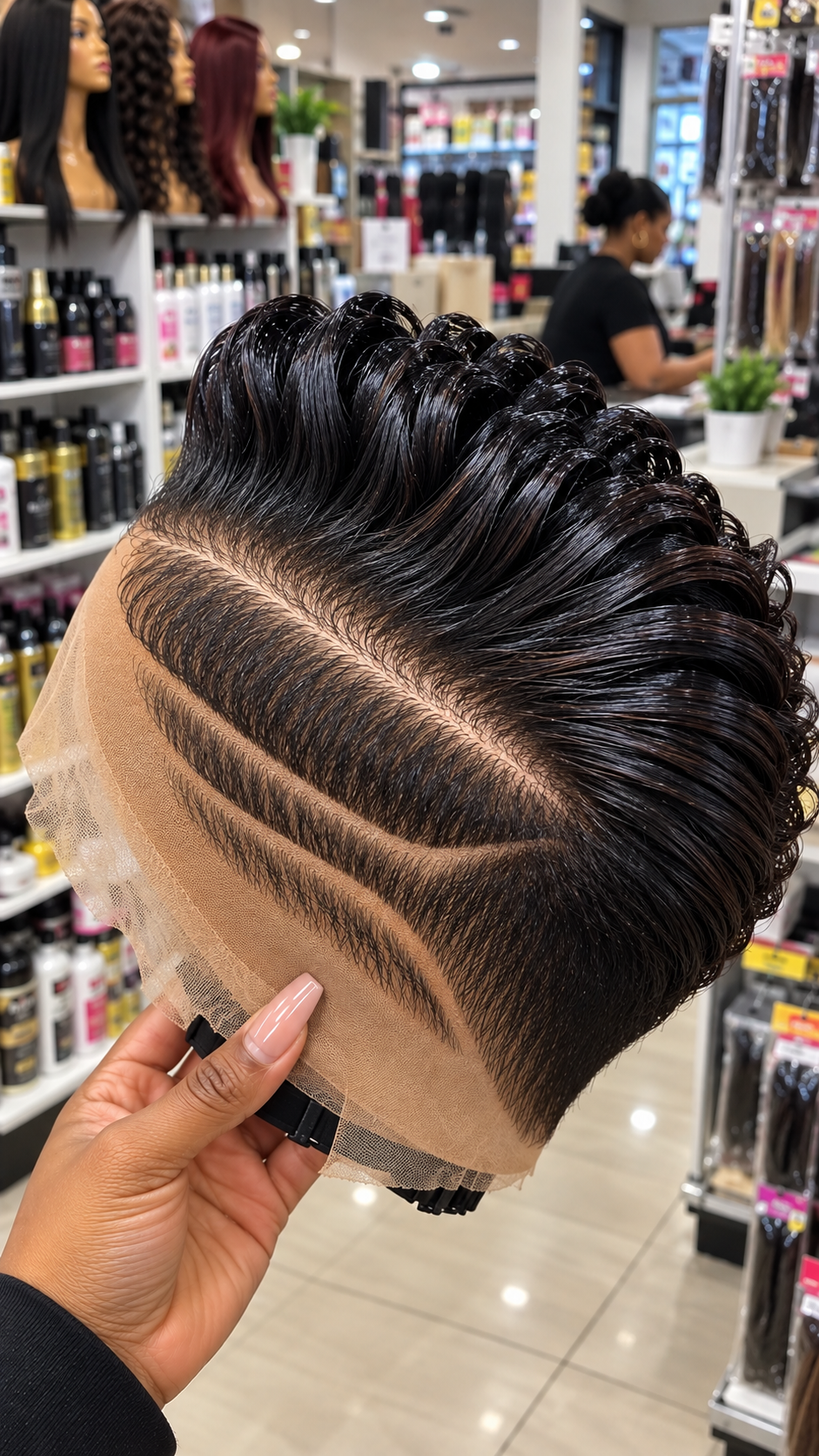
The most important decision when buying this particular wig is not which shade of black to choose. It is whether the maker can preserve the unusual relationship between the elevated, backward-directed ribbons and the two sweeping channels beneath them. In the photograph, these elements create a hairstyle that looks dramatically different from an ordinary curly pixie, even though its color remains predominantly dark.
Displayed in a busy wig retail shop, the unit is supported by one hand with its untrimmed lace facing the camera. The upper hair rises into a series of elongated loops that travel backward from the front. Beneath them, a closely arranged side panel contains two long, curved divisions, separated by a narrow band of dark hair. The lower portion follows the same general direction before tapering toward the visible side edge.
The image is especially useful for evaluating construction because the wig has not yet been installed. The lace, front hair placement, part of the interior fastening hardware, and the relationship between the upper and lower sections can all be examined. It also reveals something that conventional promotional photographs often conceal: a hairstyle with impressive upper volume still needs careful control of the lower hair to maintain its intended proportions.


The Crescent-Shaped Divisions Establish the Design’s Identity
Two elongated, pale channels curve across the visible side of the wig. They begin near the front hairline area and sweep backward, following a similar arc. The upper channel separates the raised ribbon section from a closely arranged strip of dark hair, while the lower channel creates another division beneath that strip.
The channels are not perfectly straight. Their direction changes gradually, producing a crescent-like appearance that follows the rounded contour of the wig. The middle band becomes particularly noticeable because the dark strands within it contrast with the lighter divisions above and below.
Unlike angular barber artwork, the pattern does not contain obvious triangular intersections or sharp zigzag turns. Its visual impact comes from the continuous curves and the carefully controlled distance between them.
The lower channel appears slightly narrower along portions of its length, while the upper division is more prominent near the front. Fine strands remain visible at the boundaries, making the design appear integrated into the hair rather than painted onto the surface.
The photograph cannot establish exactly how these divisions were produced. They resemble precision parting or carved channels, but the underlying method should be confirmed by the wig maker before any customer requests alterations.
Why Channel Width Matters More Than Adding Extra Lines
Adding a third decorative line might sound like an improvement, but it would change the character of this wig. The photographed design relies on two principal curved divisions with a dark strip between them. Their relative spacing gives the lower section a controlled, deliberate appearance.
If the channels are placed too close together, the central hair band may lose its visual presence. If they are spaced too far apart, the side can appear disproportionately broad compared with the upper loops.
Customers commissioning a reproduction should therefore request the same two-channel arrangement rather than asking for additional decorative artwork. A clear side photograph should be included in the order instructions, with the desired curve direction identified.
The opposite side is not sufficiently visible to confirm whether it carries the same pattern. A buyer seeking identical artwork on both sides must request that specifically.
The Upper Hair Moves Backward in Broad, Elevated Sections
The crown is dominated by a sequence of raised ribbon-like curls. Near the visible front, several broad sections rise upward before bending toward the rear. Their shape resembles elongated arches rather than small circular spring coils.
As the hair progresses backward, the ribbons overlap more closely and become increasingly compact. The visible rear edge contains tighter curved sections, giving the upper hairstyle a gradual transition from taller front loops to a denser rear arrangement.
This directional progression is one of the most distinctive aspects of the design. The hair does not fall forward over the forehead, nor does it spread outward equally in every direction. Instead, the strands appear guided backward in organized groups.
Individual ribbons show fine strand separation along their reflective surfaces. Dark openings remain visible between several loops, preventing the upper area from becoming a solid block of hair.
The overall height is noticeable without appearing excessively tall. Much of the apparent fullness comes from the curvature of the ribbons rather than from loose, expanded curls.
A Styling Request That Needs More Than the Word Curly
Describing this wig simply as a black curly pixie would leave too much room for interpretation. A supplier might provide a wig with compact ringlets, loose waves, or a rounded natural-curl crown, none of which would reproduce the visible ribbon arrangement.
A more accurate request would specify broad, elevated, backward-directed hair ribbons with overlapping arches and a compact rear transition.
The stylist should also understand that the upper ribbons must remain separate from the two curved side channels. If the upper hair is allowed to fall downward, it may conceal the very design that distinguishes this wig.
During production, a side photograph taken at approximately eye level can help establish whether the ribbon height and direction match the reference. A photograph from slightly above can reveal gaps or irregularities that are difficult to identify from the side alone.
Why This Black Appears Rich Without Contrasting Highlights
The visible hair is predominantly raven black, with subtle brownish reflections appearing along some raised strands. These warmer areas are restrained and may be influenced by the shop lighting. They do not form an obvious separate highlight pattern.
The broad ribbons reflect overhead light in elongated bands, while the closely arranged lower hair produces narrower reflections. This creates visual variety within a largely single-color hairstyle.
It would be misleading to describe the wig as containing pronounced caramel, copper, or blonde highlights. The photograph primarily shows dark hair with reflective variation.
When ordering, customers should ask for a deep black shade and confirm whether any warmer strands are intentionally incorporated. A daylight photograph is useful because bright indoor lighting can make black hair appear brown along its most reflective surfaces.
The glossy appearance also should not be confused with a guarantee of premium human hair. Synthetic fibers, human hair, styling products, and lighting can all influence how reflective a wig appears in a photograph.
For a close visual match, the more important considerations are the direction of the strands and the separation between the ribbons. These characteristics create the hairstyle’s distinctive reflective pattern.
The Visible Lace Creates Both Opportunity and Responsibility
The wig has a broad beige-brown lace extension along the front and visible side. Its fine mesh extends beyond the hairline, allowing the unit to be fitted and trimmed according to the wearer’s needs.
Because the side channels begin close to the front hairline, lace preparation requires particular attention. The stylist must establish the intended position of the wig before removing excess material.
The photograph shows fine hairs emerging near the lace boundary, including the lower side section. Their placement helps create a gradual transition from the mesh into the closely arranged hair.
However, the image does not verify a particular lace grade, ventilation method, or level of transparency. The lace should not automatically be identified as HD lace merely because the mesh appears fine.
Its suitability for an individual wearer will depend on cap measurements, lace color, hairline placement, and the chosen installation method.
A buyer should request the exact lace specifications from the seller and ask whether the unit is supplied with sufficient untrimmed material for professional fitting.
Fastening Hardware Visible Beneath the Front Edge
Near the lower edge of the photograph, dark fastening components are visible beneath the lace. These include what appears to be part of an adjustable strap or buckle arrangement, along with additional dark cap material.
The image does not provide a complete underside view, so the entire attachment system cannot be identified confidently. It would be inappropriate to assume the presence of additional combs, clips, or specific cap technologies that are not clearly shown.
Nevertheless, the visible hardware is a useful reminder that cap construction deserves as much attention as the outer styling.
Before purchasing, ask for an underside photograph showing the full perimeter, adjustment components, and any securing attachments included with the actual unit.
Head circumference, front-to-nape distance, and ear-to-ear measurements should be discussed with the seller. The double-channel design must align with the wearer’s temple area, and incorrect sizing can shift the pattern away from its intended position.
Although adjustment hardware is visible, this alone does not establish that the wig can be worn securely without adhesive. The manufacturer or installer should confirm the appropriate method.
Making a Custom Order Around the Side Profile
For this hairstyle, the side profile should be the principal approval image during production. A conventional frontal photograph may show the upper ribbons but fail to demonstrate the full length of the two curved channels.
Begin by sending the reference to a custom wig maker experienced in sculpted pixie styles. Explain that the side artwork and backward-directed ribbon arrangement are equally important.
Next, confirm the proposed cap measurements, hair material, lace specification, and whether the maker can reproduce the visible pattern using a suitable construction method.
Ask for a preliminary photograph showing the lower hair arrangement before the upper ribbons are fully completed. This provides an opportunity to inspect the curve direction and spacing without the crown obscuring the design.
Once the upper styling is finished, request another photograph from the same angle as the reference. The ribbons should rise above the curved channels without covering them.
A final rotating video can help evaluate the transition from the front to the visible rear. Since the photograph does not reveal the complete back, customers should avoid assuming that the rear styling follows an identical pattern.
Finding the Right Professional
Search for wig stylists specializing in custom pixie units, directional ribbon curls, precision side designs, and lace-front customization.
A professional familiar with barber-inspired hair artwork may also be helpful, provided they understand the limitations of wig construction. Not every cap or hair-density arrangement can safely accommodate additional cutting.
When reviewing a salon portfolio, prioritize examples of closely arranged side hair and elevated sculpted curls. Experience with ordinary loose curly wigs does not necessarily demonstrate the skills required for this design.
Customers buying online should request photographs of the actual finished unit rather than relying entirely on promotional images. They should also confirm whether alterations are included, how long production may take, and what return conditions apply.
Preparing for Installation Without Distorting the Curves
The installation appointment should begin with an inspection of the delivered wig. Check the ribbon arrangement, the continuity of both side channels, the condition of the lace, and the visible fastening hardware.
The stylist should then position the unit on the wearer’s head and assess how the curved channels align with the temple and side of the face.
Only after the position is established should the lace be prepared for trimming. Removing too much material near the decorative side could alter the intended transition between the hairline and the channels.
The securing method should be selected according to the confirmed cap construction and the wearer’s needs. Adhesive, adjustable attachments, or other suitable methods may be considered where appropriate.
During fitting, the upper ribbons should be handled carefully. Pressing them flat or pulling them forward can change the hairstyle’s silhouette.
If minor corrections are needed, they should be performed using techniques compatible with the actual fiber. The photograph does not establish whether the wig is human hair, synthetic, or a blend.
Illustrative Cost Comparison for Sculpted Black Pixie Units
Although this design does not rely on elaborate coloring, the controlled ribbon arrangement and precision side channels may involve considerable styling labor. The following USD ranges are illustrative planning estimates, not verified live prices or quotations for the photographed wig.
| Wig Category | Illustrative USD Budget | Possible Scope of Purchase |
|---|---|---|
| Premium Custom | $300–$690+ | Individual sizing, advanced backward ribbon styling, carefully positioned double curved channels, and personalized lace preparation. |
| Standard Custom | $160–$345 | Custom black pixie construction with raised ribbon curls and professionally arranged side divisions. |
| Basic Human Hair | $95–$235 | A human-hair pixie base that may require additional shaping, curl setting, and precision side work. |
| Premium Synthetic | $65–$175 | Higher-priced synthetic options with arranged curls and possible decorative side styling, subject to product specifications. |
| Basic Synthetic | $25–$90 | Budget black pixie alternatives that may resemble the general silhouette without the detailed double-channel construction. |
The largest expense may come from arranging the upper ribbons and creating the lower design with consistent spacing. A simpler black curly wig may require substantially less labor.
Cap customization can also affect pricing. Individual measurements, specialized lace preparation, and adjustments to the temple area may increase the final quotation.
Ask whether the quoted amount includes installation, shipping, cap adjustments, and future restyling. These services may be charged separately.
The material categories in the table describe possible purchasing options. They should not be interpreted as confirmed characteristics of the displayed wig.
Maintaining the Backward Ribbon Arrangement
The upper curls are arranged into elongated arches that depend on controlled strand direction. Repeated brushing, compression, or aggressive handling can disturb their shape.
Before washing, obtain the maker’s instructions for the confirmed material. Human hair and synthetic fibers may require different products, temperatures, and setting methods.
If the wig is made from human hair, the stylist should explain how the ribbons were formed and whether they can be reset after washing. If the wig is synthetic, heat compatibility must be verified before using heated tools.
Excessive styling products may cause neighboring strands to cling together, reducing the separation between the arches. Use only products recommended for the actual fiber and styling method.
During storage, support the cap on a suitable stand without pressing the upper ribbons against a shelf or container. For transportation, protective packaging should provide enough space to prevent the raised curls from being crushed.
Preventing the Side Channels From Losing Clarity
The two curved divisions are vulnerable to careless manipulation because their appearance depends on the placement of the surrounding dark strands.
Avoid brushing directly across the channels in a way that moves hair into the exposed areas. If the design becomes less visible, consult a stylist familiar with the original construction.
Do not attempt to deepen the channels with clippers or a razor without professional assessment. Depending on how the wig was made, additional cutting could expose cap material or permanently damage the design.
The lace near the front should also be handled gently during removal and cleaning. Pulling directly on the hairline can place unnecessary stress on the mesh and attached strands.
Who Will Appreciate This Particular Hair Arrangement?
This wig is well suited to someone who wants a striking pixie silhouette without relying on bright coloring. Its appeal comes from the precision of the side artwork and the height of the backward-directed curls.
The predominantly raven-black color allows the styling details to remain the main attraction. The double crescent channels provide a recognizable side profile, while the elevated ribbons create movement and fullness above them.
It is also a hairstyle that benefits from professional preparation. Customers who prefer minimal maintenance should ask how frequently the ribbons may require resetting and whether the side channels need occasional attention.
The best purchase will be one that preserves the photographed proportions rather than merely copying the general idea of a black curly pixie. Accurate cap measurements, careful channel placement, and controlled upper styling are essential to achieving a convincing result.
For buyers willing to invest in detailed customization, this design offers a distinctive combination of sculptural curls and understated geometric precision. Its strength lies in the careful arrangement of dark hair, proving that an elaborate hairstyle does not need dramatic color contrasts to make a memorable impression.
Search Terms
Raven black swept back ribbon pixie wig · Double crescent side channel lace wig · Black elongated arch curl crown · Beige lace two curved parting wig · Glossy black backward ribbon hairstyle · Dark pixie with twin sweeping side divisions · Black sculpted loop wig adjustable hardware · Untrimmed lace curved side panel pixie