
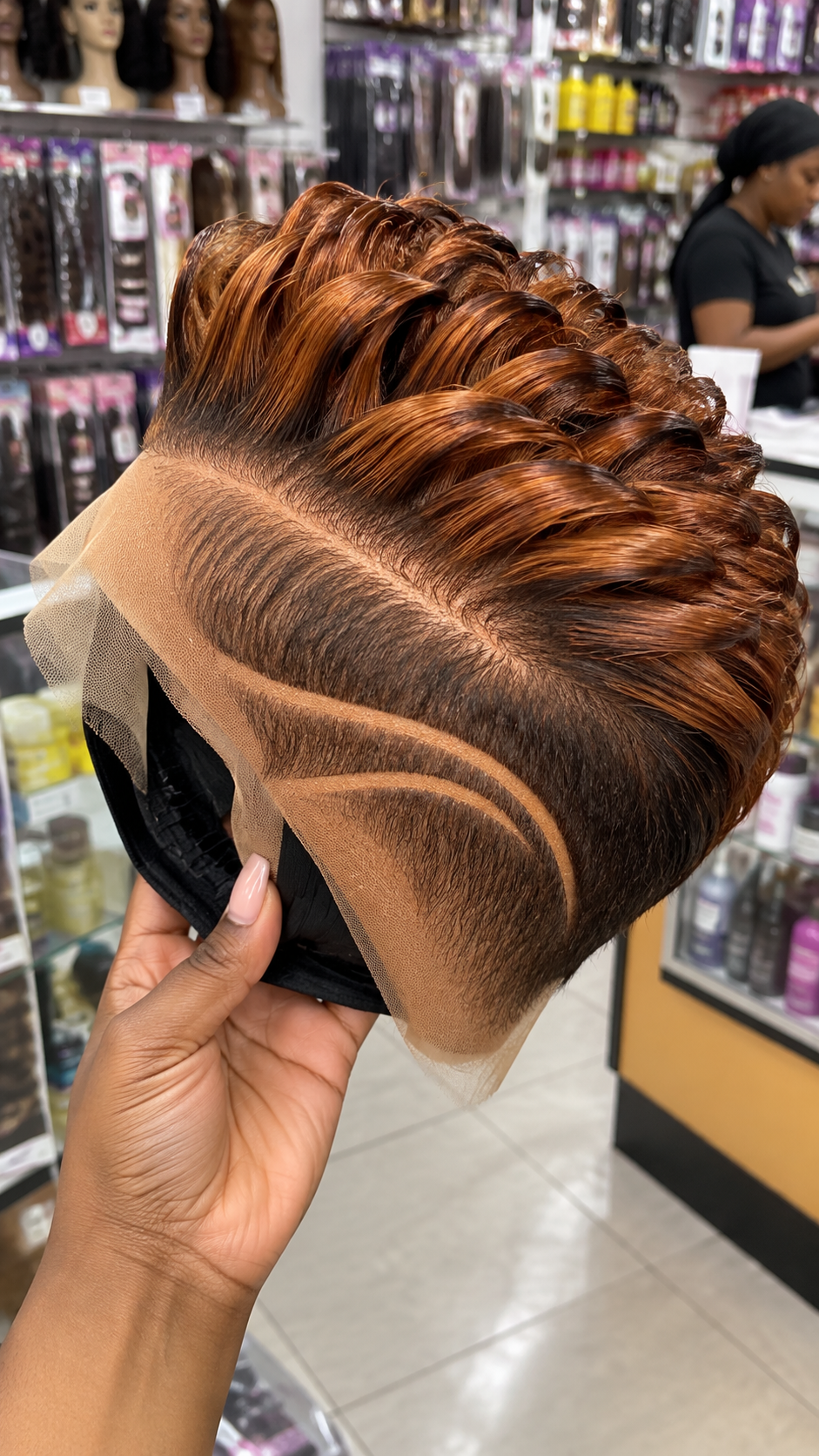
There is a particular challenge when buying a sculpted pixie wig: a product can have the correct color, approximate length, and even a similar side pattern while still looking completely different from the reference. This copper auburn hairstyle demonstrates why. Its personality comes from broad, overlapping ribbon waves that travel backward across the crown, supported by dark roots and a closely arranged temple section decorated with two sweeping curved lines.
The photograph shows the wig being held inside a beauty supply store before installation. A generous section of beige lace extends beyond the hairline, and part of the black interior cap is exposed. This allows buyers to examine the relationship between the ornamental hair, the side design, and the frontal construction before the wig is fitted.
The upper hair displays a rich copper-brown color with auburn reflections, while the roots and lower side remain considerably darker. Unlike a crown composed of small circular ringlets, this hairstyle uses wider, elongated hair sections folded into overlapping arches. The result is a directional arrangement that draws attention from the front toward the rear-visible portion of the head.


For customers interested in copper pixie lace wigs, the most important purchasing question is not simply whether a seller offers the correct shade. It is whether the maker can reproduce the layered crown, preserve the dark root transition, and position the two curved temple channels accurately.
Begin With the Shape of the Copper Hair
The upper section contains broad strands that rise from the dark foundation and bend backward into a sequence of overlapping waves. Each section has a relatively wide, glossy surface, allowing the copper color to remain highly visible across the crown.
The formations are not tightly coiled spirals or small circular rings. Instead, they resemble elongated ribbon folds, with strands passing over one another in a carefully organized direction.
Near the front, several sections rise steeply before bending backward. Farther along the crown, the hair forms wider, lower arches that overlap the sections behind them. This produces a gradual change in height rather than a uniform collection of identical curls.
The photographed side also reveals that the copper strands are grouped into distinct sections. Their boundaries remain visible, contributing to the sculpted appearance.
A stylist attempting to recreate the hairstyle should pay attention to the direction of each section. Simply curling all the hair backward may not reproduce the layered arrangement if the strands are not positioned in the correct sequence.
Why Broad Ribbon Waves Need Careful Spacing
The width of the individual waves is essential to the design. If the sections are too narrow, the crown may resemble a collection of small curls. If they are excessively wide, the overlapping structure could disappear.
The reference shows a combination of medium and broad ribbon formations, with some sections crossing visually over neighboring strands.
Customers should ask a wig maker to preserve the separation between these formations while maintaining a connected crown silhouette.
A photograph taken from the same side angle can help determine whether the completed styling resembles the reference. An additional overhead photograph may reveal how the sections are distributed across the crown.
The original setting technique cannot be established from the image. The maker should explain which styling methods and products are appropriate for the selected material.
The Copper Auburn Shade Is Concentrated Above a Dark Foundation
The color arrangement is a major part of the hairstyle’s appearance. The upper strands display a warm copper auburn tone with reddish-brown and golden-copper reflections. The color appears particularly vivid where light strikes the curved surfaces.
Near the roots, the hair becomes substantially darker. The foundation appears deep brown to nearly black, creating a strong contrast with the copper lengths.
This transition is visible across the front of the crown and along the boundary between the upper styling and the temple section.
The side hair remains predominantly dark brown, with subtle warm reflections near some of the longer strands. The lighter copper color is concentrated primarily in the elevated upper arrangement.
There is no clear evidence of blonde, burgundy-purple, or silver coloring. Buyers seeking a faithful reproduction should avoid introducing unrelated highlight shades.
Distinguishing Copper Auburn From Bright Orange
Copper hair colors vary considerably between suppliers. Some lean toward bright orange, while others contain deeper reddish-brown tones.
In this photograph, the upper hair appears closer to rich copper auburn than a vivid orange shade. The brown component gives the color depth, while the copper reflections become more noticeable under the store lighting.
Customers should request photographs under daylight and neutral indoor illumination before approving a custom color.
It is also useful to compare the proposed copper shade with the intended dark root color. The relationship between these two tones influences how prominently the sculpted waves stand out.
A uniform copper color extending from the roots may create a substantially different appearance from the reference.
Two Curved Side Lines Give the Temple Its Identity
The lower side contains a closely arranged dark hair panel with two prominent curved channels. These lines sweep backward and downward, creating a decorative pattern beneath the copper crown.
The upper channel begins near the frontal side and follows a broad curve toward the rear-visible section. A second, narrower channel runs beneath it, following a related direction before tapering toward the lower side.
The spacing between the two curves creates a distinct band of dark hair. This arrangement gives the temple a layered appearance without requiring numerous additional decorative marks.
The exposed channels appear scalp-toned, but the photograph does not establish how they were constructed within the wig.
They should not automatically be described as razor cuts made into natural hair. The image shows a removable hairpiece, and the exact technique used to create the separations requires confirmation from the maker.
Preserving the Dark Hair Between the Curves
The band of hair separating the two channels is important because it provides visual weight between the exposed lines.
If this area becomes too narrow, the curves may appear crowded. If it becomes excessively wide, the decorative pattern may lose its relationship with the upper crown.
A custom order should therefore specify not only the number of curved lines but also their approximate placement and spacing.
Ask the stylist to use the reference photograph rather than relying on a generic description such as double-line pixie.
Additional carved details should not be introduced unless the customer specifically requests a different design.
How the Side Panel Supports the Crown
The temple hair is arranged close to the underlying surface, creating a relatively compact appearance beneath the fuller copper sections.
Fine dark strands are visible throughout the side panel, and the lower area tapers toward the edge of the wig. This restrained volume prevents the side from competing with the ornamental crown.
The dark section also creates a visual foundation for the copper waves. Because the upper hair is brighter and more elevated, the eye naturally follows its movement across the head.
For customers considering this hairstyle, maintaining the balance between crown height and side density is important.
A wig with excessively thick temple hair may obscure the curved channels. A unit with too little hair could expose unwanted construction details.
The correct result depends on suitable density and precise strand placement rather than simply removing as much side hair as possible.
The Frontal Lace Remains Untrimmed
A large section of beige lace extends beyond the styled frontal hairline. The mesh is particularly visible toward the left side of the photograph, where it hangs away from the wig.
The frontal area contains fine dark strands positioned near the lace boundary. These strands contribute to the intended hairline appearance, although the photograph does not establish the exact ventilation method.
The lace has not yet been shaped to match an individual wearer’s forehead and temples.
This is an important purchasing consideration because the appearance of the frontal area may change after professional fitting and trimming.
The photograph does not provide reliable evidence that the material is HD lace. The seller should confirm the lace grade, dimensions, and available color options.
Similarly, the presence of lace does not establish that the wig is designed for adhesive-free installation.
Planning the Hairline Before Any Cutting
A professional installer should begin by positioning the wig on the wearer’s head and checking the relationship between the frontal hairline and the curved temple channels.
The lace should be evaluated against the wearer’s complexion, preferably under lighting that reveals whether the mesh is visually compatible with the skin.
Only after confirming the position should the installer determine how much excess lace needs to be removed.
Trimming too aggressively can compromise the frontal edge. Because the temple pattern sits relatively close to the hairline, an incorrect cut may also affect the visual balance of the side.
Customers should request a close-up photograph of the lace lying flat before purchase, particularly when ordering from an unfamiliar supplier.
What Can Be Seen Inside the Wig?
The photograph reveals part of a black interior cap beneath the loose lace. Dark fabric and structural sections are visible where the holder supports the wig.
However, the complete underside is not shown. The image does not establish the cap circumference, full attachment arrangement, or number of interior combs.
Buyers should request a separate photograph showing the wig turned inside out.
This allows the seller to demonstrate any adjustable straps, combs, elastic components, and other attachment-related hardware.
Accurate cap measurements are especially important for a hairstyle with prominent side detailing. If the wig shifts forward or backward, the curved channels may no longer sit in their intended position.
Comfort and secure positioning should be assessed before any permanent alterations are made.
Ordering the Right Version From a Wig Specialist
Customers searching for this design should look beyond generic copper curly wig listings. Many products may share the same color while having entirely different crown styling.
Custom wig makers, specialist lace wig salons, and independent hairpiece studios may offer suitable services.
When evaluating a potential supplier, examine previous examples of sculpted pixie hairstyles, directional ribbon waves, and decorative temple arrangements.
A maker experienced only with ordinary curls may not necessarily be able to reproduce the broad overlapping sections shown in the photograph.
Send the reference image and explain that the desired hairstyle contains copper auburn ribbon waves, dark roots, a compact temple panel, and two sweeping curved side channels.
Ask the maker whether these elements can be reproduced using the proposed material and whether the completed styling is included in the quoted price.
Ready-Made Versus Custom Construction
A ready-made unit may be convenient if its color, crown arrangement, and side pattern already resemble the reference.
However, buyers should be cautious about purchasing an ordinary copper pixie with the expectation that it can easily be transformed into this design.
Creating broad ribbon waves and precise temple channels may require specialist work. The original hair density and cap construction could limit what is possible.
Custom production may provide more control over the position of the waves, the color transition, the side pattern, and the cap measurements.
Before commissioning a custom unit, confirm the expected completion time, payment terms, revision policy, and whether photographs will be provided before shipping.
Installation Should Follow the Existing Hair Arrangement
Once the wig arrives, inspect the crown and temple before attempting to alter the styling.
Compare the copper color placement, ribbon-wave direction, and curved channels with the approved reference photographs.
The installer should then evaluate the cap fit and position the frontal lace correctly.
Any necessary trimming should be performed conservatively, with attention to the nearby temple design.
The copper crown should not be brushed aggressively during fitting. Its overlapping sections may depend on a particular setting method, and unnecessary manipulation could disturb their arrangement.
If the side requires minor correction, consult a stylist experienced with decorative wig shaping. Excessive thinning or cutting may permanently change the appearance.
After installation, photographs from the front and visible side can help confirm that the crown remains proportional and both curved channels are clearly visible.
Estimated Purchase Costs for Copper Sculpted Pixie Wigs
The cost of this hairstyle may be influenced by the copper color processing, the labor required to arrange the broad ribbon waves, the temple detailing, and the lace construction.
The following USD figures are illustrative planning ranges. They are not verified current retail prices, confirmed supplier quotations, or prices for the photographed unit.
| Wig Category | Illustrative USD Range | Potential Purchasing Considerations |
|---|---|---|
| Premium Custom | $330–$740+ | Individually commissioned copper color placement, broad ribbon-wave styling, twin curved temple channels, and possible lace customization. |
| Standard Custom | $180–$380 | Personalized styling with selected adjustments to crown direction, side detailing, and dark root transition. |
| Basic Human Hair | $105–$250 | A possible human-hair foundation that may require separate coloring and specialist sculpted styling. |
| Premium Synthetic | $75–$180 | A potential pre-styled option when the manufacturer offers comparable copper waves and decorative temple channels. |
| Basic Synthetic | $30–$90 | Budget alternatives may resemble the general copper pixie silhouette without reproducing the detailed crown arrangement. |
These categories represent possible purchasing options rather than the confirmed composition of the photographed wig. The image does not establish whether the hair is human, synthetic, or blended.
Before accepting a quotation, confirm whether the price includes the finished styling, color work, lace preparation, and cap adjustments.
Professional installation, shipping, and future maintenance may be charged separately.
For this hairstyle, the quality of the ribbon-wave construction should be a major consideration. A less expensive base wig may ultimately require substantial additional work to achieve the intended appearance.
Protecting the Copper Waves During Regular Wear
The broad overlapping waves are vulnerable to unnecessary manipulation. Repeated brushing or pulling can disturb their direction and reduce the separation between individual sections.
Customers should obtain maintenance instructions from the original maker before attempting to restyle the crown.
The correct approach depends on the material and the method used to create the waves.
If the wig is synthetic, heat styling should only be attempted when the manufacturer confirms suitable temperature limits.
If it contains human hair, previous color processing may affect its response to further heat or chemical treatments.
The copper shade also requires appropriate care. Depending on the material and coloring method, unsuitable products or repeated processing may alter the appearance of the warmer sections.
Keeping the Twin Curves Visible
The temple pattern depends on the dark strands remaining closely arranged around the exposed channels.
Heavy product buildup or aggressive manipulation could interfere with the clarity of these lines.
Ask the stylist which products are appropriate for the side and whether the channels require periodic professional attention.
When storing the wig, avoid compressing the upper waves or stretching the frontal lace. Support the cap in a manner that preserves the overall silhouette.
If the crown begins losing its original shape, professional restyling may be preferable to attempting extensive corrections without knowing the original construction.
A Copper Pixie Design Worth Choosing for Its Precision
The appeal of this wig comes from the relationship between its rich copper auburn crown and the dark, closely arranged temple. The upper hair moves backward through broad overlapping ribbon waves, while two curved side channels create a decorative boundary beneath it.
The visible untrimmed lace also provides useful information for buyers considering professional installation.
To obtain a similar result, prioritize accurate wave placement, a deep root-to-copper transition, appropriate temple density, and careful cap fitting.
Request actual product photographs, confirm the fiber and lace specifications, and discuss any customization before placing an order.
The most successful reproduction will preserve the hairstyle’s original proportions without introducing excessive crown volume, unrelated highlight colors, or additional side patterns.
For customers who appreciate detailed sculpted pixie wigs, this copper auburn design offers a compelling example of how directional styling and carefully positioned decorative lines can create a distinctive, coordinated hairstyle.
Search Terms
Copper auburn ribbon wave pixie wig · Double curved temple line lace wig · Dark root copper swept crown hairpiece · Overlapping copper ribbon curl wig · Beige untrimmed frontal lace pixie · Auburn sculpted side channel hairstyle · Black tapered temple copper crown wig · Golden copper layered wave lace wig