
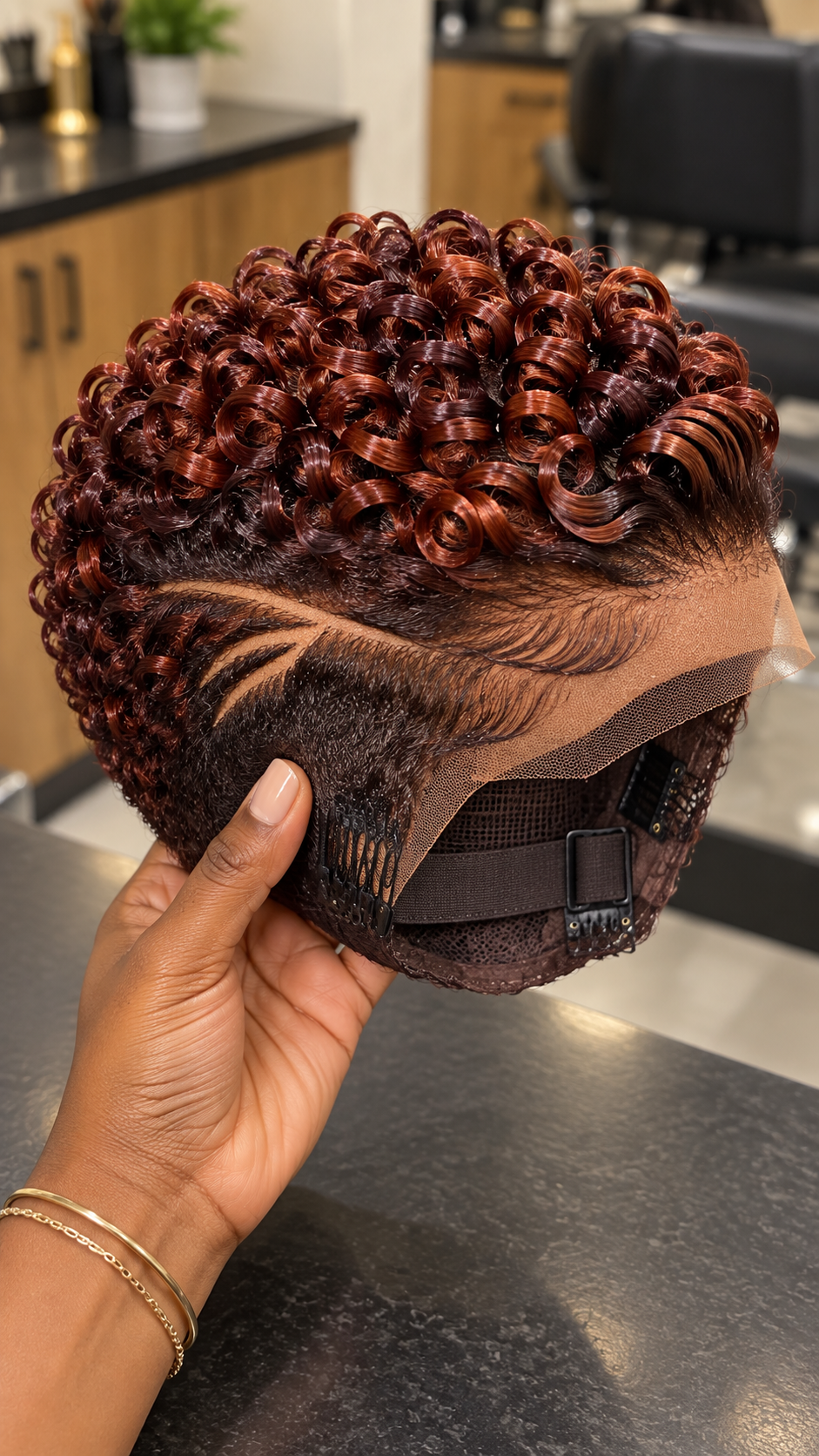
This burgundy-copper wig deserves to be read from the side inward rather than from the crown downward. The first detail that separates it from the previous spiral units is the temple architecture: beneath the dense curled crown, a sweeping side section opens into several narrow feather-like lines before returning to a compact dark lower panel. Above that geometry sits a field of glossy circular spirals in a rich reddish-brown palette, with brighter copper reflections appearing wherever the coils catch the light. The combination gives the wig two distinct personalities. From above it is a densely curled burgundy crown; from the side it becomes a precision-cut design with directional movement.
The photograph also reveals unusually useful construction information. The lace is still untrimmed, the interior cap is exposed, an adjustable elastic strap is clearly visible, and comb-style attachment pieces can be seen around the inner perimeter. These details make the image useful for someone evaluating the wig as an actual wearable product rather than merely admiring the hairstyle. Lace is visibly present, but its commercial grade cannot be established from appearance alone. There is no visual basis for calling it HD lace unless the maker confirms that specification.
The Burgundy-Copper Shade Changes With Every Coil
The crown does not read as one flat red. Its deepest areas move toward dark burgundy and reddish espresso, while raised surfaces catch brighter copper, cinnamon and auburn reflections. Because each spiral turns through several angles, one coil can display multiple intensities of the same warm color family.
This creates dimension without requiring obvious blonde highlights. The lighter appearance comes primarily from the exposed surfaces of the curled strands rather than from separate pale streaks.
For ordering purposes, a photograph is more reliable than a shade name. Burgundy, auburn, copper brown, mahogany and cinnamon can overlap substantially between suppliers. The important target here is a deep red-brown foundation with brighter copper warmth appearing through the sculpted crown.
The Crown Uses Open Spirals With Visible Centers
Across the upper surface, dozens of individual sections curl into open loops. Many have clearly visible centers, while others overlap neighboring coils and create smaller openings. This mixture prevents the crown from looking like a repeated grid.
The largest spirals become visual anchors. Smaller formations fill the gaps and help the construction follow the rounded cap. The density is substantial, but enough negative space remains for the individual curls to be identified.
A custom maker should therefore be shown an elevated reference image. Asking simply for a curly burgundy wig could produce loose curls, ringlets or an entirely different coil scale.
The Forward Spirals Have More Presence Than the Rear Edge
The upper front and central crown contain some of the broadest loops. They rise away from the foundation and create a rounded sculpted silhouette. Toward the rear and lower side, the curl work becomes progressively smaller and closer.
This reduction prevents the wig from expanding equally in every direction. The crown carries the visual weight while the lower sections support it.
For a custom order, this height distribution should be inspected before shipment. A true side photograph can reveal whether the crown retains its intended elevation without becoming excessively bulky.
The Side Begins With a Long Sweeping Boundary
Beneath the spiral field is a pronounced curved separation. It travels from the front toward the rear and establishes the lower edge of the crown. The path is neither straight nor merely decorative; it follows the contour of the wig and organizes everything beneath it.
The hair immediately below this route remains flatter than the crown. Fine burgundy-brown strands travel in the same general direction, creating a calmer surface before the more graphic temple detailing begins.
This boundary should be mapped before any smaller side lines are added because it determines how much space remains for the design underneath.
The Feathered Temple Detail Is the Signature of This Unit
The most distinctive lower feature is a group of narrow exposed lines that branch through the temple area. Rather than running as simple parallel stripes, the paths taper and separate in a feather-like arrangement.
Dark hair remains between the openings, producing several pointed sections. The result feels directional and organic rather than geometric in the manner of a lightning bolt or cross pattern.
This distinction matters for custom ordering. A request for “three side lines” would be too vague. The lines here are tapered, angled and integrated into the larger curved boundary above them.
The Side Design Depends on Preserved Dark Hair
The exposed paths attract attention, but their shape is created by the burgundy-dark hair that remains between them. Those narrow retained sections give the feather pattern its pointed structure.
Over-cutting would quickly destroy that balance. If the spaces are widened repeatedly during maintenance, the small dark sections can disappear and several individual paths may merge into one larger opening.
A barber maintaining the wig should therefore keep the original photograph available. The goal is preservation of the initial spacing, not making the pattern increasingly dramatic at every appointment.
The Lower Side Becomes Dense Again Beneath the Feather Pattern
After the decorative paths end, the lower area returns to a compact field of dark reddish-brown hair. This gives the design a clear endpoint and prevents the side from becoming mostly exposed foundation.
The lower density also visually anchors the cap. Without it, the feather pattern would occupy too much of the profile and compete with the spiral crown.
This is an important reminder that the uncut portions of a precision design can be just as important as the exposed lines.
The Front Transition Uses Long Fine Strands
Near the lace front, the hair becomes finer and more directional. These strands sweep along the perimeter before the heavier crown begins. They are visibly different from the large spiral formations above them.
This graduation gives an installer room to work with the front rather than confronting an abrupt wall of heavy curls. The strands should be evaluated after the wig is positioned on the wearer.
Automatically removing them before fitting could eliminate useful transition hair and create a harder perimeter than the reference suggests.
The Lace Is Still Ready for Individual Fitting
A substantial lace section extends beyond the front hair-bearing area. This shows that the final perimeter has not yet been customized for one wearer.
For professional installation, this is useful. The stylist can place the cap first, check where the side design lands and then determine the appropriate lace boundary. Side geometry should be evaluated at the same time because moving the cap also moves the feather pattern.
The apparent mesh tone in the photograph should not be treated as a guaranteed shade match. Buyers should ask the maker which lace colors are actually available.
The Interior Reveals an Adjustable Wear System
The underside provides considerably more information than a finished mannequin photograph. A broad adjustable elastic strap crosses the interior, and its buckle is clearly visible. This indicates that the fit can be tightened within the limits of the cap design.
Comb-style attachment pieces are also visible near the inner perimeter. Their presence should be included in a product description because some wearers actively prefer internal combs while others avoid them.
A complete underside photograph would still be useful before purchase so the customer can see the entire placement of these components.
Attachment Preferences Should Be Discussed Before a Custom Order
A customer commissioning the wig does not necessarily need to accept the exact internal arrangement shown. Someone who does not use combs can ask whether they can be omitted. Another wearer may prioritize an adjustable strap or a particular anchoring configuration.
These decisions are easier to make during construction than after the unit has arrived. They should be included alongside color, cap size and exterior styling in the order brief.
This also makes price comparisons more meaningful because two visually similar wigs may contain substantially different interior construction.
Cap Fit Is Especially Important With a Fixed Temple Pattern
The feather design is permanently positioned on the cap. If the wig sits too far backward, the pattern moves backward. If the cap is pulled too far forward, the lines can sit closer to the face than intended.
This makes accurate sizing particularly valuable. Follow the maker’s measurement system rather than assuming that all medium or large caps use the same dimensions.
If available, a wig stylist can take measurements before ordering and help determine whether standard sizing is appropriate.
Build the Custom Order Around Three Independent Maps
The first map is color: deep burgundy and reddish brown with copper reflections across the raised crown. The second is curl placement: mixed-diameter open spirals concentrated through the upper surface and becoming more compact toward the edges.
The third map is the side architecture: a sweeping crown boundary, flatter directional hair beneath it, feather-like tapered paths around the temple and a compact dark lower panel.
Once those three maps are agreed upon, practical specifications can be added: cap measurements, lace shade, adjustable strap preference, comb placement and whether the lace should remain untrimmed for local installation.
Remote Ordering Requires a Side Approval Photo, Not Just an Overhead Shot
An overhead photograph can verify curl density and color, but it cannot adequately confirm the feather pattern. A direct side image of the finished unit should be part of the approval process.
Check the number and direction of the tapered paths, the amount of dark hair between them and their relationship with the long upper boundary. The design should remain balanced rather than occupying the entire side.
A rear three-quarter photograph can then confirm how the spiral crown transitions into the back.
Neutral Lighting Is Important for Burgundy-Copper Approval
Warm indoor lighting can push this color toward bright copper, while cooler light can make it appear deeper and more burgundy. Phone-camera processing may also increase saturation.
Before approving an expensive custom unit, request at least one photograph under neutral indoor light or indirect daylight. This gives a more realistic understanding of the red-to-brown balance.
If the seller uses a color code or named shade, retain that information with the order so future maintenance has a reference point.
Price Reflects Color Placement, Spiral Labor and Precision Side Work
This unit combines several labor categories. The crown contains numerous individually arranged spirals, the warm color needs consistent depth, the feather pattern requires careful side mapping, and the cap includes visible fitting hardware.
| Category | Estimated Price Range | Potential Scope |
|---|---|---|
| Premium Custom | $350–$620+ | Higher-grade hair, individualized sizing, custom burgundy-copper coloring, hand-arranged spiral crown, precision feather-side work, adjustable cap preparation and lace customization. |
| Standard Custom | $215–$370 | Prepared warm-red spiral crown, established temple pattern and standardized adjustable cap options. |
| Basic Human Hair | $125–$225 | A human-hair foundation requiring professional coloring, spiral setting, side detailing and fitting. |
| Premium Synthetic | $85–$165 | A pre-colored and pre-set alternative that may retain the spiral crown with less frequent professional rebuilding. |
| Basic Synthetic | $40–$95 | A budget interpretation where curl separation, burgundy depth, temple precision or interior construction may be simpler. |
These are broad planning ranges rather than verified prices for the exact wig shown. Hair source, fiber, color processing, cap construction, lace specification, seller location, labor, shipping and professional installation can all alter the final cost.
When comparing quotes, ask whether the burgundy-copper color, complete spiral setting and feathered side design are included. A cheaper unfinished foundation may require enough specialist work afterward to exceed the price of a completed custom unit.
Human Hair Offers More Options for Future Spiral Repair
A human-hair version can be useful when the wearer expects periodic professional resetting. Individual spirals can potentially be reconstructed as they relax instead of rebuilding the entire crown.
The color history should still be considered. Burgundy and copper processing can affect how the strands respond to future heat. A stylist should use temperatures appropriate to the actual condition of the hair.
If color refreshing becomes necessary, preserving the deeper burgundy recesses is important. Turning the entire unit bright copper would remove much of its existing depth.
Pre-Colored Synthetic Fiber Can Reduce Color Upkeep
A premium synthetic interpretation may appeal to someone who wants the red-copper palette to remain stable with less tonal maintenance. Pre-set fibers can also hold intricate spirals effectively.
The compromise is future flexibility. Heat limits vary and standard human-hair dye methods should not be assumed suitable.
Confirm the exact fiber before purchasing if significant future restyling is part of the plan.
Wash the Spiral Crown Without Combining Neighboring Loops
Before cleansing, photograph the crown from above. Record the position of the largest spirals and the areas where smaller curls create density.
During washing, avoid vigorous rubbing between neighboring coils. That can close the open centers and merge several formations into one curl mass.
After drying, repair only the sections that have moved. Selective restoration reduces unnecessary manipulation and helps the original crown last longer.
The Side Pattern Needs a Preservation-First Routine
The feathered paths should not be recut automatically at every maintenance appointment. Wig hair does not regenerate, so each additional amount removed permanently changes the design.
If fine hairs move across the exposed areas, reposition them first. If actual refinement becomes necessary, compare the side with the original photograph before cutting.
Pay particular attention to the narrow dark sections between the paths. Preserving those sections keeps the feather structure recognizable.
Color Refresh Should Follow the Existing Spiral Placement
On a human-hair unit, the raised copper surfaces may eventually fade differently from the deeper burgundy sections. A colorist should evaluate the crown before applying one formula over everything.
Targeted refreshing can preserve the dimensional relationship between dark recesses and brighter outer curves. This is more faithful to the original than converting the entire crown into one uniform red-brown shade.
For synthetic fiber, follow the manufacturer’s color-care instructions and avoid assuming that conventional permanent dye is compatible.
Product Buildup Can Hide Both Color and Curl Architecture
The crown has a strong reflective finish, but excessive oil or holding product can cause neighboring spirals to adhere together. It can also darken the apparent copper reflections and collect inside the open centers.
Use product according to the actual material rather than applying shine automatically. When residue becomes the problem, appropriate cleansing may restore both separation and reflection.
The finer side hair should also remain relatively free from heavy buildup so the feather paths stay visually crisp.
Installation Should Come Before Optional Side Refinement
When the wig arrives, inspect the color, spiral map, temple pattern, lace and interior hardware before making permanent alterations. If a custom unit differs materially from what was approved, contact the seller before trimming.
Once accepted, fit the cap and adjust the internal strap. Only after the final wearing position is established should the side pattern be judged for possible refinement.
If the existing lines already sit correctly, additional barber work may be unnecessary.
Storage Must Protect the Open Spiral Centers
The crown requires enough vertical and side clearance for its loops to remain open. A suitable wig stand or mannequin head is preferable to laying the unit beneath other hairpieces.
The feathered side should not be pressed against a hard surface either, because compression can move fine strands across the exposed paths.
Make sure the cap and lace are fully dry before storage. During travel, choose packaging deep enough to protect the crown without forcing the lower side inward.
The Strongest Quality Check Is the Balance Between Curl and Precision Cutting
This wig succeeds because neither half overwhelms the other. The burgundy-copper spiral crown is dense and visually rich, but the side introduces a much quieter form of detail through narrow feather-like paths and compact dark hair. The warm palette adds another layer without replacing the construction underneath.
For buyers, the key inspection points are the open spiral centers, mixed curl scale, burgundy-to-copper depth, sweeping crown boundary, tapered temple paths, retained dark panels, untrimmed lace and visible adjustable cap hardware. Any specific lace grade should be confirmed directly rather than inferred from the image.
For wig businesses, this pre-installation angle is particularly valuable because it shows exterior craftsmanship and interior functionality in one photograph. Pairing it with an overhead crown image and a complete underside view would give customers a much clearer basis for comparing custom options, understanding price differences and booking the correct fitting service.
Search Terms
burgundy copper spiral wig · feathered temple line wig · auburn open coil crown · reddish brown lace wig · curved side separation wig · adjustable strap coil wig · precision side pattern hairpiece · untrimmed lace burgundy wig