
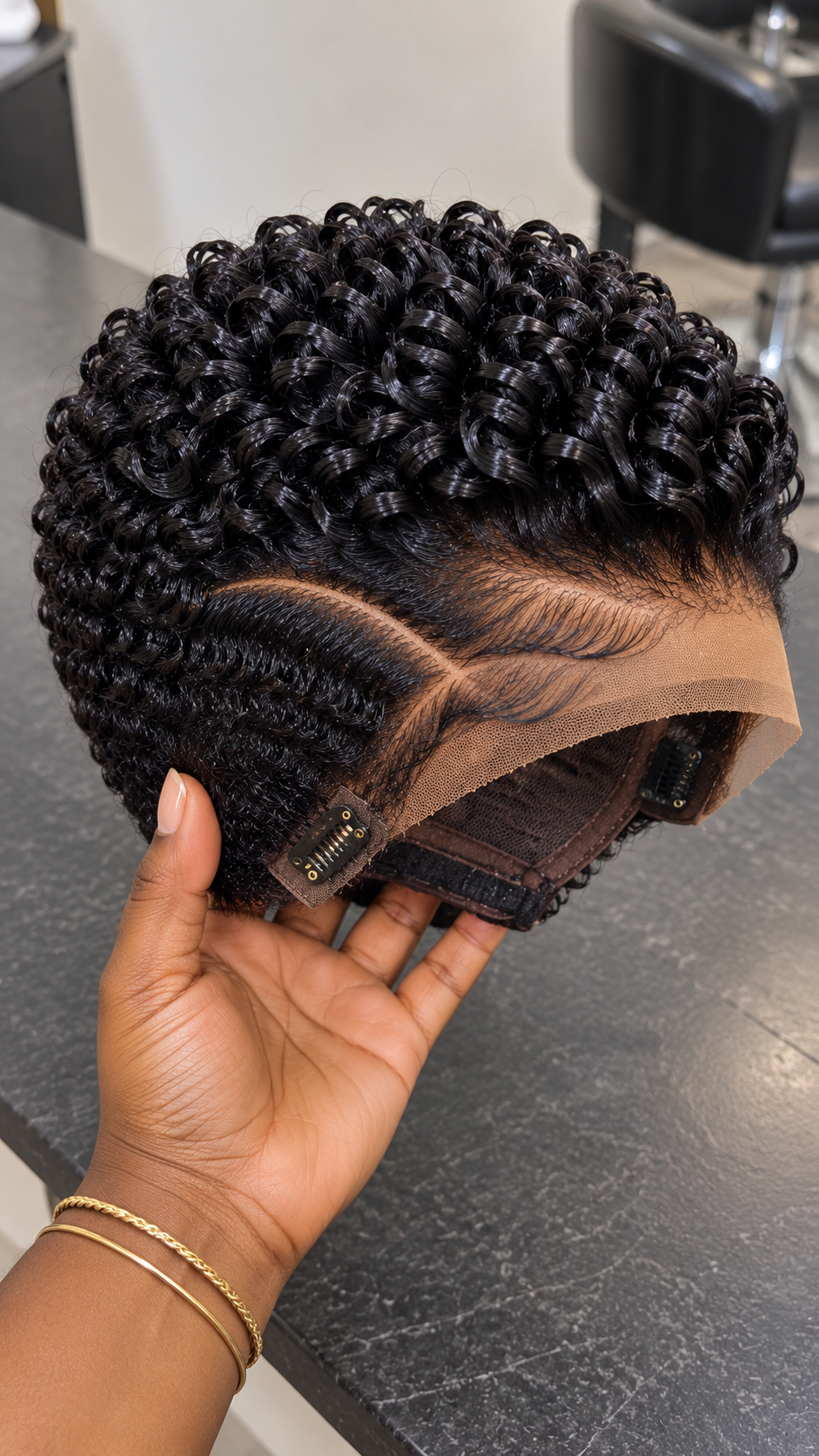
This raven-black wig is a strong example of a compact sculpted unit whose value comes from curl engineering rather than color variation. The crown is densely covered with glossy spiral coils, but the side introduces a completely different rhythm: a broad curved part opens beneath the crown, a flatter wave panel follows that curve, and the lower hair settles into much smaller compressed curls. Because the entire piece remains within a deep black palette, every change in height, direction and spacing becomes important. There are no contrasting highlights to disguise an inconsistent coil map.
The photograph is particularly useful for a buyer because the wig is shown from below and slightly to the side before installation. The lace front remains untrimmed, the interior cap is clearly visible, and small metal snap-comb attachments can be seen near the inner perimeter. A dark elastic or adjustment structure is also visible inside the cap. These are genuine construction details shown in the image. The exact lace grade, however, cannot be verified visually, so the unit should not be advertised as HD lace unless the seller can confirm that specification.
The Crown Is Built From Repeated Spirals Rather Than Flat Ring Curls
The upper surface contains dozens of tightly wound formations with open centers. Many rise vertically before curling inward, producing a tubular spiral appearance. Their repeated shape creates a dense crown without turning the hair into an indistinguishable mass.
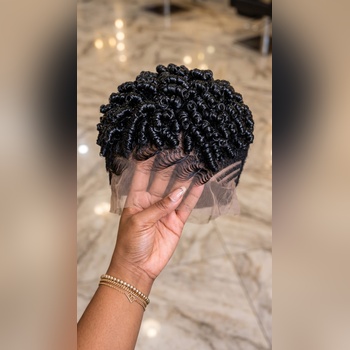
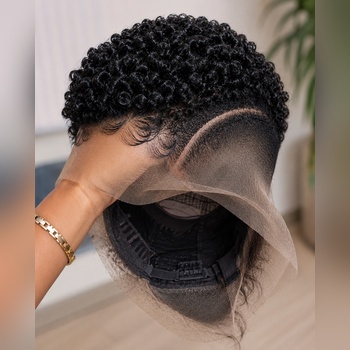
The individual coils are similar enough to create consistency, yet their diameter and orientation vary slightly as they follow the rounded cap. Larger openings appear through the central crown, while smaller formations become more common toward the edges.
This distinction matters when commissioning a recreation. A stylist should not simply create ordinary curls and press them against the crown. The reference depends on raised spiral sections whose openings remain visible from above and from the side.
Coil Spacing Creates Dimension in an All-Black Design
With no blonde, copper or burgundy accents, the black crown has to generate contrast through physical construction. Narrow highlights reflect from the curved surfaces, while the interiors remain nearly black. Small gaps between neighboring spirals create additional shadow.
Those dark spaces are not signs that the wig needs more hair. They are part of the design. Overfilling the crown could close the openings and reduce the visibility of the individual spirals.
For custom work, density should therefore be evaluated together with separation. A successful crown can look rich while still preserving enough negative space for every coil to remain readable.
The Forward Crown Has More Elevation Than the Lower Side
The spiral field rises noticeably above the foundation. This height gives the wig its sculpted silhouette, but the elevation is concentrated primarily in the crown. The side does not attempt to match that volume.
That contrast is important. A full crown sitting over a close side makes the spirals look even more prominent. Increasing side volume would soften the distinction and produce a different profile.
When approving a custom unit, ask for a true side photograph rather than relying only on an overhead image. The side view reveals whether the crown-to-side height ratio matches the reference.
The Curved Part Creates a Deliberate Opening Beneath the Crown
One of the most recognizable details is the exposed curved pathway running beneath the upper coil field. It begins toward the front and sweeps backward, creating a substantial boundary between the raised crown and the lower side.
This is not a straight conventional part. Its curvature follows the rounded shape of the wig and changes direction as it approaches the side. The result is a flowing division rather than a rigid geometric stripe.
A custom order should identify this explicitly as a curved side separation. Simply requesting a side part could lead to a much straighter route and change the entire lower architecture.
The Hair Below the Part Forms a Compressed Wave Panel
Immediately beneath the exposed curve, the strands are arranged much flatter than the spiral crown. They follow a directional wave pattern that echoes the path above them. This creates an intermediate zone between the large coils and the much closer lower hair.
The panel is particularly important because it prevents the crown from transitioning directly into a tapered perimeter. It gives the side an additional level of craftsmanship while keeping the silhouette compact.
During maintenance, this section should remain flatter. Rolling it into spiral curls would remove the visual hierarchy between crown and side.
A Second Narrow Division Creates Another Layer
Below the primary wave panel is another exposed route. It is narrower and sits closer to the perimeter, separating the upper directional waves from the compact lower curl field.
This gives the side a layered structure without requiring an elaborate carved motif. The design remains restrained, relying on curved separation rather than lightning shapes or multiple decorative razor marks.
The dark hair retained between the divisions is essential. If future cutting makes those sections too narrow, the separate pathways can begin to merge visually.
The Lower Section Uses Tiny Compressed Curls
The hair beneath the second division has a markedly different scale from the crown. Instead of large open spirals, it contains tiny close curls that hug the foundation. Their density creates a dark continuous surface while still revealing a fine curled pattern.
This is a smart way to finish the side because it maintains the curly identity of the wig without adding bulk. The curl language continues, but its scale changes dramatically.
A stylist recreating the unit should therefore avoid replacing this area with a completely flat shaved appearance. The photograph shows actual fine curled texture remaining in the lower section.
The Side Is a Three-Level Construction
Viewed structurally, the wig can be divided into three main levels. The first is the raised spiral crown. The second is the flatter directional wave panel beneath the curved part. The third is the compressed lower curl field.
This layered approach is what makes the monochromatic wig interesting. Each zone uses the same black palette but a different strand direction and degree of projection.
For a custom maker, describing these levels individually is far more useful than asking for a black curly wig with a side part.
The Front Uses Fine Directional Strands Before the Heavy Crown Begins
Near the front lace, the hair density becomes lighter. Fine black strands sweep along the perimeter before transitioning into the heavier spiral field behind them.
This graduation helps avoid an abrupt wall of dense curls at the front. It also gives the installer material that can be evaluated after the unit is placed on the wearer.
Those finer strands should not automatically be removed. Their usefulness depends on the final placement and desired front transition.
The Lace Is Clearly Visible but Its Grade Is Not
The front mesh extends beyond the hair-bearing area and remains untrimmed. Its presence is obvious, but the photograph does not provide reliable evidence about its commercial grade or exact material specification.
A buyer should therefore ask the seller directly what lace is used, what shades are available and whether the photographed unit is the exact piece being offered. If HD lace is advertised, that claim should come from product information rather than visual assumption.
Leaving the lace untrimmed can be useful for customers who prefer a local professional installation because the stylist retains more control over final placement.
The Interior Cap Is More Visible Than in Most Product Photos
The viewing angle exposes a substantial portion of the inside. Dark cap material follows the crown, while the perimeter construction can be inspected more clearly than it could on a mannequin head.
This makes the photograph particularly valuable for online selling. Customers are not limited to seeing only the attractive exterior; they can understand that the sculpted crown is attached to a structured wig foundation.
A complete underside photograph would still be useful before purchase, especially when cap size and attachment preferences matter.
Metal Snap Combs Are Visible Near the Inner Perimeter
Small black-and-gold snap-comb components are visibly attached inside the unit. Their placement provides a practical anchoring option, although whether the wearer chooses to use them is a personal fitting decision.
Customers who prefer not to use combs should ask whether they can be removed or omitted on a custom order. Likewise, someone who depends on a particular attachment configuration should verify how many are included and where they are positioned.
This is the kind of construction detail that should be listed clearly in a product description rather than discovered only after delivery.
Cap Fit Determines Where Both Curved Divisions Sit
The side architecture is fixed to the cap. If the unit sits farther forward or backward than intended, the curved part and lower division move with it. Correct sizing therefore affects the hairstyle’s geometry.
For a custom order, follow the maker’s measurement guide carefully. Circumference may not be the only requested dimension; front-to-nape and ear-to-ear measurements can also influence fit.
A professional wig stylist can assist with measurements before ordering when the side placement is an important part of the purchase.
A Strong Order Brief Should Describe Curl Scale From Top to Bottom
Begin with the crown: dense raven-black open spiral coils with moderate variation in diameter and clearly visible centers. Then specify the sweeping curved side part beneath the crown.
The next instruction should identify the flatter directional wave panel, followed by a second narrow separation and tiny compressed curls through the lower side. Finally, describe the fine front transition and request the desired cap and lace specifications.
This sequence gives the maker an actual construction map instead of forcing them to interpret a generic inspiration label.
Choose a Seller Who Can Show the Wig From Underneath
Exterior photographs can demonstrate styling skill, but a serious buyer should also understand what they are purchasing structurally. Ask for an underside photograph showing the complete cap, lace area, adjustment system and attachment components.
This is particularly important when comparing two units at different prices. Similar-looking spiral crowns can sit on very different foundations.
For a custom order, request the underside photograph before shipment so any misunderstanding about cap construction can be addressed before the unit arrives.
Salon Booking Should Focus on Fitting Before Restyling
If the wig arrives with the spiral crown intact, the first appointment should not automatically become a full styling session. The priority is to establish cap position, evaluate the lace and inspect how the curved side divisions align on the wearer.
Only displaced curls should be repaired. Rebuilding the entire crown unnecessarily introduces more manipulation and may alter the original coil map.
Tell the salon in advance that the unit already contains a sculpted spiral crown and layered side construction so the appointment can be planned accordingly.
Price Depends on Coil Mapping and Side Architecture
The absence of elaborate coloring does not make this a simple wig. Dozens of spiral sections must be arranged, the curved side divisions need accurate placement, the wave panel requires directional setting and the lower curl field needs controlled density.
| Category | Estimated Price Range | Likely Scope |
|---|---|---|
| Premium Custom | $310–$550+ | Higher-grade hair, individualized sizing, hand-mapped spiral crown, curved side architecture, layered wave work, lower curl refinement and detailed lace preparation. |
| Standard Custom | $185–$320 | Prepared black spiral crown and layered side arrangement with more standardized cap sizing and finishing. |
| Basic Human Hair | $110–$200 | A restylable foundation requiring professional spiral setting, side-wave construction, density adjustment and fitting. |
| Premium Synthetic | $75–$145 | A pre-set option designed to retain its compact spiral architecture with relatively limited rebuilding. |
| Basic Synthetic | $35–$80 | A lower-cost interpretation where coil separation, layered side work, cap construction or perimeter refinement may be simpler. |
These are broad planning ranges rather than confirmed prices for the photographed unit. Hair source, fiber, cap construction, lace specification, labor market, seller location, shipping and installation can all affect the final amount.
When comparing quotations, ask whether the crown and complete layered side architecture are already included. A cheaper base requiring several hours of specialist setting is not equivalent to a finished custom wig.
Human Hair Offers Selective Repair Options
A human-hair version can be useful because individual crown spirals can potentially be rebuilt without dismantling every section. The flatter side waves can also be addressed independently when necessary.
This selective approach reduces heat exposure and salon time. If only one area has changed, there is little reason to reset the entire unit.
Heat should still be chosen according to the condition and quality of the hair rather than automatically using the highest available temperature.
Premium Synthetic May Be Attractive for Spiral Retention
A quality synthetic version can make sense for a wearer who wants the spiral crown to stay close to its original shape. Pre-set fibers may retain circular formations with less regular salon intervention.
The limitation is future flexibility. Heat resistance varies, and major structural changes may not be appropriate. Confirm the fiber specification before attempting hot-tool work.
The better material is the one that matches the wearer’s maintenance plans rather than whichever category sounds more premium.
Take Three Reference Photos Before the First Wash
Photograph the crown from above, the side architecture directly and the rear from a three-quarter angle. These images record coil placement, both curved divisions and the transition into smaller lower curls.
If the hair changes during cleansing, the photographs provide a restoration guide. This is especially useful with black hair because the directional differences can become difficult to read when wet.
Keeping those images available for future salon appointments can also help another stylist preserve the original construction.
Clean the Crown Without Collapsing the Spiral Openings
The open centers are one of the crown’s defining characteristics. Vigorous rubbing can combine several coils and turn them into an ordinary curl mass.
Clean according to the confirmed material and minimize unnecessary manipulation. Once dry, identify which sections actually need correction before applying heat or holding product.
A preservation-first routine generally keeps a sculpted crown closer to its original form for longer.
Maintain the Wave Panel as a Separate Styling Zone
The flatter side section should not be maintained using the same technique as the spiral crown. Its strands need to remain elongated and directional.
If a ridge becomes displaced, guide it back along the existing curved route. Avoid rolling the entire panel into circular sections simply because the crown uses spirals.
The contrast between raised curls and flatter waves is one of the main reasons the side has depth despite using only black hair.
Protect the Narrow Lower Separation From Gradual Widening
The second exposed pathway is already sufficient to divide the wave panel from the compressed lower curls. It does not need repeated enlargement.
When fine strands move across the path, reposition them first. Any actual cutting should preserve the original width and curvature.
This is especially important on a wig because removed hair cannot naturally regrow and restore the original spacing.
Product Should Enhance Reflection Without Gluing the Coils Together
The crown is highly glossy, but excessive shine product can reduce the very detail that makes it attractive. Heavy oils can cause neighboring spirals to stick together and collect inside their openings.
Use only what the material requires. If buildup begins dulling the surface, suitable cleansing may be more effective than adding another layer of product.
The lower wave panel also benefits from restraint because its fine directional ridges need to remain individually visible.
Storage Must Support the Crown Without Flattening the Side
A properly sized wig stand or mannequin head gives the spiral crown enough vertical clearance to remain open. The side should also remain free from pressure so the curved wave panel is not compressed.
Store the wig fully dry and avoid stacking other units on top. For travel, choose packaging deep enough to protect the crown while leaving the lower side in its intended position.
Good storage reduces the amount of professional reconstruction required and helps preserve the original curl map between wears.
The Strength of This Wig Comes From Changing Curl Scale Without Changing Color
This raven-black unit demonstrates that a monochromatic wig can still contain several layers of visual complexity. Large open spirals dominate the crown. A curved division introduces a flatter directional wave panel. A second narrow pathway creates another transition before tiny compressed curls complete the lower side. Fine front strands and visible lace then lead into the unfinished installation perimeter.
For buyers, the quality checklist should focus on the spiral openings, crown density, curvature of the main part, consistency of the wave panel, width of the lower separation, compact curl density, cap fit and visible attachment hardware. Lace grade should be confirmed directly rather than guessed from the photograph.
For wig businesses, the pre-installation angle offers a valuable sales opportunity because both styling and construction are visible at once. Showing the complete underside in a second photograph, explaining the attachment system and documenting the layered side architecture can help customers understand why this type of black wig involves much more craftsmanship than an ordinary curled unit.
Search Terms
raven black spiral coil wig · curved side part lace wig · layered black wave panel wig · open spiral crown hairpiece · compressed side curl wig · black snap comb wig · sculpted curved part wig · untrimmed lace coil wig