
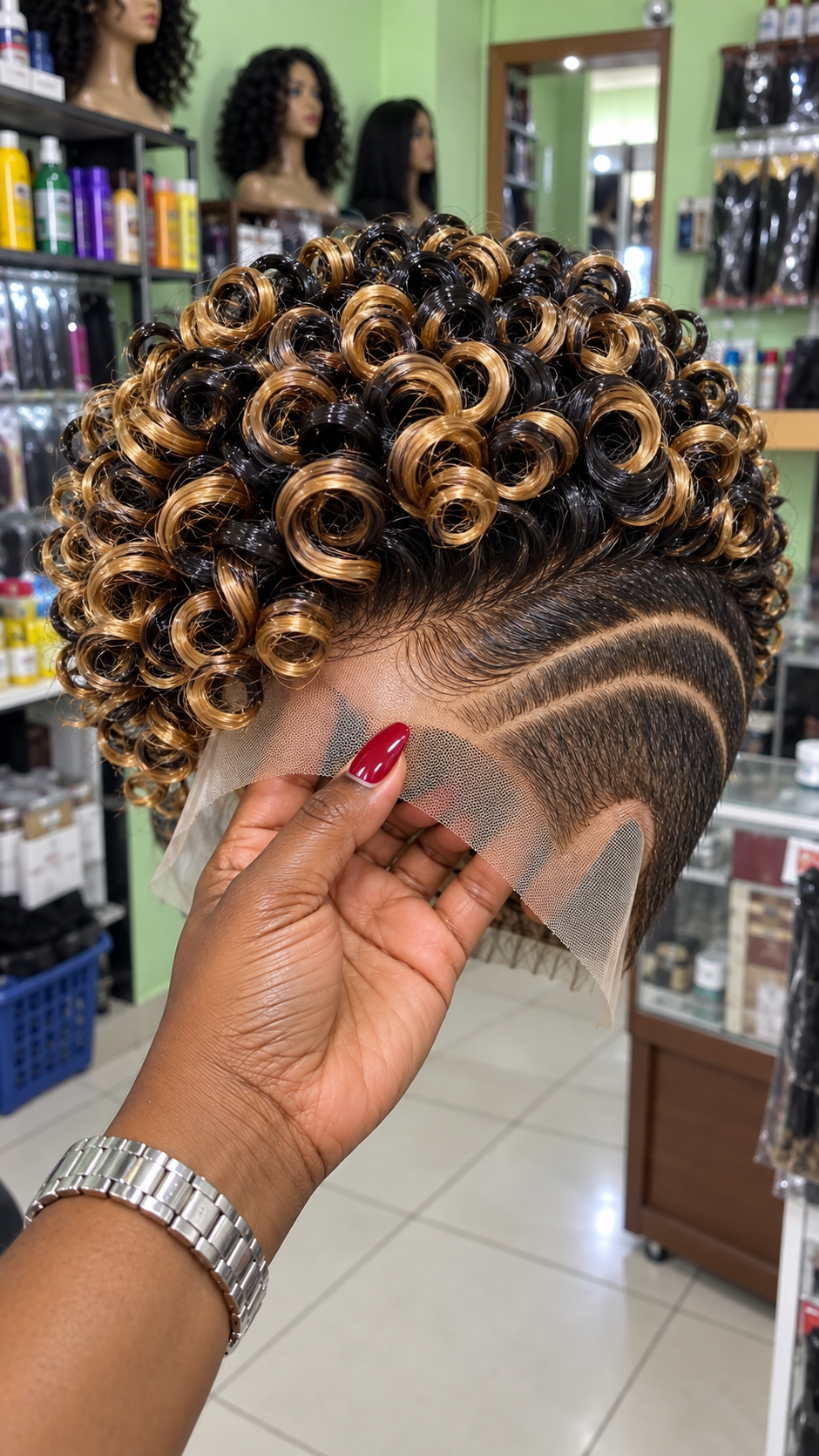
A customer looking at this wig is not simply choosing between black and blonde. The real purchasing decision concerns a highly specific combination of oversized circular coils, selective golden-honey color placement and precision side geometry. The crown is filled with large, hollow spiral formations in alternating black and warm blonde tones, while the lower section is arranged into closely positioned dark hair interrupted by three sweeping curved channels. The contrast creates a striking balance between a richly populated upper crown and a controlled, graphic side profile.
What makes this particular piece interesting is the way the lighter strands follow individual curls. Golden honey appears across selected ribbon-like rings, while black remains visible inside neighboring coils and throughout the underlying foundation. The colors are interwoven across the crown rather than divided into two separate halves. This distribution gives the wig a more intricate appearance than an ordinary blonde-highlighted unit.
The photograph also reveals an untrimmed lace perimeter extending around the front and side. This is a pre-installation presentation, not a photograph of the wig already fitted to a wearer. The image makes it possible to inspect the crown arrangement, visible side markings and excess lace, but it does not establish the hair fiber or exact lace grade. In particular, HD lace should not be claimed without confirmation from the maker.
The Crown Is Constructed Around Large Circular Openings
The upper surface is dominated by substantial ring-shaped spirals. Several have wide, visibly hollow centers, while smaller coils occupy the spaces between them. These openings create much of the design’s character because they allow the viewer to recognize individual curled sections rather than seeing one continuous mass of hair.
The larger rings are distributed across the front and central crown, with other curls arranged at slightly different angles around them. This avoids the appearance of a perfectly repeated pattern.
A buyer requesting a similar wig should specify oversized hollow spiral coils. Ordinary tight curls or loose ringlets would not reproduce the same result. The distinction is particularly important when ordering remotely because different sellers may use the phrase finger curls for substantially different constructions.
An elevated photograph of the completed unit can help verify that the crown contains a mixture of ring sizes and retains the open centers shown in the reference.
Golden Honey Ribbons Are Distributed Across a Black Foundation
The lighter color is concentrated through selected curled sections rather than appearing uniformly throughout the crown. Some ringlets are predominantly golden honey, others remain mostly black, and several contain both shades across their visible surfaces.
This creates an alternating light-and-dark arrangement without a rigid striped appearance. Warm blonde strands catch the shop lighting, while the black sections provide deeper shadow inside the spiral openings.
The overall effect depends on retaining enough black. If the maker were to lighten most of the crown, the contrast would disappear and the result would become a largely golden-blonde wig.
Conversely, adding only a few thin honey-colored streaks might fail to reproduce the prominent blonde circular ribbons visible in the photograph.
For ordering purposes, the color description should emphasize a black foundation with substantial golden-honey ribbon placement across selected spiral coils.
The Contrast Works Because Color Follows Each Coil
The warm blonde is particularly effective where it circles the outer surface of a spiral. As the strand turns inward, the darker center remains visible, creating a sense of depth.
This means the color placement should be planned in relation to the final curl arrangement. A straight section of hair may display a highlight differently once it has been rolled into a large hollow ring.
For a custom human-hair unit, the stylist should consider how the lighter and darker strands will appear after final setting. Randomly highlighting sections without accounting for the curl map can produce an uneven result.
The desired appearance is not perfectly symmetrical alternation. The reference contains enough variation for the crown to remain visually lively rather than resembling a sequence of identical black and blonde rings.
The Front Has More Visual Weight Than the Outer Edges
The crown’s largest and most noticeable spiral openings sit prominently toward the forward and upper sections. Smaller curls gradually occupy the sides and rear-facing edges, allowing the crown to follow the rounded foundation.
This distribution produces fullness without requiring long hanging hair. The overall silhouette is compact, but the circular loops rise enough to become the main focal point.
When commissioning this construction, the buyer should ask the maker to preserve a proportional crown. Increasing the height significantly could make the upper section overpower the side artwork.
The reference shows a dense arrangement of circular forms, not an extremely tall mass of curls. Maintaining that balance is important to the finished appearance.
The Three Side Channels Are a Separate Design Decision
Beneath the crown, the hair changes dramatically. Instead of large spiral formations, closely arranged dark strands create a compact side panel. Through that panel, three sweeping exposed channels follow the rounded shape of the wig.
These paths are not straight horizontal stripes. Their curvature produces a flowing layered pattern, with the upper channel sitting closer to the crown and the lower channels occupying progressively lower positions.
The side therefore has its own visual rhythm, independent of the circular movement above it.
A buyer should describe this as a three-channel curved side design rather than a generic razor-line haircut. The number of paths, their spacing and their curvature are essential to reproducing the reference.
The Dark Sections Between the Lines Must Remain Intact
Each exposed side channel is bordered by dark hair. These retained panels prevent neighboring lines from merging visually and give the pattern its distinctive layered appearance.
If the channels are carved too widely, the darker sections between them become thinner. Eventually, several paths may appear as one broad exposed area instead of separate curves.
This is especially important on a wig because removed strands cannot naturally grow back.
For initial construction, the maker should plan the side geometry before cutting. For later maintenance, the original side photograph should be used as a reference so the paths retain their intended proportions.
The Side Color Is Considerably Darker Than the Crown
Although warm blonde is prominent in the upper curls, the side remains predominantly dark brown to black. This difference gives the carved channels stronger contrast against the underlying foundation.
Carrying large quantities of blonde through the lower side would produce a different visual balance and potentially reduce the clarity of the exposed markings.
The darker side also visually connects with the black spirals in the crown, keeping the two areas related despite their different styling techniques.
A faithful custom reproduction should preserve this dark lower foundation rather than treating the entire unit as an evenly highlighted hairstyle.
The Crown-to-Side Transition Is Carefully Controlled
Between the large circular curls and the lower carved section, the hair becomes flatter and more directional. Fine strands travel backward, creating a transition rather than allowing the ringlets to end abruptly above the side artwork.
This intermediate area is important because it connects two different styling languages. The crown relies on open circles, while the side depends on close density and sweeping exposed paths.
Without the directional transition, the wig could appear as though two unrelated hairstyles had been combined.
A stylist recreating this piece should therefore work on the crown, transition and side independently while checking that their proportions remain coordinated.
The Front Lace Is Still at the Customization Stage
The photograph shows lace extending substantially beyond the hair-bearing front and side. The mesh has not yet been cut to a final wearing boundary.
For a customer planning professional installation, that extra material can provide flexibility. The wig stylist can establish the cap position, assess the hairline and determine where the side artwork sits before trimming.
The visible lace does not establish a particular commercial grade or guarantee adhesive-free wear. Buyers should confirm those details with the seller rather than relying only on the apparent fineness of the mesh.
Color matching also matters. The lace appears warm beige-brown in the photograph, but lighting and camera processing can change perceived tone. Ask which lace shades are actually available.
The Ear Area Needs Special Attention During Fitting
The excess lace continues around the side and ear-area perimeter. Its final shape should be determined with the wig positioned on the wearer.
Because the three carved channels are already incorporated into the unit, adjusting the cap also changes their position relative to the temple and ear.
Cutting the lace before establishing the correct placement may reduce the ability to make comfortable adjustments.
The installer should therefore evaluate the front, ear area and overall cap tension together before making permanent cuts.
Cap Measurements Affect the Final Geometry
A custom wig may look accurate in the hand but sit differently on an individual head. This is particularly relevant when the side carries a fixed carved pattern.
A cap that sits too far forward can move the channels toward the face. A cap positioned too far backward may place them behind their intended location.
Buyers should follow the maker’s measurement guide carefully. Depending on the construction, circumference, ear-to-ear and front-to-nape measurements may be requested.
If the unit represents a significant investment, a measurement appointment with a professional wig stylist can help reduce the chance of ordering an unsuitable size.
Buying This Wig Requires an Exact Crown Reference
A broad online search for black and blonde curly wigs may return products that match the colors but not the curl architecture. Some may have loose curls, small finger coils or scattered highlights that look very different from the oversized rings shown here.
The most effective search and ordering description should combine the crown construction with the color placement: black and golden-honey hollow spiral ringlets with a compact rounded crown.
The side geometry should then be specified separately. Ask whether the seller can supply or recreate three curved carved channels with dark hair remaining between them.
Before purchasing, confirm whether the displayed reference represents available stock or an example that must be custom-made.
Choose a Maker With Both Curl and Precision-Cutting Experience
Creating oversized hollow ringlets requires a different approach from styling loose curly hair. The maker needs to control the diameter, opening and direction of individual sections.
Precision side work is another specialized task. A professional skilled at crown setting may not automatically have the experience needed to reproduce curved barber-style channels accurately.
When evaluating a seller or salon, look for previous examples showing both compact sculpted curls and detailed side work.
If necessary, the work can be divided between a wig stylist and a barber familiar with wig customization. The cap should be fitted before final side refinement so the geometry is positioned correctly.
Separate the Order Into Crown, Color and Side Requirements
A useful custom brief begins with the crown: large hollow circular ringlets, mixed diameters, dense but separated placement and a compact rounded silhouette.
The second requirement is color. Request a predominantly black foundation with golden-honey ribbon sections distributed across selected coils. The lighter pieces should be substantial enough to create visible circular highlights without replacing the entire dark base.
The third requirement is the side: closely arranged dark hair with three sweeping exposed channels and preserved panels between them.
Finally, confirm cap measurements, available lace shades, attachment preferences and whether the lace should remain untrimmed for installation.
This breakdown helps the buyer and maker identify exactly what needs approval before the wig is shipped.
Approval Photographs Should Show the Color Arrangement From Above
The overhead view is especially important for this unit because the black and honey-blonde spirals alternate across the crown. A frontal photograph alone may not reveal whether the placement is balanced.
The buyer should check whether the largest golden loops remain visible, whether black sections retain substantial coverage and whether the curl centers stay open.
A direct side photograph should confirm the three carved channels and the amount of dark hair separating them.
A rear three-quarter image should show how the smaller curls continue around the back. If construction details are part of the purchase decision, request an underside photograph of the actual unit as well.
Golden-Honey Shade Approval Should Use Neutral Lighting
Warm salon illumination can make honey blonde appear brighter or more orange. The reference contains golden and caramel reflections, but the actual shade should be checked separately from the effects of lighting.
Ask the seller for a neutral-light photograph of the available hair or finished wig.
For human hair, the customer should also ask whether the blonde sections were produced through coloring or supplied in their final shade. The processing history can influence future maintenance.
Color selection should preserve the contrast with black rather than pushing the blonde toward an extremely pale platinum tone that would create a different appearance.
Estimated Pricing for a Two-Tone Hollow Spiral Wig
The price of this design reflects several forms of labor: arranging numerous circular coils, placing the golden ribbons, controlling the dark side density, carving three exposed channels and preparing the lace for installation.
The overall wig is compact, but compact length does not necessarily mean simple production.
| Category | Illustrative Price Range | What May Be Included |
|---|---|---|
| Premium Custom | $365–$650+ | Higher-grade hair, individualized sizing, custom black-and-honey placement, hand-arranged hollow ringlets, precision triple-channel detailing and professional lace preparation. |
| Standard Custom | $225–$390 | Prepared two-tone spiral crown, established side design and more standardized cap options. |
| Basic Human Hair | $130–$235 | A human-hair foundation that may require additional highlighting, curl setting, side customization and fitting. |
| Premium Synthetic | $90–$175 | A pre-colored and pre-set alternative with potential shape-retention benefits but less flexibility for major restyling. |
| Basic Synthetic | $45–$100 | A budget interpretation where color distribution, ring diameter, side accuracy or cap construction may be simplified. |
These ranges are budgeting illustrations rather than confirmed prices for the photographed wig. Actual quotations depend on the material, seller, location, customization, cap construction, shipping and installation.
Before comparing prices, ask whether the crown and side work are fully completed. A lower-priced foundation requiring several specialist appointments may ultimately cost more than a prepared custom unit.
Human Hair Can Support Future Ringlet Reconstruction
A human-hair version may be useful for buyers who expect professional maintenance or occasional curl resetting. Individual ringlets can potentially be restored when their circular openings begin to collapse.
The blonde sections may have undergone additional processing, so heat should be selected according to the hair’s condition.
A stylist should not automatically use the same temperature across every section without considering previous color treatment.
When refreshing the color, the black foundation and selective honey-blonde arrangement should remain part of the design.
Premium Synthetic Can Retain Pre-Set Spirals With Less Intervention
A quality synthetic interpretation may preserve the hollow ringlet pattern with relatively little daily manipulation.
This can be practical for wearers who want the wig to remain close to its original appearance rather than changing the styling frequently.
The tradeoff is reduced flexibility. Some synthetic fibers tolerate limited heat, while others can be permanently damaged. The exact fiber specification should be confirmed before using heated tools.
Maintenance Should Prioritize the Large Spiral Openings
Before brushing or adding product, examine the crown. The largest circles are particularly noticeable when they lose their shape or become covered by neighboring curls.
If only one or two spirals are displaced, address those sections individually instead of manipulating the entire crown.
An overhead photograph taken when the wig is new can help maintain the original coil map.
The objective is to preserve the balance between large honey-blonde circles and darker supporting curls rather than creating a different distribution after every styling session.
Wash the Crown Without Mixing the Two Color Groups
During cleansing, avoid aggressive rubbing between neighboring ringlets. Such movement can cause strands to intertwine, making the circular openings difficult to restore.
Use products appropriate for the confirmed human-hair or synthetic material.
After drying, separate displaced sections carefully and restore the original spiral directions according to the reference photographs.
The lighter honey strands should remain integrated with their intended coils rather than being redistributed randomly across the crown.
The Carved Side Does Not Need Constant Recutting
Unlike natural growing hair, a wig does not need routine line restoration simply because time has passed.
If the channels remain clearly visible, leaving them untouched can help preserve the original dark panels.
When fine strands move across the exposed paths, repositioning may be sufficient.
If professional cutting becomes necessary, use the reference photograph to preserve the widths and spacing. The goal is to maintain three separate curves, not gradually enlarge them into one broad pattern.
Use Styling Product Without Closing the Hollow Rings
The crown already has a glossy appearance. Heavy oils, waxes or holding products can cause neighboring strands to adhere together and reduce the visible openings.
Product buildup may also make the honey-blonde sections appear darker or less distinct from the black foundation.
Apply only what the material requires. If residue begins affecting the appearance, appropriate cleansing may be more effective than adding additional shine product.
Book the Installation Before Optional Side Refinement
When the wig arrives, inspect the crown, color placement, side markings and lace before making permanent alterations.
The wig stylist should establish the final cap position and evaluate the front and ear-area perimeter.
Once the unit is correctly positioned, any remaining side refinement can be considered. If the three channels already match the reference and sit appropriately, additional cutting may not be necessary.
For appointment booking, explain that the wig contains a pre-arranged two-tone spiral crown and precision side artwork. This helps the salon reserve time for careful fitting rather than treating it as a basic curly-wig installation.
Storage Requires Room for the Oversized Coils
The large hollow ringlets are vulnerable to compression. A suitable wig stand or mannequin head provides space for the circular openings to remain intact.
The side should also be protected from pressure because displaced fine strands can cover the exposed channels.
Store the unit only when the cap and lace are completely dry.
For transport, use packaging deep enough to avoid crushing the crown. Preserving the original circular arrangement is generally easier than arranging a complete professional reconstruction later.
The Most Successful Version Preserves Both Color and Geometry
This black-and-golden-honey wig is distinctive because the crown and side perform different visual roles. Large hollow ringlets create movement and alternating light-and-dark reflections above, while a compact black side carries three separate curved channels below.
For buyers, the essential quality checks are the size of the circular openings, the distribution of honey-blonde ribbons, the amount of black retained between the curls, the three sweeping side paths, the density of the lower hair and the available lace for fitting.
For wig businesses, photographing these details separately gives customers a more accurate understanding of the customization involved. An overhead image communicates the two-tone ringlet construction, a direct side view reveals the carved geometry, and verified cap information clarifies the practical installation requirements.
The best purchase is not necessarily the wig with the brightest blonde or the most dramatic carving. It is the one that preserves the relationships visible in this reference: substantial golden circular loops, a deep black foundation and carefully spaced side channels. When those elements are planned together, the finished unit can retain the same recognizable identity rather than becoming an ordinary highlighted curly wig.
Search Terms
black honey blonde hollow spiral wig · golden ribbon ringlet crown · triple curved side channel wig · two tone sculpted coil wig · black root honey ringlets · blonde black lace front wig · oversized circular curl hairpiece · untrimmed lace carved side wig