
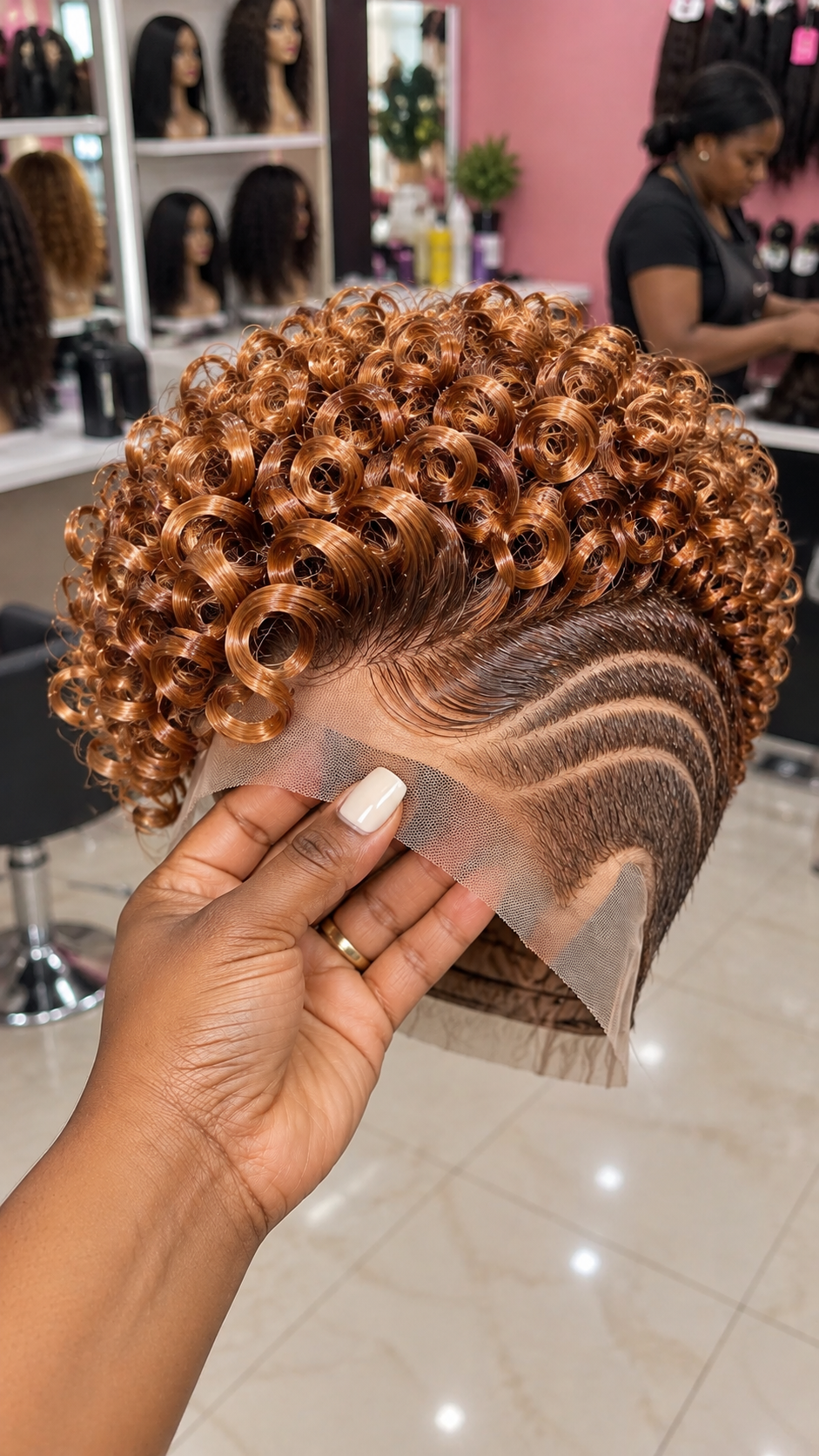
The most memorable aspect of this amber-copper wig is the contrast between its oversized circular ringlets and the closely arranged side artwork. The crown contains numerous glossy, hollow spiral formations in a rich copper-gold shade, while the lower section follows a completely different styling direction. Three sweeping exposed channels travel around the side, separated by carefully retained brown hair. Between these two areas, fine strands form elongated waves that create a transition from the rounded crown to the precision-cut lower profile.
Unlike a conventional curly wig, this design depends on the exact arrangement of individual coils. Several of the largest ringlets have clearly visible circular openings, while smaller loops occupy the gaps around them. Their placement creates a rounded, elevated crown without allowing the curls to hang loosely over the shoulders. The warm copper surface catches the light, revealing golden-amber reflections and deeper caramel tones within the curled sections.
The photograph also provides valuable information about the construction before installation. The unit is held by its extended lace perimeter, allowing the front hairline, side design and partially visible cap to be examined. The lace has not yet been trimmed for a wearer. Although the mesh is clearly visible, its commercial grade cannot be confirmed from the photograph, so it should not be described as HD lace without direct verification from the supplier.
Why the Oversized Ringlets Matter More Than Overall Volume
For this particular wig, curl diameter is one of the most important purchasing considerations. The crown contains broad circular formations that resemble carefully rolled ribbons. Several have large hollow centers, particularly across the front and upper middle sections.


Those openings are intentional visual elements. They create shadow within the golden curls and help separate neighboring spirals. Without them, the crown would become a much denser mass of ordinary curls.
A buyer requesting this design should therefore specify large hollow ringlets rather than simply asking for tight curls or finger coils. The difference affects how the entire wig looks.
The surrounding smaller spirals also play a role. They fill spaces between the larger formations and help the crown follow the rounded shape of the cap. This combination prevents the upper hair from appearing like a collection of identical circular pieces placed in rigid rows.
Amber Copper Creates Warmth Across the Outer Curl Surfaces
The color belongs to a warm amber, copper and caramel family. Bright golden reflections appear where the ringlets face the light, while deeper brown remains visible within their centers and around the roots.
This tonal relationship gives the crown considerable depth. Even when two neighboring curls are similar in color, their different angles create distinct highlights and shadows.
The image does not show an icy blonde palette or a sharply divided black-and-gold pattern. Its character comes from warm copper-gold hair with richer brown depth.
When ordering, a customer should provide the reference photograph instead of relying entirely on shade names. Amber, ginger, caramel, copper blonde and golden brown can mean different things to different suppliers.
A neutral-light photograph of the actual available hair can help prevent an order from arriving substantially more orange, red or yellow than expected.
The Crown Follows an Uneven but Deliberate Circular Map
The ringlets are distributed throughout the upper surface rather than concentrated into one narrow strip. Several prominent circles occupy the forward crown, while smaller curls continue toward the sides and rear.
The arrangement is varied enough to avoid an artificial repetitive pattern. Some spirals face the camera directly, exposing their dark centers. Others angle slightly upward or backward, allowing the glossy outer strands to become more visible.
This variation contributes to a sense of movement even though the wig is stationary.
For a custom recreation, the maker should consider how each ringlet interacts with its neighbors. Placing every coil at the same angle could make the crown appear less dimensional than the reference.
An elevated approval photograph is useful because it reveals the distribution of the ringlets more accurately than a conventional front portrait.
The Front Hairline Transitions Into a Broad Sculpted Wave
Beneath the upper curls, the styling becomes noticeably flatter. Fine copper-brown strands sweep across the front and travel toward the side in a coordinated direction.
This section creates a bridge between the large circular crown and the precision side pattern. Rather than allowing the ringlets to meet the lace abruptly, the stylist has arranged the neighboring hair into elongated movements.
The result gives the wig a more elaborate front profile without increasing its length.
During customization, these strands should remain separate from the larger curls. Rolling the entire front into additional spirals would remove the contrast between the upper and lower styling zones.
Three Curved Side Channels Create the Lower Signature
The most distinctive side detail is a group of three exposed paths that follow the rounded shape of the wig. These channels are curved rather than completely straight, and they travel backward beneath the main crown.
The upper channel is positioned closest to the directional wave section. A second exposed line follows below it, while the third creates an additional lower arc near the perimeter.
The arrangement is particularly effective because each pathway remains distinguishable. Narrow brown hair sections separate the exposed lines, providing contrast and preventing them from visually merging.
A custom wig maker should preserve the curvature and spacing of these channels. A generic request for three razor lines could produce straight marks that lack the flowing appearance of the reference.
The Brown Panels Between the Lines Are Part of the Design
The retained hair between the exposed paths is not accidental. Those sections establish the pattern’s proportions and allow the side geometry to remain recognizable.
If the channels were made considerably wider, the remaining brown panels could become too narrow. The result might resemble one broad exposed area rather than three separate arcs.
This is an important consideration for both initial construction and future barber maintenance. Wig hair does not regenerate after cutting, so every additional removal permanently changes the available density.
The safest approach is to preserve the original spacing and use the reference photograph whenever the side requires professional attention.
The Ear Area Needs a Different Fitting Approach
The photograph clearly shows lace extending around the lower side and ear-area perimeter. This material has not yet been shaped to a particular wearer’s anatomy.
Before trimming, the stylist should place the cap in its intended position and examine how the side pattern sits relative to the temple and ear.
Correct placement matters because the three curved channels are fixed to the wig. If the unit shifts forward, the entire arrangement shifts with it.
The final lace edge should therefore be established only after the wearer and stylist are satisfied with the cap’s position.
The image does not establish the exact lace shade, transparency classification or whether the wig is suitable for an adhesive-free installation. Those details need to be confirmed through the seller’s actual specifications.
The Crown Color and Lower Side Should Be Approved Together
One possible mistake when recreating this unit is concentrating entirely on the copper ringlets and treating the side as a separate decoration.
In the reference, the lower section contains richer brown tones than the brightest crown surfaces. This difference gives the carved channels enough contrast to remain visible.
Extending the brightest golden shade throughout the side could reduce that contrast. Likewise, making the entire lower section extremely dark might create a sharper color division than the photograph suggests.
The strongest reproduction retains a coordinated warm-brown foundation beneath the brighter copper-gold ringlets.
Commissioning the Wig Through a Specialist Salon
A salon experienced with sculpted wig construction is a practical starting point for this type of order. The professional needs to understand large circular coils, controlled crown density, directional front waves and precision side cutting.
Customers should ask to see previous examples of similar work rather than assuming that every curly-wig specialist can reproduce oversized hollow spirals.
The order brief should identify the essential elements: an amber-copper crown, large circular ringlets with visible centers, smaller supporting curls, a flowing front wave and three separate curved side channels.
Cap measurements, lace shade and any interior attachment preferences should be discussed after the visible design has been agreed upon.
When ordering remotely, ask whether the seller is offering the completed wig or a foundation that will require further styling after delivery.
Choosing Between a Finished Wig and a Custom Foundation
A finished custom wig can be convenient because the crown and side geometry arrive already prepared. This route is particularly attractive when the seller has a portfolio demonstrating accurate sculpted curls and carved designs.
A basic foundation offers more flexibility for local customization, but the customer must account for additional labor.
Creating large ringlets, arranging the front waves and cutting the side channels may require separate salon services. The combined expense can be greater than the original base-wig price.
Customers should request an estimate for the completed look before deciding which purchasing approach offers better value.
Photographs to Request Before the Wig Is Shipped
The most valuable approval photograph is an overhead view showing the circular crown. Large ringlets should retain visible hollow centers, with smaller coils supporting the arrangement.
A direct side image should reveal all three curved channels and the hair remaining between them.
A third image from the rear can show whether the curls continue around the back and maintain a balanced silhouette.
If the seller advertises a particular lace or cap construction, a separate underside photograph should also be requested. Exterior styling photographs cannot verify every interior specification.
Estimated Pricing for an Amber Copper Ringlet Wig
Pricing should account for the amount of individual styling involved. The wig is compact, but the large hollow ringlets require careful placement, and the three side channels introduce precision cutting that may need specialist attention.
| Category | Estimated Price Range | Typical Scope |
|---|---|---|
| Premium Custom | $350–$630+ | Higher-grade hair, custom cap measurements, planned amber-copper coloring, individually constructed ringlets, precision triple-channel detailing and personalized lace preparation. |
| Standard Custom | $215–$375 | Prepared copper-gold spiral crown, established side geometry and standardized cap options with limited individual adjustments. |
| Basic Human Hair | $125–$230 | A human-hair foundation that may require separate coloring, large-coil construction, side detailing and professional fitting. |
| Premium Synthetic | $85–$170 | A quality pre-colored and pre-set option with potential benefits for curl retention but more limited future restyling choices. |
| Basic Synthetic | $40–$95 | A budget interpretation with potentially simpler curl placement, side-channel precision, color depth or cap construction. |
These figures are illustrative budgeting estimates, not verified prices for the photographed wig. Final costs vary by seller, country, material, customization, shipping and installation.
Before purchasing, ask whether the price includes the completed crown and all three side channels. Comparing a ready-styled unit with an unfinished foundation without considering additional labor can be misleading.
Human Hair Offers More Options for Future Curl Repair
A human-hair version can be useful when the wearer expects periodic professional resetting. If individual ringlets begin losing their circular shape, a stylist may be able to restore selected sections without rebuilding the entire crown.
The amber-gold color may involve processing, so heat should be selected according to the hair’s actual condition.
Repeated excessive temperatures can reduce longevity, particularly if the strands have already undergone significant lightening or coloring.
A professional can also assess whether future color refreshing should target selected areas or the broader crown.
Synthetic Fiber Can Help Preserve Pre-Set Spirals
A premium synthetic wig may hold its circular pattern well when the ringlets have been manufactured or professionally set for shape retention.
This can reduce the need for frequent reconstruction, although major styling changes may be more restricted.
Heat tolerance varies between fibers. Buyers should confirm the exact material before applying hot tools or attempting recoloring.
The best choice depends on whether the wearer values future restyling flexibility or prefers to preserve the original arrangement with limited intervention.
Maintenance Begins With Protecting the Largest Circular Openings
Large ringlets are especially noticeable when they lose their shape. A collapsed opening can change the appearance of an entire section of the crown.
Before cleaning or adjusting the hair, inspect whether the major circles remain open and properly positioned.
If only one or two ringlets have moved, address those sections separately. Broad brushing through the crown can disturb neighboring curls that do not require attention.
An overhead photograph taken when the wig is new provides a useful maintenance reference.
Washing Should Preserve the Individual Coil Map
The crown should be handled as a collection of separate sculpted sections rather than one loose mass of curly hair.
During washing, avoid vigorous circular rubbing that can intertwine neighboring coils and close their centers.
Use products appropriate for the confirmed human-hair or synthetic material and follow the supplier’s care instructions.
After drying, inspect the individual spirals and reconstruct only what has changed. This reduces unnecessary manipulation and helps preserve the original arrangement.
The Carved Side Needs Conservative Maintenance
The three curved channels should not be widened automatically at every appointment. Because wig hair does not grow back, repeated cutting can gradually remove the brown panels separating the lines.
If fine hairs move across a channel, repositioning them may restore visibility without additional cutting.
When professional refinement becomes necessary, use the original photograph to preserve line width, curvature and spacing.
The objective is to maintain the existing design, not to create increasingly dramatic channels with each visit.
Product Buildup Can Hide the Warm Curl Dimension
The glossy copper-gold surface already reflects light strongly. Excessive oil, wax or holding product can cause neighboring strands to adhere together.
As buildup increases, the hollow curl openings may become less visible and the contrast between golden outer strands and darker interiors can weaken.
Use product sparingly and according to the confirmed material. When residue affects the appearance, appropriate cleansing may be more useful than adding another layer of shine product.
Storage Should Preserve the Rounded Crown
A suitable wig stand or mannequin head can help keep the large ringlets from being compressed between wears.
Avoid laying heavy objects over the crown or pushing the side against a hard surface. Pressure can flatten the coils and move fine strands across the carved channels.
The cap and lace should be completely dry before storage.
During transportation, use packaging deep enough to protect the largest circular formations rather than forcing them into a confined space.
The Final Fitting Should Respect the Existing Side Geometry
When the wig arrives, inspect the curls, side channels, lace and visible cap construction before making permanent alterations.
The installer should establish the cap position first and check where the curved channels sit relative to the wearer’s temple and ear.
Only after the placement has been approved should the lace be trimmed and any optional side refinement considered.
If the carved design already matches the reference, further cutting may not be necessary.
What Makes This Amber Copper Wig Worth Customizing
The strength of this design lies in the contrast between large circular ringlets and flowing precision side work. The upper crown uses bright amber and honey-gold reflections to reveal the shape of every major coil, while darker caramel-brown strands create depth inside the openings.
Beneath that rounded construction, elongated directional hair leads into three curved exposed channels. The retained brown panels prevent the side from becoming visually overcrowded, and the untrimmed lace leaves room for professional fitting.
For buyers, the essential quality checks are the diameter of the ringlets, their visible hollow centers, the arrangement of smaller supporting coils, the warm color balance, the spacing of the three side channels and the condition of the lace.
For wig businesses, detailed photographs of the crown, side and underside can help customers understand the work involved. Accurate product information, transparent customization pricing and realistic installation guidance are more useful than unsupported claims about lace or fiber.
A successful recreation should preserve the original relationships rather than simply match the copper color. When the circular crown, directional transition and three carved channels are produced with consistent proportions, the finished wig retains the distinctive appearance that makes this reference valuable for custom orders.
Search Terms
amber copper hollow ringlet wig · golden spiral crown wig · triple curved side channel wig · honey copper lace front wig · caramel brown sculpted curls · oversized circular ringlet hairpiece · sweeping side arc wig · untrimmed lace copper coil wig