
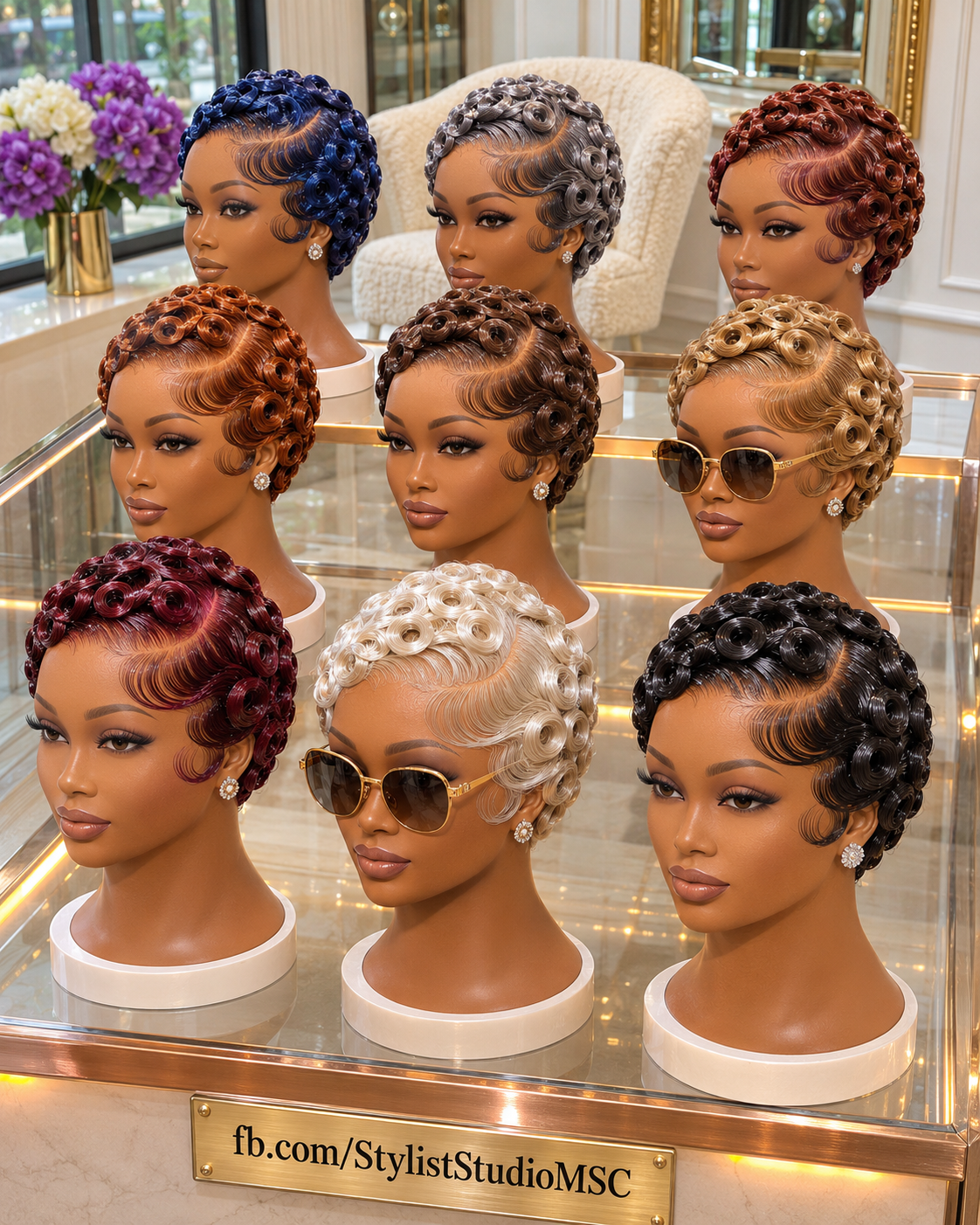
Short hairstyles can be just as expressive as longer looks, especially when every curl and wave has been carefully arranged. The beautiful pixie wigs in this collection showcase the appeal of sculpted pin curls, graceful side partings, and sweeping finger waves. Their compact silhouettes bring attention to the crown and hairline, while a selection of rich colors gives each hairstyle a distinctive personality. From deep navy blue and polished black to copper, burgundy, champagne blonde, silver, and warm brown, the display demonstrates how a classic short hairstyle can take on many different appearances.
The wigs are presented on realistic female mannequin busts arranged across a luxurious glass display counter with gold-colored framing. Their hairstyles are positioned at slightly different angles, allowing the circular curls, diagonal partings, and decorative forehead waves to remain visible. Some mannequins wear sunglasses, while others display their complete hairlines without obstruction. The result is an attractive salon presentation that emphasizes the artistry of short, closely styled hair.
The main styling feature is the combination of rounded pin curls and elongated finger waves. The upper sections contain carefully rolled circular formations, while the front and temple hair follows flowing S-shaped patterns. The curls remain relatively close to the head, producing fullness without requiring shoulder-length strands. A visible side part separates these styling areas and gives the hairstyles their recognizable asymmetric character.


Although the photograph shows completed exterior hairstyles, it does not establish the exact hair fibers, cap construction, lace materials, or fastening systems. Buyers interested in purchasing similar wigs should confirm these specifications with the supplier before placing an order.
Why These Sculpted Pixie Hairstyles Look So Beautiful
The appeal of these hairstyles comes from the coordination of several details. The upper crown is covered in glossy circular curls, while the front contains long, carefully arranged finger waves. Together, these two styling techniques produce a decorative appearance without requiring excessive hair length.
The curls are neither ordinary loose ringlets nor a completely flat finger-wave hairstyle. Instead, the crown combines small rolled circles with slightly larger open formations. These individual curls are arranged closely enough to create fullness while retaining visible separation.
The diagonal partings also contribute to the overall appearance. They establish the direction of the hair and create a clear transition between the raised curls and the flatter forehead sections.
For women who prefer short wigs with detailed styling, this combination offers an appealing alternative to conventional curly pixies.
The Glossy Pin Curl Crown Creates Beautiful Volume
The upper hair is arranged into numerous compact circular curls. Several formations have clearly visible openings, while others are rolled into tighter shapes that resemble miniature rosettes.
The individual curls create a rounded crown with noticeable fullness. Unlike long spiral curls, they remain positioned close to the head rather than hanging downward.
The mixture of curl sizes is important. Larger circles provide visual interest, while smaller curls fill the surrounding spaces and maintain consistent coverage.
A professional recreating this style should preserve the individual curl shapes instead of increasing density until the circular openings disappear.
The upper-left mannequin wears a glossy navy-blue pixie with numerous tightly arranged circular curls. The color appears dark and saturated, with blue reflections across the raised surfaces.
A pronounced diagonal part separates the crown from the decorative front waves. Fine blue strands follow the forehead in elongated curves, while smaller curls finish around the temples.
The deep blue shade adds a distinctive character without changing the compact pixie silhouette.
For custom production, buyers should distinguish navy blue from bright electric blue or blue-black. These colors may look similar in certain lighting conditions but produce noticeably different results.
Silver Gray Emphasizes Every Circular Curl
The upper-center hairstyle displays silver-gray curls with cool metallic reflections. The lighter color makes the individual rolled formations particularly recognizable.
Several circular openings remain visible across the crown, while the front contains a long sweeping finger wave.
The diagonal parting creates a clear division between the upper curls and the smaller temple sections.
This variation demonstrates how cool silver hair can highlight precise strand placement.
Buyers should confirm whether the desired shade is silver gray, ash gray, or platinum silver because these colors can differ considerably between suppliers.
Copper Auburn Adds Warmth to the Classic Pixie
The upper-right mannequin wears a rich copper-auburn hairstyle with glossy reddish-brown circular curls.
The crown contains a combination of small rosettes and larger rolled openings. Warm copper reflections follow the curved strands and make the individual formations stand out.
A prominent diagonal part guides the forehead waves toward the temple, where smaller curls continue the pattern.
This variation offers a warm alternative to the cooler blue and silver hairstyles.
For a custom order, copper auburn should be distinguished from bright orange or dark burgundy. The photographed color contains reddish-brown depth rather than a uniformly vivid shade.
Warm Copper Pixie Curls Create a Rich Golden Glow
The middle-left hairstyle presents another warm copper variation with brighter orange-brown reflections.
Its circular curls are densely arranged across the crown, while sweeping waves create movement near the forehead.
Several larger curls appear around the front and temple, producing a decorative transition toward the closely arranged lower side.
The mannequin wears no sunglasses, allowing the hairline styling to remain especially visible.
This variation can appeal to customers who want warm copper hair with a brighter appearance than deep auburn.
Chocolate Brown Offers a Rich Everyday Color
The middle-center mannequin displays a chocolate-brown pixie with glossy circular curls and a noticeable diagonal part.
The crown contains numerous small rolled formations with warm chestnut reflections. The darker areas between the curls give the hairstyle depth without requiring contrasting highlights.
The front waves follow an elongated curved path, finishing near the temple in smaller circular accents.
This color offers a softer alternative to jet black while maintaining a relatively natural-looking brown appearance.
A neutral-light photograph can help customers distinguish chocolate brown from espresso black or lighter caramel shades.
Golden Blonde Gives the Ringlets a Bright Finish
The middle-right mannequin wears a golden-blonde pixie with honey and caramel reflections.
The lighter color emphasizes the rounded shapes of the crown curls, including several ringlets with open centers.
A visible side part separates the curls from the decorative forehead waves. The strands follow closely aligned paths toward the temple.
The mannequin wears gold-framed sunglasses, complementing the warm color of the hair.
For custom ordering, buyers should request golden honey blonde rather than pale platinum if they want to reproduce this warmer appearance.
Deep Burgundy Creates a Rich Wine-Red Hairstyle
The foreground-left mannequin displays a glossy burgundy pixie with circular curls and sweeping finger waves.
The upper hair contains deep cherry-red and wine-colored reflections, while darker areas appear within the centers of several curls.
The diagonal parting establishes the direction of the forehead waves, which curve toward the temple before joining smaller ringlets.
This shade provides a distinctive red appearance without the orange-brown warmth of copper.
Buyers interested in burgundy should confirm the exact tone because cherry red, wine red, and plum can vary substantially.
Pearl Blonde Creates a Soft Light-Colored Pixie
The foreground-center hairstyle features pale pearl-blonde curls with cream-white and soft champagne reflections.
The light strands make the individual circular formations particularly noticeable. Several curls have broad openings, while smaller rolled sections provide coverage between them.
A sweeping finger wave follows the diagonal parting across the forehead.
The mannequin wears sunglasses, but much of the crown and upper hairline remains visible.
This variation is warmer than cool metallic silver and lighter than golden honey blonde.
Jet Black Gives the Hairstyle a Classic Appearance
The foreground-right mannequin wears glossy black circular curls arranged into a compact rounded crown.
The monochromatic color creates depth through reflected light rather than contrasting highlights.
A visible diagonal part separates the upper rosettes from the elongated front waves.
Smaller curls continue around the temple and side, maintaining the short silhouette.
This variation demonstrates that carefully arranged curls can create a distinctive hairstyle without relying on vivid coloring.
The Diagonal Side Part Is Essential to the Design
Across the collection, the diagonal parting provides an important structural element. It determines where the circular crown ends and where the flatter finger-wave styling begins.
Although the wigs share a similar concept, the exact angle and curve of the partings vary slightly.
These differences can influence how the hairstyle frames the forehead and temples.
For custom production, the preferred parting should be established before the final curls are arranged.
A maker should not automatically use the same parting position for every customer or color variation.
The Sweeping Finger Waves Add Vintage Character
The forehead sections contain elongated S-shaped waves formed from closely arranged strands.
These waves remain flatter than the circular curls above them, creating contrast between the crown and hairline.
Several waves travel across the forehead before bending toward the temples.
This type of styling draws on traditional finger-wave techniques, where hair is arranged into controlled curves rather than left to fall naturally.
For an accurate recreation, the stylist should preserve the wave direction and length rather than replacing the front with ordinary loose curls.
The Small Temple Curls Complete the Hairstyle
Several wigs contain small inward-turning curls near the temples and ears.
These details create a transition between the longer forehead waves and the compact lower hair.
The temple curls remain smaller than the major crown formations, maintaining a deliberate variation in scale.
A professional should evaluate their position after the wig has been fitted correctly.
Enlarging these accents unnecessarily could alter the proportions of the hairstyle.
The Short Sides Keep the Pixie Shape Balanced
The largest curls remain concentrated around the upper crown, while the lower sides are more compact.
This keeps the hairstyles from becoming excessively wide around the ears.
The visible designs emphasize curl placement and finger waves rather than extensive shaved barber patterns.
Adding unrelated zigzags or carved lines would change the original styling concept.
A faithful reproduction should preserve the compact sides and the existing decorative waves.
Hair Density Influences the Appearance of the Rosettes
The circular crown needs sufficient hair to create full coverage, but excessive density can conceal the individual curl openings.
The most suitable density depends on the curl diameter, fiber type, and cap construction.
Some wig suppliers offer standardized density choices, but the same numerical density may look different across manufacturers.
Customers should examine photographs of completed wigs rather than choosing density based only on a percentage.
The Collection Shows How Color Changes the Same Style
Dark colors emphasize the shadows between curls, while lighter shades make individual strand movements easier to see.
Black and chocolate brown create rich reflective depth. Silver and pearl blonde emphasize the fine circular construction, while golden blonde and copper introduce warm brightness.
Burgundy adds deep red saturation, and navy blue offers a cooler fashion-colored alternative.
These variations demonstrate why customers should choose their preferred color alongside the exact curl arrangement.
The Display Does Not Establish Hair Fiber Quality
The wigs are fitted to mannequin heads, concealing their interior foundations.
The photograph therefore cannot establish whether the units are made from human hair, synthetic fiber, or blends.
Nor does it confirm cap measurements, lace grade, or securing systems.
Before purchasing, buyers should request accurate product specifications and photographs of the actual selected unit.
Choosing Between Human Hair and Synthetic Wigs
Human-hair wigs may allow greater professional flexibility for curl restoration and restyling, depending on their quality and condition.
Some synthetic wigs can retain pre-set circular curls with relatively little daily manipulation.
However, synthetic fibers differ in heat tolerance, and conventional permanent coloring is generally unsuitable unless specifically approved by the manufacturer.
The best material depends on the customer’s budget, maintenance preferences, and intended styling routine.
Understanding Wig Cap and Lace Options
Comparable hairstyles may be constructed on different wig foundations.
A lace-front wig typically provides a front lace hairline, while a closure wig usually has a more limited lace area. Frontal and full-lace constructions may offer additional styling flexibility, depending on their design.
The appropriate option depends on the desired hairline and installation method.
Because the displayed wigs conceal their foundations, the actual construction must be verified individually.
Why Correct Cap Measurements Matter
The diagonal parts and decorative forehead waves are fixed to the wig foundations.
If a cap sits too far forward or backward, the hairline styling may appear in an unintended position.
For custom orders, customers should follow the manufacturer’s measurement guide.
Depending on construction, head circumference, front-to-nape, and ear-to-ear measurements may be required.
A professional wig installer can assist with finding an appropriate fit.
Where To Buy This Wig Style
Specialist wig makers, custom lace-wig studios, beauty supply retailers, and salons experienced with sculpted pin curls are practical places to begin searching.
Ready-made wigs may be suitable when the desired color and curl arrangement are already available.
Custom production offers greater control over curl diameter, diagonal part placement, and forehead-wave styling.
Before purchasing, customers should confirm whether the quoted price includes a fully completed hairstyle or an unfinished wig foundation.
How to Find a Stylist for Pin Curls and Finger Waves
These hairstyles combine rolled circular curls with carefully arranged directional waves.
The techniques require different forms of strand control.
A stylist experienced only with loose curls may not automatically reproduce the detailed crown and forehead styling accurately.
When evaluating portfolios, look for close photographs showing individual pin curls, diagonal parts, and sweeping finger waves.
A consultation using the reference photograph can help determine the services needed.
Preparing a Custom Wig Order
Begin by selecting the exact hairstyle arrangement preferred from the display.
Specify the desired color separately, using actual product photographs or hair samples where possible.
Confirm the circular curl diameter, crown density, side-parting position, and forehead-wave direction.
Discuss cap size, fiber composition, lace construction, and attachment preferences before production.
For custom work, request approval photographs before the completed wig is shipped.
Booking the Right Installation Service
A fully styled wig may require only fitting, lace preparation, and minor restoration of displaced curls.
An unfinished foundation may need extensive pin-curl setting, finger-wave styling, and additional color work.
When booking, provide the chosen reference photograph and explain that the hairstyle combines circular crown curls with elongated side-swept waves.
Ask whether the stylist offers both customization and installation or whether separate appointments are necessary.
Request Individual Photographs Before Purchasing
A group display is useful for comparing colors but does not reveal every detail of a specific wig.
Customers should request front, side, rear, and elevated crown photographs of the selected unit.
The elevated view should reveal the circular curl openings and parting placement.
The frontal photograph should show the finger-wave arrangement, while the rear should confirm complete curl coverage.
An underside image should establish the actual cap construction and fastening components.
Understanding the Cost of Sculpted Pixie Wigs
Although these wigs have compact lengths, creating numerous individual circular curls and decorative finger waves can require substantial professional labor.
The selected hair material, color processing, cap construction, lace preparation, and installation services can influence the final quotation.
Customers should compare the prices of fully styled units rather than assuming every basic curly pixie wig includes detailed professional finishing.
Estimated Pricing for Sculpted Pin Curl Pixie Wigs
| Category | Illustrative Price Range | Potential Scope |
|---|---|---|
| Premium Custom | $335–$625+ | Higher-grade hair, personalized cap sizing, selected coloring, individually arranged pin curls, detailed finger waves, and professional lace preparation where applicable. |
| Standard Custom | $205–$375 | Prepared circular curl crown, chosen shade, decorative front waves, and standard cap options. |
| Basic Human Hair | $120–$225 | A human-hair foundation requiring curling, color work, hairline styling, and professional fitting. |
| Premium Synthetic | $80–$165 | A quality pre-colored and pre-set alternative that may retain circular curls with comparatively limited routine styling. |
| Basic Synthetic | $40–$95 | A budget interpretation where curl detail, color depth, hairline precision, or cap construction may be simpler. |
These price ranges are illustrative budgeting estimates, not verified retail prices for the displayed wigs. Actual costs vary by material, supplier, location, customization labor, shipping, and installation.
Before placing an order, confirm whether the final price covers the completed curl arrangement, cap preparation, and any fitting services.
Maintaining the Circular Curls
The pin curls should be handled gently to preserve their rolled shapes.
Avoid repeatedly brushing through the crown or pulling neighboring curls apart aggressively.
If individual curls become displaced, targeted restoration may help preserve the overall arrangement.
The correct technique depends on whether the wig contains human hair or synthetic fiber.
Washing Without Damaging the Pin Curl Pattern
Before washing, photograph the crown from above to document the original curl placement.
Use cleansing products suitable for the confirmed material.
Avoid aggressive rubbing that can intertwine neighboring ringlets and obscure their circular openings.
Allow the wig to dry without pressure flattening the crown.
Restore displaced curls individually using material-appropriate methods when necessary.
The Finger Waves Require Separate Maintenance
The elongated front strands should retain their sweeping movement rather than being rolled into additional circular curls.
If a wave becomes displaced, carefully restore its direction using appropriate styling techniques.
Heavy styling products may cause the fine strands to adhere together and reduce their separation.
The goal should be maintaining the original flowing curves without unnecessary buildup.
Color Maintenance Depends on the Selected Shade
Different colors may require different maintenance routines.
Black and chocolate-brown wigs generally have different tonal care needs from heavily lightened pearl-blonde or vivid fashion-colored human-hair versions.
Copper and burgundy may gradually change in intensity, while silver and ivory shades may require special attention depending on their processing history.
Any future coloring should be based on the verified fiber composition.
Protect the Decorative Hairline
The side-swept finger waves are important styling elements and should not be removed automatically during fitting.
Before trimming the lace or modifying the hairline, a professional should establish the correct wearing position.
The decorative strands should remain aligned with the selected parting.
Unnecessary cutting could permanently alter the appearance of the hairstyle.
Avoid Heavy Oils and Styling Waxes
The glossy circular curls already reflect light strongly.
Excess oils and waxes can cause neighboring ringlets to merge and lose their individual outlines.
Product buildup may also change the apparent color and shine of the hair.
Use products appropriate for the confirmed fiber and apply them conservatively.
Storing Short Curly Wigs Correctly
A suitable wig stand or mannequin head can help preserve the rounded crown between wears.
Avoid stacking wigs or placing heavy objects against their curls.
The decorative forehead waves should remain free from pressure that could flatten the styling.
Ensure the hair and cap are completely dry before storage.
For transportation, choose packaging with adequate room around the crown.
Advantages of Sculpted Pin Curl Pixies
These hairstyles offer detailed curl placement within a compact shape.
The circular crown creates fullness without long hanging strands, while the finger waves provide distinctive face-framing movement.
The variety of available colors also gives customers flexibility in choosing between natural-looking shades and expressive fashion tones.
For women who enjoy carefully styled short hair, these qualities can make sculpted pixie wigs especially appealing.
Potential Limitations to Consider
The rolled curls may require more careful handling than ordinary loose-curly wigs.
Individual pin curls can become displaced through compression, aggressive brushing, or unsuitable heat styling.
The decorative finger waves may also need occasional professional restoration.
Buyers should consider the maintenance requirements and styling costs before choosing an intricate design.
Beautiful Short Hairstyles That Celebrate Curl Craftsmanship
This collection demonstrates how small circular pin curls, graceful diagonal parts, and sweeping finger waves can create distinctive pixie hairstyles across a wide range of colors. Navy blue and silver bring cool reflective tones, copper and golden blonde add warmth, burgundy offers rich red depth, and chocolate brown and black emphasize the shape of the curls.
For buyers, the essential quality checks are curl diameter, visible circular openings, crown coverage, parting placement, finger-wave direction, color accuracy, and verified cap construction.
For wig businesses, coordinated salon displays can help customers compare colors and styling choices, while individual photographs and accurate product specifications remain essential before purchase.
A successful custom recreation should preserve the selected wig’s particular curl arrangement and decorative hairline instead of treating every color variation as identical. The strongest result combines beautiful color, carefully arranged curls, and a properly fitted foundation.
Search Terms
beautiful side part pixie wigs · glossy pin curl hairstyles · navy blue finger wave pixie · silver rosette curl wig · copper auburn short curls · champagne blonde finger waves · burgundy sculpted pixie wig · black side swept pin curls