
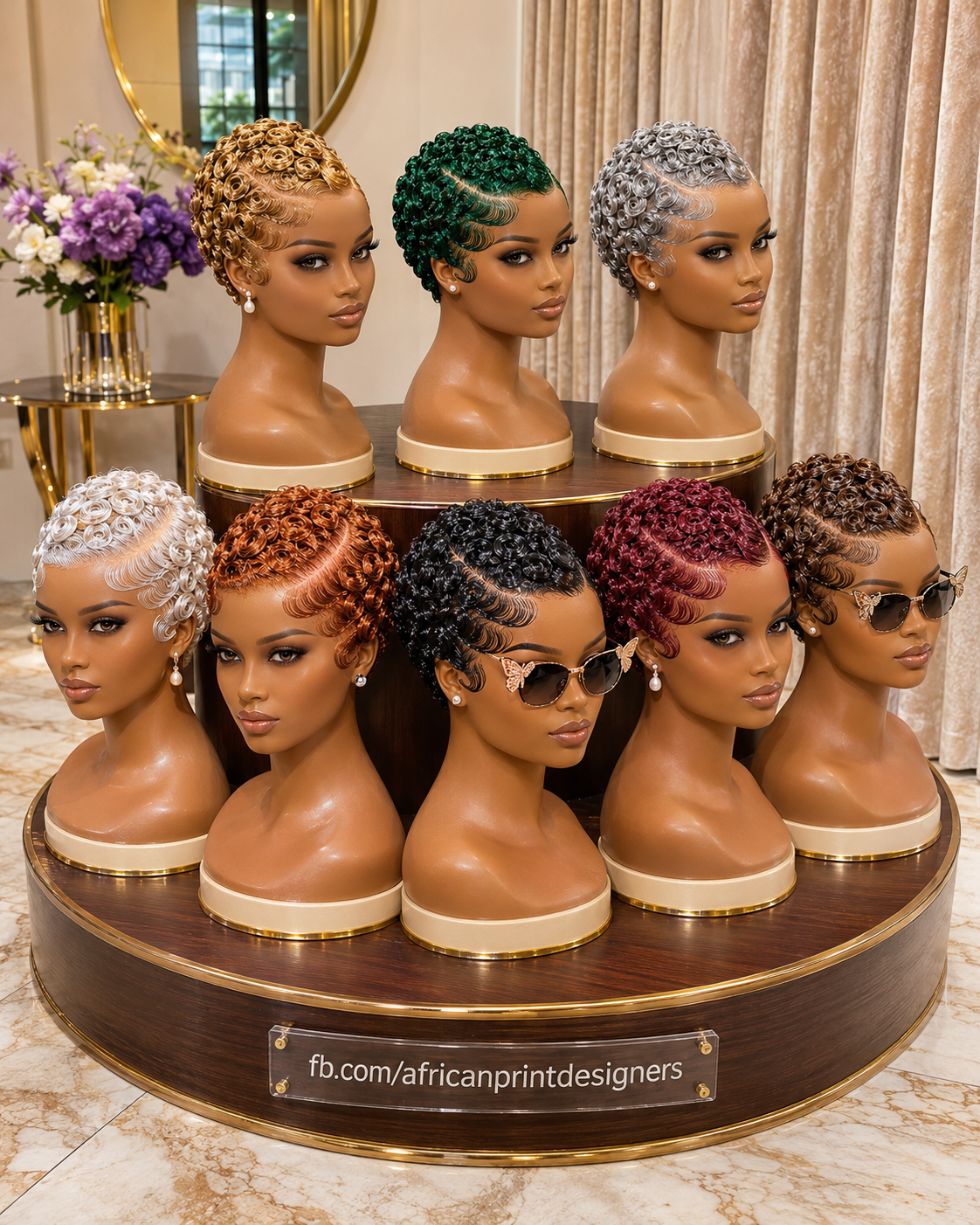
The display presents the hairstyle in golden blonde, emerald green, silver, pearl white, copper, black, burgundy, and brown. Each color changes how the curls and waves catch the light, but the main design remains recognizable. For someone considering a rosette curl pixie wig, this is a useful reference for choosing a finished shape as well as a shade. The best order will translate those visible details into a comfortable cap, an appropriate construction, and a care routine you can maintain.
The Side Waves Give the Cut Its Direction
The most distinctive feature is the sequence of flatter waves beneath the curved part. They descend toward the temple in separate sweeps, creating a repeated pattern beside the face. The raised curls above them have a different profile, which makes the transition easy to see. When describing this hairstyle to a supplier, point out that contrast. A short curly unit with no arranged side section would not reproduce the same appearance, even if its color and crown curls were similar.


The waves also create an asymmetrical impression from the angles shown. One side carries a more visible arrangement, while the crown curls follow the head around it. However, the photograph does not establish the complete opposite-side layout of every unit. Ask for additional views before deciding how closely the style matches your preferences. For custom work, agree on the unseen sections rather than assuming that the maker will repeat or reverse the visible pattern.
Wave placement should be assessed on the wearer. A curve that sits attractively on a mannequin may land differently near an individual forehead or ear. Discuss how far down the temple you want the last section to extend and how prominent the front should remain. The stylist can then work within the unit’s construction while keeping the relationship between the waves and crown intact. That is more useful than copying each strand without considering fit.
Circular Curls Without an Oversized Crown
The upper hair is arranged into small loops with visible centers. Some sit slightly above neighboring sections, while others follow the curve of the head more closely. This creates dimension without a dramatically tall outline. The curls resemble miniature rosettes, but sellers may describe comparable styling as pin curls, molded curls, or a sculpted pixie set. Use those phrases to locate examples, then compare the photographs to establish what each seller actually means.
Look at the spacing between the curls as carefully as the curls themselves. A little separation allows the circular shapes to remain readable. Crowding the crown with more hair could obscure their centers and make the unit appear heavier. If you like the proportions in this image, show the maker the outline rather than automatically requesting maximum density. Coverage, curl size, and section placement should work together to produce the result you want.
The back also needs enough shape to support the crown. These front and three-quarter views do not provide a complete assessment of the nape or rear silhouette. Request a back photograph and a slow rotation of the unit. Ask whether the lower sections are closely shaped or left longer. A cropped wig should remain coherent from behind, with a deliberate transition from the curled upper area into the lower edge.
Choose the Detail You Want to Notice First
Before selecting a color, decide whether you want the hairstyle or the shade to make the strongest impression. Black and brown tend to place more attention on the arrangement and reflected light across the curls. Pearl white and silver introduce stronger contrast against the face. Copper and golden blonde create warmth, while burgundy and emerald offer deeper color statements. These are different visual directions within the same haircut, rather than interchangeable versions of one neutral shade.
Think about how the wig will fit into your wardrobe. An everyday option may need to work with clothes and accessories you already wear frequently. An occasional unit may be chosen for a specific outfit or a more expressive appearance. Neither approach requires buying several colors at once. Select the version you can picture using independently of the display, then confirm that the fit and maintenance are suitable for that purpose.
If you are undecided, compare two finalists under similar lighting. One might be a familiar dark shade and the other a color you are excited to try. Request separate photographs of each unit rather than relying only on the full collection. This helps you assess the actual hairline, curl placement, and color distribution. A shade can look appealing among several contrasting wigs but feel different when it becomes the only color surrounding your face.
Warm Colors and Dark Foundations
The golden blonde version has a warm appearance that makes the circular curls easy to distinguish. Copper carries a stronger orange-brown tone, particularly across the front and raised sections. If either attracts you, ask for the supplier’s specific shade reference. Honey, gold, caramel, and copper can describe broad ranges. A daylight video is useful for seeing whether the proposed color remains close to your preference as the wig turns and different sections catch the light.
Burgundy provides a darker wine-colored option, with brighter red reflections across some curls. Brown offers a warmer alternative to black without the same red emphasis. Clarify whether you want a uniform shade, darker roots, or lighter strands through the crown. The photograph cannot establish every hidden section. Ask how the chosen color continues through the back, nape, and close side areas so the complete unit matches the intended appearance.
Black creates a particularly clear relationship between the exposed part, close waves, and raised curls. Its shine should not be used as the only measure of quality. Ask to see the actual unit in ordinary light, including the spaces between curls. You should be able to assess coverage and shape without a freshly applied finishing spray dominating the photograph. The material and care instructions still require written confirmation, regardless of how convincing the surface appears.
White, Silver, and Emerald Need Precise References
The pearl-white version at the lower left appears warmer and brighter than the silver unit on the upper right. Silver has more gray depth, while pearl white reads as a pale creamy shade in this lighting. If you choose either, do not rely on the word platinum alone. Ask whether the seller’s proposed color is white, ivory, silver, or light blonde, and request an example against a consistent background.
Emerald introduces a deep green interpretation of the hairstyle. The crown catches brighter green reflections, while the side sections look darker. Someone ordering this version should specify that depth. A dark emerald and a much brighter green would create different effects. Request footage of the actual unit or an approved color sample before custom work begins. The shade should be chosen deliberately, with the same attention given to its placement through the curls and side waves.
For all pale or saturated options, ask about color care for the verified material. Do not assume that the same products used on another wig are appropriate. Also clarify whether the displayed finish is achieved through the supplied fiber color, additional coloring, or another process. You do not need to choose a technique yourself, but you do need a reliable description of what you are buying and how its appearance is maintained.
Where To Buy This Wig
The page address on the display is visible reference information, but it does not independently verify the maker, current availability, or sales terms. To locate similar units, search for wig boutiques, independent makers, and salons whose portfolios include short sculpted curl wigs. Useful phrases include “rosette pixie wig with side waves,” “molded curl wig,” and “short pin curl wig.” Examine the actual styling behind each listing rather than relying on the product name.
Look for examples showing both the rounded curls and the flatter side arrangement. A maker who regularly styles loose ringlets may not have demonstrated the particular setting shown here. Ask for front, side, back, and overhead views of comparable work. Also establish whether the business supplies a complete finished unit, customizes a sourced base, or offers styling only. Each route can work, but the remaining tasks and costs need to be clear.
Send the image with a practical brief. Identify the color you want, the compact crown, the circular curls, the curved part, and the stacked side waves. Ask which details can be adapted for cap size and personal preference. Request the verified fiber, construction, measurements, styling inclusions, and complete quote. Clear questions allow the supplier to explain their approach and make it easier to compare offers that may otherwise sound identical.
For a ready-made order, request a rotating video of the exact item being supplied. For custom work, agree on a color reference, estimated completion window, and any review photographs before dispatch. Read the return and alteration terms before payment, particularly when individual cutting or coloring is involved. Keep the written specification and responses together. If an adjustment is needed, those records help identify the specific issue rather than leaving the discussion at a general impression.
Understand the Cap Beneath the Finished Hair
The image shows the exterior, so it cannot establish whether these units use a closure, frontal, wefted cap, or another construction. Ask for an interior photograph and a clear description of the areas available for parting and customization. A closure-based unit provides a different working space from a frontal. The appropriate choice depends on how the part and side waves are created. Ask the supplier to explain why their proposed base supports this particular layout.
If you want the option to move the part later, discuss that before purchase. Some units are built around a limited or fixed arrangement, while others allow more placement choices. Additional lace space does not mean the finished set changes without work. The surrounding curls and waves may need to be rearranged. Decide whether you want a consistent preset style or expect to change its direction, then choose construction that supports that preference.
The hair material also needs separate confirmation. Visible strands and a glossy finish cannot prove human hair, synthetic fiber, or a blend. Ask whether the curl pattern is built into the material or created through a temporary set. That determines what happens after washing and how the pictured finish is restored. Obtain care directions for the specific product rather than relying on broad claims that a material category is easy to maintain.
Fit, Length, and Density as One Decision
A short wig depends on accurate placement because there is little length to conceal an edge sitting too high or low. Measure according to the supplier’s instructions, including any requested circumference, front-to-nape, or ear-to-ear dimensions. Do not assume that a size label from a previous purchase guarantees the same fit. The cap should sit evenly over your usual hair preparation while keeping the front waves and side section in their intended positions.
Discuss density through the finished outline. Too much hair can widen the sides or cover the part, while insufficient coverage can leave unintended gaps between curls. Ask the maker to demonstrate the result rather than relying only on a percentage. Length descriptions also need context. A measurement may refer to stretched strands or an uncut base, not the height of the finished crown. Your order should describe the cropped appearance you expect to receive.
For regular removal, ask whether a suitable glueless option is available and how its cap stays secure. The display cannot verify that feature. If you prefer an installed finish, discuss the method with a wig stylist and follow the relevant product directions. Either route should include removal guidance that protects the front. If excess lace requires trimming, settle the fit first so the final edge is customized around the intended placement.
A Five-Tier Budget for Comparing Offers
The following figures are illustrative planning bands in US dollars. They are not verified prices for the photographed wigs or a current market price list. Actual quotations depend on documented materials, construction, color work, cutting, setting, fitting, and included services. Offers may fall outside these bands. Use the table to organize your questions and compare complete proposals rather than treating price alone as proof of quality.
| Price Tier | Illustrative Budget | Purchase Route | What to Confirm |
|---|---|---|---|
| Budget Starting Unit | Under $75 | A stock cropped wig or basic base for further preparation | Whether the circular curls, side waves, and final shaping are included |
| Ready-Styled Stock | $75–$150 | A preset finished unit in a standard shade and cap size | The exact item, verified material, measurements, and care directions |
| Salon-Finished Option | $150–$300 | A selected base combined with cutting, setting, or fitting | Which color and front preparation services are covered by the quote |
| Individual Custom Order | $300–$500 | A project with agreed color, cap fit, crown height, and wave placement | The construction, review stage, completion terms, and alterations |
| Premium Bespoke Package | Above $500 | An individually specified unit or package with additional appointments | The materials, workmanship, fitting, and aftercare supporting the total |
Compare the total needed to reach the same wearable result. One quote may include cutting, setting, fitting, and lace preparation, while another covers only the base wig. Delivery, taxes, installation, and later resetting may be separate. Ask for a written breakdown where several services are involved. If your budget is limited, prioritize a suitable cap and accurate styling before optional extras. Presentation packaging cannot correct an uncomfortable fit or waves placed differently from the agreed reference.
Maintenance should also fit your budget. If you want a professional to reset the unit after cleaning, find out who can provide that service and what it involves. Ask whether the original maker offers aftercare and whether a local stylist can work with the verified material. You do not need to commit to an arbitrary appointment schedule before trying the wig, but you should understand the likely process and have a practical route to help.
Book the Stylist Before Buying an Unfinished Base
If you plan to have the style created locally, look for a wig specialist with examples of pin curls, molded waves, or short sculpted finishes. Send the reference before booking and explain whether you need a complete unit, fitting, installation, or restyling. If you already own the base, provide its material details and current photographs. The stylist needs enough information to judge whether its length and construction can support the requested arrangement.
During consultation, establish the silhouette first, then refine the side waves and front. Agree on crown height, side closeness, and the back finish before the final set is completed. Ask whether you can review the wig on your head during that process. Bring your normal glasses so their position can be considered near the temples. Also confirm whether cutting, coloring, lace customization, setting, and fitting are separate services or part of one appointment.
Protect the Set Without Overworking It
Before each wear, inspect the crown for compressed curls and check that the side waves remain arranged. After wearing, look for residue or displaced sections before storage. Cleaning frequency should follow the product’s instructions and condition, considering wear and product use. Ask what the unit is expected to look like after washing and which finishing steps restore the style. A temporary set may need renewal even when the underlying hair remains in good condition.
Support the cap when lifting the wig rather than pulling on individual curls. Avoid brushing the entire crown into one mass, since that can separate the loops and change the outline. Ask the stylist to demonstrate a suitable correction for a small displaced section. Use products only as directed for the verified material. If heat is permitted, follow the specific manufacturer’s limits. Do not assume that a sculpted appearance establishes heat compatibility or requires additional shine spray.
Store the unit on a suitable support with room around the curls and side waves. Avoid stretching the cap over an oversized form or pressing the front against another object. For travel, protect the crown from compression and keep delicate sections from folding beneath heavy items. Follow drying directions fully before enclosed storage. Once the fit and set are right, take front, side, and back photographs as a reference for future maintenance.
The Right Finish for Your Routine
The main appeal is a compact hairstyle with detail distributed throughout the cut. Circular curls give the crown dimension, while the descending side waves add movement beside the face. There are few loose ends to manage, and color provides another way to personalize the same basic silhouette. The commitment lies in maintaining the arrangement. Compression, unsuitable brushing, or a cap that shifts can affect the finish, so the style benefits from careful handling and an understood care plan.
Before accepting a completed unit, inspect the color, curl size, part, side waves, and cap fit in ordinary light. Request any missing angles and compare the result with the written specification. For delivered purchases, complete that inspection before alterations that may affect return terms. A convincing version should preserve the balance shown here: a rounded crown of small curls above a close outline, with cascading waves giving the side its expressive direction.
Search Terms
rosette curl pixie wig · cascading side waves · short molded curl wig · curved side part pixie · copper pin curls · pearl white cropped wig · black sculpted waves · burgundy short curl wig