
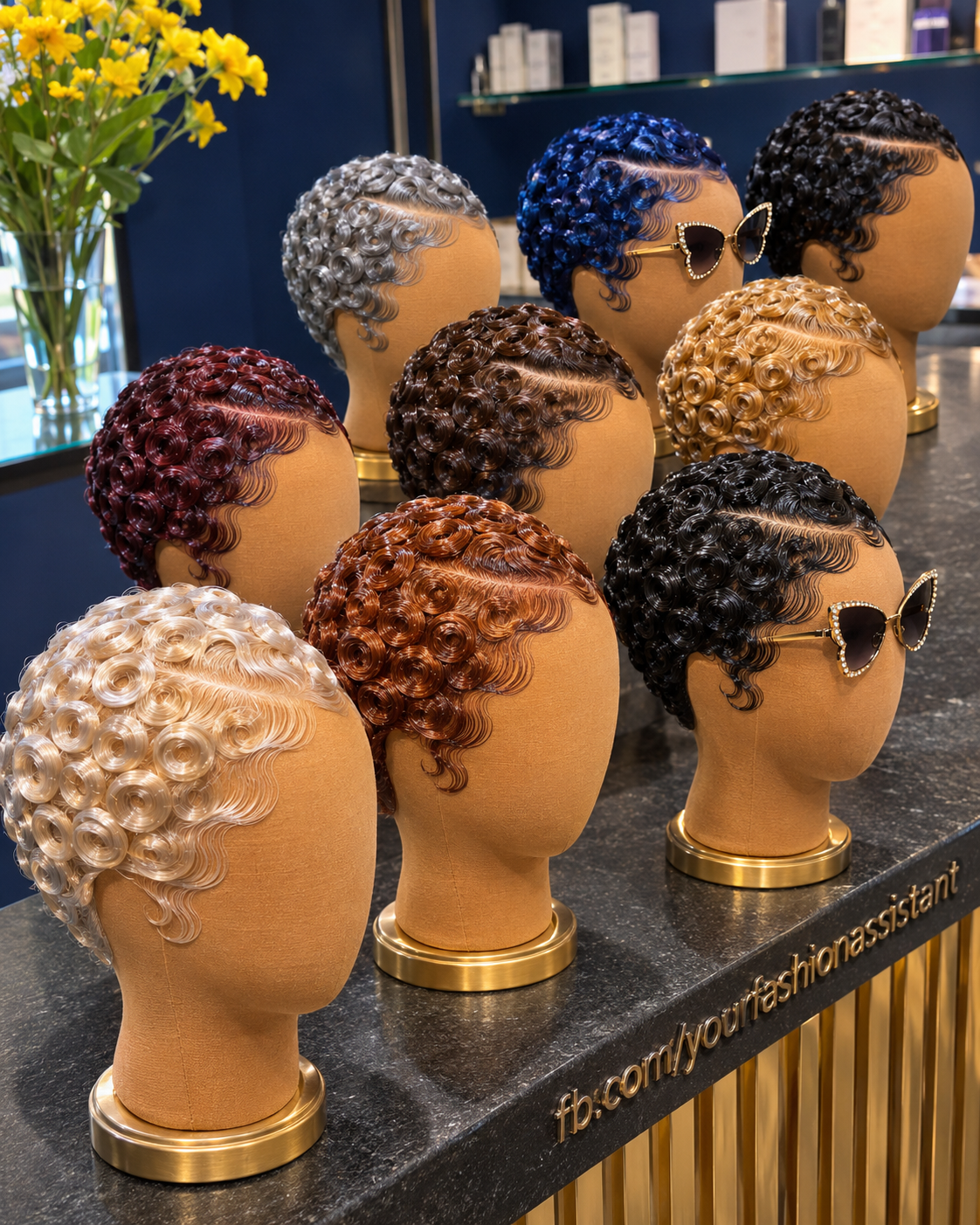
There is something particularly appealing about a pixie hairstyle that combines tiny circular curls with beautifully arranged strands around the forehead. The hairstyle can remain compact while offering considerable detail, personality, and movement. This collection of colorful rosette curl pixie wigs demonstrates that combination through glossy spiral crowns, graceful temple swirls, and carefully positioned side partings.
Displayed on warm caramel-brown mannequin heads inside a stylish wig boutique, the collection presents a variety of hair colors, including ivory blonde, copper auburn, burgundy, chocolate brown, golden blonde, metallic silver, royal blue, and glossy black. The wigs are arranged closely together on a dark stone counter with gold detailing, allowing their individual colors and curl arrangements to be compared.
The most recognizable styling characteristic is the transition between the circular crown curls and the fine waves near the hairline. Several wigs contain small, open rosettes positioned above a sweeping diagonal separation. Beneath that parting, delicate strands curve across the forehead, creating ornamental swirls that follow the shape of the temple.


Unlike conventional curly pixie wigs with loose hanging spirals, these hairstyles rely on closely arranged circular loops. The curls sit near the upper head, creating fullness without requiring considerable length. Some rings are larger and more prominent, while smaller coils fill the surrounding spaces.
For women considering a curly pixie wig, this collection provides useful inspiration for choosing a color and communicating the desired styling details to a salon professional. However, the mannequin presentation does not establish the fiber composition, exact cap construction, lace type, or attachment system of the displayed wigs. Those specifications require confirmation before purchasing.
A Color Collection That Changes the Appearance of Every Curl
The photograph contains nine mannequin heads arranged across three staggered rows. The nearest row displays ivory blonde, copper auburn, and glossy black. Behind them are burgundy, chocolate brown, and golden blonde. The upper row contains metallic silver, royal blue, and another black design.
Although the hairstyles share a compact rosette-curl structure, their individual color treatments create noticeably different results. Some colors emphasize the outline of the circular curls, while others make the hairline waves and exposed partings more prominent.
Ivory Blonde With Soft Circular Spirals
The nearest mannequin on the left wears a pale ivory-blonde pixie. Numerous circular curls cover the crown, with several large rings positioned near the front and upper side.
The color appears creamy white with subtle champagne-blonde reflections. Individual strands remain particularly visible because the light shade emphasizes the circular movement of the curls.
A diagonal parting separates the upper styling from sweeping waves along the forehead. The fine blonde strands curve toward the temple, where they form a decorative extension beneath the raised curls.
This shade offers a lighter alternative to warm golden blonde. Buyers should confirm whether the desired color is ivory, cream blonde, or pale platinum because those descriptions can produce different results.
Copper Auburn With Rich Spiral Curls
The front-center mannequin wears a warm copper-auburn hairstyle. The crown contains numerous circular curls in reddish-brown and orange-copper tones, with darker areas visible between the rings.
The front hairline includes a curved separation and finely arranged strands that sweep toward the temple. Several smaller curls frame the visible side, adding detail without increasing the overall length.
The copper shade gives the hairstyle a warm appearance while preserving the individual circular formations.
For an accurate recreation, request a copper-auburn shade with reddish-brown depth rather than a uniformly bright orange color.
Glossy Black With a Distinctive Side Part
The front-right mannequin displays a deep black pixie with densely arranged circular curls. The crown contains several prominent rosettes, while smaller spirals continue around the visible side.
A diagonal separation is particularly noticeable because the exposed foundation contrasts with the black strands. Beneath the parting, glossy waves travel across the forehead and form small curved accents near the temple.
This hairstyle demonstrates how a single dark color can emphasize intricate styling. No contrasting dyed highlights are clearly visible.
The mannequin also wears decorative sunglasses, which are separate accessories rather than part of the wig.
Burgundy Wine With Compact Rosettes
The burgundy wig in the middle row contains a dense collection of circular curls in deep wine-red and cherry-brown tones.
The curls appear closely packed across the upper head, creating a rounded crown with numerous visible openings.
The side parting and forehead waves maintain the same general styling direction as the surrounding wigs, although individual curl placement varies.
The deep red shade creates a noticeable alternative to black and brown without requiring a longer hairstyle.
Chocolate Brown With Warm Reflections
The middle-center mannequin wears a rich chocolate-brown pixie. The crown contains glossy circular curls with warm brown highlights created by the lighting and reflective strands.
The darker spaces between the curls give the upper hair depth. A prominent diagonal parting divides the styling, while decorative waves follow the forehead contour.
This color may appeal to women who prefer a softer dark shade than jet black.
Before purchasing, compare actual product photographs to distinguish chocolate brown from espresso or dark chestnut.
Golden Blonde With Bright Rosette Curls
The golden-blonde wig in the middle-right position contains numerous rounded curls in honey-gold and amber tones.
The upper rings appear especially prominent because sunlight and salon illumination reflect across their curved surfaces.
The front styling contains sweeping finger waves beneath a visible parting. Several small curls continue toward the temple, maintaining the compact silhouette.
This shade is considerably warmer than ivory blonde and offers a more golden appearance.
Metallic Silver With Pearl-Gray Curls
The upper-left mannequin presents a metallic silver pixie. Its circular curls contain cool gray and pale silver reflections, with darker-looking spaces between the loops.
The diagonal parting is visible through the upper front, and delicate strands curve across the forehead.
The silver shade emphasizes the shape of individual curls without introducing warm blonde tones.
The photograph cannot establish whether the color was manufactured into synthetic fibers or produced through chemical treatment. That distinction should be confirmed before choosing maintenance products.
Royal Blue With Dramatic Circular Coils
The upper-center mannequin wears a vivid royal-blue pixie. Numerous circular curls cover the crown, showing brighter cobalt reflections and deeper navy shadows.
The diagonal separation and temple swirls remain recognizable despite the saturated color.
The mannequin wears decorative sunglasses, which are not included as part of the hairstyle itself.
For a custom commission, specify whether the desired color should be royal blue, cobalt, or a deeper navy shade. The photograph appears predominantly rich blue rather than pale or pastel blue.
Deep Black With Closely Arranged Front Waves
The upper-right mannequin wears another black pixie. Its crown appears densely curled, with numerous small rosettes covering the upper hair.
The front hairline contains a sweeping wave arrangement beneath a clearly visible diagonal parting.
Although this wig shares its color with the black piece in the nearest row, the photographed angles and visible curl placements are not identical.
Buyers should therefore identify the specific mannequin they prefer rather than treating both black examples as interchangeable.
The Rosette Crown Gives These Pixies Their Identity
The circular curls are the unifying characteristic of the collection. Each hairstyle contains numerous rounded loops, many with recognizable openings at their centers.
These curls remain relatively close to the head rather than extending into long hanging spirals. Their compact arrangement creates a rounded upper silhouette without excessive height.
The individual curl diameters vary. Some wigs contain larger rings near the front, while others have smaller, more closely grouped spirals across the crown.
That variation is important because curl diameter influences how the hairstyle appears from a distance.
Larger rosettes create a more pronounced circular pattern, while smaller coils produce a denser surface. Both approaches can work beautifully when the crown remains proportionate.
For a custom wig, ask the maker to discuss the preferred curl size before construction begins. A reference image showing the individual rings will communicate more than simply requesting a curly pixie.
The stylist should also establish whether the crown will have uniform density or contain larger curls concentrated toward the front.
Why the Temple Swirls Deserve Special Attention
The most delicate parts of these hairstyles are the fine strands near the forehead and temples. Unlike the compact circular crown curls, these strands are arranged into elongated waves that lie closer to the mannequin surface.
Several wigs show a series of curved lines extending from the diagonal parting toward the side of the forehead.
The strands follow neighboring paths, creating the appearance of carefully shaped finger waves. Some sections end in small spirals near the temple, while others continue backward into the surrounding curls.
These details are important because they visually connect the upper rosettes to the hairline.
If the larger curls were extended directly across the forehead, the fine waves could become concealed. Conversely, removing the front swirls would give the wigs a simpler appearance.
For a faithful recreation, the forehead waves should be discussed separately from the crown curls.
Ask whether the seller supplies the front styling already arranged or whether it requires professional customization after delivery.
Diagonal Partings Create a Graceful Direction
Most of the displayed hairstyles have a prominent diagonal parting near the upper front. This separation divides the circular curls from the flowing hairline waves.
The exposed channels appear lighter than the surrounding hair because an underlying foundation is visible between the strands.
The parting angle influences the direction of the decorative waves. It also determines where the larger curls begin and how the crown is divided.
The photograph does not establish that the partings were created using a razor or by shaving natural scalp hair. These are mannequin-displayed wigs, and the construction technique remains unverified.
For a custom order, identify the exact parting direction shown on the preferred wig. A straight center part or a differently angled side part could change the appearance considerably.
Because cap positioning affects the final hairline, the parting should also be evaluated during fitting.
Choosing a Color Without Losing the Hairstyle
Color selection is important, but a beautiful shade cannot compensate for an inaccurate curl arrangement.
A royal-blue wig with loose hanging spirals would not reproduce the compact rosette appearance. Similarly, a golden-blonde wig without the decorative forehead waves would have a different character.
When comparing products, examine curl size and parting direction alongside the color.
The warmer shades, including golden blonde, copper, and chocolate brown, create rich reflections along the circular loops. Burgundy introduces deeper red tones, while black emphasizes shape through gloss and shadow.
Ivory blonde and metallic silver allow fine strands to remain especially visible. Royal blue provides the most saturated color alternative in the collection.
Personal preferences, clothing, makeup, and the intended occasion can all influence the final color choice.
The mannequin display is useful for comparison, but it cannot establish exactly how a wig will appear on every individual wearer.
Find Out Where To Buy This
Women seeking similar hairstyles can begin with online wig retailers, local beauty supply shops, and independent wig makers specializing in compact circular curls.
Search descriptions such as rosette curl pixie wig, finger curl pixie, side-parted spiral wig, and sculpted finger-wave hairpiece may help identify relevant products.
However, the actual product photographs are more important than the listing titles.
Ask whether the available wig contains the same type of circular crown, diagonal parting, and temple swirls shown in the preferred reference.
A ready-made wig may be appropriate if those characteristics are already present. Custom construction may offer greater control over curl diameter, color selection, and hairline styling.
Before paying a deposit, verify the material composition, cap dimensions, available colors, production schedule, shipping terms, and return policy.
Do not assume that a specific retailer or manufacturer supplied the photographed wigs simply because the display includes a social media address.
What to Request From a Custom Wig Maker
Start by sharing the reference image and identifying the particular color and curl arrangement to recreate.
Explain that the desired hairstyle should remain compact, with recognizable circular curls and decorative forehead strands.
Ask the wig maker whether the crown will be constructed using individually arranged loops or a different technique capable of producing a similar appearance.
The maker should explain which details can be reproduced accurately and which may vary during hand styling.
Request photographs of the finished hairstyle from above, the front, both sides, and the rear.
A complete underside photograph is also important because the mannequin display does not reveal the internal construction.
Confirm the fiber composition and whether the selected material permits future restyling.
Human hair and synthetic fibers may have very different requirements. A glossy appearance alone does not establish the material.
Cap Types, Density, and Length Choices
The displayed wigs appear compact, but their actual hair lengths cannot be measured from the photograph. Circular styling can make longer strands appear much shorter once they are arranged into loops.
Ask the seller to specify the strand length before styling and the approximate finished hairstyle height.
Hair density should also be discussed. Too little density may leave unwanted gaps between the circular curls. Excessive density may create unnecessary bulk or obscure the parting.
Cap options may include basic wig caps, closure-based constructions, or frontal designs, depending on the supplier and intended hairline. These are possible purchasing categories, not confirmed descriptions of the displayed pieces.
A closure may provide a more limited area for parting and styling, while a frontal may offer greater flexibility across the front hairline. The suitability of either depends on the actual construction and the desired design.
If the product is described as glueless, ask about its attachment system, sizing, and adjustment features rather than relying solely on the claim.
Request cap circumference, front-to-nape length, and ear-to-ear width to help establish a comfortable fit.
Booking a Salon Appointment for Installation
A wig stylist experienced in circular curl placement, precision parting, and finger-wave hairlines is a suitable choice for recreating these hairstyles.
During consultation, identify the preferred curl pattern and show how the front swirls should follow the forehead.
The stylist should check the cap fit before performing any irreversible adjustments.
If the chosen wig contains lace, its position and color should be assessed before trimming. Removing too much lace can compromise the hairline and may be difficult or impossible to correct.
The installation method should depend on the actual cap construction and the wearer’s comfort.
After fitting, inspect the parting and temple waves from different angles to ensure the hairstyle remains proportionate.
Illustrative Prices for Rosette Curl Pixie Wigs
The cost of a similar wig may depend on its material, cap construction, color, curl placement, and any additional customization required.
The following USD ranges are illustrative planning estimates rather than verified live selling prices for the displayed collection.
| Wig Category | Illustrative USD Range | Potential Cost Considerations |
|---|---|---|
| Premium Custom | $380–$960+ | Individual cap measurements, advanced circular curl placement, detailed temple swirls, and custom color arrangements. |
| Standard Custom | $190–$450 | Selected cap options, made-to-order rosettes, and adjustments to the side parting and front waves. |
| Basic Human Hair | $105–$295 | Human-hair base unit that may require separate curling, coloring, and hairline preparation. |
| Premium Synthetic | $70–$200 | Higher-grade synthetic options with prearranged circular curls and material-dependent styling possibilities. |
| Basic Synthetic | $25–$95 | Budget options that may differ in curl precision, color accuracy, and cap construction. |
These figures represent possible purchasing budgets, not confirmed quotations for the photographed products. Actual costs vary by seller, country, materials, workmanship, and included services.
Special colors such as royal blue or metallic silver may involve additional sourcing or processing, depending on the material.
However, the precision of the individual rosette curls and decorative temple waves may also contribute substantially to a custom price.
Ask whether a quotation includes the base wig, completed styling, cap fitting, lace preparation, installation, shipping, and maintenance services.
Maintaining the Ringlets and Forehead Swirls
The main maintenance priority is preserving the circular rosette arrangement.
Aggressive brushing, repeated finger separation, and compression can disturb the loops and reduce their recognizable openings.
The forehead swirls require more delicate handling because their appearance depends on the direction of fine strands.
Ask the supplier how the hairstyle was set and whether the curls can be safely repositioned after washing.
Cleaning methods should follow the verified fiber composition. Synthetic hair should not be exposed to heated styling tools unless the manufacturer explicitly permits them.
Human hair may allow different methods, but previous coloring, chemical processing, and the condition of the fibers should be considered.
Bright colors may require particular attention to colorfastness. Do not assume that products designed for dyed human hair are suitable for synthetic wigs.
For storage, support the compact crown without crushing the curls or placing unnecessary pressure on any lace hairline.
The Benefits and Limitations of Sculpted Pixie Wigs
One advantage of this hairstyle family is its compact length. Women who prefer closely arranged curls may appreciate having a distinctive hairstyle without managing long, hanging hair.
The circular rosettes provide visual fullness, while the decorative forehead waves offer an additional styling detail.
The collection also demonstrates substantial color flexibility, from dark natural-looking shades to brighter fashion colors.
However, intricately arranged curls can require careful maintenance. They may not tolerate ordinary brushing or repeated restyling without losing their original form.
Some custom versions may also involve higher labor costs because the curls and hairline details must be positioned individually.
A proper cap fit remains essential regardless of the hairstyle’s appearance. A beautiful wig that sits incorrectly may fail to position the parting and temple swirls as intended.
Finding the Right Rosette Pixie
This collection illustrates how a single hairstyle family can produce a broad variety of appearances through color, curl size, and decorative hairline movement.
The circular crown creates a compact silhouette, while the diagonal partings and temple swirls give the wigs their recognizable character.
Whether the preferred shade is golden blonde, chocolate brown, copper auburn, burgundy, metallic silver, royal blue, ivory blonde, or glossy black, the best choice should preserve the relationship between the curls and front styling.
Before purchasing, examine photographs of the actual product, verify the cap and material specifications, and discuss fitting with a qualified stylist when necessary.
A carefully chosen rosette pixie can provide an attractive combination of compact curls, expressive color, and delicate hairline styling while remaining practical to wear with appropriate care.
Search Terms
Rosette curl pixie hairstyles · Delicate temple swirl pixie wigs · Royal blue circular coil hairpiece · Metallic silver side parted curls · Burgundy finger wave pixie wig · Ivory blonde open rosette crown · Copper auburn forehead swirl hairstyle · Glossy black compact spiral pixie