
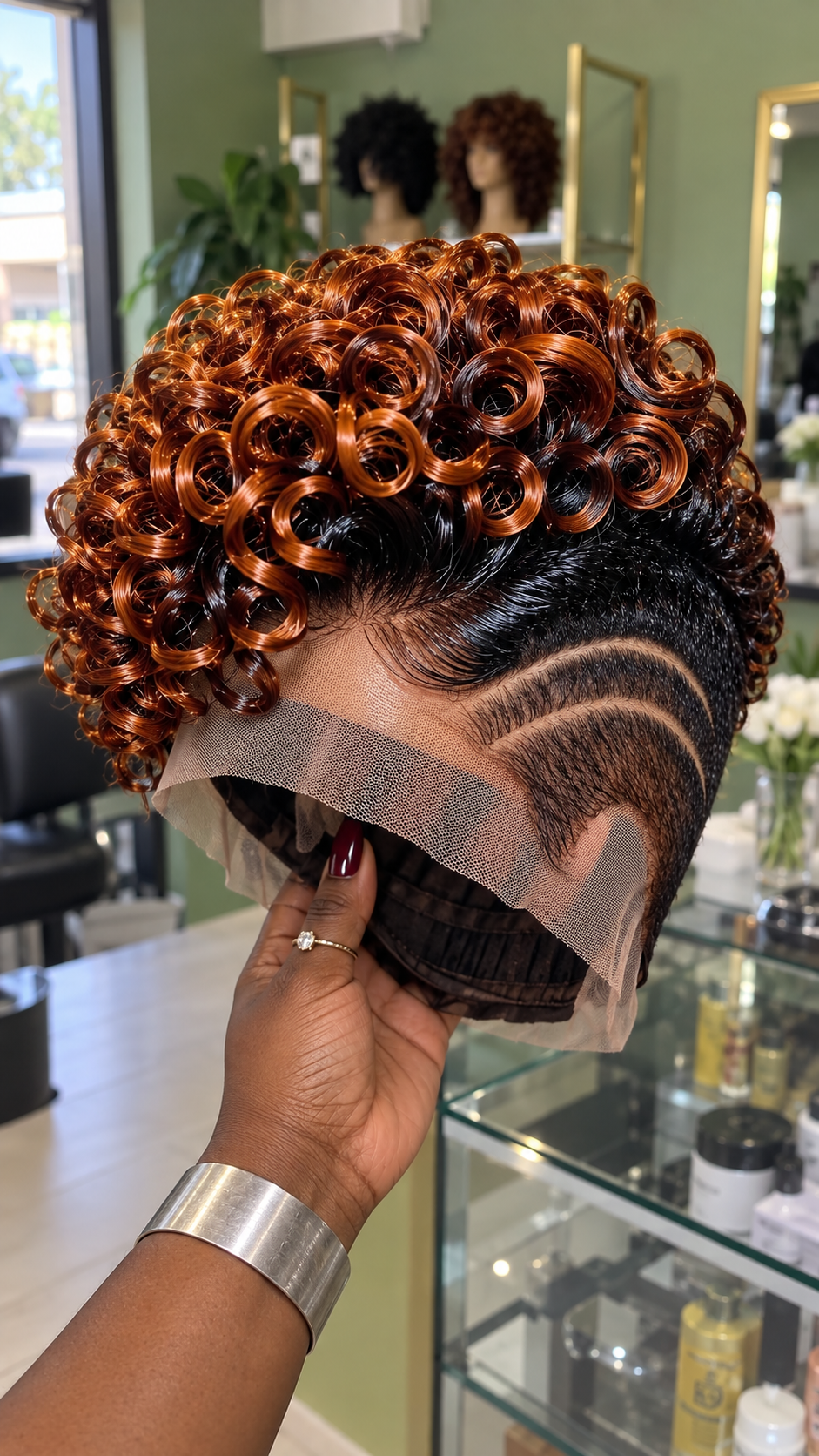
There is a striking difference between a wig that simply has copper-colored curls and one in which every circular ringlet contributes to a carefully arranged composition. This salon photograph captures the latter: a vivid copper-orange curly wig with deep black foundations, closely packed spiral loops, and two sweeping curved channels along the visible temple. The hairstyle combines the brightness of metallic-looking copper curls with the precision of a closely arranged dark side section.
The wig is shown before installation, supported by one hand beneath its exposed cap. A broad section of beige-brown lace extends beyond the front hairline and down the visible side. This presentation makes it possible to study the relationship between the circular upper curls, the dark hair beneath them, and the curved side pattern that would otherwise be more difficult to inspect.
The most compelling aspect is the deliberate contrast between circular and sweeping shapes. The upper hair forms numerous small and medium-sized ringlets, while the temple carries two elongated curves that follow the contour of the side. Rather than competing, these elements create a distinctive silhouette that can appeal to customers seeking a colorful pixie wig with decorative barber-inspired detailing.
Where the Copper Begins and the Black Foundation Remains Visible
The copper coloring is concentrated across the raised ringlets. Under the salon lighting, the curls display bright orange-copper reflections, with darker auburn tones appearing inside the spiral openings and between overlapping sections. The color is especially vivid across the front and uppermost curls, where the strands catch the strongest light.
Near the base of the ringlets, dark hair remains visible. This black foundation creates depth beneath the copper surface and prevents the hairstyle from appearing uniformly orange. The visible temple and lower side are predominantly black, giving the decorative curved channels a darker background.
These are meaningful distinctions for anyone commissioning a similar wig. A fully copper-colored pixie would produce a different visual result, particularly around the face. The reference depends on keeping the lower hair dark while allowing the elevated ringlets to carry most of the warm color.
The copper also has a glossy, almost polished appearance in the photograph. However, the reflective surface should not be interpreted as proof of a particular fiber, hair grade, or finishing product. Salon lighting and the direction of the strands can significantly influence the apparent shine.
Choosing Between Copper, Auburn, and Burnt Orange
Color terminology can create confusion when ordering this style. Copper orange usually suggests a bright mixture of red and orange, while auburn tends to contain more brown. Burnt orange may appear deeper and less reflective, depending on the manufacturer’s formulation.
The photographed curls lean toward a bright copper-orange appearance with darker reddish-brown areas. They do not resemble pale strawberry blonde or conventional golden blonde highlights.
A buyer should send the reference photograph and request confirmation of the proposed shade under daylight. If the seller offers a color chart, compare the actual hair samples rather than relying exclusively on a numbered shade description.
It is also worth confirming whether the copper color extends through each ringlet or whether the maker plans to create a darker-root effect. The visible design uses dark hair beneath the curls, and preserving that contrast is essential to reproducing the overall appearance.
The Circular Ringlets Create a Sculptural Surface
The upper portion contains dozens of individually recognizable spiral loops. Some form almost complete circles with dark openings at their centers, while others overlap, bend sideways, or descend toward the front edge. The arrangement creates a dense but highly decorative surface.
Several prominent ringlets near the front are approximately similar in apparent size, although perspective makes exact measurements impossible. Farther toward the visible rear, smaller loops fill the spaces between larger curls. This variation helps maintain a continuous rounded silhouette without making the arrangement look mechanically identical.
The copper strands follow the circular paths closely. Bright reflections trace the outer edges of the loops, emphasizing their shape against the dark interior. The result resembles a collection of polished copper spirals arranged over a black foundation.
Unlike loose curls that naturally fall toward the shoulders, these ringlets are elevated and concentrated near the head. Their placement gives the wig a compact overall length while creating considerable detail across the upper surface.
Why Ordinary Curly Wigs May Not Reproduce This Appearance
A ready-made curly pixie may have the correct color and approximate length but still look very different. The reference uses relatively organized circular loops rather than an irregular mass of springy curls.
To reproduce the hairstyle, a wig maker must consider the diameter of the ringlets, their direction, how closely they sit together, and how they connect to the dark foundation.
If the loops are too large, the upper section may appear bulky. If they are too small or tightly compressed, the distinctive circular openings may become difficult to recognize.
Customers should therefore ask whether the stylist can create visible ringlet openings across the upper section instead of simply adding curls to a pixie base.
A photograph taken from directly above can be useful during customization. It reveals whether the upper curls are evenly distributed and whether any large gaps interrupt the intended rounded arrangement.
The Twin Curves at the Temple Deserve Special Attention
The visible side carries two prominent curved channels that sweep backward from the front temple area. They are separated by a dark band of closely arranged hair and follow a broadly similar direction, creating a nested curved appearance.
The upper curve sits close to the transition between the black hairline area and the lower temple section. Beneath it, a second curved channel follows a related path, producing a layered design.
The channels appear lighter than the surrounding hair, making their shape clearly visible against the black foundation. Their rounded direction complements the circular curls above, but they remain visually separate because the lower hair is closely fitted to the head.
This design should not be confused with straight parallel lines or zigzag artwork. Its identity comes from the sweeping curves and the way they follow the side contour.
The photograph suggests a carved or carefully separated hair pattern, although the exact method used to create the lighter channels cannot be established from the image alone. A wig maker should explain whether the design involves cutting, controlled parting, ventilation, or another construction technique.
Positioning the Curves on the Wearer’s Head
The temple artwork occupies a noticeable portion of the visible side. Its placement matters because the curves are intended to be seen beneath the copper ringlets rather than hidden by them.
If the wig sits too far forward, the pattern may approach the face unnaturally. If it sits too far backward, the decorative curves may become less visible from a normal viewing angle.
Before installation, a stylist should position the cap and examine how the pattern aligns with the wearer’s temple and ear area. The lace should not be trimmed until the intended placement is established.
The photograph does not show the opposite side clearly enough to establish whether matching curves are present there. Buyers who want symmetrical artwork should request confirmation before ordering.
A Closer Examination of the Untrimmed Lace
The front of the wig includes a broad beige-brown lace extension. Its mesh is visible across the forehead area and continues downward along the exposed side. Fine dark hairs emerge near the styled hairline, while the lace itself extends beyond the areas containing hair.
This extra material provides room for fitting and trimming, but it should not be cut indiscriminately. The temple design approaches the lace boundary, making careful preparation especially important.
At the front, the hairline includes a small sweeping arrangement of dark strands beneath the copper curls. These strands create a transition between the raised ringlets and the exposed lace.
The lace appears fine in the photograph, but its exact category cannot be confirmed visually. It would be inappropriate to identify it as HD lace without reliable product information.
Likewise, the photograph does not establish whether the unit is designed for adhesive-free wear. The visible cap and lace provide construction clues, but the securing system must be confirmed by the seller.
What the Exposed Cap Tells a Careful Buyer
The underside of the wig is partially visible because it is held from below. A dark brown interior cap with stitched fabric sections can be seen beneath the lace perimeter.
The cap appears structured enough to maintain the wig’s general shape while it is being displayed, but the image does not reveal its exact measurements, ventilation method, or complete attachment system.
Before purchasing, request a photograph showing the entire underside. This should include the front lace area, side construction, rear perimeter, and any adjustable straps, combs, or clips that are actually present.
Cap measurements are especially important for this hairstyle because the decorative temple curves must sit in a specific location. A poorly fitted cap can distort the relationship between the hairline, the side artwork, and the raised curls.
Ask the maker which measurements are required. These commonly include head circumference, front-to-nape distance, ear-to-ear distance, and temple measurements.
If ordering online, confirm whether the seller offers multiple cap sizes or individual adjustments. Do not assume that a standard-size unit will fit every wearer comfortably.
Finding a Stylist Who Can Combine Copper Ringlets With Side Artwork
This wig requires more than basic curling. The upper section needs carefully arranged circular ringlets, while the lower side demands precision in the placement of the curved channels.
A stylist experienced only with loose curly wigs may not be familiar with the sculptural ringlet arrangement. Similarly, a barber skilled in side designs may not necessarily understand lace wig construction.
The ideal professional is a custom wig maker or salon with experience in both structured curl styling and detailed pixie customization.
When researching local salons, search for specialists offering custom lace pixie wigs, spiral curl wig styling, curved side hair designs, or sculpted curly wig installations.
Ask to see previous examples of similar work. Photographs showing compact curls and carefully arranged temple details are more relevant than a general portfolio of long wigs.
For online orders, provide the reference image and identify the three elements that must remain consistent: bright copper ringlets, a dark lower foundation, and two sweeping temple curves.
Request photographs of the actual finished unit before shipping. A catalog photograph alone may not demonstrate whether the product matches the advertised styling.
From Custom Order to the First Salon Fitting
The production process should begin with agreement on the hairstyle’s proportions. The maker needs to understand the intended height of the copper ringlets, the approximate width of the dark lower section, and the location of the curved temple artwork.
Next, the customer should confirm the proposed hair material, cap size, lace specifications, and color arrangement. The photograph does not establish whether the displayed wig uses human hair or synthetic fibers, so these details must be obtained directly from the seller.
Once the base is prepared, ask for a side photograph before the final curl arrangement is completed. This allows the temple design to be inspected without the upper ringlets obscuring its edges.
After the curls are arranged, request front, side, and rear views. The rear photograph is particularly important because the reference does not fully reveal how the curls transition around the back.
When the wig arrives, inspect it before cutting the lace. Check the color, curl placement, cap condition, and the position of the temple curves.
During installation, the stylist should establish the correct cap position, evaluate the lace, and make only the adjustments necessary for a secure and natural-looking fit.
Any trimming near the decorative side pattern should be approached cautiously. Removing hair or lace from the wrong area can permanently alter the design.
Estimated Pricing for Copper Ringlet and Curved Temple Wig Designs
A wig with this level of decorative styling may cost more than a conventional curly pixie because of the work involved in arranging the circular loops and preparing the side pattern. The following USD amounts are illustrative planning ranges, not verified live prices or quotations for the photographed unit.
| Wig Category | Illustrative USD Range | Possible Purchase Characteristics |
|---|---|---|
| Premium Custom | $310–$720+ | Individual sizing, specialized copper color placement, detailed ringlet arrangement, curved temple artwork, and customized lace preparation. |
| Standard Custom | $165–$355 | Customized copper curls, dark lower sections, and a professionally arranged curved side pattern. |
| Basic Human Hair | $100–$245 | A human-hair base that may require additional coloring, curl formation, and temple customization. |
| Premium Synthetic | $75–$185 | Higher-priced synthetic options with copper coloring and prearranged curls, subject to manufacturer specifications. |
| Basic Synthetic | $30–$95 | Budget curly pixie alternatives that may resemble the copper color without reproducing the intricate side design. |
The largest price difference may come from the amount of individual styling required. A wig with loosely curled copper hair is generally a different production challenge from one containing numerous recognizable circular ringlets.
The curved temple pattern may also require specialist labor. Its cost depends on how it is created and whether the base wig is suitable for the intended design.
Color preparation can influence the quotation as well. Producing bright copper curls over a dark foundation may involve different materials or processes from preparing a single-color unit.
Ask whether the quoted amount includes installation, lace trimming, shipping, and any necessary cap alterations. These services may be billed separately.
The categories above describe possible buying options. They should not be interpreted as evidence that the photographed wig belongs to any particular material category.
Keeping the Copper Ringlets Circular After Repeated Wear
The main maintenance concern is preserving the shape of the individual ringlets. Their visual appeal depends on recognizable circular openings, and aggressive brushing can separate the strands or cause neighboring curls to merge.
Before washing, ask the maker whether the curls are intended to retain their arrangement naturally or require professional resetting. The answer depends on the actual fiber and styling method.
For human-hair versions, repeated washing and heat styling may gradually affect the ringlet formation. If the hair has been chemically colored, the copper shade may also require additional care to reduce fading.
For synthetic versions, the manufacturer’s heat and washing instructions should take priority. Do not use heated tools or attempt recoloring without confirming compatibility.
Avoid applying excessive heavy products to the circular curls. Product buildup may reduce strand separation and make the ringlets appear less distinct.
When handling the wig, support the cap rather than pulling on individual curls. This helps reduce unnecessary tension on the styled sections.
Protecting the Black Temple Area
The dark side requires careful handling because its appearance depends on the contrast between the closely arranged hair and the lighter curved channels.
Avoid brushing across the channels in a way that displaces the surrounding strands. If the pattern begins losing its clarity, consult a stylist familiar with the wig’s construction.
Do not attempt to deepen the channels with clippers or a razor without professional assessment. The underlying cap and hair density may not support additional cutting.
During storage, place the wig on a suitable stand that supports the cap without compressing the copper ringlets. Keep the decorative side away from surfaces that could rub against the hair.
Evaluating the Design as a Long-Term Purchase
This copper-orange wig offers a particularly distinctive combination of color and structure. The bright circular ringlets attract attention immediately, while the dark foundation and twin curved temple channels add a second layer of detail.
Its appearance is most successful when the upper and lower sections remain visually balanced. The ringlets should be prominent without overwhelming the side artwork, and the black hair should provide enough contrast for the copper color to remain vivid.
For buyers considering a similar unit, the most useful approach is to prioritize craftsmanship over generic product descriptions. Ask for accurate color photographs, confirmation of the cap construction, and evidence that the stylist can reproduce both the ringlet arrangement and the curved side design.
The result can be a memorable pixie wig that combines warm copper coloring with intricate hair artistry. With careful ordering, appropriate fitting, and material-specific maintenance, the distinctive circular curls and temple detailing can remain the central attraction of the hairstyle.
Search Terms
Copper orange circular ringlet lace wig · Black root copper spiral pixie wig · Twin curved temple line curly wig · Glossy auburn copper loop crown · Beige lace copper ringlet wig · Black side nested curve pixie hairstyle · Dark foundation orange spiral curl wig · Untrimmed lace copper curly wig with exposed cap