
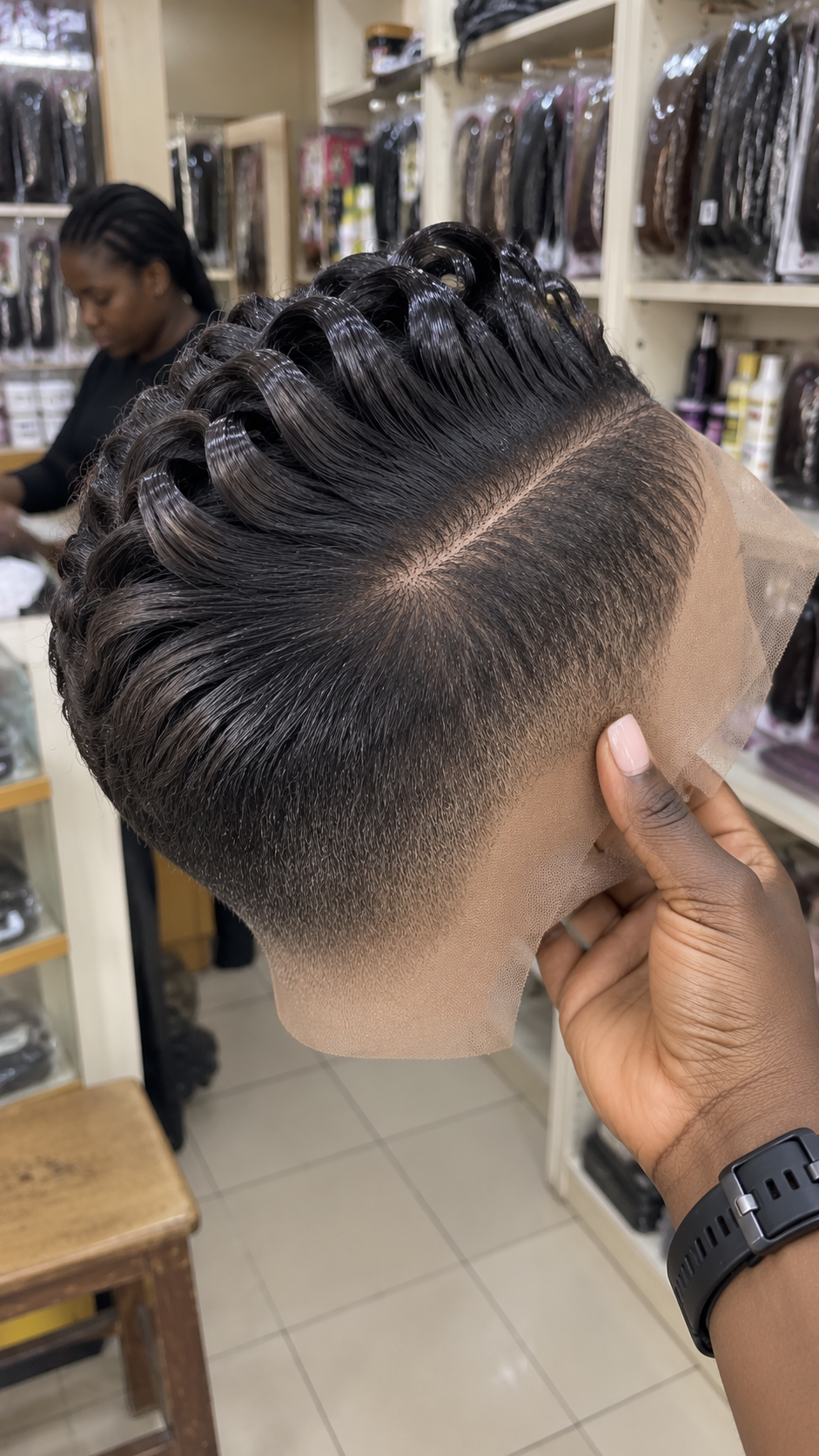
The most revealing detail in this jet black wig is not the shine of its curls. It is the narrow, pale parting that separates the elevated upper hair from the closely arranged side section. That single line gives the hairstyle a strong sense of direction, making the contrast between the raised barrel loops and the compact lower hair immediately noticeable. For women shopping for a sculpted pixie wig, this distinction is worth understanding before choosing a product based on color or length alone.
Photographed inside a beauty supply shop, the wig is supported by one hand while its lace extends beyond the styled hairline. The viewing angle reveals the side arrangement, a substantial portion of the upper hairstyle, and the transition toward the lower perimeter. The black hair has a highly reflective appearance, with silver-gray highlights produced by light striking the curved strands. These reflections do not establish the presence of gray coloring or a separate highlight treatment.
The design combines several styling techniques that should not be confused with one another. Broad looped curls occupy the upper portion, a narrow diagonal parting creates separation, and the lower side contains closely directed hair with a gradual reduction in apparent density near the perimeter. The photograph does not show a conventional exposed scalp fade on a person; it shows a styled wig on a lace foundation. That difference matters when requesting an accurate reproduction.
A Single Diagonal Channel Controls the Hair Direction
Unlike wigs that rely on multiple decorative partings, this piece uses one prominent channel to divide its visual structure. The line begins near the forward upper side and travels diagonally across the visible surface toward the denser rearward hair. Its pale appearance contrasts against the dark strands on either side.
The parting is relatively narrow, but its position makes it highly noticeable. Above it, the hair rises toward the barrel-loop arrangement. Below it, the strands lie much closer to the wig foundation and follow a downward and backward direction.
The channel is not perfectly horizontal, and that is important. Its diagonal orientation creates a transition between the high upper styling and the lower side rather than simply dividing the wig into equal sections.
A customer describing this design to a stylist should emphasize the continuous diagonal separation. Asking for a generic side part could produce a line that begins in a different position or follows a different angle.
The exposed channel appears to reveal a lighter foundation beneath the dark hair. The exact material responsible for that appearance cannot be established from the photograph. It should not automatically be described as a shaved scalp line or a particular lace technology.
What Can Go Wrong With the Parting Placement?
Moving the parting too high would reduce the area available for the raised loops. Positioning it too low could make the compact side section appear unnecessarily wide. A thicker channel might also create a stronger contrast than the photographed design requires.
For custom work, ask the stylist to position the parting while the wig is being assessed on a suitable head form or during a fitting. The correct angle should be evaluated together with the height of the upper hair.
If the parting has already been established during manufacture, changing it may be difficult without disturbing the surrounding strands. That makes its placement an important purchasing criterion rather than a minor detail to correct later.
The Barrel Loops Create Height Without Excessive Bulk
The upper hair is arranged into elongated, rounded loops that curve backward over the head. Several loops have wide openings, allowing their individual shapes to remain visible instead of merging into a continuous mass of curls.
The front portion rises from the hairline and feeds into the curved upper arrangement. Moving farther across the visible crown, the loops become closely grouped, creating a controlled ridge of raised hair.
This is different from a hairstyle made entirely of small finger coils. The visible curls are comparatively broad, with sections of hair traveling together in ribbon-like arcs. Their shape contributes to the elevated profile without requiring a large, rounded afro-style crown.
The outer edges of the loops are particularly reflective. Bright streaks follow the curvature of individual strands, making the styling appear almost lacquered under the shop lighting. The photograph alone cannot establish whether the appearance comes from styling products, the fiber surface, or a combination of both.
For buyers who want this appearance, the essential request is a controlled barrel-loop crown with a backward movement and distinct curved sections. Simply asking for curly black hair may result in a very different wig.
Maintaining the Correct Crown Proportions
The upper section needs enough height to remain visibly separate from the lower side, but excessive height would change the silhouette. The photographed hairstyle achieves its impact through the arrangement of the loops rather than through uncontrolled fullness.
When evaluating a custom sample, examine the distance between the parting and the highest point of the upper hair. The loops should appear supported and intentional, with their openings remaining recognizable from a side perspective.
A video showing the wig being rotated slowly can help establish whether the crown has consistent structure. A single photograph may conceal flattened areas or differences in curl placement on the opposite side.
The image does not reveal the complete back of the wig, so the precise rear arrangement should be confirmed with additional photographs before a custom order is approved.
Black Hair With Cool Reflective Highlights
The dominant hair color appears to be a deep natural-to-jet black. Under the shop lighting, individual strands reflect cool silver-gray tones, particularly along the upper loops and the longer strands above the parting.
These reflective streaks should not be mistaken for a black-to-silver color transition. No clearly separate silver-dyed section is visible. The underlying color appears consistently dark across the photographed hairstyle.
The lower side looks slightly softer and less reflective than the upper curls. This difference is consistent with the shorter, closely arranged strands catching less direct light, although the photograph cannot establish whether the sections contain identical fibers or styling products.
For online ordering, request photographs under natural daylight as well as indoor lighting. A deep black wig may appear warmer or cooler depending on the camera, surrounding colors, and illumination.
Ask the seller whether the available shade is described as natural black, off-black, or jet black. These names are not always used consistently across manufacturers, so actual photographs or color samples are more dependable than a label alone.
The Lower Side Is About Density and Direction
Below the diagonal channel, the hair lies close to the wig surface. The upper part of this section contains numerous fine strands directed backward and downward, creating a compact appearance beneath the raised curls.
Near the lower perimeter, the visible hair becomes less dense and the tan foundation is easier to see. This produces a tapered visual effect, although the photograph does not prove that the wig was constructed using a conventional barber fade technique.
The transition is important because the lower section acts as a visual counterweight to the elevated loops. Without it, the upper styling might appear disconnected from the rest of the wig.
Buyers should examine how the lower hair is attached and arranged. A close-up photograph can reveal whether the transition looks consistent or whether the density changes abruptly.
If the seller advertises a tapered pixie wig, request a side photograph taken at eye level. This helps distinguish a genuinely close-fitting lower profile from a wig that merely appears narrow because of the camera angle.
Untrimmed Lace and the Questions It Raises
A broad section of tan lace extends beyond the hairline around the visible front and side. The lace is clearly untrimmed, indicating that the wig is being displayed before final preparation for wearing.
The mesh provides an opportunity for fitting, but its exact grade and dimensions are not established. The photograph does not confirm HD lace, a full-lace cap, or a particular installation system.
The hand holding the wig supports its outer edge, and the image does not expose the complete interior. Consequently, there is no reliable basis for claiming that the unit includes adjustable straps, attachment combs, elastic bands, or other internal hardware.
Before ordering, ask for an underside photograph that shows the complete cap. This should be accompanied by measurements of the cap circumference, front-to-nape distance, and ear-to-ear width.
The lace color also deserves attention. Although it appears tan in the photograph, its appearance against an individual’s skin may differ. A stylist can assess whether the lace is suitable for the intended installation without assuming that it will automatically blend with every complexion.
Why the Lace Should Remain Uncut Until Fitting
Trimming the lace before checking the wig’s position can create unnecessary problems. The hairline, side parting, and lower perimeter need to sit correctly relative to the wearer’s forehead and temples.
Once the wig has been positioned and assessed, a qualified stylist can determine how much lace should be removed. Cutting too close to the hairline can eliminate useful material and may be impossible to correct.
The visible lace does not establish that adhesive is required. Equally, it does not establish that the wig can be worn securely without adhesive. The appropriate attachment method depends on the actual cap construction and the wearer’s needs.
Finding the Right Wig Maker for This Design
Women seeking this hairstyle should look for a wig customization specialist with experience in sculpted pixie units, precision parting, and structured curl placement. A general hair retailer may carry similar black wigs, but the exact upper-loop arrangement may require specialist styling.
When contacting a seller, share the photograph and identify the three elements that matter most: the diagonal parting, the raised backward-facing loops, and the closely arranged lower side.
Ask whether the wig is sold in its completed hairstyle or whether the photograph represents a sample that may vary from the delivered product.
A ready-made piece can be a practical option if these characteristics are already present. However, a custom order may offer greater control over crown height, loop placement, and the relationship between the upper and lower sections.
Before paying a deposit, request confirmation of the fiber composition, cap dimensions, lace specifications, customization services, production time, and return conditions.
If the seller cannot provide a clear side photograph or explain how the parting is constructed, consider comparing other suppliers rather than relying on promotional descriptions alone.
Planning the Installation Appointment
The installation process should begin with an inspection of the delivered wig. Check that the loops have retained their shape during shipping and that the diagonal channel remains visible without hair crossing over it.
The stylist should then assess the cap fit and position the wig on the wearer’s head. The parting needs to follow the intended angle, while the lower side should sit comfortably without pulling against the temples.
Any necessary lace trimming should follow the fitting rather than precede it. If minor adjustments are needed around the front hairline, they should preserve the upward direction of the strands feeding into the barrel loops.
After the wig is secured using a suitable method, the stylist can examine the upper arrangement from different angles. The curls should retain their raised structure without creating an exaggerated or unbalanced profile.
For an appointment, search for professionals using descriptions such as lace wig customization specialist, sculpted pixie wig stylist, or precision parting wig installation. Review photographs of their previous work before booking.
Estimated Investment for a Sculpted Black Lace Wig
The main potential expense in recreating this design is the labor required to establish the diagonal parting and arrange the elevated loops. The dark color may not require the same processing as a complex multitone blonde wig, but precision styling can still increase the cost.
The following USD amounts are illustrative planning ranges rather than verified live prices. The photographed wig’s fiber composition and actual selling price are unknown.
| Purchasing Category | Illustrative USD Budget | What May Influence the Cost |
|---|---|---|
| Premium Custom | $330–$800+ | Individual cap fitting, specialist barrel-loop construction, precise parting placement, and advanced hairline preparation. |
| Standard Custom | $170–$370 | Customized upper curls, selected cap specifications, and adjustments to the lower side arrangement. |
| Basic Human Hair | $90–$240 | Human-hair base wig that may require separate curl setting, parting work, and lace customization. |
| Premium Synthetic | $60–$160 | Higher-grade synthetic alternatives with factory-arranged styling and material-dependent curl retention. |
| Basic Synthetic | $25–$70 | Budget alternatives that may offer simpler loop placement, less precise parting, or different cap construction. |
These categories represent possible purchasing options, not confirmed classifications of the pictured product. The price of a finished wig may differ substantially from the cost of buying an unstylized base unit and paying a professional to recreate the hairstyle.
Ask whether the quotation includes the lace preparation, final styling, fitting appointment, and installation. Shipping and additional salon services may be charged separately.
For this design, a lower-priced wig that already has accurate loop placement could offer better practical value than a more expensive base unit requiring extensive reconstruction.
Preserving the Barrel Shapes Without Disturbing the Parting
Routine care should focus on protecting the relationship between the upper loops and the diagonal channel. Aggressive brushing across the top could pull individual strands out of their curved arrangement and interfere with the styling direction.
Rather than repeatedly separating the loops with fingers, ask the supplier how they were formed and whether they can be repositioned safely. Some styles may require professional resetting after significant disturbance.
The closely arranged lower side also needs careful handling. Product buildup can make fine strands clump together, while excessive manipulation may cause hair to cross the parting and reduce its visibility.
Cleaning instructions depend on the verified material. Synthetic fibers should not be exposed to heated tools unless the manufacturer confirms their suitability. Human hair may tolerate different styling methods, but previous chemical processing and the condition of the fibers still matter.
During storage, avoid compressing the raised loops. Use an appropriately sized support that maintains the wig’s general profile without placing excessive tension on the lace.
If the parting becomes less distinct or the loops lose their original shape, a professional maintenance appointment may be preferable to attempting major restyling without knowing the construction method.
Choosing Accuracy Over Generic Product Descriptions
This wig demonstrates how a relatively restrained color palette can support an intricate hairstyle. The deep black shade keeps attention on the raised barrel loops, while the diagonal parting creates a clear division between the upper styling and the close-fitting lower section.
For buyers, the most useful comparison is not simply whether another product is black, curly, and described as a pixie. It is whether the alternative preserves the specific direction of the loops, the angle of the parting, and the compact lower silhouette.
Requesting additional product angles, confirming the cap construction, and arranging a proper fitting can prevent misunderstandings that are difficult to correct after customization.
The final result should maintain the distinctive upper shape without sacrificing comfort or natural positioning. When those details are handled carefully, the hairstyle can retain the striking contrast visible in the reference while being adapted appropriately to the individual wearer.
Search Terms
Jet black barrel loop lace pixie wig · Single diagonal parting black wig · Elevated ribbon curl crown hairpiece · Black tapered side lace wig · Untrimmed tan lace sculpted pixie · Backward swept barrel curls wig · Glossy black precision parted hairpiece · Close fitting side with looped crown wig