
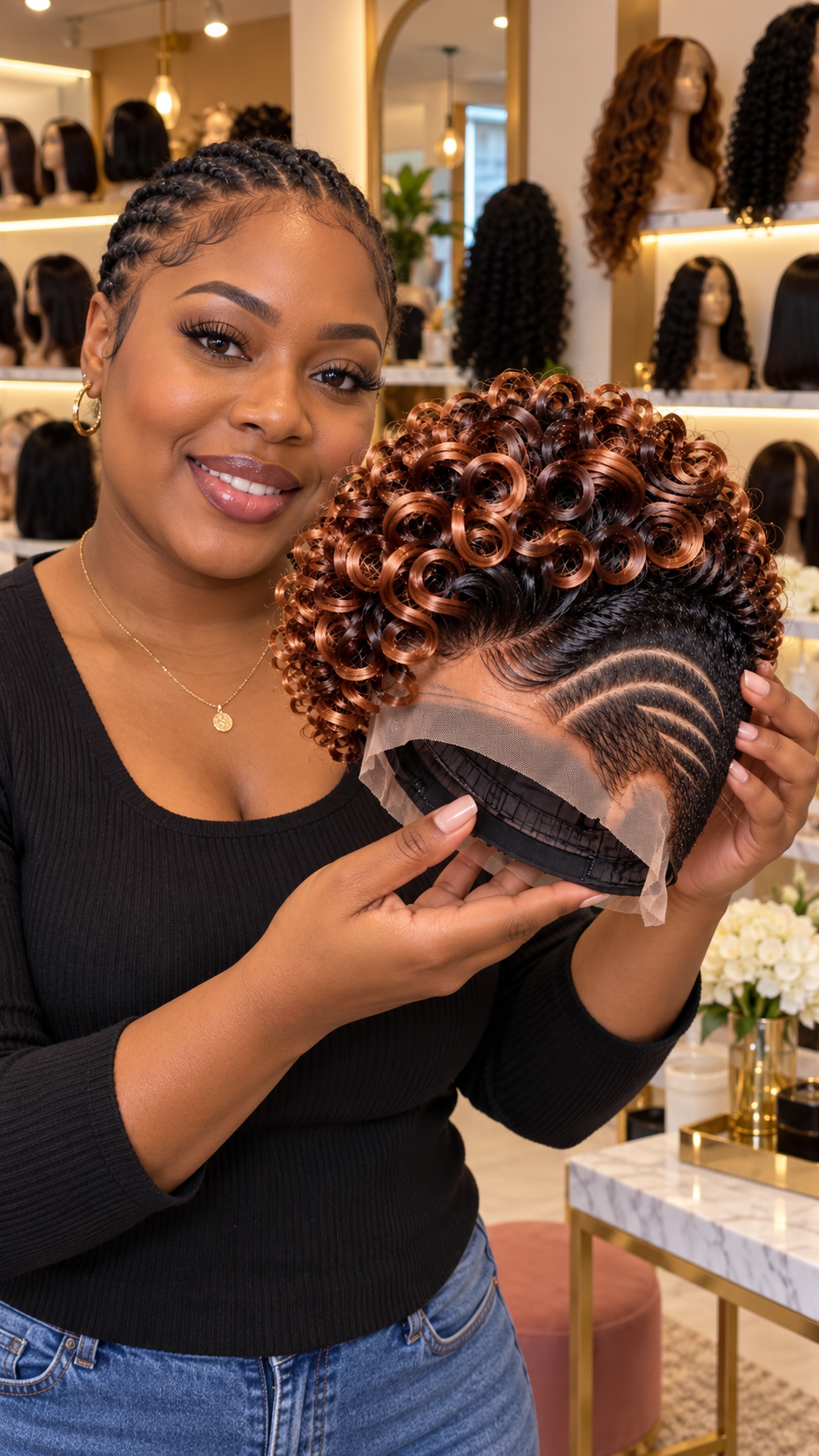
A customer examining this burnished-copper wig in a salon is seeing more than a collection of attractive curls. The stylist is holding the unit before installation, allowing the raised circular crown, dark root construction, curved temple markings and lace perimeter to be inspected together. This presentation matters because the hairstyle combines several demanding elements that cannot be evaluated accurately from a conventional front-facing portrait alone.
The crown contains numerous hollow ringlets in rich copper, auburn and reddish-brown tones. Their outer surfaces reflect warm light, while darker strands remain visible inside many of the circular openings. Beneath the crown, a predominantly black foundation leads into a sculpted side section carrying three prominent curved channels. Fine directional strands follow the front transition, creating a deliberate connection between the raised copper coils and the darker lower hair.
The photograph also shows part of the interior cap and untrimmed lace extending beyond the hair-bearing perimeter. These details demonstrate that the wig is being presented before its final fitting. Although the mesh and cap are visible, the exact hair material, lace grade and suitability for adhesive-free installation cannot be confirmed from the image. Those specifications should come from the seller rather than assumptions based on appearance.
What the Salon Presentation Reveals Before a Purchase
Holding a wig away from the head allows its construction to be inspected without the finished installation concealing important details. In this photograph, the seller presents the unit at an angle that exposes both the copper crown and the precision work along one side.
The buyer can examine whether the ringlets remain circular, whether the copper is distributed consistently and whether the dark side retains enough hair between its exposed channels. The extended lace also shows how much material remains for the installer to position and trim.
This type of presentation is especially valuable for customized hairpieces. A wig can look appealing on a mannequin while having poorly arranged rear curls or an unsuitable cap. Showing the actual unit in hand allows more informed questions before payment.
For a remote buyer, requesting a comparable demonstration video can be worthwhile. The seller can rotate the wig slowly, showing the front, crown, sides and rear while also displaying the interior construction.
The Copper Crown Uses Hollow Circular Ringlets
The upper hair is arranged into numerous large and medium-sized circular coils. Many have open centers, giving them the appearance of individually rolled hair ribbons rather than ordinary loose curls.
Several prominent ringlets occupy the forward and central crown, while smaller formations fill the surrounding spaces. The variation creates a rounded silhouette without making the wig appear rigid or mechanically repeated.
The curls are elevated but remain compact. They do not hang down toward the shoulders or form a long fringe. Instead, they create a raised surface across the head, allowing the side styling to remain visible.
A custom wig maker should understand that the circular openings are an essential part of the design. Additional hair should not automatically be inserted into every gap. The goal is to preserve the separate coil shapes while maintaining adequate crown coverage.
Burnished Copper Creates a Different Effect From Bright Orange
The visible color is rich and warm, with copper and auburn reflections across the outer surfaces of the ringlets. Some strands appear brighter under the salon lighting, while darker reddish-brown remains within recessed areas.
This is different from an entirely bright-orange wig. The deeper shades provide contrast, allowing the circular curls to remain visually distinct.
The darker foundation also gives the copper a richer appearance. Rather than covering every visible strand in one flat color, the styling allows black and deep brown to remain visible beneath portions of the crown.
Customers should therefore request a burnished copper or deep copper-auburn result with dark roots rather than choosing a shade solely because it is labeled copper.
Color terminology varies between suppliers. A neutral-light photograph of the available hair can help establish whether the shade leans toward reddish copper, golden copper or darker auburn before an order is approved.
The Black Foundation Gives the Copper Its Visual Depth
The root area is substantially darker than the raised crown. Deep black and near-black strands appear beneath the copper curls and continue into the close side.
This contrast serves two purposes. It gives the upper ringlets a darker background, and it allows the carved temple design to remain clearly visible.
If the entire side were colored bright copper, the exposed pathways might have less contrast against their surrounding hair. Similarly, removing the dark roots from the crown would reduce the shadow inside its circular openings.
For custom production, the black foundation should be treated as a deliberate part of the color specification rather than an unfinished area awaiting additional lightening.
The Largest Ringlets Should Remain Separate
The crown is relatively dense, but its largest circular formations remain individually recognizable. Their openings vary in diameter, creating a natural visual rhythm across the upper surface.
Spacing is particularly important near the front. Several prominent curls sit close to one another, yet their outer ribbons remain distinguishable.
A maker who compresses the coils too tightly could produce a solid mass of curled hair. Someone who arranges them too far apart may leave the crown looking insufficiently populated.
The correct balance lies between those extremes. Large hollow rings provide the main visual identity, while smaller supporting curls maintain continuity.
An overhead approval photograph should be requested before shipment. It allows the buyer to inspect the openings, spacing and orientation of the curls more accurately than a front portrait.
The Crown and Temple Follow Different Styling Directions
One reason this wig has a distinctive appearance is the difference between its circular upper styling and elongated side movement.
The crown uses rolled formations that rise above the foundation. The front transition contains finer strands directed backward, while the temple introduces broad curved sections following the contour of the cap.
These styling zones should not be treated as interchangeable. Rolling the side hair into additional circular coils would remove the deliberate contrast. Flattening the entire crown into waves would eliminate the hollow ringlet structure.
During construction, the stylist should establish where the circular curls end and the directional side work begins. That boundary influences the hairstyle’s overall proportions.
Three Sculpted Arches Give the Side Its Identity
The side artwork consists of three prominent sweeping channels beneath the crown. These exposed paths bend around the temple rather than traveling as ordinary straight stripes.
The upper channel is positioned closest to the crown, with the additional paths arranged progressively lower. Their curvature creates a nested appearance, while retained dark hair separates the individual openings.
The result is more elaborate than a single side part but less angular than lightning-shaped or zigzag carving.
When ordering a similar wig, the buyer should specifically describe three curved temple arches. Requesting generic barber lines could result in an entirely different pattern.
The seller should provide a direct side photograph so the buyer can inspect the curvature, separation and endpoints of the channels.
The Hair Between the Arches Must Be Protected
The exposed channels would lose much of their identity without the dark hair separating them. Those retained sections create contrast and allow each path to remain individually visible.
Precision cutting therefore involves deciding what to leave in place as carefully as deciding what to remove.
If a channel is made excessively wide, the dark section next to it becomes narrower. Repeated cutting can eventually cause adjacent paths to merge into one larger exposed area.
For a wig, this is a permanent concern because removed strands cannot naturally regrow.
A professional should preserve the original side geometry and avoid adding extra cuts that were not part of the agreed design.
The Lace Is Still Ready for Custom Fitting
The front and side perimeter contain a broad section of untrimmed lace. This allows the eventual installer to position the unit before deciding where the remaining mesh should be removed.
Fine strands are visible near the front hairline, creating a transition toward the darker foundation and raised copper crown.
Those strands should be evaluated after the wig is positioned on the wearer. Automatically removing them before fitting could produce an unnecessarily abrupt front edge.
The lace appears beige-brown under the salon lighting, but the photograph cannot establish its precise shade or grade. Buyers should ask the seller which lace materials and colors are actually available.
The presence of lace does not, by itself, confirm HD lace or adhesive-free wear.
The Interior Cap Should Be Examined Before Payment
A portion of the dark interior foundation is visible beneath the extended lace. This indicates that the sculpted exterior is supported by a constructed wig cap.
However, the photograph does not provide a complete view of every attachment or adjustment component. The buyer should request an underside image if cap construction is important to the purchase.
Questions worth resolving include the available cap dimensions, attachment preferences, lace placement and whether the unit will arrive fully styled.
These details can influence both installation cost and the wearer’s future maintenance routine.
Cap Sizing Influences the Position of the Carved Side
The three temple arches are fixed to the cap. Moving the wig forward or backward also moves the side design relative to the wearer’s face.
This makes accurate sizing especially valuable. A correctly constructed temple pattern may still look misplaced if the cap does not sit properly.
For a made-to-order wig, follow the manufacturer’s measurement guide. Depending on construction, circumference, ear-to-ear and front-to-nape measurements may be required.
A wig stylist can assist with measurements before the commission begins, particularly when the exact temple placement is important.
A Commission Should Begin With the Side Reference
For this particular design, the side photograph may be more informative than the front because it displays the curved artwork, dark foundation and copper crown in one view.
The first production requirement should establish the three temple arches, including their widths and the dark sections between them.
The second should address the crown: oversized hollow copper ringlets with smaller supporting curls and darker root depth.
The third should describe practical construction, including the cap, lace and preferred delivery condition.
This ordering sequence gives the maker clear requirements rather than relying on an overall impression of a copper curly wig.
Finding a Professional With the Appropriate Skills
The hairstyle requires experience in both sculpted curl setting and precision wig-side cutting. These are separate technical tasks.
A custom lace-wig maker may be able to prepare the crown and cap, while a professional experienced with barber-inspired wig designs can handle the carved temple work.
When evaluating a supplier, look for previous examples of large hollow ringlets and curved side patterns. A portfolio containing only loose curly wigs may not demonstrate the required styling ability.
If separate professionals are involved, the final side refinement should follow a successful cap fitting so the artwork is positioned correctly.
Where to Source a Comparable Copper Wig
Specialist wig studios, custom hairpiece makers and salons offering sculpted pixie wigs are practical places to begin.
A general wig retailer may carry an appropriate dark-root copper foundation, but reproducing the hollow crown and carved side could require additional professional services.
For remote ordering, send the reference image and ask whether the quoted price covers the completed ringlets and three curved channels.
A seller should also clarify whether the photographed style is available as finished stock or would need to be commissioned.
Approve the Crown and Side Separately
Before a custom wig ships, request an elevated photograph showing the crown’s largest spiral openings.
A direct side photograph should document all three arches and the amount of dark hair between them.
A rear three-quarter view can establish whether the copper coils continue consistently around the back and whether the silhouette remains balanced.
Finally, request an underside photograph when cap construction or attachment methods affect the purchasing decision.
Approving these elements separately reduces the chance of receiving a wig that matches one detail while differing substantially in another.
Estimated Pricing for a Copper Ringlet and Temple-Arch Wig
Although the wig is compact, creating its appearance can involve substantial labor. The crown contains numerous individually arranged curls, the color requires dark-root contrast, and the side includes precision-cut curved channels.
| Category | Illustrative Price Range | Likely Scope |
|---|---|---|
| Premium Custom | $365–$645+ | Higher-grade hair, personalized cap sizing, planned copper coloring, individually arranged hollow ringlets, precision temple arches and detailed lace preparation. |
| Standard Custom | $220–$385 | Prepared copper spiral crown, dark-root foundation, established side geometry and standardized fitting options. |
| Basic Human Hair | $130–$235 | A human-hair foundation requiring separate color work, spiral setting, side customization and professional installation. |
| Premium Synthetic | $90–$175 | A pre-colored and pre-set interpretation with potential curl-retention advantages and limited future modification flexibility. |
| Basic Synthetic | $45–$100 | A budget option with potentially simpler curl placement, color depth, side carving or cap construction. |
These ranges are illustrative budgeting estimates rather than verified prices for the exact photographed wig. Material, seller location, labor, cap construction, shipping and installation can all affect the final amount.
Ask for an itemized quotation before comparing sellers. A lower-priced foundation may require enough additional styling work to exceed the cost of a completed custom unit.
Human Hair Allows Targeted Spiral Restoration
A human-hair version can provide greater flexibility for future professional maintenance. Individual ringlets may be reset when they lose their circular openings, provided the hair is suitable for the chosen method.
However, copper-colored hair may have undergone processing. Heat should be selected according to the actual condition of the strands rather than assuming unlimited tolerance.
Selective restoration can reduce unnecessary manipulation. If only several spirals have moved, rebuilding the entire crown may not be necessary.
Synthetic Fiber Can Preserve Pre-Set Circular Forms
A premium synthetic version may be useful for buyers who prefer to maintain the original hairstyle with relatively limited daily styling.
Pre-set synthetic ringlets can retain their shape effectively, although performance depends on the fiber and manufacturing quality.
The limitation is future flexibility. Heat tolerance varies, and conventional human-hair coloring methods should not be assumed compatible.
Material selection should reflect the customer’s intended maintenance routine.
Maintenance Should Follow the Original Ringlet Map
Before washing, photograph the crown from above. This records the position of the largest hollow curls and the smaller supporting formations.
During cleansing, avoid aggressive rubbing that can intertwine neighboring spirals and close their circular openings.
Use care methods appropriate for the confirmed material and allow the unit to dry without compressing its raised crown.
Afterward, restore only the curls that have moved rather than automatically reconstructing every section.
The Temple Arches Need Preservation Rather Than Enlargement
The three carved channels are permanent elements. They should not be widened simply because a routine maintenance appointment has been scheduled.
If fine strands shift across an exposed path, careful repositioning may restore the original appearance without cutting.
When refinement is necessary, the stylist should preserve the original curvature and dark hair between the arches.
Repeated aggressive cutting can gradually remove those separating sections, making the original design increasingly difficult to maintain.
Copper Color Maintenance Should Respect the Black Roots
If the wig is human hair and the copper eventually fades, a professional colorist should consider how the shade was originally distributed.
The darker root areas contribute to the dimensional appearance and should not automatically be colored bright copper.
Preserving black depth inside the ringlets helps maintain the contrast between reflective copper surfaces and darker recessed hair.
Synthetic units should only be recolored using methods confirmed appropriate for their fiber.
Product Buildup Can Reduce the Circular Detail
The crown already has substantial shine. Heavy oils, waxes or holding products can cause neighboring curls to adhere together and reduce their visible openings.
Excess residue may also alter the apparent copper shade, making the brightest sections appear darker.
Use only products suitable for the material and apply them conservatively. When buildup affects the appearance, appropriate cleansing may be more useful than adding additional shine product.
The First Fitting Should Protect the Existing Artwork
When a completed custom unit arrives, inspect the ringlet crown, copper placement, temple arches, lace and cap before permanent alterations.
The installer should establish the cap’s wearing position and check where the side channels fall relative to the temple and ear.
Only after that placement is correct should excess lace be trimmed and optional side refinement considered.
If the artwork already matches the reference, additional cutting may not be necessary.
Storage Requires Space for the Hollow Ringlets
Large circular coils can lose their shape when compressed. A suitable wig stand or mannequin head can support the crown between wears.
Avoid stacking other hairpieces over the wig or pressing the temple artwork against hard surfaces.
The cap and lace should be fully dry before storage.
For transport, choose packaging deep enough to protect the raised ringlets instead of flattening them into a confined space.
The Best Purchase Preserves the Relationship Between Copper and Black
This wig works because its warm and dark areas have different roles. Burnished-copper ringlets dominate the crown, while black roots and compact side hair provide the foundation. Three sculpted arches introduce precision geometry beneath the circular upper forms.
For buyers, the principal quality checks are the size and openness of the ringlets, the copper-to-black color balance, the retained dark hair around the temple markings, the condition of the untrimmed lace and the suitability of the cap.
For wig businesses, showing the actual product in hand provides a valuable opportunity to demonstrate craftsmanship. Additional crown, side and interior photographs can help customers understand what is included in the quoted price and what remains to be completed during installation.
A successful custom reproduction will not depend on making the copper brighter or the carved channels deeper. It will depend on preserving the proportions, color placement and precise relationship between the hollow crown curls and sculpted temple design.
Search Terms
burnished copper hollow ringlet wig · black root copper spiral crown · three curved temple arches wig · auburn sculpted coil lace wig · copper black precision side wig · open circular copper curls · dark temple channel hairpiece · untrimmed lace copper wig