
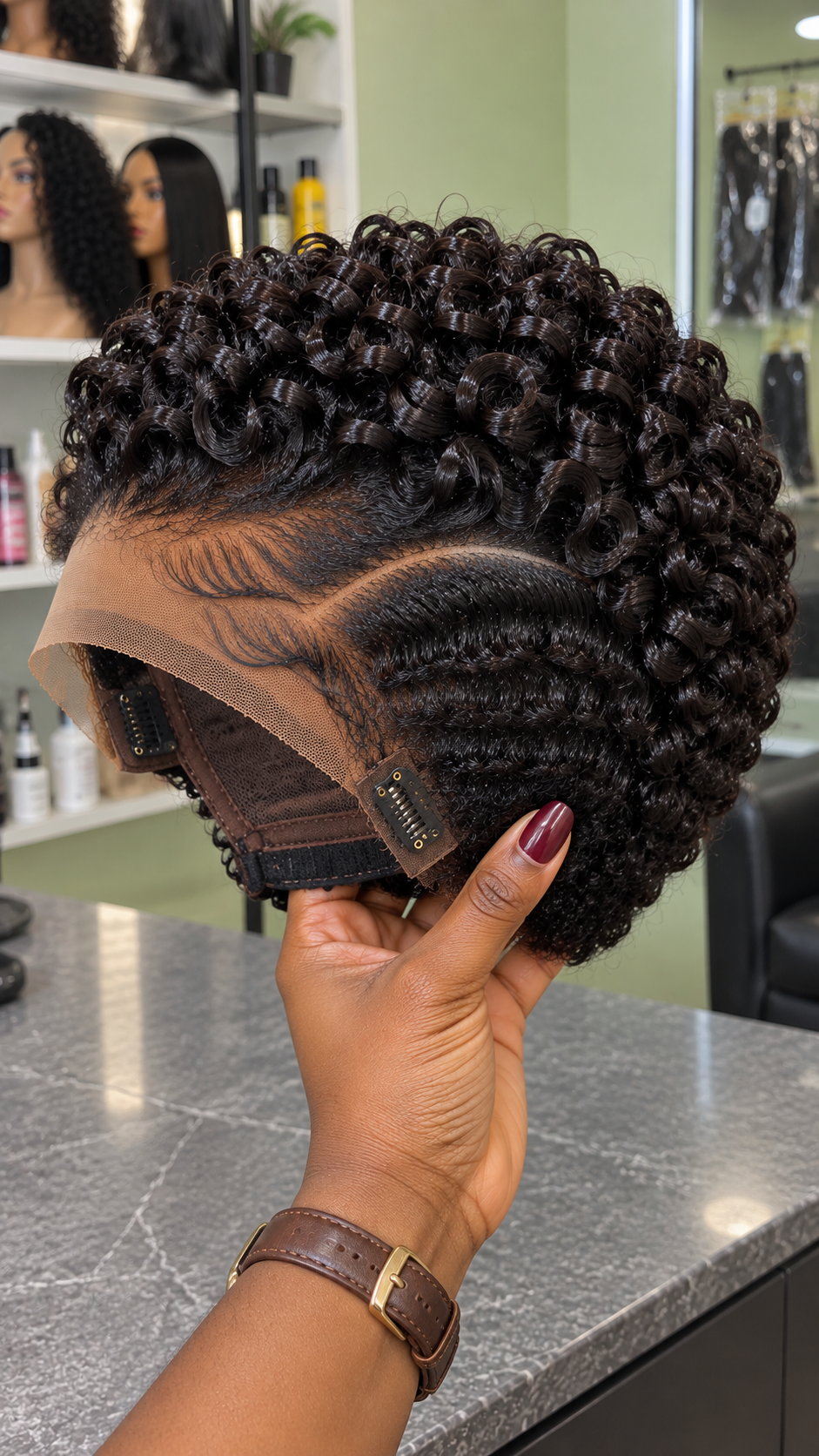
One of the most interesting things about this deep espresso wig is that its most intricate styling is not confined to the crown. The upper hair consists of tightly arranged, open spiral coils, but the front introduces a broad finger-wave crest that travels toward the temple before meeting a pronounced curved separation. Below that division, much smaller curls create a compact side. The photograph also reveals internal comb attachments and part of the cap, making this a useful reference for buyers who want to understand both the appearance and the practical requirements of commissioning a comparable lace wig.
The dark color remains consistent throughout the visible hair. Rather than using blonde or copper highlights to create variation, the wig relies on the changing angles of its curls. Raised surfaces reflect warmer espresso-brown light, while the interiors of the spiral openings appear almost black. This subtle difference gives the crown dimensional depth without requiring a second obvious color.
For a buyer comparing ready-made wigs or discussing custom construction, the essential question is whether the supplier can reproduce the contrast between the large upper spirals and the much flatter front and side styling. Matching the dark espresso shade alone would not be enough. The exact curl scale, sweeping front direction, curved temple boundary and lower density are central to the design.
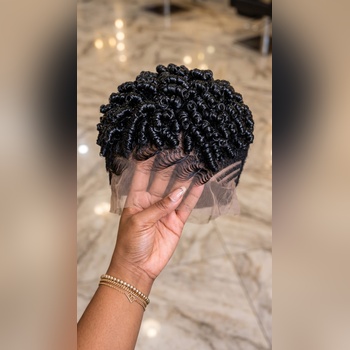
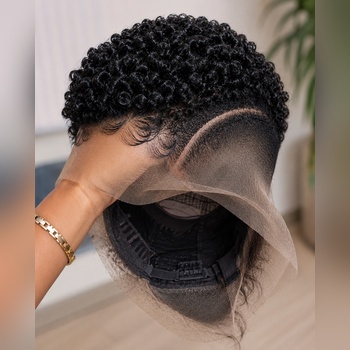
The Sculpted Front Crest Establishes the Hairstyle’s Direction
The front section is the most useful place to begin examining this wig. Fine dark strands sweep across the lace area and rise into an elongated wave crest beneath the spiral crown. The strands are arranged in a deliberate directional pattern rather than falling forward as loose curls.
The crest begins near the forward hairline and travels sideways toward the temple. As it approaches the outer section, it narrows and connects with the curved separation beneath the crown.
This creates movement across the front without requiring a conventional fringe. The forehead remains visually open while the hair introduces a strong curved shape above it.
A professional recreating the unit should treat this crest as its own styling section. Rolling it into the same circular spirals used above would remove the contrast that makes the design recognizable.
The Crown Uses Dense Tubular Spirals With Open Centers
Across the upper surface, the hair forms a substantial field of compact spiral coils. Several sections have clearly visible circular openings, while others overlap more closely and appear as smaller tubular forms.
The mixture gives the crown a richly populated appearance without turning it into one continuous mass of curls.
Larger openings are particularly noticeable through the forward and central areas. Smaller curls occupy the outer sections, allowing the construction to follow the rounded shape of the wig.
For custom ordering, the curl diameter should be specified rather than relying on broad terms such as curly pixie or spiral wig. Those descriptions can refer to very different styles.
The reference calls for a crown containing individual rolled formations with enough separation for the circular centers to remain visible.
Deep Espresso Creates Dimension Through Shadow
The hair appears within a dark espresso-to-near-black brown family. Strong reflections across the curls produce warmer brown highlights, while the root areas and inner spirals remain substantially deeper.
This tonal variation does not necessarily indicate separate coloring. The photograph does not show an obvious second highlight shade. Much of the depth may come from light reflecting across the curved surfaces.
A customer trying to reproduce the same color should therefore request rich dark espresso rather than a bright chocolate or caramel-highlighted wig.
A neutral-light photograph of the actual available hair is useful because warm salon lighting can exaggerate reddish or brown reflections.
Why the Crown Should Not Be Made Excessively Full
The density of the upper coils is substantial, but the individual spiral openings still matter. If too much additional hair is introduced, neighboring sections may overlap until their circular shapes become difficult to distinguish.
This makes crown construction a matter of proportion rather than maximum volume.
The professional should balance the amount of hair with the size of each spiral. Larger coils need enough space to remain open, while smaller sections can fill the surrounding areas without covering the major formations.
For buyers, an overhead photograph provides a practical quality check. The crown should look rich while retaining recognizable separate curls.
The Side Changes From Broad Waves to Compact Curls
Below the front crest, the hair begins traveling in longer, flatter movements. These strands follow the curved shape of the side rather than repeating the large circular coils above.
The change in direction creates a transition between the elevated crown and lower compact section.
Farther down, the hair becomes much smaller and closely curled. The lower side maintains substantial density but sits near the foundation, avoiding the projection of the upper spirals.
This graduated construction is important because it keeps the silhouette compact without making the side appear unfinished.
The Curved Temple Division Creates a Strong Visual Boundary
A pronounced exposed path travels through the upper side, curving between the flatter directional hair and the smaller curls below. Its route follows the rounded contour of the wig rather than forming a straight stripe.
This division is one of the design’s most recognizable elements. It creates a clear break between two styling zones while maintaining a flowing profile.
The path should not be made unnecessarily wide. Dark hair remains above and below it, and those retained sections provide the contrast needed for the curve to remain visible.
When commissioning a recreation, provide a direct side photograph and request the same broad curvature rather than a generic side line.
The Dark Section Below the Curve Remains Densely Curled
The hair beneath the exposed temple path is not a bare shaved surface. It contains numerous small, close curls that create a dark field beneath the larger crown.
This detail distinguishes the unit from wigs with extremely low barber-style fades. The lower hair retains its own curled pattern while remaining substantially flatter than the upper spirals.
A stylist should avoid removing too much of this section during customization. Reducing its density excessively would make the side appear more exposed than the reference.
Because wig hair cannot naturally grow back, conservative cutting is especially important.
The Front Perimeter Uses Fine Directional Strands
Along the front lace, thinner strands create a gradual transition into the heavier hair behind them. Their direction follows the large wave crest rather than forming separate ringlets.
These strands should be evaluated during fitting before any thinning or removal is performed.
A professional installer can determine whether the existing arrangement complements the wearer’s hairline and how much of the lace needs trimming.
Automatically cutting away the finer front strands could change the appearance of the crest and create a harder transition than the reference shows.
The Photograph Reveals Untrimmed Lace Construction
The mesh extends beyond the hair-bearing edge, indicating that the final installation perimeter has not yet been established.
For professional fitting, retaining excess lace can provide useful flexibility. The stylist can position the wig first and then determine the appropriate trimming route.
The mesh appears beige-brown under the shop lighting, but the exact shade should be confirmed through the seller’s actual options.
The photograph does not establish a particular commercial lace grade. A fine-looking mesh is not automatically HD lace, and the image does not prove that the unit is intended for adhesive-free use.
The Interior Cap Shows Attachment Components
Part of the dark brown interior cap is visible beneath the front lace. Two small comb-style attachments can be seen near the inside perimeter.
These components give buyers information about potential securing options, but the full construction is not visible. The photograph cannot confirm the complete attachment arrangement or cap measurement range.
Customers who prefer particular securing methods should ask the supplier for a full underside photograph.
Any claim about glueless wear should be based on the product’s verified design rather than the presence of internal combs alone.
Cap Fit Determines the Position of the Front Crest
The wave crest and curved temple division are fixed to the wig foundation. If the cap sits too far forward, the crest may approach the forehead differently from the reference. If the unit shifts backward, the temple curve moves with it.
Accurate cap sizing therefore affects appearance as well as comfort.
For made-to-order wigs, follow the manufacturer’s measurement instructions. Depending on the cap, circumference, front-to-nape and ear-to-ear measurements may be relevant.
A local wig stylist can assist with measuring before an expensive custom order is placed.
The Best Order Brief Separates Shape From Material
A useful custom specification begins with the crown: deep espresso hair arranged into compact open tubular spirals with mixed diameters.
The second requirement concerns the front: a broad directional wave crest extending toward a curved temple separation.
The third requirement is the lower side, where small close curls should provide dense coverage without projecting outward excessively.
Finally, confirm practical information such as cap sizing, lace material, available shades, attachment preferences and whether the lace should remain untrimmed for fitting.
This makes the order more precise than simply requesting a dark curly lace wig.
Finding a Specialist for This Construction
Custom wig studios and salons offering sculpted finger-coil styling are practical sources for a comparable unit. The maker should understand the difference between a raised spiral crown and a flatter directional front wave.
Look for previous work showing consistent open coils, controlled crown density and curved perimeter styling.
A general wig retailer may offer a suitable base, but additional professional work could be required to recreate the finished appearance.
If commissioning locally, send the reference photograph before booking so the stylist can estimate the amount of curl setting and front-wave construction involved.
Request Approval Photographs That Reveal the Entire Design
An overhead image should show the spiral crown and the balance between large and small curl openings.
A direct side photograph should clearly reveal the wave crest, curved temple separation and compact lower curls.
A rear three-quarter image can confirm that the crown continues consistently around the back.
If the supplier advertises a particular cap construction, request a separate underside photograph of the exact unit.
These views make it easier to approve the hairstyle and practical construction independently before shipment.
Estimated Pricing for a Deep Espresso Spiral Wig
The compact length of the wig should not be mistaken for simple production. The price may reflect individually arranged spiral coils, precision front-wave setting, lower density management, lace preparation and cap construction.
| Category | Illustrative Price Range | Potential Scope |
|---|---|---|
| Premium Custom | $320–$580+ | Higher-grade hair, personalized sizing, hand-arranged open spiral crown, sculpted front crest, precision temple division and detailed lace preparation. |
| Standard Custom | $195–$345 | Prepared espresso spiral crown, established front-wave arrangement and standardized cap options. |
| Basic Human Hair | $115–$210 | A human-hair foundation requiring additional spiral setting, front-wave construction and professional fitting. |
| Premium Synthetic | $75–$155 | A quality pre-set option with potential shape-retention benefits and more limited future restyling choices. |
| Basic Synthetic | $35–$90 | A budget interpretation where coil separation, front-wave accuracy, lower density or cap construction may be simpler. |
These are illustrative planning ranges rather than confirmed prices for the photographed wig. Actual quotations depend on material, seller location, labor, cap construction, shipping and installation.
Before comparing sellers, ask whether the price includes both the spiral crown and sculpted front crest. A lower-priced unfinished foundation may require enough additional professional work to make the total cost higher than expected.
Human Hair Offers Options for Professional Curl Restoration
A human-hair version may allow a stylist to reset individual spiral sections when they become displaced, provided the hair is suitable for the chosen technique.
The front wave can also be maintained separately rather than rebuilding the entire crown.
Heat should be selected according to hair quality and processing history. Human hair does not automatically tolerate unlimited high temperatures.
Selective maintenance can reduce unnecessary handling and help preserve the original arrangement.
Premium Synthetic Can Be Useful for Pre-Set Shape Retention
A well-made synthetic version may hold its spiral crown and directional front wave with relatively little daily manipulation.
This can be practical for buyers who intend to retain the original style rather than frequently change it.
The tradeoff is flexibility. Heat tolerance varies, and major recoloring or reshaping may not be appropriate.
The exact fiber should be confirmed before hot tools or chemical treatments are attempted.
Care Should Begin With the Front Wave
The wave crest is highly visible because it occupies the transition between the lace and spiral crown. Even a small change in its direction can affect the entire front appearance.
During routine inspection, check whether its fine strands still follow the intended curve.
If only one section has lifted, targeted repositioning may be sufficient. There is no reason to dismantle the entire crown when the problem is limited to the front.
Preserve the Spiral Openings During Washing
Before the first wash, photograph the crown from above. This records the original position and diameter of the major spirals.
During cleansing, avoid vigorous rubbing between neighboring coils. Excess friction can cause them to intertwine and reduce their visible openings.
Use products appropriate for the confirmed material.
After drying, restore only those sections that have moved, using the original photograph as a guide.
The Side Separation Should Not Be Recut Automatically
The curved temple pathway is already an established part of the wig’s construction. It does not need to be widened simply because time has passed.
If fine hairs move across the exposed area, repositioning may restore its appearance without cutting.
When professional refinement becomes necessary, the original side photograph should guide the width and curvature.
This is particularly important because removed wig hair cannot naturally regrow.
Heavy Shine Products Can Conceal the Spiral Structure
The dark espresso crown already reflects light across its raised surfaces. Excessive oils or holding products may cause adjacent spirals to stick together.
As buildup increases, the circular openings can become less visible and the crown may appear heavier.
Use only what the confirmed hair or fiber requires. When residue becomes a problem, appropriate cleansing may restore separation more effectively than adding another layer of shine product.
Install the Unit Before Making Additional Styling Changes
When the wig arrives, inspect the crown, front crest, lace, cap and attachment components before permanent alteration.
The stylist should establish the final wearing position and evaluate where the curved temple separation sits.
Only after the fit is correct should the lace be trimmed and optional adjustments considered.
If the existing sculpted styling already matches the reference, extensive restyling may be unnecessary.
Store the Crown Without Flattening the Raised Spirals
A suitable wig stand or mannequin head can support the compact rounded crown between wears.
The upper spirals need enough room to retain their open centers, while the front wave should remain clear of surfaces that could flatten its direction.
Store the unit only when the cap and lace are completely dry.
For transportation, choose packaging with enough depth to avoid crushing the crown.
The Wig’s Identity Comes From Three Different Scales of Hair
This espresso spiral wig is distinctive because it uses different styling proportions in coordinated areas. The crown contains large open tubular spirals. The front introduces long fine waves and a pronounced curved division. The lower side completes the silhouette with smaller close curls.
For buyers, the most important quality checks are crown density, spiral openings, front-wave direction, temple curvature, lower curl scale, lace condition and visible interior attachments.
For wig businesses, detailed photographs of the crown, side and underside can help customers understand these elements more accurately than generic descriptions. Clear material specifications, realistic pricing and practical fitting information support more informed purchasing decisions.
A faithful reproduction should preserve the relationship between raised spirals, directional front styling and compact lower curls. When those areas are built with consistent proportions, the resulting wig retains the character of the reference while remaining suitable for professional fitting and ongoing maintenance.
Search Terms
deep espresso spiral lace wig · sculpted front wave crest wig · dark brown open coil crown · curved temple division wig · compact espresso curl hairpiece · tubular spiral wig · black brown lace front curls · interior comb spiral wig