
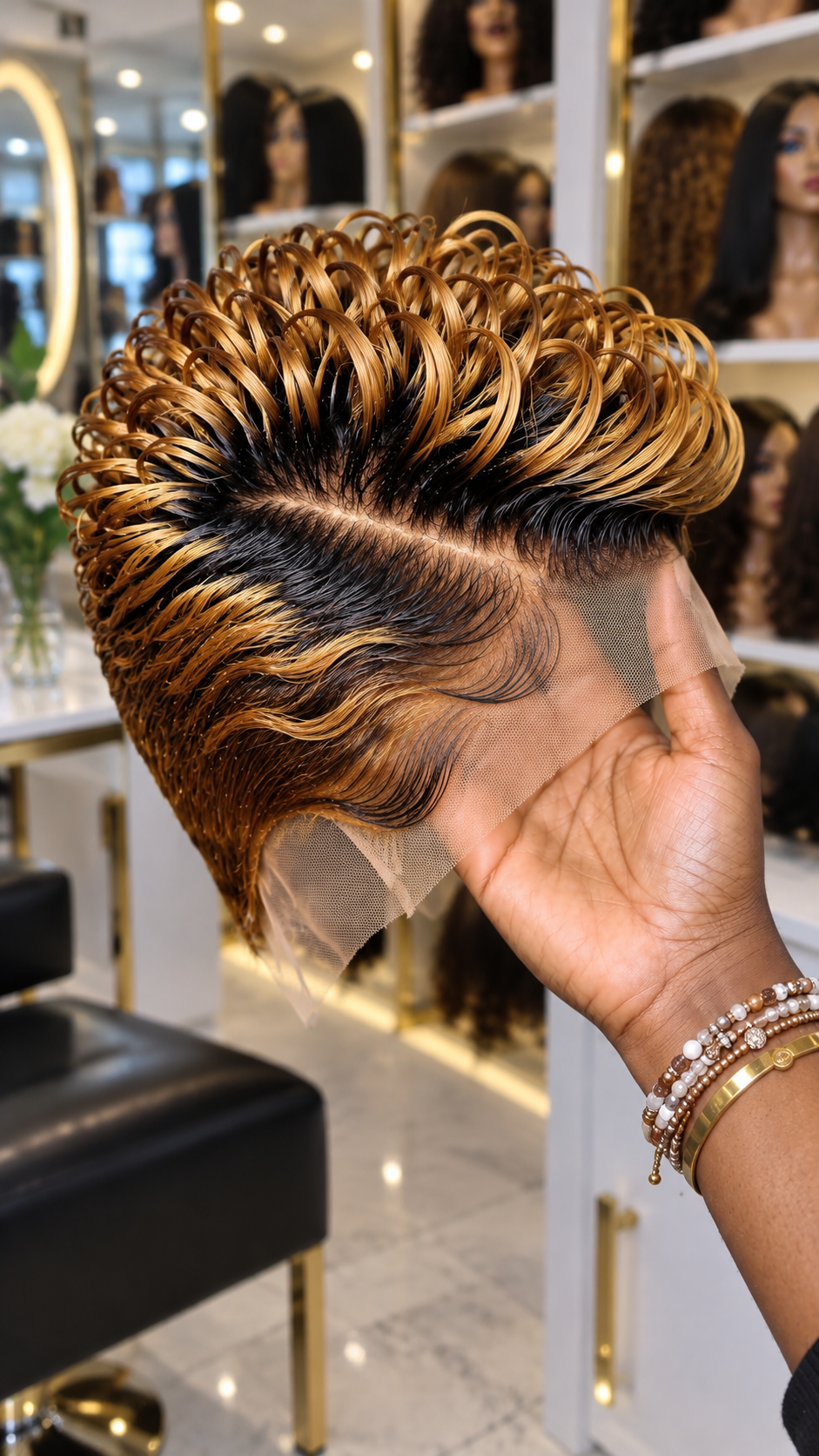
The most important decision when purchasing this golden-blonde wig is whether the buyer wants a hairstyle dominated by upright loop formations rather than conventional curls. The photographed unit uses elongated honey-gold ribbons that rise from a dark foundation, curve into open loops and overlap across the crown. Beneath them, a broad exposed part separates the raised hair from a series of flowing finger waves. The lower section continues toward the rear in a compact arrangement of golden-brown strands, creating movement without relying on shaved decorative patterns.
The wig is displayed in hand inside a hair salon, with an extended lace perimeter visible around the front and lower side. Its styling is already arranged, but the mesh has not yet been trimmed to an individual wearer’s hairline. The photograph confirms the presence of lace and shows the direction of the upper and lower hair. It does not establish whether the hair is human or synthetic, whether the lace is HD grade, or whether the cap is intended for adhesive-free installation.
For a custom order, the defining combination is specific: bright golden-blonde loops over deep black roots, a directional crown separation, and elongated side waves rather than conventional barber-carved lines. The color is particularly important because the lighter surfaces trace each loop, while black roots provide the shadow necessary for the raised forms to remain distinguishable.
The Crown Creates Height Through Narrow Upright Loops
The upper hairstyle contains numerous elongated loop formations standing above the foundation. Their strands travel together in narrow bands before bending backward, creating open arches with visible spaces inside them.
These loops are different from the round tubular ringlets found on many compact finger-coil wigs. Their shape is taller and more directional. Rather than forming small circles close to the head, the hair rises and folds into an arrangement that resembles overlapping ribbons.
Several sections near the upper center stand more vertically, while neighboring loops lean sideways or backward. This variation creates a lively crown without making every formation identical.
A custom wig maker should preserve the relative height and narrowness of the loops. Using ordinary spiral rollers may produce attractive curls, but it would not necessarily recreate the elongated construction shown in the photograph.
Golden Blonde Is Positioned Across the Visible Loop Surfaces
The lighter hair appears in a warm golden-blonde family with honey and caramel reflections. It is particularly prominent across the raised upper loops, where the strands face the salon lighting.
The roots beneath these ribbons remain substantially darker. Black and deep brown are visible where the strands emerge from the foundation and in recessed spaces between the loops.
This creates a strong light-and-dark relationship without requiring rigid alternating stripes. The brighter sections follow the direction of the styling, making each raised curve easier to identify.
For ordering, request warm golden-blonde crown ribbons over deep black roots. A uniformly blonde wig would produce a different visual balance, while thin conventional highlights might not provide enough light coverage across the larger loops.
The Black Root Area Is Part of the Crown Construction
The dark roots do more than create a color transition. They establish the visual foundation from which the blonde loops rise.
Because the upper sections are highly elevated, black hair remains visible beneath their openings. That shadow separates neighboring loops and prevents the blonde crown from appearing like one solid mass.
Lightening the roots excessively could reduce this contrast. The resulting wig might still be bright and attractive, but its raised architecture would be less distinct.
When commissioning a human-hair version, the colorist should consider the final loop arrangement before deciding where the blonde begins. Placement that looks balanced on straight strands may appear different once the hair is folded.
The Upper Loops Change Direction Toward the Rear
The photographed crown does not consist of identical upright pieces from front to back. Several forward and central loops rise prominently, while others lean backward and follow the contour of the foundation.
This difference allows the hair to occupy the crown without creating excessive height everywhere.
The rear-facing sections become more closely arranged and interlock with neighboring loops. Smaller curved ends fill some of the spaces between the longer ribbons, helping the styling maintain continuity.
A buyer should request an elevated rear three-quarter photograph before approving a custom unit. The supplied view demonstrates the upper and side construction, but it does not establish every detail of the opposite side and back.
The Exposed Crown Part Is a Structural Division
A clear scalp-toned pathway runs beneath the raised loops and separates the crown from the flatter directional hair below. The part travels diagonally across the visible side rather than appearing as a simple central division.
This exposed route organizes the styling. Above it, the strands rise into elongated blonde loops. Below it, they travel in longer, flatter waves.
The location of the part influences the apparent size of the crown and the amount of side hair visible beneath it.
Moving it upward would reduce the upper curl field, while positioning it lower could make the side appear narrower. A faithful recreation should therefore preserve the proportional relationship between the crown and the parting.
The Side Uses Sculpted Finger Waves Instead of Razor Artwork
The lower side contains multiple elongated S-shaped movements. Dark roots and golden-brown strands travel together in coordinated ridges, creating a flowing appearance beneath the raised crown.
These waves are made by arranging the visible strands rather than relying on several clearly exposed shaved channels. Their reflective surfaces create contrast against darker recessed sections.
This distinction is central to the hairstyle. Adding decorative barber stripes would introduce a different design language and change the reference considerably.
A stylist recreating the wig should focus on the direction, spacing and continuity of the wave ridges. The side needs to remain relatively close to the foundation while retaining its elongated movement.
Blonde Ribbons Continue Through the Side-Wave Panel
The warm blonde is not confined entirely to the upright crown. Lighter strands also appear through portions of the sculpted side waves, following their curved paths toward the rear.
This continuity connects the two styling zones. The crown and side use different shapes, but selected golden strands travel through both areas.
Deep black remains visible between the highlighted sections, maintaining shadow and giving the waves a more dimensional appearance.
For custom coloring, this means the side should not automatically be treated as uniformly black. The photographed design uses golden-brown movement beneath the crown, even though the roots and recessed portions are considerably darker.
The Lower Rear Settles Into a Compact Shape
As the side-wave panel approaches the lower rear, the hair becomes increasingly compact. The highlighted strands continue backward, but their projection decreases.
This reduction gives the silhouette a controlled endpoint beneath the taller crown.
A wig whose lower rear remains as elevated as the upper loops could appear excessively full. Conversely, removing too much hair could make the side transition abrupt.
The objective is a gradual change in height: raised loops above, elongated waves through the side, and closer hair toward the rear perimeter.
The Front Hairline Contains Fine Directional Strands
Near the lace edge, finer strands move backward toward the heavier upper sections. Their density is lighter than the main crown, creating a gradual transition rather than a hard boundary.
These fine hairs should be evaluated during fitting before any permanent thinning or trimming is performed.
The installer can determine whether the existing arrangement suits the wearer’s desired placement and whether minor adjustments are necessary.
Removing the finer strands automatically may create a sharper front edge than intended and could alter the relationship between the lace and the raised blonde loops.
The Lace Perimeter Is Still Untrimmed
The photograph shows a broad section of mesh extending beyond the hair-bearing front and side. This indicates that the unit has not yet been trimmed to fit a particular wearer.
For professional installation, the extra material can provide useful flexibility. The stylist can position the wig first, inspect the crown height and side-wave alignment, and then establish the final perimeter.
The visible mesh appears beige-brown, but its exact shade cannot be reliably determined from a photograph taken under salon lighting.
A fine-looking lace front should not automatically be described as HD lace. Buyers should request the seller’s actual material specifications and available shade options.
The Photograph Does Not Establish the Complete Interior Cap
Although the lace perimeter is clearly visible, the image does not provide a full view of the interior cap or every attachment component.
Customers should therefore avoid assuming the presence of particular combs, adjustable straps or securing mechanisms unless those are confirmed by the seller.
Before purchasing a custom unit, request a complete underside photograph. This can help clarify cap construction, lace placement, available sizing and attachment preferences.
The exterior hairstyle and the interior foundation should be evaluated as separate purchasing considerations.
Cap Fit Influences the Crown’s Position
The direction of the raised loops and side waves is fixed to the wig foundation. If the cap sits too far forward or backward, the entire arrangement shifts with it.
This is particularly important because the crown has substantial height. Incorrect placement can change where the loops rise relative to the wearer’s forehead.
For made-to-order wigs, follow the manufacturer’s measurement chart and provide all requested dimensions.
Depending on construction, these may include circumference, ear-to-ear width and front-to-nape length.
A professional wig stylist can help with measurements before a custom order is placed.
Choosing a Wig Maker With Ribbon-Loop Experience
This hairstyle requires a different technique from ordinary loose curls or small finger coils. The upper hair must be arranged into narrow, elevated loops that retain their openings while overlapping in a coordinated direction.
The side also requires controlled finger-wave styling, with elongated ridges that remain distinct rather than merging into one flat surface.
When comparing suppliers, look for examples of sculpted ribbon crowns and precision finger-wave work.
A maker whose portfolio contains only conventional curly wigs may not automatically reproduce the combination shown here.
Where to Order a Similar Golden-Blonde Wig
Specialist lace-wig studios, custom wig makers and salons offering sculpted pixie and finger-wave styling are practical sources for a comparable unit.
A general wig retailer may carry an appropriate black-root blonde foundation, but the raised crown loops and side waves may require additional professional work.
When contacting a seller, send the reference photograph and explain that the desired result includes elongated golden loops, a dark root foundation and sculpted side waves rather than decorative carved lines.
Ask whether the quoted price includes the completed styling or only the underlying hairpiece.
A Custom Order Should Separate Color From Shape
The first specification should establish the crown structure: numerous narrow upright loops, visible openings and gradually backward-moving sections.
The second should describe the color: deep black roots with warm golden-blonde and honey ribbons across the raised hair.
The third should address the side styling: a diagonal crown separation, elongated S-shaped waves and a compact lower rear.
Finally, confirm cap sizing, lace shade, attachment preferences and whether the lace should remain untrimmed for installation.
These requirements should be agreed upon before a deposit is paid, particularly when the wig is being made specifically for the buyer.
Approval Photographs Should Prioritize the Loop Silhouette
A direct side photograph is essential because it shows the height of the upright crown and the relationship between the loops and side waves.
An elevated view should reveal whether the individual ribbons retain their openings and whether the blonde distribution follows the intended construction.
A rear three-quarter photograph can show how the larger sections transition into smaller curved forms.
For expensive custom work, the buyer should request photographs of the actual completed unit whenever the seller offers approval before shipment.
Neutral Lighting Is Important for Golden-Blonde Approval
The salon lighting in the photograph makes the hair appear highly reflective and warm. Some strands look golden honey, while others approach caramel or amber.
A neutral-light photograph can help establish the actual shade before purchase.
The intended result should remain warm blonde rather than pale platinum, with a substantial black root foundation.
If the unit is made from human hair, the buyer should also ask about the processing used to produce the lighter sections because that history may influence future heat and color maintenance.
Price Should Reflect Sculpting and Color Placement
The wig’s compact overall dimensions do not necessarily make it simple to produce. Forming many upright ribbon loops, placing the blonde accurately and arranging the side waves can require considerable professional labor.
The price may also depend on cap construction, lace choice and fitting services.
Estimated Pricing for a Golden Ribbon Crown Wig
| Category | Illustrative Price Range | Possible Scope |
|---|---|---|
| Premium Custom | $350–$625+ | Higher-grade hair, individualized sizing, black-root golden-blonde color placement, hand-arranged ribbon loops, sculpted side waves and professional lace preparation. |
| Standard Custom | $215–$375 | Prepared honey-blonde loop crown, dark foundation, established finger-wave side styling and standardized fitting options. |
| Basic Human Hair | $125–$225 | A human-hair foundation requiring additional lightening, highlighting, loop setting, side-wave construction and installation. |
| Premium Synthetic | $85–$170 | A quality pre-colored and pre-set alternative that may retain the sculpted loops with relatively limited rebuilding. |
| Basic Synthetic | $40–$95 | A budget interpretation where color placement, loop separation, side-wave accuracy or cap construction may be simpler. |
These figures are illustrative budgeting estimates, not verified prices for the photographed wig. Actual costs depend on material, supplier, location, labor, cap construction, shipping and installation.
When comparing quotations, ask whether the golden color placement and completed sculpted styling are included. An unfinished foundation requiring several salon services may ultimately cost more than a prepared custom unit.
Human Hair Gives More Freedom for Future Loop Resetting
A human-hair version can be useful for buyers who expect professional crown maintenance. Individual ribbons may be reset if they lose their original shape, provided the hair remains suitable for the styling method.
The blonde strands may have undergone coloring or lightening, so future heat should be selected according to their condition.
Repeated excessive temperatures can reduce longevity, particularly on processed sections.
Targeted maintenance may preserve the original construction better than rebuilding the entire crown unnecessarily.
Premium Synthetic May Preserve Pre-Set Loops
A high-quality synthetic unit can be practical when the wearer prefers to retain the original elevated loop arrangement with limited daily styling.
Pre-set fibers may hold sculpted shapes effectively, although future modifications can be restricted.
Heat resistance varies, and conventional permanent hair dye should not be assumed suitable.
Buyers should confirm the exact material before using hot tools or attempting recoloring.
Maintenance Should Protect the Loop Openings
Before washing, photograph the crown from above and from the side. These images record the height, direction and spacing of the larger blonde ribbons.
During cleansing, avoid aggressive rubbing that can intertwine neighboring sections and close their openings.
Use products suitable for the confirmed human-hair or synthetic composition.
After drying, restore only the sections that have moved instead of automatically reconstructing the entire crown.
The Side Waves Need Their Own Maintenance Technique
The elongated S-shaped ridges below the crown should remain distinct from the raised loops.
If a wave loses its direction, guide it back along its original curve rather than curling it into another upright formation.
Heavy styling product can make adjacent ridges stick together, reducing the visible separation between them.
A reference photograph of the side can help preserve the original movement during future salon appointments.
The Dark Roots Should Remain Visible During Color Refresh
If a human-hair version eventually needs color maintenance, the professional should preserve the black root foundation.
Applying blonde uniformly across the entire crown would eliminate the dark depth that separates the raised ribbons.
The lighter color should remain concentrated along the intended sections, allowing shadow to continue appearing beneath the open loops.
For synthetic versions, follow fiber-specific recommendations rather than attempting conventional human-hair recoloring methods.
Use Shine Products Without Flattening the Sculpture
The upper hair already reflects light strongly. Heavy oils and waxes can cause neighboring ribbons to adhere together and reduce their open appearance.
Product buildup may also change the way the blonde is perceived, making the color look darker or more heavily coated.
Use only what the material requires. When buildup becomes noticeable, appropriate cleansing may restore separation more effectively than applying additional shine product.
Book the First Appointment Around Fitting
When the completed unit arrives, inspect the crown, blonde placement, side waves, lace and cap before permanent alterations.
The wig stylist should position the cap and evaluate where the raised loops begin relative to the forehead.
Only after establishing the correct placement should excess lace be trimmed and minor styling adjustments considered.
If the crown and side already match the reference, unnecessary restyling should be avoided.
Storage Should Protect the Upright Crown
The elongated loops need enough vertical clearance to remain open. A suitable wig stand or mannequin head can help preserve their height between wears.
The side also needs space so the S-shaped waves are not flattened against a hard surface.
Store the unit only when the cap and lace are completely dry.
For travel, choose packaging deep enough to prevent the upper ribbons from being crushed.
The Most Successful Version Preserves Direction and Contrast
The defining feature of this wig is the relationship between elevated golden-blonde ribbons and the dark foundation beneath them. The crown rises into narrow open loops, while the side transitions into elongated finger waves that carry selected lighter strands toward a compact rear.
For buyers, the most useful checkpoints are loop height, ribbon spacing, blonde placement, root depth, the diagonal crown separation, side-wave direction, lower density and untrimmed lace condition.
For wig businesses, detailed side and overhead photographs can communicate this craftsmanship far more effectively than a generic description of a blonde curly wig. Accurate construction information and transparent customization pricing help customers understand which elements are included in the purchase.
A faithful recreation should not depend on adding more volume, brighter highlights or decorative carved lines. It should preserve the precise directional relationship between the raised loop crown and flowing side waves, allowing the golden color to emphasize the construction rather than replace it.
Search Terms
golden blonde loop crown wig · black root honey ribbon wig · upright sculpted hair loops · golden finger wave side wig · black blonde directional crown · honey caramel lace front hairpiece · elongated blonde loop wig · untrimmed lace golden crown