
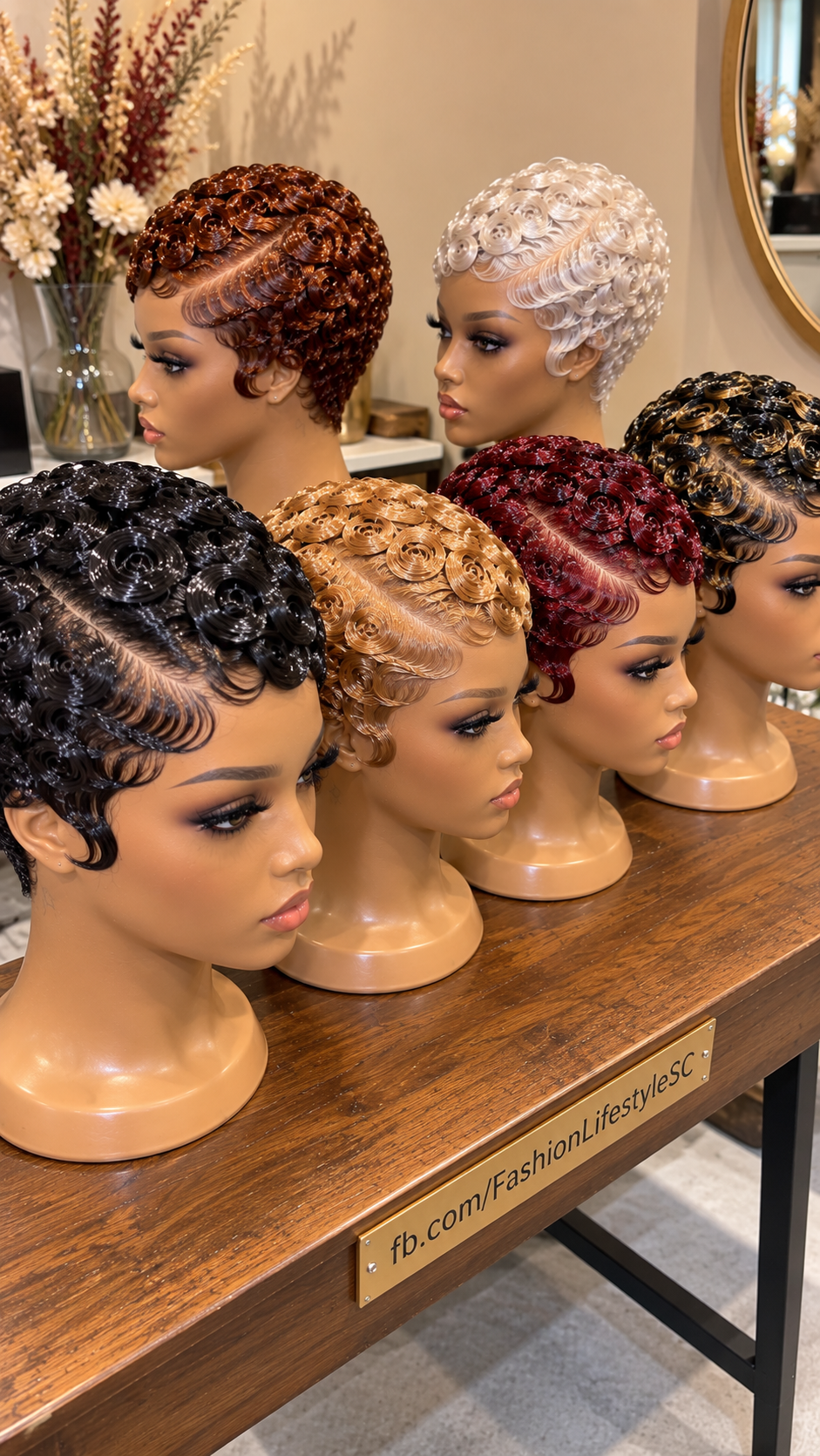
A salon display becomes genuinely useful when it shows customers how one styling family can branch into several different personalities. This six-wig collection does exactly that. The mannequins share a compact finger-coil concept, yet the visible results differ through color placement, curl scale, directional parting and the way the flatter perimeter work interacts with the circular crown. Glossy onyx black, warm honey-bronze, deep burgundy, pearl blonde, rich copper-brown and a black base with golden accents can all be compared within the same scene.
The collection is especially valuable for customers who know they like sculpted finger coils but have not decided how bold they want the final result to be. The black option emphasizes contrast and precision. Burgundy adds depth through wine-red reflections. Honey-bronze brings more warmth to the face, while pearl blonde exposes practically every bend in the curl arrangement. The copper-brown and black-and-gold versions sit between those extremes and show how warmer color can be introduced without abandoning a darker foundation.
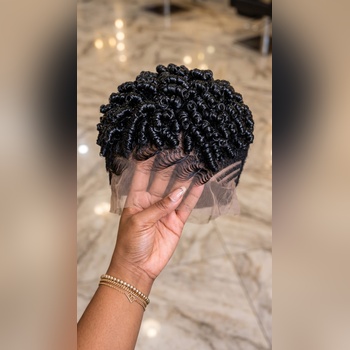
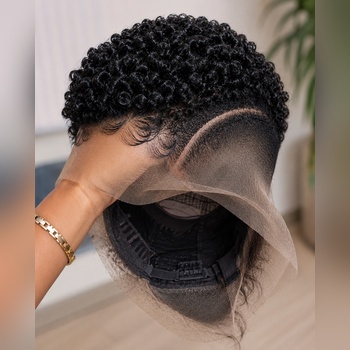
Because these wigs are already displayed on mannequin heads, the photograph does not expose enough of their underside construction to verify lace type, cap material or attachment method for each individual piece. No HD lace claim should be made from this image alone. A buyer interested in one of the displayed wigs should request photographs of that exact unit off the mannequin and ask the seller to confirm its construction.
Six Wigs Should Be Treated as Six Styling References
The temptation with a coordinated salon display is to describe everything as one wig available in several colors. That would overlook visible differences between these units. The front black wig carries large glossy circular coils and a strong diagonal division, with long curved strands sweeping along the exposed path. The honey-bronze wig beside it has a brighter crown and softer tonal contrast, causing the individual rings to become more prominent.
The burgundy unit uses its dark red palette to create another effect. Raised coils catch brighter red reflections while deeper sections remain wine-colored. Behind the foreground wigs, the copper-brown version concentrates rich warm tones across densely packed circles. The pearl-blonde mannequin relies less on shadow and more on the actual geometry of the pale coils. At the far side, black hair with golden-brown placement introduces contrast within the crown itself.
For a salon customer, these differences create a useful decision process. The first question does not have to be “Which color?” It can be “Which crown and side arrangement?” Once the preferred construction is identified, the stylist can discuss whether it is available in another shade.
Onyx Black Puts Coil Precision Under the Spotlight
The foreground black wig is visually powerful because the color offers almost no distraction from construction. Large ring-shaped coils occupy the crown, and their glossy surfaces catch narrow reflections from the salon lighting. The centers remain dark, giving the circular pattern substantial depth.
A diagonal scalp-toned path divides the crown from the flatter front and side work. Fine black strands sweep along this path in long arcs before smaller movements appear near the temple. The contrast between circular crown coils and elongated perimeter curves gives the wig more complexity than an all-over ring-curl design.
This is a useful reference for customers who want dark hair but still want the styling to be immediately noticeable. The visual interest comes from spacing, direction and shine rather than contrasting color.
Honey Bronze Makes Every Circular Section Easy to Read
The foreground honey-bronze wig creates a much warmer impression. Its crown contains individually recognizable circular formations, with golden-brown reflections concentrated across the raised surfaces. Slightly deeper tones inside the loops prevent the crown from appearing flat.
The lighter palette also makes small construction differences easier to see. Individual rings can be counted more readily than on the deepest black version, and the direction of the flatter strands near the parting is clearly visible.
A customer requesting this color should send the photograph rather than relying exclusively on a shade name. Depending on the supplier, a similar result might be labeled honey brown, bronze blonde, caramel, golden brown or light copper. Visual approval avoids confusion caused by inconsistent color terminology.
Burgundy Uses Tonal Depth Instead of a Second Highlight Color
The burgundy mannequin demonstrates how a single red family can create its own contrast. The recessed portions of the curls appear considerably darker than the raised surfaces, which reflect a richer red-wine tone. This gives the crown depth without obvious blonde or copper streaks.
The diagonal division is also highly visible because it interrupts the dense red curl field. Fine directional strands follow the boundary and create a controlled transition toward the forehead and side.
Burgundy can appear very different under daylight, warm salon bulbs and phone-camera processing. Anyone ordering this shade remotely should request a neutral-light photograph of the actual unit before approving the color. A seller’s burgundy sample may be more purple, red or brown than the version represented on a customer’s screen.
Pearl Blonde Changes the Balance Between Shadow and Shape
The pearl-blonde unit offers the clearest demonstration of the actual curl architecture. Because the strands are pale, deep shadows no longer dominate the crown. Instead, the eye follows the edges of the circular loops and the sweeping direction of the flatter front sections.
This creates a brighter overall silhouette even though the hair remains compact. The color also makes the perimeter work highly visible, so accuracy around the forehead and temple becomes especially important.
If this is human hair, buyers should ask about the processing used to reach the pale shade and obtain appropriate heat and care recommendations. If it is synthetic, they should request the fiber specification before attempting heat styling. Neither material can be reliably identified from the photograph alone.
Copper Brown Creates a Richer, Deeper Warm Option
The rear copper-brown wig occupies an interesting position between the honey-bronze and burgundy options. Its warmth is obvious, but the color remains deep enough to preserve substantial shadow inside the coils. This gives the crown a rich appearance without the brightness of the lighter golden unit.
Large and small rings are distributed across the head rather than appearing in one uniform size. That variation makes the surface more organic and prevents the crown from resembling rows of mechanically identical circles.
For customers who prefer warm color but want more depth than a light bronze, this type of brown can be an effective reference. Again, the exact shade should be confirmed through photographs because supplier naming varies considerably.
Black With Golden Accents Introduces Color Placement as a Separate Choice
The black-and-gold unit at the side differs from the single-color wigs because its lighter strands are distributed through a dark foundation. Golden-brown sections trace selected curls while black remains visible both at the roots and between the loops.
This means the customer has two color decisions rather than one: the shade of the accent and where that accent should appear. Even if the correct golden tone is selected, random streak placement could create a very different wig.
When ordering a similar two-tone version, request an elevated crown photograph before shipping. It should show whether the lighter strands follow the coil arrangement and whether enough black remains visible to maintain contrast.
The Diagonal Part Is a Construction Choice, Not a Minor Detail
Several wigs in the display use a diagonal exposed path that begins toward the front and travels back through the crown. This line determines how the ring curls are distributed and where the flatter perimeter styling begins.
Changing the angle of that path can make the same coil pattern look surprisingly different. Moving it toward the center creates more symmetry. Moving it farther to the side produces a larger uninterrupted curl field on the opposite portion of the crown.
Customers commissioning a custom wig should therefore specify the desired parting direction. An elevated reference image is particularly useful because it shows the complete path rather than only the portion visible from the front.
Perimeter Waves Need Their Own Discussion During Customization
The flatter strands near the forehead and temple deserve to be treated separately from the crown coils. On several mannequins, these strands form long parallel arcs along the parting. Elsewhere they turn into smaller curls around the temple.
This creates a deliberate contrast in scale. The crown uses compact circles, while the perimeter stretches the hair into longer directional movements. Removing those flatter sections would leave a very different hairstyle even if every crown curl remained unchanged.
When combining inspiration from several wigs, tell the stylist exactly which perimeter treatment is preferred. A customer might want the honey-bronze color but the front movement of the black wig. Making that distinction at the consultation stage prevents assumptions later.
A Salon Can Turn the Display Into an Ordering Menu
Instead of assigning only a color name to each mannequin, a wig business can document four attributes for every unit: crown pattern, color, part direction and perimeter treatment. Customers can then compare those attributes individually.
This approach is especially effective for online inquiries. The salon can send numbered reference photographs and ask the customer to identify the preferred crown and shade. Measurements and material options can then be discussed after the visual specification is established.
For existing inventory, the salon should photograph the exact available unit. For a made-to-order piece, reference images should be treated as the production brief rather than as proof that the final wig will be identical without additional customization.
Ask for Off-Mannequin Images Before Evaluating Lace or Cap Quality
A styled mannequin photograph is useful for evaluating appearance but limited for judging construction. The cap is concealed, the perimeter has already been arranged against the mannequin and lighting can make mesh difficult to distinguish.
Before purchasing a higher-priced wig, ask the seller to remove the selected unit from the mannequin and photograph the inside. The customer can then inspect the visible cap construction and lace area and ask which materials have actually been used.
This is also the correct stage to ask whether the lace arrives trimmed, whether different lace shades are available and what sizing system the seller uses. Marketing terminology should never substitute for photographs and confirmed specifications.
Custom Pricing Should Account for Curl Placement and Color Work
The compact size of these wigs does not automatically make them inexpensive to produce. Much of their value can lie in labor. Each ring must be positioned, the parting has to coordinate with the crown, perimeter strands require controlled direction and some colors may involve additional processing or custom placement.
| Category | Estimated Price Range | Possible Scope of Service |
|---|---|---|
| Premium Custom | $325–$575+ | Higher-grade hair, personalized sizing, individually arranged coils, custom color work, planned parting and detailed perimeter styling. |
| Standard Custom | $195–$345 | Selected color with prepared finger-coil crown, directional parting and standardized fitting options. |
| Basic Human Hair | $120–$215 | A human-hair base intended for additional professional coil setting, color adjustment and front styling. |
| Premium Synthetic | $75–$150 | A higher-quality pre-set option that may retain the circular crown arrangement with less frequent resetting. |
| Basic Synthetic | $35–$85 | A lower-cost version where coil placement, color depth, parting work or cap construction may be less elaborate. |
These ranges are general budgeting references and are not confirmed prices for the displayed wigs. Hair source, fiber type, coloring, cap construction, seller location, customization labor and shipping can all change the amount. Professional fitting or installation may be charged separately.
Customers should compare what is included rather than choosing from price alone. A basic human-hair wig that still needs crown setting and color work may require substantial additional salon spending, while a more expensive custom unit may arrive with most of that labor already completed.
Human Hair Is Useful for Customers Who Expect Future Restyling
Human hair can make sense when the wearer wants a stylist to refresh the ring pattern periodically or modify the crown later. It generally gives professionals more freedom, although the safe heat range depends on the quality and previous processing of the hair.
This is especially relevant to pale blonde, burgundy and warm bronze units because color processing can influence how aggressively the hair should be treated. A professional should know the history of the unit whenever possible.
Synthetic fiber offers a different benefit. A pre-set synthetic coil may retain its circular form with less intervention. However, the wearer has less freedom to change the arrangement, and heat tolerance varies by fiber. Confirm the specification before using heated tools.
Care for the Coils as Individual Sections
The ring crown should not be maintained with broad brushing. Doing so can open several loops simultaneously and erase the carefully arranged circular pattern. Instead, identify which coil needs attention and work with that section alone.
Before the first full wash, photograph the crown from above and both sides. These images become a personal map of the original arrangement. If the coils relax while wet, the stylist can refer to the photographs during reconstruction.
Heavy styling product should also be avoided. Residue can accumulate inside the rings, cause neighboring sections to stick together and reduce the visible spacing that gives the crown its dimensional appearance.
Color Maintenance Should Match the Chosen Palette
Black requires different attention from pearl blonde, burgundy or honey bronze. If the colored wigs are made from processed human hair, cleansing products appropriate for color-treated hair can help protect the shade. Excessive heat should also be avoided when it is not needed.
A fading burgundy unit should not automatically be recolored across the entire wig without considering the original depth. Likewise, a two-tone black-and-gold piece needs its color placement preserved rather than covered with one uniform shade.
Synthetic color should be treated according to the fiber manufacturer. Conventional permanent dye is not automatically suitable for synthetic hair, and experimental recoloring can permanently damage a finished unit.
Protect Circular Crowns From Compression
Storage has a direct effect on these wigs because the crowns contain many raised loops. Placing the unit flat beneath other items can crush one side and change the coil diameter.
A wig stand or suitable mannequin head gives the crown enough space to remain intact. Make sure the unit is fully dry before storage. For the pearl-blonde option, use a clean surface that will not transfer pigment to the pale hair.
When transporting the wig, choose a container deep enough to avoid pressing directly on the crown. Preserving the existing construction is usually easier than arranging a complete professional reset after every trip.
Booking Depends on Whether the Wig Is Finished or Still a Base
A customer purchasing one of the finished display units may need only fitting and minor adjustment. Someone ordering a basic foundation to recreate the look may need a longer salon session for crown formation, parting work and perimeter styling.
Clarify this before making an appointment. Ask whether the salon provides both wig fitting and sculpted finger-coil work. If separate professionals are required, schedule the services in an order that avoids one person undoing the work of another.
For online purchases, inspect the delivered wig before any irreversible alteration. Compare the color, coil arrangement and parting with the approved photographs. If there is a significant discrepancy, contact the seller before cutting, coloring or restyling.
The Best Purchase Starts With Construction and Ends With Color
This display demonstrates why choosing only by shade can be limiting. Onyx black, honey bronze, burgundy, pearl blonde, copper brown and black with golden accents all create different impressions, but color is only one layer of the decision. Coil size, crown density, diagonal parting and perimeter direction can change the wig just as dramatically.
A buyer can make the process easier by selecting the preferred crown first, then the parting and side treatment, and finally the color. If an existing mannequin already combines all of those elements successfully, request close photographs of that exact unit. If not, use the chosen components as a clear custom brief.
For wig businesses, documenting these differences turns a beautiful salon display into a practical sales tool. Individual product photography, verified construction details, transparent customization prices and realistic care information allow customers to order with much greater confidence while keeping the description grounded in what can actually be confirmed.
Search Terms
onyx black finger coil wig · honey bronze ring curl wig · burgundy diagonal part wig · pearl blonde coil crown wig · copper brown finger curl wig · black gold coil wig · sculpted perimeter wave wig · compact circular crown wig